
What Color Is Bmw Coolant?

BMW coolant color is not arbitrary; it’s a critical identifier of the specific chemical formulation engineered for your BMW’s engine. Using the wrong color coolant, even if it’s “universal,” can lead to severe corrosion, overheating, and catastrophic engine damage. Always verify the exact specification (like G48 or HT12) from your owner’s manual, not just the color, to ensure optimal protection and performance.
You pop the hood of your BMW, a machine celebrated for its precision engineering and driving pleasure. Your eyes scan the engine bay, and one of the first things you might notice is the vibrant liquid in the translucent coolant reservoir. Is it blue? Green? Pink? You’ve probably heard that coolant color matters, but when it comes to a BMW, that color isn’t just for show—it’s a coded message from the engineers in Munich about the exact chemical lifeblood your engine needs. Getting it wrong isn’t a minor oversight; it’s a direct ticket to a very expensive repair bill. So, what color is BMW coolant? The answer is both simple and profoundly complex, because for BMW, the color is the tip of the iceberg.
Let’s clear up the biggest myth first: there is no single “BMW coolant color.” Over its long history, BMW has used several different coolant formulations, each with its own distinct hue, each engineered for the specific materials and operating conditions of its engines from different eras. This isn’t about aesthetics; it’s about chemistry. The color is a visual indicator of the inhibitor package—the special additives that prevent corrosion, cavitation, and scale buildup inside your engine’s aluminum block, cylinder head, and intricate cooling passages. Using the wrong one means those inhibitors won’t work as intended, and your engine’s metal and plastic components will start to corrode from the inside out. This guide will decode the rainbow of BMW coolant, explain why the specification matters infinitely more than the shade, and give you the definitive steps to identify and use the correct fluid for your specific vehicle.
Key Takeaways
- Color Equals Chemistry: In BMWs, coolant color (typically blue, green, or pink) directly corresponds to a specific, patented chemical formulation designed for their aluminum engines.
- Mixing is Dangerous: Combining different BMW coolant types or using generic aftermarket fluids can create a corrosive sludge that blocks coolant passages and ruins the water pump and thermostat.
- Model-Year Specific: The required coolant type changed over the years. Pre-2000 models often used a different formula than post-2000 models, and newer B48/B58 engines have their own specs.
- Color Can Be Deceptive: A dyed aftermarket “universal” coolant might match the color but lack the essential organic acid technology (OAT) inhibitors BMW engines require.
- Check the Manual, Not Just the Bottle: The only sure way to identify correct coolant is by consulting your owner’s manual for the specification number (e.g., G48, HT12, G13) or a BMW dealership’s parts lookup.
- Professional Flush is Recommended: If you’re unsure about the current coolant in your system or are switching types, a complete professional flush is the safest method to avoid contamination.
- It Affects More Than the Engine: Correct coolant protects the entire cooling system, including the plastic coolant reservoir, thermostat housing, and intricate heat exchangers.
📑 Table of Contents
- The Critical Importance of Using the Correct BMW Coolant
- Decoding the Colors: A Historical Guide to BMW Coolant Formulations
- The “Why” Behind the Color Changes: Engineering Evolution
- How to Identify EXACTLY What Coolant Your BMW Needs
- Practical Tips for Servicing Your BMW’s Coolant
- Conclusion: Respect the Specification
The Critical Importance of Using the Correct BMW Coolant
Before we dive into the color chart, we must understand why this is so non-negotiable for a BMW. Unlike some older American or Japanese vehicles that used more robust cast-iron blocks, modern BMW engines are predominantly made of lightweight aluminum and magnesium alloys. These materials are fantastic for performance but are inherently more susceptible to a specific type of corrosion called galvanic corrosion when in contact with certain coolant chemistries. The correct BMW coolant contains a precise blend of organic acids that form a protective microscopic layer on all metal surfaces, preventing this corrosive reaction. It’s also formulated to be perfectly compatible with the many plastic and rubber components in the cooling system—hoses, thermostat housings, and the coolant reservoir itself.
The High Cost of a “Good Enough” Coolant
We’ve all been there: at the auto parts store, faced with a wall of “Universal” or “Extended Life” coolants in every color of the rainbow. The temptation to grab a green one because your reservoir looks green is strong. But this is where BMW owners must exercise extreme discipline. A “universal” coolant is a compromise formula meant to be compatible with most older vehicles, not with the specific, high-performance demands of a modern BMW. Its inhibitor package is different. When mixed with the remnants of the old BMW-specific coolant in your system, it can create a chemical conflict. This often results in a gel-like or particulate sludge that can clog the tiny coolant passages in the cylinder head or the radiator, leading to localized hot spots, overheating, and ultimately, a warped head or a failed water pump. The repair for such damage easily runs into the thousands, far surpassing the minor cost difference of using the correct, specific coolant.
It’s a System-Wide Protector
Think of your BMW’s cooling system as a closed-loop ecosystem. It’s not just about the engine block. The coolant flows through the radiator, the heater core (which gives you cabin heat), the transmission oil cooler (in automatics), and the turbocharger(s) if equipped. Each of these components is made from different materials. The correct BMW coolant is designed to protect this entire ecosystem harmoniously. A generic coolant might protect the aluminum but degrade the plastic reservoir over time, causing a leak. It might not properly lubricate the water pump’s seal. The specification is a holistic system requirement, not an engine-only one.
Decoding the Colors: A Historical Guide to BMW Coolant Formulations
Now, to the core of your question. What color is it? The answer depends entirely on the era and model of your BMW. BMW has transitioned through several official coolant specifications over the decades, each with its own trademarked name and color. Here is a breakdown of the most common ones you will encounter.
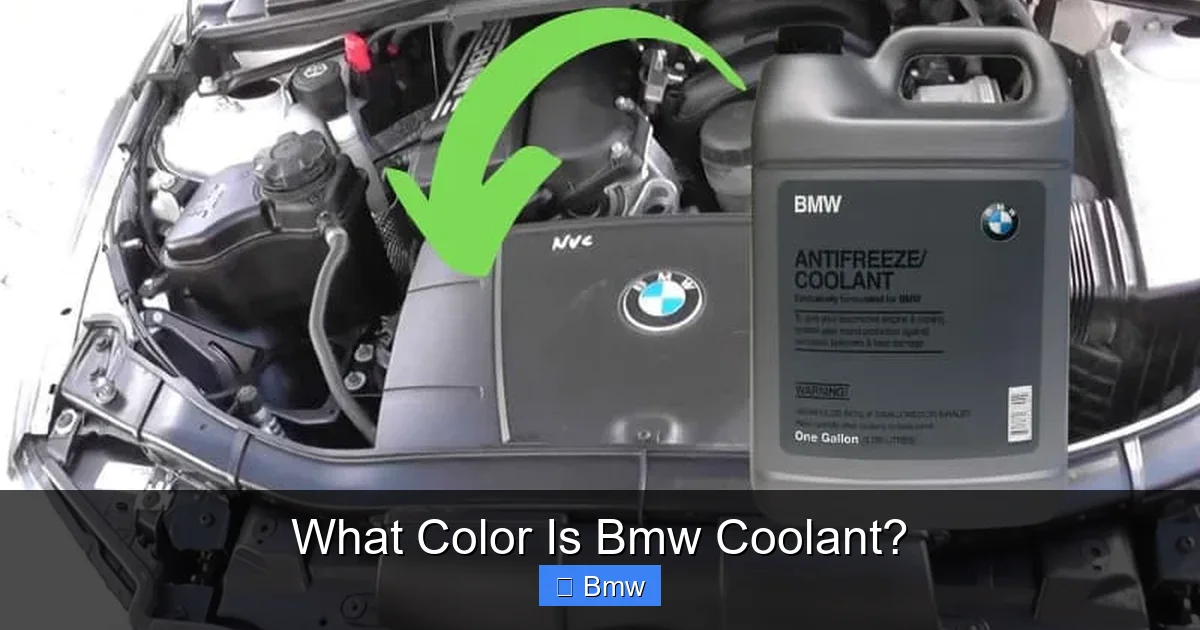
Visual guide about What Color Is Bmw Coolant?
Image source: rxmechanic.com
G11 (The Classic Green)
This is the old-school coolant, predominantly used in BMWs from the 1990s through the early 2000s, including many E36, E39, and early E46 models. It is a silicate-based inorganic acid technology (IAT) coolant. Its color is a very distinct, almost neon, green. While effective for its time, silicate-based coolants have a shorter service life (typically 2-3 years) and the silicates can drop out of solution over time, creating abrasive particles that can damage water pump seals and cause deposits. You should not use G11 in any BMW that originally came with a later specification.
G12 and G12+ (The Teal/Turquoise Era)
Introduced in the late 1990s/early 2000s, G12 marked BMW’s shift to organic acid technology (OAT). This was a major advancement. OAT coolants are “phosphate-free” and “silicate-free,” offering much longer service intervals (5+ years) and superior protection without the abrasive particulate issue. G12 is a distinctive teal or turquoise color. G12+ is a variation with a slightly different additive package but is also teal and is considered compatible for topping off in G12 systems. These are found in many E46, E60, E90, and F30 models from their respective model years. Crucially, G12 is NOT compatible with G11 systems. Mixing them negates the benefits and can cause problems.
G13 (The Purple Reign)
Launched around 2008, G13 is BMW’s “Dex-Cool” equivalent. It is an OAT-based coolant but is specifically formulated to be phosphate-free, silicate-free, and borate-free. Its color is a deep, vibrant purple (sometimes almost magenta). G13 was the standard for many N-series engine models (like the N20, N52, N55) throughout the 2010s. It boasts an exceptionally long service life (often marketed as “lifetime” under ideal conditions, but 10-12 years is a realistic service interval). G13 is NOT compatible with G12 or G11. It is, however, backward-compatible with some older G12+ systems, but this should only be done in an emergency and the system should be properly flushed to G13 at the next service. If you have a purple coolant, you almost certainly have G13.
G48 (The Modern Blue)
This is the current standard for the vast majority of new BMWs, starting around 2016-2017 and carrying through to today’s models with the B-series engines (B48, B58, etc.). G48 is also an OAT coolant, but it has a different, optimized inhibitor package specifically designed for the newest aluminum alloys and turbocharger materials. Its color is a clear, bright blue, similar to G11 but chemically worlds apart. G48 is NOT compatible with G12 or G13. It is BMW’s latest specification and is what you should use for any vehicle that calls for it. If your 2020 X3 or 2022 3 Series has blue coolant, it is almost certainly G48, not the old green G11.
HT12 (The Specialty Yellow)
This one is a bit of an outlier. HT12 is a yellow silicate-free coolant, but it’s primarily used in BMW’s diesel engines (the M57, N47, B47, etc.) and some specific high-performance applications. It has a different additive package tailored to the higher combustion pressures and specific materials in diesel engines. It is not interchangeable with the gasoline engine coolants (G12, G13, G48). If you own a BMW 328d or an older 335d, you must use HT12.
The “Why” Behind the Color Changes: Engineering Evolution
BMW didn’t change coolant colors on a whim. Each new specification was a direct response to advancements in engine technology and materials science. The move from silicate-based G11 to silicate-free OAT (G12) was driven by the need for longer service intervals and to protect sensitive water pump seals. The shift to phosphate-free G13 was to prevent the formation of calcium phosphate deposits in the cooling system, a problem exacerbated by harder water and the increased use of aluminum. The development of G48 was necessary because the new B-series turbocharged engines operate at higher thermal loads and use different aluminum alloys; the G13 formula wasn’t optimal for these new conditions. The color is simply the dye BMW’s chemical supplier adds to make the fluid easily identifiable for technicians and owners, preventing costly mistakes. It’s a visual safety feature.
Visual guide about What Color Is Bmw Coolant?
Image source: bmwinsights.com
What About “Lifetime” Coolant?
You’ll see G13 and G48 marketed as “lifetime” coolants. This is a qualified term. From BMW’s perspective, “lifetime” means the useful life of the vehicle under normal operating conditions, assuming no external contamination (like a leak or overheating event) and that the system remains sealed. In practice, this translates to a service interval of 10-12 years or 150,000 miles. However, it’s still a wise preventive maintenance step to have the coolant tested for corrosion inhibitors and acidity (pH) every 3-4 years, especially on older vehicles. A simple refractometer test at a shop can tell you if the coolant has lost its protective properties.
How to Identify EXACTLY What Coolant Your BMW Needs
So you see blue, green, or purple in your reservoir. How do you know if it’s the right blue? Here is the definitive, foolproof method, in order of reliability.
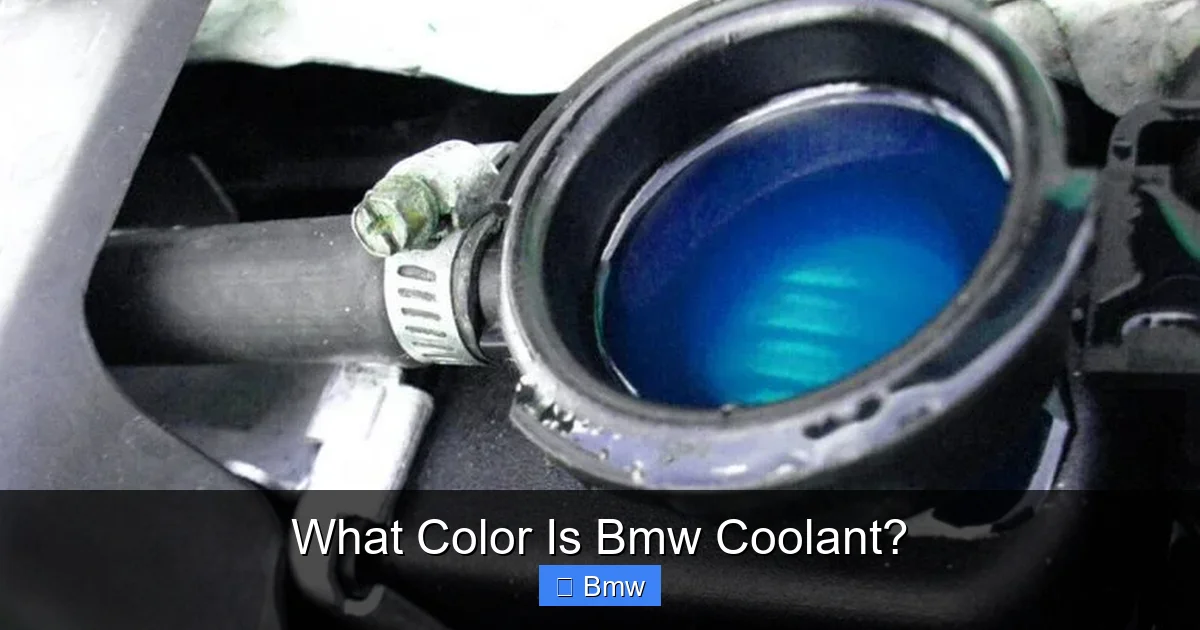
Visual guide about What Color Is Bmw Coolant?
Image source: autoscopecarcare.com
1. Consult Your Owner’s Manual
This is the absolute primary source. Your owner’s manual will have a “Fluids and Capacities” section that lists the exact coolant specification required. It will say something like “BMW Coolant G48” or “Coolant Antifreeze HT12.” Trust this document above all else.
2. Use the BMW Parts Catalog or Dealer
If you don’t have the manual, use your VIN (Vehicle Identification Number). You can enter it on BMW’s official parts website (shopbmwparts.com) or call a BMW parts department. They can look up the exact specification for your vehicle’s production date and engine code. This is the most accurate method.
3. Decode the Reservoir Label (If Present)
Many BMW coolant reservoirs have a molded-in label or an attached sticker that specifies the required fluid type. Look for text like “G48” or “Only use BMW-approved coolant.” This is a strong indicator.
4. Identify the Existing Coolant (With Caution)
If you are simply topping off and the system is already full of the correct coolant, you need to identify what’s in there. Do not rely on color alone. Take a small sample in a clear container. Compare it to known reference charts online from reputable BMW suppliers. Be aware that over time, coolant can darken or change slightly due to heat and oxidation. A G48 blue might look a bit more teal after 8 years. This method is for identification only, not for determining what to add if you are unsure. When in doubt, flush and refill with the correct new fluid.
5. The “When in Doubt, Flush” Rule
If you have purchased a used BMW with unknown service history, the safest and most cost-effective long-term move is to perform a complete cooling system flush. This involves draining the old fluid, flushing the system with distilled water (or a dedicated flush chemical), and then refilling with the correct, fresh BMW-approved coolant mixed with distilled water to the proper ratio (typically 50/50 for freeze/boil protection, but check your manual). This eliminates all guesswork and contamination risk.
Practical Tips for Servicing Your BMW’s Coolant
Armed with the correct specification, here’s how to handle coolant service properly.
Mixing: The Golden Rule
Never, under any circumstances, intentionally mix different BMW coolant specifications (G12 with G13, G48 with G12, etc.). If you must add a small amount in an emergency to prevent overheating, use only the exact specified type. After the emergency is over, plan a complete flush as soon as possible. Mixing different chemistries is the primary cause of the damaging sludge mentioned earlier.
Distilled Water is Non-Negotiable
Always mix the concentrated BMW coolant with 100% distilled water. Tap water contains minerals (calcium, magnesium) that will cause scale buildup inside the radiator and engine, drastically reducing cooling efficiency and leading to hot spots. Pre-mixed coolants are acceptable if they are the official BMW product, as they guarantee the correct dilution with distilled water.
Bleeding the Air
BMW cooling systems are sensitive to air pockets. After a drain and fill, you must properly bleed the system. This is often done using the vehicle’s built-in bleeder valves (consult your service manual for locations, which can be on the thermostat housing or radiator) and by setting the climate control to maximum heat with the blower on. Some newer models require the use of a diagnostic tool (like BMW’s ISTA or a compatible scanner) to activate the electronic water pump for bleeding. This is a key reason many owners opt for a professional flush—improper bleeding can leave air pockets that cause overheating.
Check for TSBs and Model-Specific Issues
Some BMW models, particularly certain N47 diesel engines or early F30 4-cylinder models, have known issues with plastic water pump impellers or thermostat housings failing prematurely. While using the correct coolant won’t prevent a mechanical failure, it ensures the environment around those components isn’t corrosive, which could accelerate a failure. Always check for Technical Service Bulletins (TSBs) related to your specific chassis and engine code when diagnosing cooling system problems. You can find these through a dealership or a paid service like BMW TIS.
Conclusion: Respect the Specification
The color of your BMW’s coolant is a vital clue, but it is not the final answer. The true answer lies in the specification: G11, G12, G12+, G13, G48, or HT12. This specification is a direct reflection of the advanced engineering and material science that goes into every BMW engine. Treating the cooling system with the same respect you give the engine’s timing chain or turbochargers is essential for long-term reliability. Using the correct fluid is one of the simplest, most inexpensive forms of preventive maintenance you can perform. It protects a multi-thousand-dollar engine from a slow, corrosive death. When in doubt, consult the manual, use the VIN, and when all else fails, flush the system and start fresh with the manufacturer-approved fluid. Your BMW’s future reliability—and your wallet—will thank you.
For a broader look at how different manufacturers approach coolant technology, you can see how Subaru formulates its coolant for its boxer engines, which presents a different set of engineering challenges. Similarly, understanding that color-coding is a universal industry practice, as seen with Toyota’s specific color names like “Ice Cap”, helps reinforce that this isn’t a BMW quirk but a critical engineering standard. Even within BMW, features like Eco Pro mode can subtly affect engine operating temperatures, making a healthy cooling system even more crucial for optimal performance and efficiency.
Frequently Asked Questions
Can I use a universal coolant in my BMW?
No. Universal coolants are a compromise formula and do not contain the specific organic acid inhibitors required for BMW’s aluminum engines. Using one risks corrosion and system damage. Always use the BMW-specified coolant (G48, G13, etc.).
My coolant is brown and rusty. What does this mean?
This indicates severe corrosion and that the coolant’s protective inhibitors have been depleted. The rust particles are circulating through your system. This is a serious issue that requires an immediate, thorough flush and refill with the correct new coolant. Continuing to drive with this coolant will damage the water pump, thermostat, and radiator.
How often should I change my BMW coolant?
For modern long-life coolants (G13, G48), BMW’s official interval is typically every 10-12 years or 150,000 miles. However, it is highly recommended to have the coolant tested for corrosion protection and pH level every 3-4 years, especially on higher-mileage vehicles. If the test shows weakness, change it.
Is it okay to mix a little bit of water in an emergency?
In a true overheat emergency on the side of the road, adding clean water (not muddy or rusty) to get to a safe location is acceptable. However, the system must be completely drained, flushed, and refilled with the correct 50/50 coolant/distilled water mix as soon as possible. Water alone provides no corrosion protection and has a lower boiling point.
What’s the difference between G13 and G48 coolant?
Both are OAT, phosphate-free, silicate-free long-life coolants, but they have different optimized inhibitor packages. G13 (purple) was designed for engines up to the N55. G48 (blue) is specifically engineered for the newer B-series turbocharged engines (B48, B58) and their higher thermal demands. They are not interchangeable.
My 2005 BMW E90 has teal coolant. Is that G12?
Very likely, yes. Teal/turquoise coolant from that era is almost always G12 or G12+. You should confirm this with your owner’s manual or VIN lookup, as using G13 or G48 in a system designed for G12 is not recommended without a full flush.
