
Will Disconnecting the Battery Reset Toyota Anti-theft?

Disconnecting your Toyota’s battery will almost never reset the factory anti-theft immobilizer system. This critical security data is stored in permanent, non-volatile memory that retains information even when power is cut. While a battery disconnect can reset some electronic settings like radio presets or clock time, the immobilizer’s learned key data remains intact. Attempting this can actually cause temporary starting issues or trigger a security lockout, requiring a specific key-cycle procedure or professional tools to resolve. For genuine reset procedures, consult your owner’s manual or a certified technician.
You’re standing by your Toyota, keys in hand, but the engine just cranks and cranks without starting. The anti-theft immobilizer light is blinking furiously on the dash. In a moment of frustration or desperation, you think: “I’ll just disconnect the battery for a few minutes. That’ll reset everything and get my car going again.” It’s a classic move, a piece of automotive folklore passed down through generations of car owners. But when it comes to your Toyota’s sophisticated anti-theft system, this old trick is not just ineffective—it can sometimes make the situation worse. Let’s dive deep into why disconnecting the battery is not a reset for your Toyota’s immobilizer and what you should actually do instead.
Key Takeaways
- The immobilizer memory is permanent: Toyota’s anti-theft system uses non-volatile memory to store key transponder codes, so a simple battery disconnect erases none of this critical security data.
- You’ll likely create more problems: Disconnecting the battery can trigger a “security” light or put the ECU into a confused state, sometimes requiring a specific 10-15 minute wait period before the system recovers.
- Other systems *will* reset: While the anti-theft system stays, disconnecting the battery *will* reset the clock, radio settings, and sometimes throttle body or transmission adaptation values.
- The correct “reset” is a key cycle: For many Toyota models, the official reset procedure involves turning the key to “ON” for a set time (often 10-15 minutes) without starting the engine, not disconnecting the battery.
- Professional tools are often needed: If the system is truly locked or has lost key programming, a locksmith or dealer must use specialized scan tools to re-learn keys or clear immobilizer faults.
- Myths persist from older cars: The “battery disconnect reset” was a valid trick for 1980s/90s carbureted cars with basic ignition systems, but it does not apply to modern immobilizer-equipped vehicles.
- Consult your manual first: Your Toyota owner’s manual contains the exact, model-specific procedure for addressing a no-start condition that might be related to the anti-theft system.
📑 Table of Contents
- Understanding Toyota’s Immobilizer: More Than Just a Light
- Why Disconnecting the Battery Is Not an Immobilizer Reset
- What Actually Happens When You Disconnect the Battery (The Risks)
- Proper Methods to Reset or Troubleshoot Toyota Anti-Theft Issues
- Debunking Myths: The “Battery Reset” in Context
- Conclusion: Knowledge Over Convenience
Understanding Toyota’s Immobilizer: More Than Just a Light
Before we can explain why a battery disconnect fails, we need to understand what we’re trying to reset. The “anti-theft system” in modern Toyotas is primarily an immobilizer. It’s not an alarm that makes noise (though it’s often part of the same system); it’s a silent, electronic gatekeeper in your ignition circuit.
How the Immobilizer Works
At the heart of the system is a tiny chip embedded in your key’s transponder (the black plastic head of a standard key, or the circuit board in a smart key fob). When you insert the key and turn it to the “ON” position, a ring antenna around the ignition cylinder sends out a low-frequency signal. The chip in the key absorbs this energy and broadcasts back its unique, encrypted ID code. The immobilizer control module (often part of the Engine Control Unit/ECU) listens for this code. If it matches one of the codes it has stored in its memory, it allows the starter relay to engage and the engine to start. If the code is missing or incorrect, it disables the starter and/or fuel pump, and a security warning light (usually a car with a key icon) blinks on the dashboard.
Where the “Allowed” Keys Are Stored
This is the crucial part. The list of authorized key transponder codes is not stored in volatile RAM (Random Access Memory) that forgets everything when power is removed. It is stored in non-volatile memory, specifically EEPROM (Electrically Erasable Programmable Read-Only Memory) or flash memory within the immobilizer/ECU. This memory is designed to retain its data for decades without any battery power. It’s the same type of memory that stores your vehicle’s permanent calibration data and emission-related information. It’s not wiped by a simple loss of battery voltage.
Why Disconnecting the Battery Is Not an Immobilizer Reset
Now we connect the dots. You remove the battery cables. The car’s entire electrical system goes dead. The clock resets to 12:00. The radio forgets its presets. The power windows don’t work. But deep inside the ECU, that little chip of EEPROM still holds your key’s ID code. It never lost power because it has its own dedicated, always-hot memory circuit, often backed by a small internal capacitor or a direct connection to the always-on battery feed (even when the main cables are off, a small parasitic draw remains).
Visual guide about Will Disconnecting the Battery Reset Toyota Anti-theft?
Image source: batterytools.net
What *Does* Get Reset? The Confusion Explained
The reason the “battery disconnect” myth is so persistent is that it *does* reset many other things in the car, and people often confuse these resets with fixing the anti-theft problem. Disconnecting the battery will typically reset:
- Adaptive Learning Values: The throttle body’s “learned” position, transmission shift points, and idle air control values can revert to factory defaults. This might cause rough idle or quirky shifting for a few drive cycles, but it won’t affect the immobilizer.
- ECU/BCM Temporary Codes: Some transient, non-critical fault codes in other modules may clear, but any permanent immobilizer fault (like “key not recognized”) will remain stored.
- Clock, Radio, and Window Auto-Up/Down: All these convenience features lose their memory.
- System Voltage Relearn: The ECU may need to re-learn the battery’s charging characteristics.
So, if you disconnected the battery, turned the key, and the car started, it was likely a coincidence—perhaps the immobilizer had a temporary glitch that resolved itself during the power-off period, or you jiggled a loose connection. The battery disconnect did not “reset” the immobilizer; it may have simply allowed other systems to stabilize.
The Real Culprit: A “Learned” Key Cycle is Often Needed
Many modern Toyotas have a procedure that *feels* like a reset but is actually a synchronization event. This is often called a “key cycle” or “relearn.” The process usually involves turning the key to the “ON” position (dashboard lights on, engine off) and leaving it there for a specific time—often 10, 15, or 20 minutes. During this time, the immobilizer module is “awake” and powered, but the engine is not running. This prolonged “ON” state can sometimes allow the system to re-establish communication with the key’s transponder if there was a temporary communication error. It is a software-based synchronization, not a memory wipe. This is the procedure you should try first from your owner’s manual, not disconnecting the battery.
What Actually Happens When You Disconnect the Battery (The Risks)
So you did it. You disconnected the negative terminal for 30 minutes, reconnected it, and now what? You might encounter several scenarios:
Visual guide about Will Disconnecting the Battery Reset Toyota Anti-theft?
Image source: upgradedvehicle.com
Scenario 1: Nothing Changes. The Car Still Won’t Start.
This is the most common outcome. The immobilizer light still blinks. The engine cranks but doesn’t fire. You’ve wasted time and gained nothing. You’ve also created the inconvenience of resetting your clock and radio.
Scenario 2: The Security Light Is Solid or Flashing in a New Pattern.
This can happen because the ECU experienced an unexpected power loss while the ignition was in a certain state. Some systems interpret this as a potential theft attempt or a system fault. The car may now be in a “lockout” mode where it will not even attempt to read the key for a set period (sometimes 10-15 minutes) or until a specific procedure is performed. You’ve essentially triggered a security protocol, not cleared one.
Scenario 3: The Car Starts, But Runs Poorly.
As mentioned, you’ve reset all the adaptive learning data. The throttle body might be hunting for idle, the transmission might shift harshly. The car is drivable but needs a few drive cycles to re-learn. This has nothing to do with the immobilizer working correctly.
The Risk of Triggering a Full Immobilizer Lock
On some models, particularly if the battery is disconnected while the key is in the ignition or the car is in a specific mode, it can cause the immobilizer to enter a permanent “wait” state. The system might now require not just the correct key, but also a dealer-specific login or scan tool command to clear the flag and allow normal operation. This turns a simple annoyance into a costly tow and dealer visit. For specific models like the Corolla, the process is more nuanced, which is why resources on how to disable the anti-theft system on a Toyota Corolla emphasize following precise steps, not brute-force methods like battery disconnection.
Proper Methods to Reset or Troubleshoot Toyota Anti-Theft Issues
So, if disconnecting the battery is the wrong tool, what is the right one? The answer depends entirely on the specific problem and your Toyota model year.
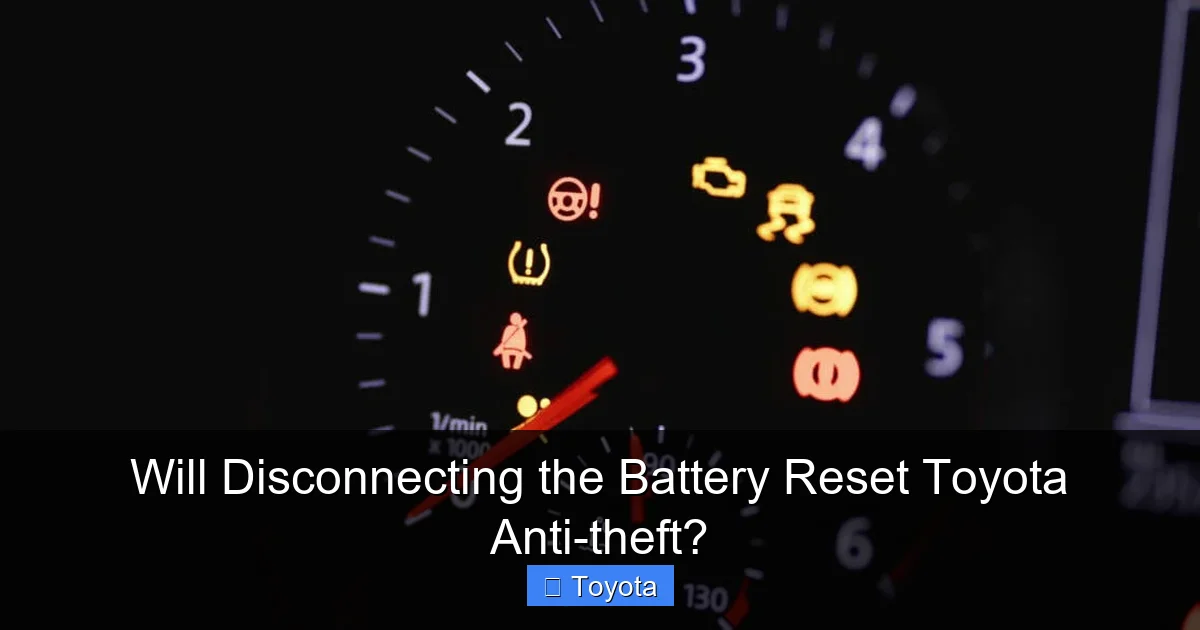
Visual guide about Will Disconnecting the Battery Reset Toyota Anti-theft?
Image source: toolsweek.com
Step 1: The Official Key Cycle Procedure
This is your first and safest move. Find your owner’s manual (or a digital version online for your specific model and year). Look for the index entries: “Immobilizer,” “Anti-theft system,” “If your engine will not start,” or “Security system.” Toyota often provides a timed key-on procedure. A very common one is:
- Insert the key into the ignition.
- Turn it to the “ON” position (all dash lights on, engine off). Do NOT crank.
- Leave it in this position for exactly 10-15 minutes (the manual will specify). You will see the security light continue to blink or may go solid.
- After the time has passed, turn the key back to “OFF,” remove it, and re-insert it.
- Now, attempt to start the engine normally.
The theory is that during the prolonged “ON” time, the immobilizer module’s internal capacitor fully charges, and a communication handshake with the key can be re-initiated. This solves many temporary glitches.
Step 2: Check the Obvious: Key and Battery
Before any complex reset, rule out the simple stuff:
- Key Battery: If you have a smart key fob, a dead fob battery can prevent the key’s signal from being strong enough. Replace the coin cell battery in the fob. For standard keys, the transponder is passive but the fob’s remote functions need a battery.
- Spare Key: Try your other, known-good Toyota key. If the spare works, the primary key’s transponder chip may be damaged or its code may have been accidentally deleted from the system’s memory.
- Physical Damage: Is the key’s transponder chip area cracked or water-damaged?
Step 3: Professional Diagnosis and Programming
If the key cycle and spare key test fail, the problem is likely internal:
- The immobilizer/ECU memory may have become corrupted.
- The antenna ring around the ignition may be faulty.
- The system may need to have your key(s) re-programmed or “re-learned.”
This requires a professional with the right tools. A locksmith or dealership will use a scan tool that can communicate with the immobilizer system, read fault codes, and perform a “key registration” procedure. They will add your key’s transponder code back into the system’s permanent memory. This is not something a generic OBD2 code reader can do; it requires manufacturer-specific software and security access.
For other Toyota models, similar reset procedures exist for systems like the maintenance light or oil light, which often involve different button sequences. The immobilizer is on a completely separate, more secure communication network.
Debunking Myths: The “Battery Reset” in Context
The battery disconnect myth is a remnant of the pre-immobilizer era. Let’s separate fact from fiction for modern Toyotas (generally models from 1998 onward in the US).
Myth: “It resets the engine computer and clears all codes.”
Fact: It will clear temporary and pending codes, but any stored, hard, or permanent codes—especially those related to the immobilizer, emission systems (like EVAP or O2 sensor), or safety systems (airbags)—will remain. The Check Engine Light may turn off temporarily but will return if the fault persists. For emission-related codes, the vehicle will also fail a readiness monitor check until the system completes drive cycles.
Myth: “If the car won’t start, disconnecting the battery is the first thing to try.”
Fact: This is terrible advice for a no-start with a security light. You are ignoring the most likely culprit (the immobilizer) and potentially adding a lockout condition. The first steps should be: 1) Check key fob battery, 2) Try spare key, 3) Perform the manual key-cycle procedure, 4) Check for other symptoms (does the door lock/unlock with the fob? is the steering wheel locked?).
Myth: “It’s a safe, no-cost troubleshooting step.”
Fact: The cost is not monetary, but in time, convenience, and potential complication. You will reset all your vehicle’s personalized settings. You risk triggering a security lockout that requires professional help. You also risk corrupting the ECU’s adaptive data, leading to poor performance until it re-learns (which can take 50-100 miles of driving).
Conclusion: Knowledge Over Convenience
The idea that disconnecting the battery is a universal reset button for car troubles is a comforting but outdated myth. Your Toyota’s anti-theft immobilizer is a sophisticated security feature designed to be resilient against exactly this kind of simple power-cycling attack. Its memory is intentionally non-volatile to prevent thieves from bypassing it by disconnecting power.
When faced with a Toyota that won’t start and shows a security light, your best action is inaction—don’t reach for the wrenches. Instead, reach for your owner’s manual and perform the manufacturer-prescribed key cycle procedure. If that fails, diagnose the simple things: key battery, spare key. If those don’t work, the issue has moved beyond DIY and into the realm of professional security system diagnosis.
Remember, the goal of the immobilizer is to stop unauthorized starting. Sometimes, its protocols can be so sensitive that they mistake a simple electrical glitch for a theft attempt. Treating it with the respect and specific procedures it requires—rather than with the blunt instrument of a battery disconnect—is the only reliable way to get your Toyota back on the road safely and without causing further electronic chaos.
Frequently Asked Questions
Will disconnecting the battery reset the immobilizer on my Toyota Camry/Corolla/Rav4?
No. For virtually all modern Toyotas (1998+), the immobilizer’s stored key codes are in non-volatile memory. Disconnecting the battery will not erase them. The car will still only start with keys that are already programmed into the system.
How long should I disconnect the Toyota battery to try and reset systems?
While it won’t reset the immobilizer, if you need to reset other systems (like the battery light or clear some transient codes), disconnecting the negative terminal for 10-15 minutes is generally sufficient to drain residual capacitors. For the immobilizer, this duration is irrelevant.
What are the risks of disconnecting my Toyota’s battery to fix a no-start?
The main risk is triggering a security lockout or “learn mode” that requires a specific timed key procedure (e.g., 15 minutes with key in ON position) before the system will try to read the key again. You also reset all radio, clock, and adaptive learning settings, and may need a dealer to clear any resulting immobilizer fault codes.
What is the correct way to reset a Toyota immobilizer after a battery change?
Often, no reset is needed at all. If the car doesn’t start after a battery replacement, perform the manual key cycle: turn the key to “ON” (dashboard lights on) for 10-15 minutes without cranking, then try starting. If the light still blinks, you may need a professional to verify the key codes are still registered, as a severe voltage drop can sometimes cause ECU corruption.
When should I call a professional about my Toyota’s anti-theft system?
Call a locksmith or dealer if: 1) The security light is solid (not blinking) and the car won’t start after trying the manual key cycle. 2) Your spare key also fails to start the car. 3) The immobilizer light is flashing in an unusual pattern. These indicate a system fault or lost key programming that requires scan tool access.
Does this apply to all Toyota models and years?
The principle is universal for immobilizer-equipped vehicles. Very old Toyotas (pre-1998) without transponder keys do not have an immobilizer, so disconnecting the battery would clear any basic “theft” systems, but those are just alarms, not engine inhibitors. For any Toyota with a chip in the key (most from the late 90s onward), the immobilizer memory is permanent.
