
Iowa Window Tint Law Guide

Iowa’s window tint laws set specific VLT percentages for different windows to ensure safety and visibility. Front side windows must allow at least 70% of light, while back windows can be darker at 35%. Violations can result in fines and removal orders, but medical exemptions are available for those with qualifying conditions.
Key Takeaways
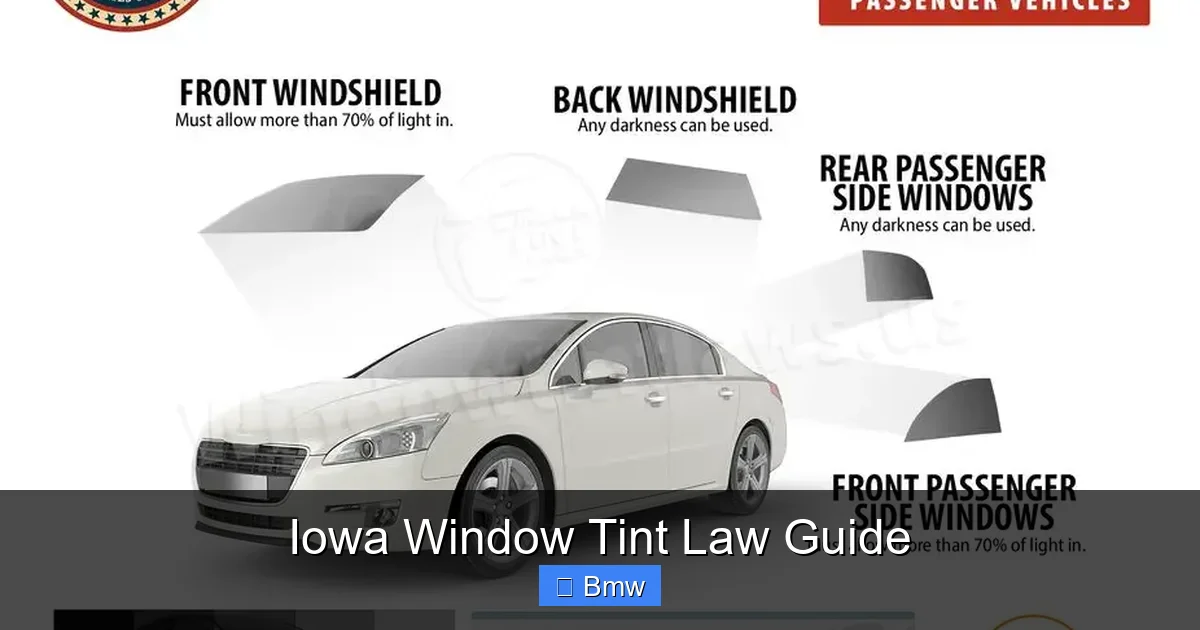
- Front Side Windows: Must allow at least 70% of light (VLT ≥ 70%), blocking no more than 30%.
- Back Side & Rear Windows: Must allow at least 35% of light (VLT ≥ 35%), allowing up to 65% blockage.
- Windshield Rules: Only non-reflective tint is permitted on the area above the manufacturer’s AS-1 line.
- Reflective Tint: Any mirrored or metallic reflective tint is illegal on all windows in Iowa.
- Medical Exemptions: Drivers with certain medical conditions can apply for a permit for darker tint on any window.
- Penalties: First offenses typically result in a fine and a “fix-it” ticket requiring tint removal or replacement.
- Enforcement: Police use handheld tint meters to measure VLT during traffic stops if they suspect a violation.
[FEATURED_IMAGE_PLACEHOLDER]
📑 Table of Contents
- Navigating Iowa’s Window Tint Laws: A Complete Guide for Every Driver
- Iowa’s Specific Window Tint Regulations by Location
- Special Considerations: Medical Exemptions and Factory Tint
- Penalties and Enforcement: What Happens If You Break the Law?
- How to Ensure Compliance: A Step-by-Step Guide
- Conclusion: Tint Smart, Drive Legal
So, you’re thinking about tinting your car windows. Maybe you drive a sleek BMW and want that cool, shaded look while protecting your interior from Iowa’s harsh sun. Or perhaps you just value a little extra privacy on the road. Whatever your reason, before you head to the tint shop, you need to know Iowa’s specific window tint laws. They aren’t just suggestions—they’re legal requirements. Getting it wrong can mean costly tickets, a forced removal of your new tint, and even a court appearance. This guide cuts through the confusion. We’ll explain exactly what’s allowed, what’s not, and how to stay perfectly legal while enjoying the benefits of window tint. Think of this as your friendly, no-nonsense handbook for Iowa’s roads.
Iowa, like every state, has its own set of rules governing how dark your car windows can be. These laws are primarily about safety—ensuring police officers can see inside your vehicle for their safety and yours, and maintaining adequate visibility for drivers, especially at night or in poor weather. For BMW owners, this is particularly important. Many BMW models come with a slight factory tint, usually around 80% VLT (Visible Light Transmission) on all windows. That’s perfectly legal. But if you add an aftermarket tint that makes your front windows darker than the state allows, you’re instantly breaking the law, even if your car is a luxury vehicle. Understanding these percentages is the key to avoiding trouble.
What is VLT and Why Does It Matter?
VLT stands for Visible Light Transmission. Simply put, it’s the percentage of visible light that passes through your window glass and tint film. A higher VLT number means a lighter tint. A lower VLT number means a darker tint. For example, a window with 70% VLT allows 70% of outside light to enter and blocks 30%. A window with 20% VLT only allows 20% of light in and blocks a significant 80%. Iowa law sets minimum VLT thresholds—meaning your windows must let in a certain minimum amount of light. You cannot go below (darker than) these set percentages on specific windows.
It’s crucial to measure VLT correctly. The measurement is taken of the combined glass and tint film. If your BMW’s factory glass already has a slight tint (say, 80% VLT), and you add a aftermarket film rated at 60% VLT, the combined darkness is not 60%. The two layers work together. The factory glass lets in 80% of light, then the film on top of it only lets 60% of that remaining light through. The math is multiplicative: 0.80 x 0.60 = 0.48, or 48% VLT combined. That 48% combined VLT on your front side windows would be a major violation in Iowa, where the minimum is 70%. This is a common pitfall for luxury car owners who assume they can just add any tint over factory glass. Always ask your installer for the final combined VLT to ensure compliance.
Iowa’s Specific Window Tint Regulations by Location
Iowa’s law, found in Iowa Code § 321.495, doesn’t treat all your car windows the same. The rules differ for the windshield, front side windows, back side windows, and the rear window. Let’s break it down window by window so you know exactly what’s legal for your vehicle, whether it’s a BMW, a truck, or a family sedan.

Visual guide about Iowa Window Tint Law Guide
Image source: low-offset.com
Front Windshield: The Most Restrictive
This is the simplest rule. No tint is allowed on the front windshield, with one narrow exception. You may apply a non-reflective, tinted strip along the very top of the windshield. This strip must be located above the manufacturer’s AS-1 line. The AS-1 line is a marking, usually a small triangle or the letters “AS-1,” etched into the windshield glass near the top. It marks the boundary for safe sun shading. The tint in this area must not be reflective or mirrored in any way. The purpose is to reduce glare from the sun for the driver without obstructing the critical forward view. Full windshield tinting is a clear violation.
Front Side Windows: The 70% Rule
This is the most commonly enforced rule. Iowa law mandates that the front driver and front passenger windows must allow a minimum of 70% of visible light to pass through. This means the combined VLT of your factory glass plus any aftermarket film must be 70% or higher. In practice, this means your front windows should look very lightly tinted, almost like they have no tint at all to the casual observer. Many people mistakenly think “70% tint” means it’s dark, but it’s actually very light. For a BMW with factory 80% glass, you could only add a film with a VLT of about 87% or higher to stay at or above the 70% combined threshold—which is essentially just a clear protective film. Most BMW owners looking for a darker aesthetic will find they cannot legally tint the front sides at all without violating this law. This is the #1 violation we see on luxury cars.
Back Side and Rear Windows: The 35% Rule
Here, Iowa allows for much darker tint. The back side windows (behind the driver and passenger seats) and the rear window (the back glass) must allow a minimum of 35% of visible light to pass through. This is a significant difference from the front. A combined VLT of 35% means a very dark, limousine-style tint is permissible on these rear windows. For a BMW, this is where you can legally achieve that sleek, shaded look on the rear half of the car. If your BMW has a rear window that is part of a hatch or trunk, the same 35% rule applies. Note that if your vehicle has a split rear window (like on some older models or vans), the rule applies to the entire rear window area.
The Ban on Reflective and Mirror-Like Tint
Beyond just darkness (VLT), Iowa explicitly prohibits any window tint that is reflective or mirror-like in appearance. This means no metallic or “chrome” films that create a shiny, mirrored effect from the outside. The law states the tint must not “obscure the view” in a reflective manner. Even if your VLT percentage is within legal limits, if the film has a noticeable reflective sheen, it is illegal. This type of tint is often marketed for privacy and heat rejection, but it’s a definite ticket risk in Iowa. Always choose a non-reflective, dyed, or carbon-based film for compliance.
Special Considerations: Medical Exemptions and Factory Tint
Iowa law isn’t completely rigid. There are provisions for special circumstances, most notably medical exemptions. Additionally, understanding the difference between your car’s factory tint and aftermarket tint is critical for compliance.
Visual guide about Iowa Window Tint Law Guide
Image source: windowtintlaws.us
Medical Exemption Process
If you have a diagnosed medical condition that requires protection from sunlight—such as lupus, melanoma, xeroderma pigmentosum, or severe photosensitivity—you may qualify for a medical exemption. This allows you to tint your front side windows darker than the standard 70% VLT requirement. To obtain this exemption, you must:
- Obtain a signed statement from a licensed physician (MD or DO) in Iowa. The statement must detail your condition and explicitly state that window tint is medically necessary.
- Submit this statement, along with a completed application and a fee, to the Iowa Department of Transportation (Iowa DOT).
- Receive an official exemption permit, which you must keep in your vehicle at all times.
- The permit is typically valid for one year and must be renewed with updated medical documentation.
It’s important to note that the medical exemption only applies to the front side windows. The rear windows can already be tinted to 35% VLT legally. The exemption does not change the windshield rule (non-reflective above AS-1 line only) or the ban on reflective tint. This process is serious and designed for legitimate medical needs, not for aesthetic preference.
Factory Tint vs. Aftermarket Tint: The BMW Example
Many modern vehicles, including BMWs, come from the factory with a very light tint on all windows, usually around 80-85% VLT. This is perfectly legal and is considered part of the vehicle’s original equipment. The problem arises when owners want a darker look. If you take your BMW with 80% factory glass and apply a 50% VLT aftermarket film to the front windows, your combined VLT becomes 40% (0.80 x 0.50 = 0.40). That is far below Iowa’s 70% minimum and is a clear violation.
To stay legal on a BMW with factory tint, you have two choices for the front windows: 1) Do not add any aftermarket film and keep the factory glass as-is (which is already compliant at ~80% VLT), or 2) Add only a clear, non-tinted protective film (like a PPF or ceramic coating) that has a VLT of 95% or higher, which will not significantly change the combined VLT. For the rear windows, you can add a darker aftermarket film since the law allows down to 35% VLT, and your factory glass is already lighter than that. Always get the combined VLT calculation in writing from your installer before they begin work.
Penalties and Enforcement: What Happens If You Break the Law?
Iowa takes its window tint laws seriously, and law enforcement has tools to check compliance. Understanding the potential consequences is a strong motivator for doing it right the first time.
Visual guide about Iowa Window Tint Law Guide
Image source: windowtintlaws.us
Typical Penalties for a First Offense
If you’re pulled over and an officer suspects your tint is too dark, they will likely use a handheld device called a tint meter to measure the VLT right there on the spot. If your windows fail to meet the legal minimum, you will be issued a citation. For a first-time offense in Iowa, this is typically treated as a non-moving violation. The most common outcome is what’s known as a “fix-it” ticket or a correction order. You will be given a specific timeframe (often 30 days) to:
- Remove the illegal tint entirely, or
- Replace it with a compliant tint that meets the VLT requirements.
You will usually have to provide proof of correction to the court or the issuing agency, often in the form of a receipt from a licensed tint shop or a reinspection. The monetary fine for the citation itself can range from $50 to $200, depending on the county. The cost of removing and replacing the tint is an additional, often significant, out-of-pocket expense that you must bear.
Repeat Offenses and Escalation
While the first offense is usually a fix-it ticket, subsequent violations can be treated more harshly. A second offense within a certain period may result in a higher fine without the option for a simple correction. In some cases, especially if the tint is extremely dark on the front windows, it could be considered a more serious equipment violation. It’s also worth noting that if you are from out of state and are passing through Iowa with illegal tint, you are still subject to Iowa’s laws and can be cited. The best policy is to ensure your vehicle is compliant the moment you drive it on Iowa roads. To understand the potential financial impact, you can review our detailed guide on how much a window tint ticket costs in various scenarios.
How to Ensure Compliance: A Step-by-Step Guide
Don’t let the complexity of the law scare you. Following these steps will help you get beautiful, legal tint on your vehicle without the headache of a ticket.
1. Know Your Car’s Factory VLT
Before you do anything, find out the factory VLT of your windows. This is especially important for BMWs and other luxury brands that often have slight factory tint. You can usually find this information in your owner’s manual, by contacting the dealership’s service department, or by searching online forums for your specific model and year. If you can’t find the exact number, assume it’s around 80% for most modern cars with “privacy glass.” This baseline is critical for calculating your final combined VLT.
2. Choose a Reputable, Knowledgeable Installer
Do not go to just any tint shop. Seek out a professional installer who is explicitly familiar with Iowa’s specific laws. A good installer will:
- Ask you for your vehicle’s make and model.
- Know the factory VLT for common vehicles like BMWs.
- Recommend film products and percentages that will result in a final combined VLT that is 100% legal for each window position.
- Provide you with a written quote that specifies the film’s VLT rating and the expected combined VLT for your car.
- Give you a certificate of compliance or a warranty card that states the film’s VLT and that it meets Iowa state law.
This documentation is your best defense if you are ever questioned. A shop that guarantees legal compliance is worth every penny.
3. Understand the Film Percentages
When you talk to an installer, they will offer films in different VLT ratings (e.g., 50%, 35%, 20%). Remember, these are the film’s rating alone. You must factor in your factory glass. For front windows on a car with factory glass, you will almost always need to choose a film rated at 70% VLT or higher (which is very clear) to stay legal. For the rear, you have more flexibility. A 35% film on top of 80% factory glass gives you a combined VLT of 28% (0.80 x 0.35 = 0.28), which is well below the 35% minimum and therefore illegal. You would need a film rated around 44% VLT to hit the 35% combined threshold (0.80 x 0.44 = 0.35). This math is why professional consultation is non-negotiable.
4. Get it Documented
Once the tint is installed, get a detailed receipt and a compliance certificate from the shop. This certificate should list:
- Your vehicle’s VIN.
- The make, model, and year of the vehicle.
- The specific windows tinted.
- The film manufacturer, product name, and film VLT rating.
- A statement that the installation meets all applicable Iowa state window tint laws.
- The installer’s name, signature, and business information.
Keep this document in your glove compartment. If you are ever stopped, you can present it as evidence of your good-faith effort to comply with the law. It may prevent a ticket if the officer believes you were misinformed.
5. Check Your Work
For peace of mind, you can purchase a simple, handheld tint meter online for $20-$50. After the installation, test each window yourself on a sunny day. The meter will give you a VLT reading. Compare it to the legal minimums (70% front, 35% rear). If it’s close to the limit, you might want a second opinion from your installer. This small investment can save you from a big headache later.
Conclusion: Tint Smart, Drive Legal
Iowa’s window tint laws are clear in their intent: to balance driver comfort and privacy with public safety. For BMW owners and all motorists, the rules are straightforward once you understand VLT and how it applies to each window. The front side windows must remain very light (≥70% VLT), while the rear windows can be quite dark (≥35% VLT). Windshield tint is highly restricted, and any reflective film is illegal. Medical exemptions exist for those with genuine needs, requiring a formal permit.
The biggest mistake is assuming you can add any dark film over your factory glass. The combined VLT is what matters, and on most cars with factory tint, adding dark film to the front will instantly make you non-compliant. The path to enjoying tint without worry is simple: research your car’s factory VLT, consult with a professional installer who knows Iowa law, get everything in writing, and keep your proof of compliance in the car. A little due diligence upfront saves you from fines, forced removals, and the stress of a traffic stop. So tint smart, drive legal, and enjoy your ride with confidence on Iowa’s roads.
If you’re planning to tint your vehicle, remember that costs can vary based on the type of film and your car’s window size. For a better understanding of pricing, check out our article on how much auto window tint costs. And if you’re moving to or from Iowa, it’s wise to review the window tint laws by state to avoid surprises in different jurisdictions. For a visual reference on what different VLT percentages actually look like, our guide on 70 percent window tint meaning provides real-life examples that can help you choose the right look while staying within the law.
Frequently Asked Questions
What is the darkest legal tint I can put on my front windows in Iowa?
The front side windows must allow at least 70% of light to pass through. This means the combined VLT of your factory glass and aftermarket film must be 70% or higher. This results in a very light, almost clear tint. Anything darker is illegal.
Can I get a medical exemption for front window tint in Iowa?
Yes. If you have a qualifying medical condition like lupus or severe photosensitivity, you can apply for a medical exemption permit from the Iowa DOT. This allows you to tint your front side windows darker than the standard 70% VLT limit, but you must carry the permit and a doctor’s statement in your vehicle at all times.
What are the penalties for having illegal window tint in Iowa?
For a first offense, you will typically receive a “fix-it” ticket. This requires you to remove or replace the illegal tint within a set period (usually 30 days) and provide proof of correction to the court. There is also a monetary fine, generally between $50 and $200. Repeat offenses can lead to higher fines without the correction option.
I have a BMW with factory tint. Can I add darker film to the front windows?
Almost certainly not. BMW factory tint is usually around 80% VLT. Adding any significant aftermarket film will lower the combined VLT below the legal 70% minimum for front windows. To stay legal, you should either keep the factory glass as-is or add only a very clear, high-VLT (95%+) protective film that doesn’t significantly reduce light transmission.
Do I need to get my tint inspected annually in Iowa?
No. Iowa does not have an annual safety inspection that includes window tint. However, tint compliance can be checked during any traffic stop if an officer suspects a violation. It is your responsibility to ensure your vehicle complies with the law at all times.
Is reflective or mirror tint legal on any window in Iowa?
No. Iowa law explicitly bans any window tint that is reflective or mirror-like in appearance. This applies to all windows, including the rear. You must use a non-reflective film. Metallic or chrome films that create a shiny, mirrored effect from the outside are illegal regardless of the VLT percentage.
