
What Is the Gas Mileage on a 2009 Toyota Highlander?

The 2009 Toyota Highlander’s gas mileage varies significantly by engine and drivetrain. The fuel-efficient 4-cylinder model achieves up to 20 city / 27 highway MPG, while the popular V6 averages 18 city / 23 highway MPG. All-wheel drive (AWD) reduces fuel economy by about 1-2 MPG across all models. Real-world driving often yields slightly lower numbers due to factors like cargo load and driving style. Understanding your specific Highlander’s configuration is key to accurate expectations.
Key Takeaways
- Engine Dictates Efficiency: The 2.7L 4-cylinder is the most fuel-efficient, while the 3.5L V6 (especially with AWD) consumes more fuel for its added power.
- AWD Comes at a Cost: Choosing all-wheel drive over front-wheel drive consistently lowers MPG by 1-2 miles per gallon in both city and highway driving.
- EPA vs. Reality: Official EPA estimates are achievable with gentle, consistent driving, but most owners see 1-3 MPG less in real-world mixed use.
- Model Year Specific: The 2009 model year was the last for the second-generation Highlander before a redesign, making its fuel economy figures distinct from newer models.
- Maintenance is Key: Proper tire inflation, regular oil changes, and a clean air filter are critical to maintaining the manufacturer’s stated MPG figures over time.
- Fuel Type: All 2009 Highlander engines are designed for regular unleaded gasoline; using premium offers no mileage benefit.
- Compare Before Buying: It’s smart to compare the Highlander’s MPG to its competitors, like the Nissan Rogue, to understand its relative efficiency in the midsize SUV segment.
[FEATURED_IMAGE_PLACEHOLDER]
📑 Table of Contents
- Understanding the 2009 Toyota Highlander’s Fuel Economy
- Real-World Gas Mileage: What Owners Actually Experience
- Factors That Make or Break Your Highlander’s MPG
- Comparing the Highlander to Its Peers (and the Competition)
- Maximizing Your Fuel Efficiency: Practical Tips for 2009 Highlander Owners
- The Bottom Line: Is the 2009 Highlander Fuel-Efficient?
Understanding the 2009 Toyota Highlander’s Fuel Economy
So, you’re looking at a 2009 Toyota Highlander, or maybe you already own one and are wondering where that fuel gauge is heading so quickly. It’s a great question! The “gas mileage”—or miles per gallon (MPG)—on a 2009 Highlander isn’t a single number. It’s a range, and it depends entirely on which engine is under the hood and whether you have front-wheel drive or all-wheel drive. This second-generation Highlander (2007-2013) was a popular family hauler known for its reliability and versatility, but its fuel efficiency was considered average at best for its class at the time.
Let’s break it down simply. For the 2009 model year, Toyota offered two primary gasoline engines: a fuel-sipping 2.7-liter 4-cylinder and a more powerful 3.5-liter V6. Each had its own EPA ratings, and the choice of drivetrain (FWD vs. AWD) tweaked those numbers slightly. In this deep dive, we’ll look at the official ratings, what you can realistically expect in daily driving, the factors that hurt or help your MPG, and how it stacks up against other SUVs from its era. We’ll even touch on how something like the snow button on a Highlander (which engages AWD) directly impacts your fuel economy.
The Official EPA Ratings: A Breakdown by Engine and Drivetrain
The U.S. Environmental Protection Agency (EPA) tests vehicles under controlled conditions to provide standardized estimates. For the 2009 Highlander, here are the official numbers you’ll find on the window sticker and in all official literature:
- 2.7L 4-Cylinder Engine (159 hp):
- Front-Wheel Drive (FWD): 20 MPG city / 27 MPG highway / 23 MPG combined
- All-Wheel Drive (AWD): 19 MPG city / 25 MPG highway / 21 MPG combined
- 3.5L V6 Engine (270 hp):
- Front-Wheel Drive (FWD): 18 MPG city / 23 MPG highway / 20 MPG combined
- All-Wheel Drive (AWD): 17 MPG city / 22 MPG highway / 19 MPG combined
As you can see, the pattern is clear. The 4-cylinder is the efficiency champion, offering a noticeable 2-3 MPG advantage in combined driving. The AWD system, while excellent for traction and peace of mind, costs about 1-2 MPG across the board due to the added weight and mechanical drag of the rear differential and driveshafts. The V6 provides a significant power boost—essential for a fully loaded Highlander or for passing—but you pay for it at the pump.
Real-World Gas Mileage: What Owners Actually Experience
EPA numbers are a fantastic baseline, but they’re achieved in a lab with ideal conditions. Your real-world MPG is a living, breathing number that changes with every trip. Let’s talk about what most 2009 Highlander owners report.

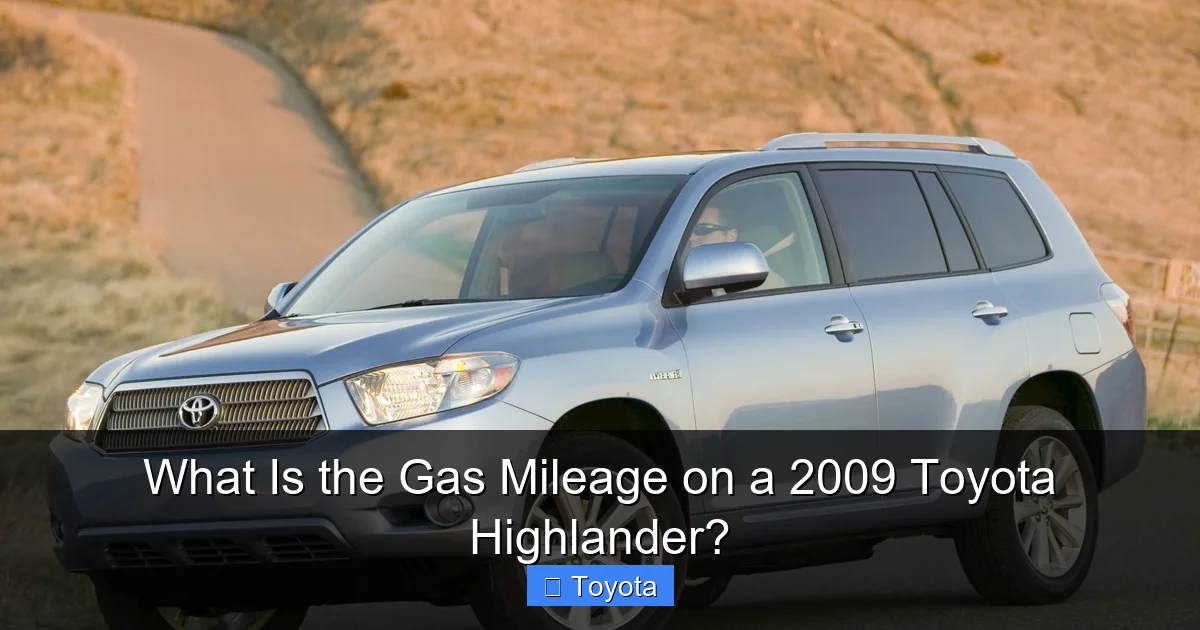
Visual guide about What Is the Gas Mileage on a 2009 Toyota Highlander?
Image source: cdn.dlron.us
Mixed Driving: The Most Common Scenario
For the average driver doing a mix of city and highway driving, here are realistic expectations:
- 4-Cylinder FWD: Most owners consistently see 21-24 MPG combined. Highway road trips can easily hit 26-28 MPG if you keep speeds around 65-70 mph.
- 4-Cylinder AWD: Expect 20-22 MPG combined. The AWD penalty is most noticeable in city driving.
- V6 FWD: Real-world combined numbers typically fall in the 18-20 MPG range.
- V6 AWD: The most common configuration sold, and it often delivers 17-19 MPG combined in real life.
These numbers assume a well-maintained vehicle with properly inflated tires and no excessive weight. If your Highlander is your primary family vehicle, constantly loaded with kids, sports gear, and groceries, subtract another 1-2 MPG from these estimates.
Heavy Loads and City Driving: The Fuel Guzzlers
Two scenarios will absolutely nuke your fuel economy:
- Stop-and-Go City Traffic: The EPA city cycle is bad, but real city traffic with long idling periods is worse. The V6 AWD can dip into the low-to-mid 15 MPG range in dense urban traffic.
- Full Load + Hills/Mountains: The Highlander is a capable hauler, but a fully loaded V6 (7-8 people + luggage) climbing mountain passes will struggle to get 14-15 MPG. The 4-cylinder will feel particularly strained in this scenario, downshifting frequently and burning more fuel.
If your driving pattern heavily features these conditions, you must mentally adjust your fuel budget accordingly. A vehicle’s gas tank size (the Highlander holds about 19.2 gallons) becomes a factor in your range. A V6 AWD with a 15 MPG real-world average has a range of roughly 290 miles, while a 4-cylinder FWD at 23 MPG can stretch to over 440 miles on a tank.
Factors That Make or Break Your Highlander’s MPG
Your 2009 Highlander’s fuel efficiency isn’t set in stone. It’s a direct result of mechanical health and driving habits. Here’s what you can control.
Visual guide about What Is the Gas Mileage on a 2009 Toyota Highlander?
Image source: motordesktop.com
Maintenance: The Foundation of Good MPG
A neglected engine is a thirsty engine. These simple, often overlooked, maintenance items have a huge impact:
- Tire Pressure: This is the #1 culprit for poor MPG. Under-inflated tires increase rolling resistance dramatically. Check pressures monthly when tires are cold. The factory recommendation is usually on a sticker inside the driver’s door jamb, not the tire sidewall. Proper inflation can improve MPG by 3% or more.
- Air Filter: A clogged air filter starves the engine of air, forcing it to work harder and burn more fuel. Inspect it every 12,000 miles and replace as needed—it’s a cheap and easy fix.
- Spark Plugs: Worn plugs cause misfires and inefficient combustion. The 2009 Highlander’s recommended interval is 120,000 miles, but if you have high mileage or notice roughness, checking/replacing them is wise.
- Oxygen Sensors: A faulty O2 sensor can reduce MPG by 10-40% as the engine computer guesses at the correct fuel mixture. If your check engine light is on, get it scanned immediately.
- Oil Viscosity: Using the correct oil (5W-20 for most 2009 models) is specified for optimal fuel economy. Thicker oil increases internal engine friction.
Driving Style: You Are the Biggest Variable
How you drive matters more than any other factor. The difference between a “lead foot” and a “feather foot” can be a 5-8 MPG swing.
- Aggressive Acceleration & Braking: Speeding up quickly from stops and slamming on the brakes wastes enormous energy. Accelerate smoothly and anticipate traffic flow. Try the “pulse and glide” method in safe, light traffic.
- Highway Speeds: Aerodynamic drag increases exponentially with speed. Driving 75 mph vs. 65 mph can reduce highway MPG by 3-5 MPG. Use cruise control on flat highways.
- Excessive Idling: Letting the engine run for more than 30 seconds (except in traffic) wastes fuel. Modern engines warm up quickly. If you’re stopped for more than a minute, turn it off.
- Weight and Drag: Remove unnecessary roof racks or cargo carriers when not in use. They create significant wind resistance. Clean out heavy items from the cargo area—every 100 lbs. reduces MPG by about 1-2%.
Comparing the Highlander to Its Peers (and the Competition)
Was the 2009 Highlander a fuel-sipper or a guzzler? Context is everything. Let’s compare it to its primary rivals and its own successor.
Visual guide about What Is the Gas Mileage on a 2009 Toyota Highlander?
Image source: topelectricsuv.com
Within the Midsize SUV Segment (2009)
Its direct competitors were the Ford Explorer, Honda Pilot, and the Nissan Rogue (a smaller crossover).
- Honda Pilot (2009): Offered only a 3.5L V6. EPA ratings were 17 city / 23 highway (FWD) and 16/21 (AWD). Very similar to the Highlander V6, slightly worse in AWD.
- Ford Explorer (2009): Also V6-only (4.0L). Rated at 14 city / 20 highway (2WD) and 13/19 (AWD). Noticeably thirstier than both the Highlander and Pilot.
- Nissan Rogue (2009): A compact crossover with a 2.5L 4-cylinder. Rated at 22 city / 27 highway (FWD) and 21/26 (AWD). It was significantly more efficient, but also smaller and less powerful.
Verdict: The Highlander’s 4-cylinder was competitive, and its V6 was about average for a traditional, body-on-frame-inspired midsize SUV of its time. It wasn’t a leader in efficiency, but it wasn’t the worst either. Its advantage lay in Toyota’s predicted reliability.
Generational Change: The 2009 vs. The Newer Highlander
The 2009 was the final model year for the second generation. The completely redesigned 2014 Highlander (third gen) made big strides in efficiency, thanks to a more efficient 3.5L V6 and the addition of a hybrid model. The current fourth-generation models (2020+) offer even more efficient turbocharged 4-cylinder options and standard hybrid power in many trims. If fuel economy is your top priority, a newer Highlander is a much better choice. However, if you’re committed to the 2009 model for budget or preference, knowing its limitations is key.
Maximizing Your Fuel Efficiency: Practical Tips for 2009 Highlander Owners
Okay, you have the 2009 Highlander. It’s paid for, and you like it. How do you squeeze every last drop of gasoline? It’s a combination of care and conscious driving.
The “Big Three” Maintenance Must-Dos
Prioritize these three items above all others for immediate, noticeable MPG gains:
- Inflate Tires to the Door Jamb PSI: Not the max on the tire. Do this now and check monthly.
- Replace a Dirty Engine Air Filter: A $20 part that can improve MPG by 2-4%.
- Use the Recommended Oil and Change on Schedule: Don’t skip or extend intervals. Consider a synthetic oil for its superior friction-reducing properties, especially in older engines.
Driving Habit Tweaks That Add Up
- Plan Your Trips: Combine errands into one longer trip rather than several short, cold-start trips. A warmed-up engine is more efficient.
- Use Overdrive Gears: Ensure your OD (overdrive) button is ON. This allows the transmission to shift into a higher gear at cruising speeds, lowering engine RPM.
- Limit Accessory Load: On the highway, using the air conditioner is more efficient than driving with windows down (due to drag). In city driving, crack windows instead of using AC at low speeds.
- Check Your Gas Cap: A loose or faulty gas cap can trigger the “check engine” light and allow fuel vapors to escape, wasting fuel and causing evaporative system errors.
Understanding Highlander-Specific Features and MPG
Does your Highlander have that mysterious HOLD button or the snow button? Understanding factory features helps you use the vehicle as intended.
- Snow Button / AWD Lock: Pressing this button locks the AWD system into a 50/50 torque split for low-traction situations. Do not use this for normal dry pavement driving. It causes unnecessary drivetrain binding and significantly reduces fuel economy. It should automatically disengage at higher speeds, but it’s best to only use it when needed.
- ECT Power Button: This changes the transmission’s shift points to hold gears longer for more responsive acceleration. It makes the vehicle feel quicker but harms fuel economy. Use it only for passing or merging. For maximum MPG, leave it off.
- Eco Mode (if equipped): Some later 2009 models or certain trims might have an “Eco” mode that softens throttle response and optimizes shift points. Use this for daily commuting to save fuel.
The Bottom Line: Is the 2009 Highlander Fuel-Efficient?
We’ve thrown a lot of numbers at you. So, what’s the final takeaway?
By today’s standards, the 2009 Toyota Highlander is not a fuel-efficient vehicle. Even the best-case-scenario 4-cylinder FWD model, at 23 combined MPG, is beaten by many modern crossovers, including hybrids. However, we must judge it by the standards of its time. In 2009, for a traditional, 7-passenger, gasoline-powered SUV with genuine towing capacity (up to 5,000 lbs. for the V6), its fuel economy was middle-of-the-road to respectable. It was more efficient than the V8-powered competitors and on par with its main V6 rivals.
Its value proposition was never about sipping fuel; it was about Toyota’s legendary reliability, practicality, and comfortable, safe family transportation. If you are buying a used 2009 Highlander today, you are likely prioritizing low purchase price and proven durability over the best possible MPG. To manage your expectations and your budget, you must:
- Know your engine. Check the VIN or engine bay for the 2.7L or 3.5L.
- Factor in AWD. If you don’t need it for snow or serious rain, the FWD model will save you 1-2 MPG consistently.
- Budget for reality. Plan on the lower end of the real-world MPG ranges mentioned above, especially if you have a V6 AWD.
- Maintain it meticulously. A well-cared-for Highlander will reward you with its best possible fuel economy and, more importantly, with hundreds of thousands of miles of service.
In the end, the 2009 Highlander’s gas mileage is what it is: average for its class and era. Understanding the specifics of your model, driving sensibly, and staying on top of maintenance are the only ways to ensure you’re not spending more than necessary at the pump. It’s a solid, dependable people-mover that asks for a modest, predictable fuel bill in return.
Frequently Asked Questions
How does the 2009 Highlander’s gas mileage compare to a newer model?
Significantly worse. The redesigned 2014 Highlander and later models, especially hybrids, offer substantially better fuel efficiency due to advanced engine technology and lighter weight. A 2023 Highlander Hybrid, for example, achieves up to 36 MPG combined, which is nearly double the real-world average of a 2009 V6 model.
What is the best fuel economy I can realistically get with a 2009 Highlander?
The absolute best-case scenario is with a 4-cylinder FWD model. On a steady, flat highway trip at 65 mph, you can see 28-29 MPG. For realistic mixed driving (city and highway), aim for 21-24 MPG combined. Anything consistently below 19 MPG in a 4-cylinder indicates a maintenance issue.
Should I use premium gasoline in my 2009 Highlander to get better mileage?
No. All 2009 Highlander engines are specifically designed and tuned to run on regular unleaded gasoline (87 octane). Using premium provides no performance or mileage benefit and is a waste of money. The owner’s manual clearly states the minimum fuel requirement.
What is the most common reason for poor gas mileage in a 2009 Highlander?
The most common and easily fixable reason is severely under-inflated tires. The second most common is a clogged engine air filter. Other frequent culprits include failing oxygen sensors, dirty fuel injectors, or a stuck-open thermostat causing the engine to run rich. A professional diagnostic scan is the best way to pinpoint electronic issues.
Does using the air conditioning significantly hurt the 2009 Highlander’s MPG?
Yes, but the impact varies. In city driving, using the AC can reduce MPG by 1-3 MPG. On the highway, the aerodynamic drag from open windows often costs more MPG than using the AC, so the penalty is smaller (around 0.5-1 MPG). Using the recirculate setting is slightly more efficient than pulling in outside air.
Is the 2009 Highlander’s fuel economy better with a manual transmission?
This is a trick question! For the 2009 model year in the United States, the Highlander was only available with an automatic transmission (a 5-speed for the 4-cylinder and a 5-speed or 6-speed for the V6 depending on the exact model). A manual transmission was not offered on this generation in the North American market.
