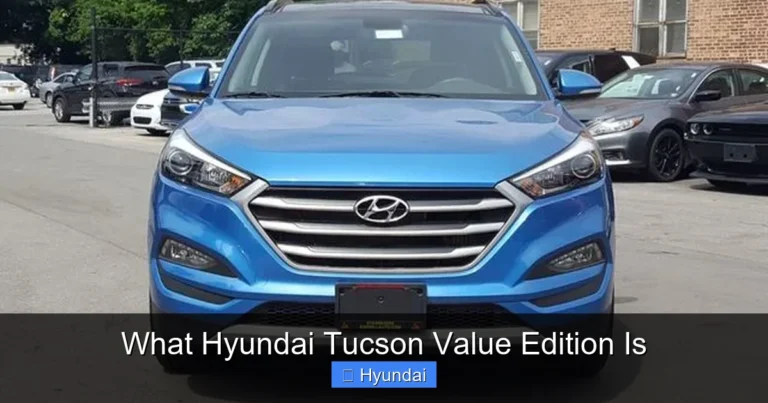
Does the Hyundai Tucson Have 3rd-row Seating?

The Hyundai Tucson does not offer 3rd-row seating. It is a spacious and versatile two-row SUV designed for families of four or five. If you require a third row, Hyundai’s larger Santa Fe or Palisade models are the solutions within the brand’s lineup.
Key Takeaways
- The Tucson is a two-row SUV only: Every Hyundai Tucson model, across all trims and model years, is engineered with two rows of seating for up to five passengers.
- It maximizes interior space efficiently: Despite the lack of a third row, the Tucson provides generous legroom and headroom for front and rear passengers, along with class-competitive cargo volume.
- No third-row option exists: Hyundai does not offer a third-row variant or package for the Tucson; the design philosophy prioritizes agile handling and fuel efficiency for its class.
- Hyundai’s three-row alternatives are distinct models: For families needing more than five seats, Hyundai produces the three-row Santa Fe and the larger, eight-passenger Palisade, which are separate from the Tucson.
- It excels for typical family use: The Tucson is an excellent choice for most families, daily commuting, and road trips where three rows of seats are not a necessity.
- The compact SUV segment largely avoids third rows: Most rivals in the Tucson’s size category, such as the Kia Sportage and Chevrolet Equinox, also do not offer third-row seating, focusing instead on efficient two-row layouts.
- Cargo flexibility is a key strength: The Tucson’s 60/40 split-folding rear seats allow for a wide range of passenger and cargo configurations, mitigating the absence of a third row for many users.
📑 Table of Contents
- Direct Answer: The Hyundai Tucson and Third-Row Seating
- The Tucson’s Design Philosophy: Mastering the Two-Row Space
- Detailed Look at Seating and Cargo Configurations
- Hyundai’s Official Three-Row Alternatives: Santa Fe and Palisade
- Maximizing Your Tucson: Tips for Space Management
- When You Need a Third Row: Looking Beyond Hyundai
- Conclusion: Is the Tucson Right for You?
Direct Answer: The Hyundai Tucson and Third-Row Seating
Let’s get straight to the point. The short, definitive answer is no, the Hyundai Tucson does not have 3rd-row seating. No matter which model year you look at—from the latest 2024 version back to its origins—the Tucson has always been and remains a two-row SUV. It is designed, built, and sold exclusively as a five-passenger vehicle. This is a fundamental characteristic of its design and market positioning. If your primary shopping list includes a non-negotiable third row, the Tucson is not the vehicle for you, and you should immediately shift your search to larger, three-row SUVs like Hyundai’s own Santa Fe or Palisade.
However, this “no” answer is just the beginning of the story. The question “Does the Hyundai Tucson have 3rd-row seating?” often gets asked for a reason. The Tucson is a phenomenally popular vehicle, consistently one of the best-selling compact SUVs in America. Its modern, bold design and relatively generous footprint can sometimes create the impression that it might hide a third row within its sleek silhouette. Many shoppers, especially those with growing families, are instinctively drawn to vehicles that feel substantial and spacious. The Tucson absolutely delivers on that feeling of roominess, but it channels all that engineering prowess into creating a best-in-class experience within its two-row constraint. Understanding why Hyundai made this choice, and what the Tucson offers instead, is crucial for any buyer evaluating this segment.
The Tucson’s Design Philosophy: Mastering the Two-Row Space
Targeting the Heart of the SUV Market
The Hyundai Tucson occupies the highly competitive compact SUV segment, also known as the “crossover” category. This is arguably the most popular vehicle class for American families and individual buyers alike. The key selling points here are a balance of passenger comfort, cargo practicality, fuel efficiency, manageable size for parking and maneuverability, and affordability. Introducing a third row into a vehicle of this size would fundamentally compromise several of these core tenets.
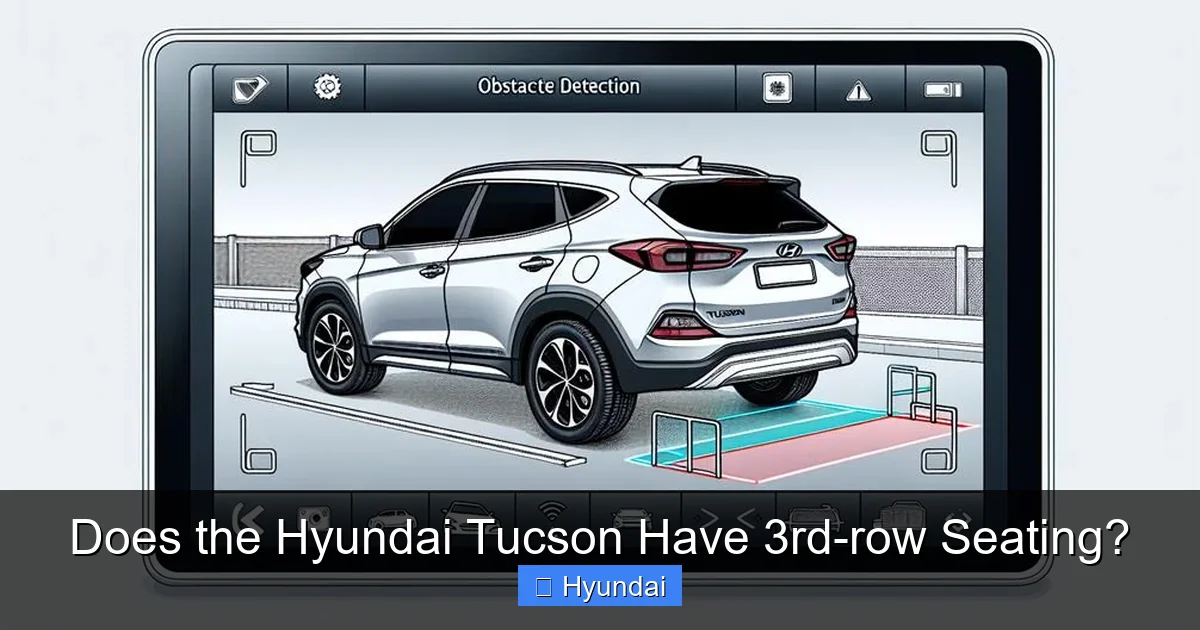
Visual guide about Does the Hyundai Tucson Have 3rd-row Seating?
Image source: hyundaimaintenance.com
Adding a third row requires a longer wheelbase and overall length to create usable space. This would make the Tucson larger, heavier, and less agile. It would also likely reduce cargo space behind the third row to a nearly useless trunk, a common complaint in many three-row crossovers. Fuel economy would suffer due to the increased mass and aerodynamic drag. Most importantly, from Hyundai’s perspective, it would create internal competition with its own three-row offerings. The Tucson is perfectly honed for buyers who need comfortable seating for four adults and their gear, or a family with two children and all their paraphernalia. It is not intended for families that regularly need to transport six or seven people.
Interior Dimensions: Room Where It Counts
So, what do you get instead of a third row? You get exceptional space for the first two rows. Hyundai has brilliantly optimized the Tucson’s architecture to maximize every cubic inch for front and rear passengers. Let’s look at some typical measurements (which can vary slightly by model year and trim).
- Front Headroom/Legroom: The driver and front passenger enjoy a commanding seating position with ample headroom (often over 40 inches) and generous legroom, even with the seat adjusted for a tall driver.
- Rear Legroom: This is a standout feature. The Tucson consistently offers over 28 inches of rear legroom, which is excellent for the class. Teenagers and adults can sit comfortably on longer drives without feeling cramped. The seat cushion is at a good height, providing proper thigh support.
- Rear Headroom: Thanks to its sloping roofline design, headroom is adequate for most passengers, though very tall individuals may notice the contouring more than in a boxier SUV.
- Cargo Volume: Behind the second row, the Tucson provides a very respectable cargo area, typically in the range of 30-38 cubic feet (depending on model year and whether you measure to the ceiling or the window line). This is more than enough for groceries, sports equipment, or luggage for a family trip. Fold the 60/40 split rear seats down, and you open up a vast, flat-load floor approaching 70 cubic feet, rivaling some larger SUVs.
This focus on first- and second-row space means that every passenger in the vehicle gets a comfortable, well-appointed seat. There’s no compromise where it matters most for the majority of its buyers.
Detailed Look at Seating and Cargo Configurations
The Five-Passenger Layout
The Tucson’s seating is straightforward: two front bucket seats and a rear bench that accommodates three passengers (though the middle position is best for children due to a driveline hump and seat shape). The rear seatbacks recline slightly for added comfort on long journeys—a feature not available in all competitors. The seat folds easily via levers in the cargo area or from the rear seatbacks themselves, creating a seamless transition from passenger carrier to cargo hauler.
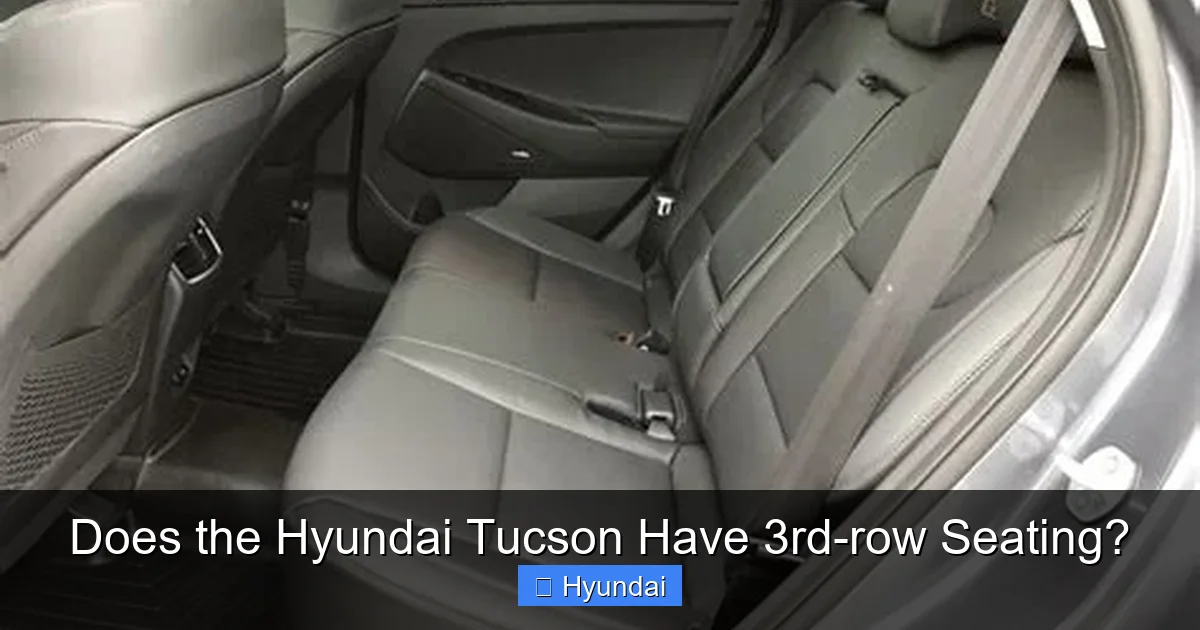
Visual guide about Does the Hyundai Tucson Have 3rd-row Seating?
Image source: autozonic.com
For families with young children, installing car seats is a key practical concern. The Tucson’s outboard rear positions have complete lower LATCH anchors and top tethers, making it relatively easy to secure two or even three car seats, depending on their width. The wide rear seat helps here, but parents should always test their specific seats. The lack of a third row means there is no need to contort yourself into a cramped space to install a seat in a difficult-to-access third row, which is a significant usability advantage.
Cargo Versatility Without the Third Row
Without a third row folding into the floor, the Tucson’s cargo area is a single, unified space. This offers several advantages:
- Easier Loading: You have one wide, tall opening to load bulky items like strollers, coolers, or furniture. There’s no need to remove a heavy third-row seat to create maximum space.
- Cleaner Floor: The load floor is flat and unobstructed when the rear seats are folded, making it simpler to slide in long items like lumber or luggage.
- Always Available: You never have to choose between carrying passengers and carrying cargo. With all five seats in use, you still have a useful 30+ cubic feet of cargo space. This is a tangible daily usability benefit that owners of three-row crossovers often sacrifice when they need to carry more than two people.
For the type of family adventure where you have two kids, two adults, and a dog, or for a weekend getaway with friends, this two-row/cargo-space balance is frequently more practical than a squeezed third row with a tiny trunk.
Hyundai’s Official Three-Row Alternatives: Santa Fe and Palisade
If you’ve determined that you absolutely need a third row, Hyundai has you covered—just not with the Tucson. The brand has a clear, two-tiered strategy for families needing more than five seats.
Visual guide about Does the Hyundai Tucson Have 3rd-row Seating?
Image source: situswebsite.com
The Hyundai Santa Fe: The Accessible Three-Row Choice
The Hyundai Santa Fe is the direct, larger sibling to the Tucson. It slots into the midsize SUV category. For the 2024 model year, the Santa Fe is offered in both five-seat and, crucially, eight-seat configurations with a third row. The third-row seat is best suited for children or smaller adults, as is typical for this segment, but it provides the essential functionality of carrying more people. The Santa Fe represents the “step up” from the Tucson, offering more space, more power (especially in the Santa Fe Calligraphy or hybrid trims), and the official third-row option. It’s the natural progression for a Tucson buyer whose family has outgrown five seats.
The Hyundai Palisade: The Maximum Space Luxury Option
For those needing even more space, luxury, and true eight-passenger capacity, the Hyundai Palisade is the brand’s flagship SUV. It is significantly larger than the Santa Fe and Tucson in every dimension. The Palisade’s third row is among the most spacious and comfortable in the industry for a non-full-size SUV, often cited as being usable for adults on shorter trips. The Palisade is packed with premium features, a more powerful V6 engine, and a more upscale interior. It’s designed to compete with vehicles like the Honda Pilot and Toyota Grand Highlander, not the Tucson. Choosing between a Tucson and a Palisade is not about trim levels; it’s about choosing an entirely different class of vehicle based on your non-negotiable seating requirements.
Maximizing Your Tucson: Tips for Space Management
Living happily without a third row in a Tucson is easy if you plan ahead. Here’s how to make the most of its two-row, high-cargo design.
Clever Storage and Organization
Take full advantage of the Tucson’s numerous storage nooks. The center console has a deep, covered bin. There are door pockets, rear seatback organizers (available as accessories), and a useful under-cargo-floor storage compartment in some models. Keeping the cabin tidy maximizes the perceived space and makes every seat more comfortable.
Utilizing Roof Rails and Cargo Carriers
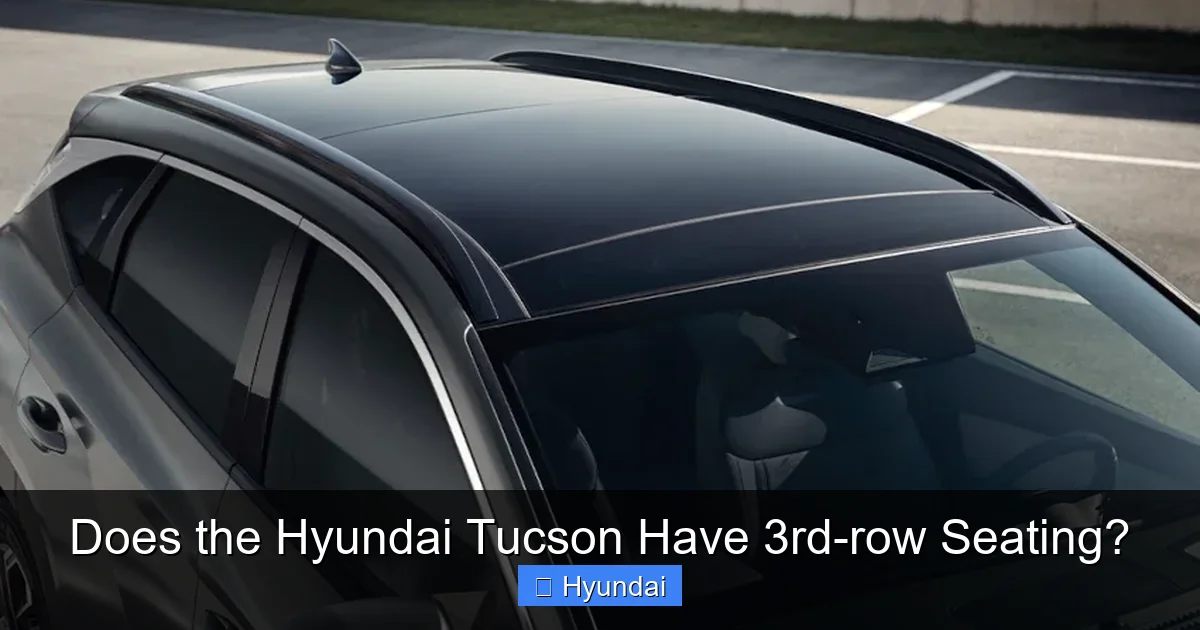
The Tucson comes standard with roof rails. This opens up a world of additional cargo capacity for those rare occasions when you need to haul more than the cargo hold can manage—think kayaks, a rooftop tent, or extra luggage for a long road trip. By using a roof rack and cargo box or basket, you can effectively add “bonus” storage without ever needing to fold down the rear seats and sacrifice passenger space. This is a key strategy for two-row families who occasionally need the capacity of a larger vehicle.
When You Need a Third Row: Looking Beyond Hyundai
If your search has led you to the Tucson but you’ve realized you need a third row, it’s time to expand your horizons. While Hyundai’s own larger models are the first alternatives, the market is full of excellent three-row options from other brands.
Within the Hyundai Family: The Clear Path
As discussed, your Hyundai-brand path is simple: test drive the Santa Fe with the third row and the Palisade. They share design language and many features with the Tucson but scale up significantly. The Santa Fe is a more direct size and price jump, while the Palisade is a full-size, feature-rich flagship. A test drive in both will immediately highlight the differences in space, ride quality, and overall presence.
Competitor Three-Row SUVs Worth Your Time
The three-row SUV segment is fiercely competitive. If you’re cross-shopping the Tucson, you’re likely also looking at vehicles like the Nissan Pathfinder. The Pathfinder is a legendary nameplate that returned to a body-on-frame-inspired design for better off-road and towing capability, all while offering a spacious and accessible third row. It’s a direct competitor to the Santa Fe. For a more car-like, unibody ride, the Toyota Highlander and Ford Explorer are perennial favorites, each with their own strengths in reliability, driving dynamics, and technology. Exploring these will give you a full picture of what’s available in the $40,000-$60,000 price range that the Tucson and its larger siblings inhabit.
The Compact SUV Reality: Most Lack a Third Row
It’s also helpful to understand the segment norms. If you’re drawn to the Tucson’s size and price, you’re looking at compact crossovers. In this category, a third row is exceptionally rare. Vehicles like the Kia Sportage (Tucson’s platform sibling), Chevrolet Equinox, Ford Escape, Toyota RAV4, and Honda CR-V are all strictly two-row designs. Even luxury brands like Audi with the Q5 and Q8, and BMW with the X3 and X5 (some X5s have an optional third row that is extremely cramped), largely avoid putting a functional third row in vehicles of this size. The Audi Q8, for example, is a sleek, sporty two-row coupe-SUV with no third-row option. The engineering trade-offs are simply too great. Therefore, your search for a third row inherently means moving up to the midsize or large SUV class, which brings with it a larger footprint, higher price, and often lower fuel economy. The Tucson’s lack of a third row isn’t a flaw; it’s a conscious design choice that defines its class.
Conclusion: Is the Tucson Right for You?
To circle back to our central question: Does the Hyundai Tucson have 3rd-row seating? The answer remains a firm no. It is a two-row vehicle through and through. This is not a secret or a hidden drawback; it is the core of its identity. The Tucson is engineered to be the best possible compact SUV for people who need comfortable, efficient, and spacious transportation for up to five occupants and their gear. It excels in cargo flexibility, on-road comfort, technology, and value.
If your family regularly needs to carry six or seven people, your search should begin with the Hyundai Santa Fe or Palisade, or their competitors from Nissan, Toyota, Ford, and Kia (like the Telluride). However, if your passenger needs are comfortably met by two rows, the Tucson should be at the very top of your list. Its lack of a third row allows it to be sharper to drive, more fuel-efficient, and more practical on a daily basis than a larger, three-row vehicle would be. Take a test drive, bring your car seats and your typical gear, and experience firsthand how much space Hyundai has packed into this brilliantly designed two-row package. You might just find that you don’t miss a third row at all.
Frequently Asked Questions
Does any model year or trim level of the Hyundai Tucson offer a third-row seat?
No. Across its entire production history and for all current 2024 model year trims (from the base SE to the top Calligraphy), the Hyundai Tucson is manufactured as a five-passenger, two-row SUV. Hyundai does not produce a Tucson with a third-row seating option.
How many passengers can the Hyundai Tucson seat safely?
The Hyundai Tucson is rated and designed to safely seat up to five passengers. This includes the driver, a front passenger, and three occupants in the rear seat. The rear middle position is suitable for a child or a smaller adult due to seat contouring and a driveline hump.
What is the cargo capacity of the Hyundai Tucson with the rear seats folded down?
With the 60/40 split-folding rear seats lowered, the Hyundai Tucson provides a maximum cargo volume of approximately 70 cubic feet (exact figure varies slightly by model year). This creates a long, flat load floor ideal for hauling large items like furniture, bicycles, or gear for a family trip.
Is the Hyundai Tucson still a good family SUV if it doesn’t have a third row?
Absolutely. For the vast majority of families—particularly those with one or two children—the Tucson is an outstanding family SUV. Its excellent rear legroom, safety features, easy-to-clean interior, and massive cargo space with seats folded make it highly practical. The third row is only a necessity for larger families or those who frequently carpool with multiple adults.
How does the Hyundai Tucson’s interior space compare to the Kia Sportage?
The Hyundai Tucson and Kia Sportage are closely related platform siblings. They offer very similar passenger and cargo space, both being two-row, five-passenger compact SUVs. The Tucson may have a slight edge in overall cargo volume and rear legroom in some model years, but the differences are minimal. Both are excellent choices in the segment and neither offers a third row. You can read more about the Kia Sportage’s seating configuration here.
If I need a third row, which Hyundai model should I consider instead of the Tucson?
You should look at the Hyundai Santa Fe, which offers an available third-row seat in its eight-seat configuration, or the larger Hyundai Palisade, which provides standard three-row seating and even more spacious third-row accommodations. These are separate models from the Tucson and are designed specifically for families requiring more than five seats.