
Why Does My Bmw Shut Off When I Stop

If your BMW shuts off when you come to a stop, it’s primarily an idle control issue, often stemming from a faulty idle air control valve, dirty throttle body, or a problematic Start-Stop system. While the engine restarting is usually normal for BMW’s efficient Start-Stop feature, a stalling engine that doesn’t restart points to a mechanical or sensor failure. Immediate diagnosis with a professional scan tool is crucial, as the problem can range from a simple $200 throttle body cleaning to a more serious $1,000+ fuel pump or ignition component replacement.
You’re sitting at a red light, the engine is running smoothly, you take your foot off the brake to prepare to go, and… nothing. The car shuts off. Or maybe it shudders and dies right as you come to a complete stop. That sinking feeling in your stomach is all too familiar for many BMW owners. It’s not just an inconvenience; it’s a potential safety issue, especially in heavy traffic. The question “Why does my BMW shut off when I stop?” has a few very specific answers, rooted in the precision engineering of your Ultimate Driving Machine. Let’s break down the culprits, from the simple to the complex, so you can understand what’s happening under the hood and get it fixed properly.
First, we must make a critical distinction. BMWs from roughly 2008 onward are equipped with a factory feature called Start-Stop or Auto Start-Stop. This system is designed to shut off the engine when you come to a complete stop (at a light, in stop-and-go traffic) to save fuel and reduce emissions. It then automatically restarts the engine when you press the accelerator pedal or release the clutch (in manual cars). If your car is doing this smoothly and reliably, with the engine restarting instantly, then the system is working as intended. You can often temporarily disable it by pressing the “A” button on the center console. The problem we’re addressing is when the engine stalls unintentionally—it shuts off when it shouldn’t, struggles or fails to restart, or does so with severe shuddering and warning lights. This is a malfunction, not a feature.
Key Takeaways
- Normal Start-Stop vs. Problematic Stall: BMW’s factory Start-Stop system is designed to shut off the engine at stops and restart smoothly when you press the accelerator. A true problem occurs if the engine stalls, struggles to restart, or shuts off without the system’s prompt.
- Primary Culprit is Idle Air Control: The most frequent cause is a faulty Idle Air Control (IAC) valve or a severely dirty throttle body, which cannot regulate air intake properly when the engine is idling.
- Fuel Delivery Issues Are Common: Weak fuel pressure from a failing fuel pump, clogged fuel filter, or dirty fuel injectors can starve the engine of fuel at low RPMs, causing it to die.
- Ignition System Failures: Worn spark plugs, failing ignition coils, or a malfunctioning crankshaft position sensor can interrupt the spark needed to keep the engine running at a stop.
- Vacuum Leaks Disrupt Air-Fuel Ratio: A major vacuum leak in hoses or the intake manifold allows unmetered air into the engine, leaning out the mixture and causing unstable idle and stalling.
- Diagnostics Are Non-Negotiable: Never guess. A proper diagnosis using a BMW-specific diagnostic scanner (like ISTA) to read engine control module (DME) fault codes is the only reliable way to pinpoint the exact failed component.
- Costs Vary Widely: Repairs can range from $150 for a throttle body cleaning to over $1,500 for a new fuel pump or major intake manifold gasket repair, depending on the root cause.
📑 Table of Contents
The Usual Suspects: Why Your BMW Idles Poorly and Stalls
When your BMW’s engine loses its ability to maintain a stable, low-speed idle, it’s almost always an issue with one of three core systems: Air Intake, Fuel Delivery, or Ignition. The engine’s computer, the Digital Motor Electronics (DME), is constantly making micro-adjustments to keep the engine running smoothly at 600-800 RPMs when stopped. If a sensor or component fails, the DME can’t compensate, and the engine dies. Let’s explore the most common failures in each category.
1. The Idle Air Control Valve and Throttle Body
This is, by far, the number one cause of stalling at idle in many BMW models, especially the popular N46, N47, N52, N55, and B48 engines. The throttle body is the large valve that controls how much air enters the engine. Inside it is a small motor and valve called the Idle Air Control (IAC) valve. Its only job is to allow a precise amount of air to bypass the throttle plate when the engine is idling, keeping the RPMs steady.
- Failure Mode: The IAC valve can get clogged with carbon deposits from oil vapor (part of the PCV system) and gunk. It can also fail electrically. A stuck or slow IAC valve means the DME cannot add the necessary air to keep the engine running when accessories (like the AC compressor) load the engine down at a stop.
- Symptoms: The idle RPM will fluctuate wildly on its own (e.g., dropping to 400 RPM, then jumping to 1000 RPM) before finally stalling. The stalling often happens when turning the steering wheel (power steering load) or turning on the AC. You might see a fault code like 2B7E – Idle Speed Control.
- Solution: Often, a thorough chemical cleaning of the throttle body and IAC valve can restore function. However, in many modern BMWs, the IAC valve is integrated into the throttle body assembly as a single unit, requiring a full throttle body replacement, which can cost $400-$800+ for the part alone.
2. Fuel System Weakness
Your BMW’s high-pressure fuel pump (HPFP) and injectors are engineering marvels, but they are under immense stress. If they can’t maintain the required fuel pressure at low engine speeds, the engine will starve and die.
- High-Pressure Fuel Pump (HPFP): Common on N54, N55, and B58 engines. These electric pumps can wear out. A failing HPFP often sets a low fuel pressure code (like 2B3E – Fuel Rail Pressure Too Low). The engine may run fine under acceleration (high RPM) where fuel demand is met by the pump’s speed, but at idle, pressure drops, causing a stall.
- Fuel Filter: A clogged in-line fuel filter restricts flow. It’s a wear item that should be replaced per the maintenance schedule (often every 30k-60k miles). A restricted filter causes low压力 at the rail.
- Fuel Injectors: Dirty or failing injectors may not atomize fuel properly or may leak, causing a rough, lean idle that can stall.
- Low-Pressure Fuel Pump (In-Tank): The pump in your gas tank supplies fuel to the HPFP. If it’s weak, it can’t feed the high-pressure system adequately, leading to low-pressure symptoms at idle.
3. Ignition System Components
Modern BMWs use coil-on-plug ignition. Each cylinder has its own ignition coil that sits directly on the spark plug. These are robust but not indestructible.
- Failing Ignition Coils: A coil that is beginning to fail may work fine under load but misfire at idle when the spark energy requirement is different. Multiple failing coils will cause a severe rough idle and stall. You’ll likely see misfire codes (P0300-P030X).
- Worn Spark Plugs: Spark plugs have a specific service interval. Over-gapped, fouled, or worn plugs can struggle to create a strong enough spark at low RPMs, leading to mis fires and stalling.
- Crankshaft Position Sensor: This sensor tells the DME exactly where the crankshaft is. If it fails or gives a weak signal, the DME loses its reference for fuel injection and ignition timing, often causing the engine to stall immediately or not start at all. This is a critical failure.
4. Vacuum and Intake Leaks
Your engine’s computer calculates the exact amount of air entering through the throttle body. If there’s an unmetered air leak after the throttle body (in the intake manifold, hoses, or from a cracked manifold), the computer doesn’t know about it. This creates a lean air-fuel mixture (too much air, not enough fuel) that can cause a rough idle and stall.
- Common Leak Points: The plastic intake manifold itself can crack (especially on older 6-cylinder models). The numerous small vacuum hoses for the PCV system and brake booster can become brittle and crack. A leaking valve cover gasket (which also seals the PCV passages) is a very common source of vacuum leaks on BMWs.
- Diagnosis: A smoke machine test is the best way to find vacuum/intake leaks. You can sometimes hear a hissing sound near the engine with the hood open. A lean condition code (P0171, P0174) is a strong indicator.
BMW-Specific Systems That Can Cause Confusion
Beyond the generic mechanical failures, your BMW has some sophisticated systems that are unique to the brand and can be mistaken for a fault when they are actually operating as designed—or failing in a BMW-specific way.

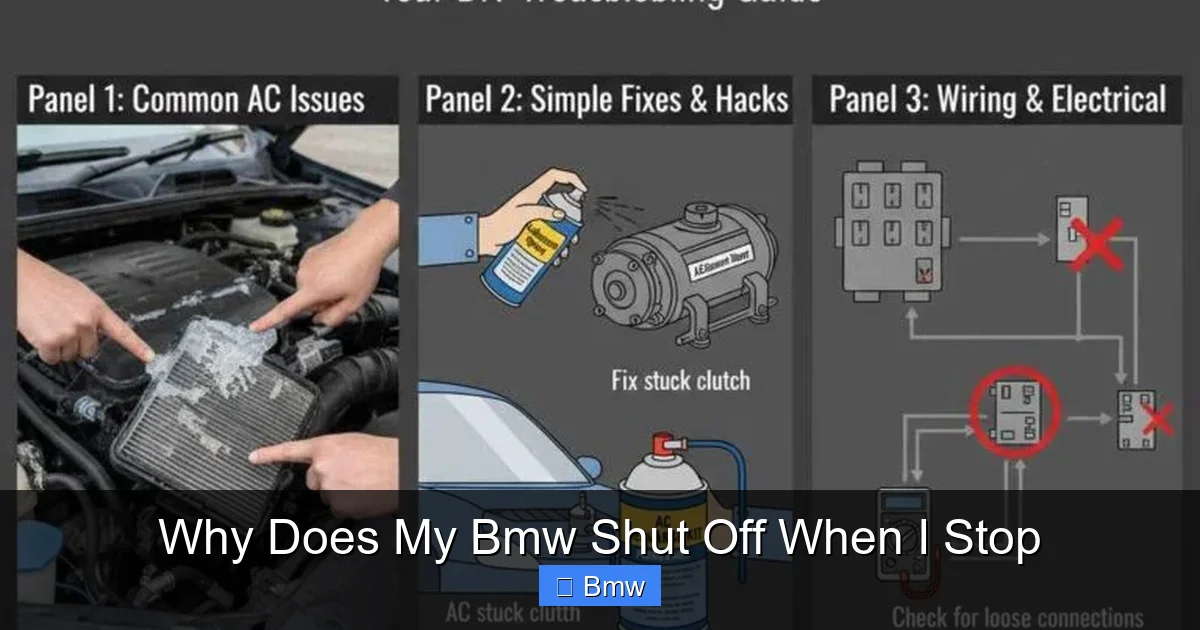
Visual guide about Why Does My Bmw Shut Off When I Stop
Image source: cdn.thedailyautomotive.com
The Intelligent Start-Stop System
As mentioned, this is the most common source of owner confusion. It’s a feature, not a bug. However, the system has many prerequisites to activate. If any of these conditions aren’t met, the system will not turn off the engine at a stop, which can feel like a malfunction if you’re expecting it to work.
- When it WON’T activate: Engine not at operating temperature, cabin not at set temperature (if AC/heat is on), battery state of charge too low, steering wheel turned too sharply (for parking maneuvers), or if the system detects a fault (like a weak battery or a faulty sensor). A malfunctioning Start-Stop system that doesn’t shut off is often a symptom of a separate issue, like a weak battery or a faulty brake pedal switch.
- When it malfunctions: The engine shuts off, but then fails to restart when you press the accelerator. This is usually due to a weak starter motor, a faulty start-stop relay, or a problem with the dual-mass flywheel (in manual cars) or torque converter (in automatics) that the system relies on for restarting.
The Valvetronic System
Most modern BMWs use Valvetronic, which eliminates the traditional throttle plate for part-load operation by varying valve lift. It uses electric motors on the cylinder head to control intake valve opening. While incredibly efficient, it introduces more potential failure points.
- Relevant Failure: A faulty Valvetronic motor or a worn eccentric shaft sensor can cause the system to malfunction. The DME may then default to using the throttle plate as a backup, but if the IAC valve is also faulty, you get a perfect storm for a stall at idle. A common code is 2B7E or 2B7F related to Valvetronic.
Software Glitches and DME Updates
Sometimes, the problem isn’t a physical part but the software governing it. BMW has released service bulletins and software updates over the years to refine idle control logic, Start-Stop behavior, and sensor calibration. A simple, free software update from the dealer can resolve a stalling issue if it’s a known programming bug. This is why a proper diagnostic scan is step one—to check for stored software-related fault codes and TSBs.
How to Diagnose: A Step-by-Step Guide
Before you start throwing parts at the problem, you need a diagnosis. Here is the logical flowchart a competent technician follows.

Visual guide about Why Does My Bmw Shut Off When I Stop
Image source: cdn.thedailyautomotive.com
Step 1: The Essential Scan
This is non-negotiable. You must read the fault codes from the DME (engine computer) and other relevant modules (like the DME for fuel pump control). A generic OBD2 scanner will only give you generic P-codes. You need a BMW-specific diagnostic tool like ISTA (the official dealer software), a high-quality aftermarket tool (e.g., BimmerCode, Carly, or a professional-grade scanner like Autel or Launch with BMW software), or a visit to a specialist. Look for:
- Pending vs. Stored Codes: Pending codes indicate a fault that has occurred but hasn’t yet fully tripped the light. They are goldmines for intermittent problems.
- Specific BMW Codes: Codes starting with 2xxx are BMW-specific. For example, 2B7E points directly to the idle control system.
- Sensor Data: Live data streaming is key. Watch the Mass Air Flow (MAF) sensor reading, fuel trims (short-term and long-term), idle RPM, and oxygen sensor voltages while the engine is idling. Erratic MAF readings or fuel trims that are maxed out (+10% or -10%) point to air or fuel issues.
Step 2: Basic Physical Checks
With codes in hand, or if no codes exist, perform foundational checks:
- Air Filter: Is it clogged with leaves and dirt? A severely restricted air filter can cause low airflow, but it’s rare to cause a stall alone.
- Fuel Cap: A faulty or missing gas cap can cause a large vacuum leak in the fuel system, triggering a lean condition and stall. Ensure it’s tight and the seal is intact.
- Visual Inspection: Look for obvious cracked or disconnected vacuum hoses. Check for oil leaks around the valve cover gasket (a common source of vacuum leaks). Listen for hissing sounds with the engine running.
- Battery and Charging System: A weak battery (<12.4V at rest) or a failing alternator can cause low voltage to the engine control systems and starter, leading to Start-Stop malfunctions and rough idling. Have the battery load-tested.
Step 3: Component-Specific Testing
Based on the codes and checks:
- For IAC/Throttle Codes: Remove the throttle body and inspect. If it’s a drive-by-wire system (no throttle cable), the throttle plate will be motorized. Check for carbon buildup. A professional can perform a throttle body adaptation/reset using the diagnostic tool.
- For Fuel Pressure Codes: A fuel pressure gauge must be installed to test rail pressure against BMW specifications (often 50-100+ bar for HPFP systems). This is a critical test.
- For Misfire Codes: Swap the suspect ignition coil with a known good one on a different cylinder. If the misfire code moves to the new cylinder, the coil is bad. Same for spark plugs.
- For Vacuum Leaks: Perform a smoke test. This is the most definitive method.
Common Fixes and Their Costs
Now that we’ve diagnosed the likely cause, what does the fix involve? Costs vary dramatically by model, engine, and whether you do it yourself or go to a dealer.

Visual guide about Why Does My Bmw Shut Off When I Stop
Image source: cdn.thedailyautomotive.com
Throttle Body / IAC Valve Replacement
This is the most common repair. For models where the IAC is separate (older cars), a cleaning or valve replacement might suffice ($150-$300 in parts/labor). For integrated units, a new OEM throttle body is often required. Part cost ranges from $400 to $900+. Labor is 2-4 hours. Aftermarket parts are available but vary in quality. Important: A throttle body replacement on a BMW requires a throttle body adaptation/reset using the diagnostic software. Simply plugging in a new one will not work.
Fuel Pump (High-Pressure)
The HPFP is a critical, high-stress component. Replacing it is a significant job. The pump is located on the engine (often under the valve cover). Labor can be 4-8 hours. The pump itself costs $300-$700 for OEM. Total dealer cost: $1,200 – $2,000+. Some independent specialists may be less.
Ignition Coils and Spark Plugs
A relatively straightforward and common maintenance/repair item. A set of 6 ignition coils for an inline-6 is $400-$700 for OEM. Spark plugs (for the same engine) are $80-$150. Labor is 1-2 hours. This is a job many DIYers with basic tools can handle, though coil-on-plug boots can be brittle.
Vacuum Leak Repair
Cost depends entirely on the leak source. A cracked hose: $20 and 0.5 hours. A leaking valve cover gasket (which requires removing the valve cover): $150-$300 in parts and 3-5 hours labor. A cracked plastic intake manifold: the part alone can be $500-$1,000, with 4-6 hours labor.
Software Updates and adaptations
If the issue is software-related, a dealer or specialist can perform a DME update. This can cost $100-$300 in diagnostic/labor time but may solve the problem permanently with no parts cost.
Prevention and Long-Term Care
Can you prevent this from happening? While no car is immune to component failure, adherence to a strict maintenance schedule is your best defense.
Follow BMW’s Maintenance Schedule Diligently
This is not optional. BMW’s Inspection I and II services are designed to catch these issues. At a minimum, ensure:
- Oil changes every 7,500-10,000 miles (or yearly) with the correct LL-01 or LL-04 spec oil. Poor oil quality can harm the PCV system and lead to throttle body gunk.
- Air filter replacement every 30,000 miles.
- Fuel filter replacement as specified (often every 30k-60k miles).
- Spark plug replacement at the recommended interval (typically every 60k-100k miles, but check your manual).
- Ignition coil inspection/replacement as needed—they are wear items.
Address Small Problems Immediately
If you notice a rough idle, a check engine light, or a slight hesitation, get it scanned immediately. A small vacuum leak or a slightly weak coil can be caught and fixed before it causes a full stall and potentially leaves you stranded. Catching a pending code is far cheaper than a tow bill and a catastrophic failure from running lean.
Use Quality Parts and Specialists
When repairs are needed, use OEM or high-quality aftermarket parts from reputable brands (Bosch, Siemens, Mahle). The cheapest throttle body or fuel pump on the market is often a false economy. Furthermore, for complex systems like Valvetronic or high-pressure fuel, a technician who specializes in BMWs will have the experience and tools (like the BMW diagnostic system) to do the job correctly the first time. A general mechanic might replace a part only to find a software adaptation was needed, or they might misdiagnose a vacuum leak.
Conclusion: Don’t Ignore the Stall
Your BMW shutting off when you stop is a clear cry for help from your engine management system. It is not a normal characteristic, even if your car has a Start-Stop system. The root cause is almost always a failure in the idle air control, fuel delivery, or ignition systems, with the idle air control valve/throttle body being the most frequent offender. The path forward is methodical: get a proper BMW-specific diagnostic scan to read the codes and live data, then inspect and test the implicated systems. While the cost of repair can range from a few hundred to a couple of thousand dollars, ignoring the problem is not an option. A stalling engine is a dangerous one, and what starts as a rough idle can lead to more severe damage, like a clogged catalytic converter from running too lean or a misfire. Take the symptom seriously, invest in a correct diagnosis, and repair it with quality parts. Your safety—and the long-term health of your BMW—depends on it.
Frequently Asked Questions
Is it safe to drive my BMW if it shuts off when I stop?
No, it is not safe. A stalling engine at a stoplight or in traffic creates a dangerous situation where you lose power steering and brakes, and you risk being rear-ended. You should have the car towed to a repair shop if the stalling is severe or frequent.
How is this different from the normal Start-Stop system?
The normal Start-Stop system is seamless: the engine shuts off at stops and restarts instantly and smoothly when you press the accelerator. A problem occurs if the engine stalls unintentionally, struggles to restart, shudders violently during restart, or if the system fails to activate when it should. These are signs of a malfunction.
Can I turn off the Start-Stop system permanently?
You can temporarily disable it by pressing the “A” button on the center console, and it will re-enable with each new ignition cycle. Some aftermarket coding tools (like BimmerCode) can disable it permanently, but this may affect your car’s emissions compliance and fuel economy ratings. It does not fix the underlying stall problem.
What is the most likely first part I should replace?
Based on prevalence, the most common single component failure is the throttle body (which contains the IAC valve) on many BMW models. However, you should never guess. A diagnostic scan could reveal a $50 vacuum leak instead of a $800 throttle body. Always diagnose first.
Will a bad battery cause my BMW to stall at idle?
Yes, a severely weak or failing battery can cause stalling and Start-Stop malfunctions. The Start-Stop system requires a specific state of charge to operate. A weak battery can also cause voltage drops that confuse engine sensors. Always have the battery health checked as part of the diagnostic process.
My BMW stalled and now won’t start at all. Is it the same problem?
It could be related. A severe fuel delivery issue (like a completely failed HPFP) or a critical sensor failure (like the crankshaft position sensor) could cause a stall and then prevent restarting. However, a “crank-but-no-start” condition has a different diagnostic tree than a “stall-at-idle” issue. The initial scan will reveal the direction. Similar issues in Dodge Rams, where a faulty crankshaft sensor causes a stall and no-start, show how sensor failures can manifest this way across brands.
