
How to Remove Flat Tire Warning on an Infiniti Q50

If your Infiniti Q50’s flat tire warning light is on, don’t panic! First, check your tire pressures and inflate if needed. Then, use the TPMS reset button or drive cycle to clear the warning. Always address the root cause to prevent recurrence. Our guide covers both methods in detail.
Key Takeaways
- TPMS alerts for low pressure, not always a flat: The warning indicates one or more tires are below the recommended psi, which could be due to temperature changes, a slow leak, or a damaged sensor.
- Always check and adjust pressures first: Never reset the system without verifying all tires (including the spare) are inflated to the pressure listed on your driver’s door jamb sticker.
- Manual reset uses the dedicated TPMS button: Located under the dashboard, this button initiates the reset sequence after you’ve corrected the pressures.
- The drive cycle is an automatic reset method: If the manual reset fails, driving at highway speeds for a set duration often allows the system to recalibrate on its own.
- Persistent warnings may signal faulty hardware: A constantly illuminated light after proper reset can mean a bad tire pressure sensor or a dead sensor battery.
- Regular maintenance prevents false alerts: Consistent tire rotations, pressure checks, and timely oil changes for your Infiniti Q50 support overall vehicle health, including TPMS function.
- Safety comes first: A true flat tire requires immediate safe stopping and tire replacement. The warning system is a helper, not a substitute for visual inspection.
📑 Table of Contents
- Understanding Your Infiniti Q50’s Tire Pressure Monitoring System (TPMS)
- Immediate Steps When the Flat Tire Warning Lights Up
- How to Manually Reset the TPMS on an Infiniti Q50
- The Drive Cycle Method: Letting Your Q50 Reset Itself
- When the Warning Persists: Diagnosing Persistent TPMS Issues
- Proactive Maintenance: Preventing Future TPMS Alerts
- Conclusion: Confidence on the Road
Understanding Your Infiniti Q50’s Tire Pressure Monitoring System (TPMS)
That little yellow exclamation point inside a tire on your Infiniti Q50’s dashboard isn’t just a nuisance—it’s your car’s way of talking to you. It’s the Tire Pressure Monitoring System (TPMS) at work. Since 2007, all vehicles sold in the U.S., including your Q50, have been required to have this safety feature. Its job is simple and critical: to warn you when tire pressure drops 25% or more below the manufacturer’s recommended level. Driving on under-inflated tires is dangerous. It reduces traction, increases stopping distances, causes uneven tire wear, and lowers your fuel economy. On a performance-oriented car like the Q50, proper tire pressure is even more vital for handling and performance.
The system in your Infiniti is a direct TPMS. This means each wheel has its own tiny sensor, usually mounted inside the valve stem. These sensors broadcast a unique radio signal to your car’s computer. When the pressure in any sensor’s tire falls below the threshold, the dashboard warning light illuminates. It’s a brilliant system, but it has quirks. The most common frustration for Q50 owners is the light staying on even after they’ve fixed the problem—like adding air to a low tire. This is where learning how to remove the flat tire warning on an Infiniti Q50 becomes essential knowledge.
How Direct TPMS Works in Your Q50
Unlike older indirect systems that used the anti-lock brake sensors to guess pressure, your Q50’s direct system gets real-time data. Each sensor has a small, non-replaceable battery that lasts about 7-10 years. When that battery dies, the sensor must be replaced. The system also needs to “learn” the sensors. When you rotate tires or replace a sensor, the car’s computer must be told which sensor is at which wheel location. This is often part of the reset process. For more on how these systems function across different models, you can explore resources on checking tire pressure on a Nissan Altima, as Infiniti shares much of its technology with its parent company.
Immediate Steps When the Flat Tire Warning Lights Up
Seeing that light can be alarming, but your reaction should be calm and methodical. The absolute first step is not to hunt for the reset button. The reset button is for after you’ve solved the problem, not for ignoring it. Here is your safety-first action plan.
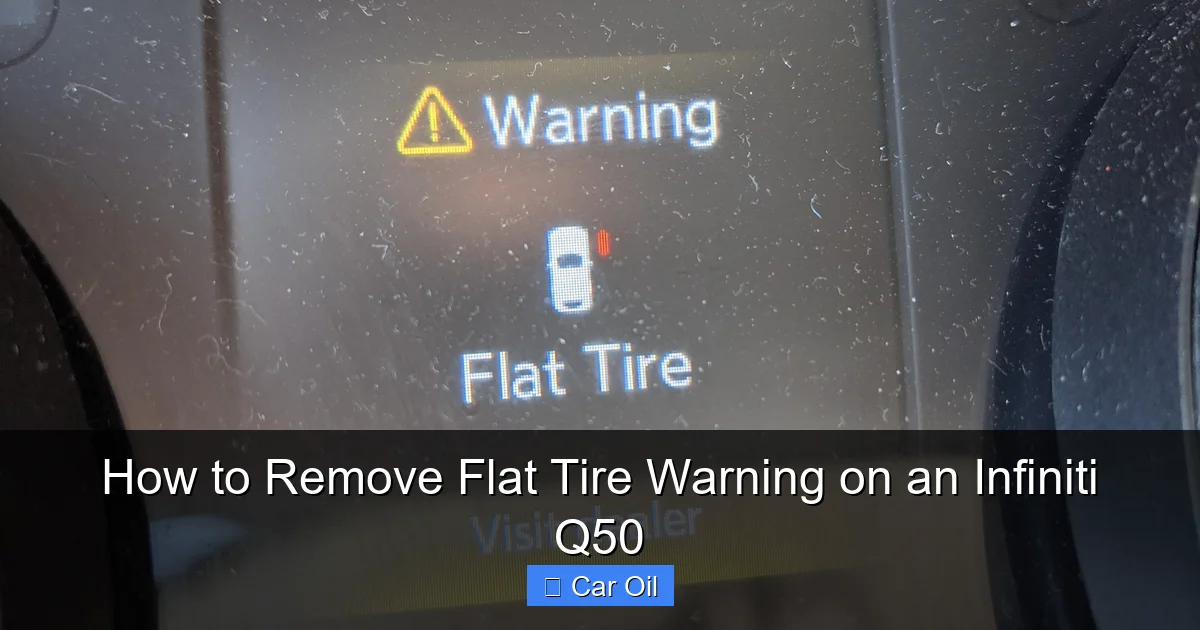
Visual guide about How to Remove Flat Tire Warning on an Infiniti Q50
Image source: i.redd.it
Safely Pull Over and Inspect Your Tires
If the light comes on while driving, find a safe, level place to pull over as soon as practical. Turn on your hazard lights. Visually inspect all four tires. Look for obvious signs of a flat: a severely slumped sidewall, a nail or screw in the tread, or a tire that’s clearly low on air. If you have a true flat—a tire that is completely deflated or has a major puncture—do not drive on it. Driving on a flat can destroy the tire and damage your wheel. You’ll need to install your spare or call for roadside assistance.
Check All Four Tires (and the Spare!) with a Gauge
Often, the issue is a slow leak or a pressure drop due to cold weather. You must use a proper tire pressure gauge, not just your eyes. The recommended pressure for your specific Q50 trim and tire size is on a yellow and white sticker on the driver’s side door jamb. It is not the number printed on the tire sidewall. Check each tire when they are cold (driven less than a mile). Inflate any low tire to the exact specified pressure. Don’t over-inflate! This step is non-negotiable. You cannot successfully reset the system if the underlying pressure issue isn’t fixed. Many owners find that after a seasonal temperature change, all four tires drop a few psi, triggering the light. A quick visit to an air pump solves it.
How to Manually Reset the TPMS on an Infiniti Q50
Once you’ve confirmed all tires are properly inflated to the door jamb spec, you can proceed with the reset. The Infiniti Q50 has a dedicated TPMS reset button. The process is straightforward but requires the ignition to be in the “ON” position (engine off, dashboard lights on).
Locating the TPMS Reset Button
The button is typically located in the driver’s footwell area, near the bottom of the dashboard column. It’s often to the left of the steering column, sometimes behind a small plastic cover. It is usually labeled with the TPMS symbol (the cross-section of a tire with an exclamation mark). On some model years, it might be near the OBD-II port under the dash. Take a moment to familiarize yourself with its location when the car is parked and calm. You don’t want to be fumbling for it in the dark or during bad weather.
The Step-by-Step Reset Procedure
- Ensure all tires are inflated to the correct cold pressure.
- Turn the ignition key to the “ON” position. Do not start the engine. You should see all dashboard lights illuminate.
- Press and hold the TPMS reset button. You’ll need to hold it for several seconds.
- The TPMS warning light on the dashboard should blink three times, then turn off. This indicates the reset command has been accepted.
- Release the button. The system is now in “relearn” mode. You must drive the car for a period of time so the sensors can communicate with the computer.
- Drive at a steady speed above 30 mph for about 10-15 minutes. The light should remain off after this drive cycle. If it comes back on, the system has not successfully learned the sensors, and you may need to repeat the process or try the drive cycle method described next.
For a visual guide with exact button location for your specific model year, our detailed article on how to clear a flat tire warning on an Infiniti Q50 provides helpful photos and tips.
The Drive Cycle Method: Letting Your Q50 Reset Itself
Sometimes, the manual button press doesn’t take. Or perhaps you inflated your tires and simply want to see if the light will go away on its own. Your Q50’s computer has a built-in drive cycle that can automatically clear the warning once it verifies all sensors are reporting pressures within the acceptable range.
How the Automatic Relearn Works
After you’ve corrected the tire pressures, simply drive your Q50 normally for a while. The system needs to receive consistent, valid signals from all four wheel sensors. This typically happens at highway speeds. The computer compares the signals and, if all is well, extinguishes the light on its own. No button pressing required.
Executing a Successful Drive Cycle
For the best results, follow this simple routine:
- Make sure all tires are perfectly inflated to spec.
- Drive on a highway or open road where you can maintain a steady speed.
- Maintain a speed of at least 50 mph (80 km/h) for about 10-15 minutes.
- Vary your speed slightly, but avoid stopping. The constant motion and speed allow the sensors to transmit repeatedly.
- After this drive, check if the warning light is off. It may take a couple of drive cycles for some systems to fully register the change.
This method is particularly useful if you’ve just rotated your tires. The car needs to figure out which sensor is at which corner. Driving allows it to map the sensor locations based on their relative positions and signal strengths. If the light persists after a couple of highway drives, you may need to perform the manual reset to force a relearn. A comprehensive look at the process is available in our sister guide on how to clear the flat tire warning on an Infiniti Q50, which covers both methods in depth.
When the Warning Persists: Diagnosing Persistent TPMS Issues
You’ve inflated the tires. You’ve pressed the reset button. You’ve done the drive cycle. The light is still on. Now what? A stubborn warning light points to a deeper issue that a simple reset cannot fix.
Common Culprits for a Stubborn Light
- Faulty or Dead Sensor: The sensor’s internal battery has a finite life. If one dies, it will stop transmitting, and the system will flag an error. The sensor must be replaced.
- Damaged Sensor: A sensor can be damaged during a tire service, like when a tire changer impacts the valve stem area. It may still work intermittently, causing the light to flash or stay on.
- Sensor Not Recognized After Tire Service: If you had a tire repaired or replaced and the shop didn’t perform a TPMS relearn procedure, your car’s computer may not know which sensor is where. This is common after tire rotations.
- Spare Tire is Low: Many drivers forget their spare! If your full-size spare is mounted on the car and is low, it will trigger the warning.
- Extreme Temperature Fluctuations: A very rapid drop in outside temperature can cause a temporary pressure drop that sets off the light. Once the tires warm up from driving, pressure rises and the light may go off. If it stays on, check pressures anyway.
Diagnosing and Fixing the Problem
At this stage, you likely need professional help. A repair shop or tire center will use a TPMS scan tool. This tool can read the individual sensor IDs and their pressure and temperature data in real-time. It can identify:
- Which specific sensor is faulty or missing.
- If a sensor’s battery is low.
- If the system’s relearn procedure is incomplete.
Replacing a sensor involves removing the tire from the wheel, replacing the valve stem/sensor unit, remounting the tire, and balancing the wheel. It’s not typically a DIY job unless you have the proper tools and experience. The cost varies but expect $50-$150 per sensor for parts and labor. For those experiencing similar issues with other vehicles, the diagnostic process for resetting a tire pressure sensor on a Nissan Murano shares many of the same principles and tool requirements.
Proactive Maintenance: Preventing Future TPMS Alerts
The best way to deal with a TPMS warning is to avoid getting one in the first place. A little proactive care goes a long way.
Monthly Pressure Checks are Non-Negotiable
Make it a habit to check all your tire pressures, including the spare, at least once a month and before any long trips. Use a reliable digital gauge. Tires naturally lose about 1 psi per month. Temperature changes can cause more dramatic swings. Catching a slow leak early can save you from a flat and a warning light.
Don’t Forget About the Spare
A neglected spare is a common trap. If your Q50 has a full-size spare mounted on the car (like in some trims), check its pressure regularly. If it’s a temporary “donut” spare, ensure it’s inflated to its specific, usually higher, pressure (often 60 psi).
TPMS Sensor Care During Tire Service
Whenever you have your tires rotated, repaired, or replaced, specifically ask the technician to perform a TPMS relearn procedure if needed. This is a standard step on most modern cars, but it’s good to confirm. Also, ask them to inspect the sensors for physical damage. If you’re buying new tires, consider replacing sensors if they are more than 7-8 years old, as battery failure is imminent.
The Big Picture: Holistic Vehicle Care
Your Infiniti Q50 is a complex machine where all systems interact. Neglecting one area can stress another. For instance, failing to get regular oil changes for your Infiniti Q50 leads to engine sludge and wear, which can cause vibrations that might indirectly affect sensor longevity. Keeping up with all scheduled maintenance—oil changes, brake service, suspension checks—creates an environment where your TPMS and other systems can function correctly and reliably. Think of it as preventive medicine for your car.
Conclusion: Confidence on the Road
Removing the flat tire warning on your Infiniti Q50 is a two-part process: solving the problem and then resetting the system. The reset button and drive cycle are just tools. The real work is in ensuring your tires are properly inflated and in good condition. By understanding your TPMS, performing regular pressure checks, and knowing the reset procedures, you transform that dashboard warning from a source of anxiety into a simple, manageable task. You’ll enjoy safer driving, better fuel economy, and longer tire life. Remember, the system is there to help you. Listen to it, investigate when it speaks, and you’ll keep your Q50 performing at its best for years to come. For any persistent issues that evade these steps, a qualified technician with the right scan tool is your best ally.
Frequently Asked Questions
Why does my Infiniti Q50’s flat tire warning keep coming back after I reset it?
This usually means the underlying issue wasn’t fixed. Re-check all tire pressures with a gauge, including the spare. A slow leak from a nail or a faulty sensor could be the cause. If pressures are correct, a bad TPMS sensor likely needs replacement.
Can I just disconnect the battery to clear the TPMS light?
No, disconnecting the battery will reset other systems like the radio and clock, but it will not clear the TPMS warning. The TPMS has a dedicated memory and requires its specific reset procedure or a drive cycle to clear.
Where exactly is the TPMS reset button on a 2018 Infiniti Q50?
It is typically located in the driver’s footwell area, to the left of the steering column, near the bottom of the dash. Look for a small black button with the tire and exclamation point symbol. Consult your owner’s manual for the exact location for your specific model year.
Do I need a special tool to reset the TPMS after rotating my tires?
For a simple pressure adjustment, the dashboard button and drive cycle are sufficient. However, after a tire rotation where sensors have moved to new wheel positions, some vehicles require a professional relearn procedure using a scan tool to tell the car which sensor is at which wheel. The Q50’s system often learns automatically during driving, but it can sometimes need the manual button press.
Is it safe to drive with the TPMS light on?
It depends. If the light is solid, it means at least one tire is significantly under-inflated. Driving this way is unsafe—it can cause tire damage, poor handling, and increased wear. You should check and adjust pressures immediately. If the light is flashing, it indicates a system malfunction, and you should have it inspected promptly.
How much does it cost to replace a faulty TPMS sensor on an Infiniti Q50?
The total cost per sensor, including parts and labor, typically ranges from $80 to $150. The sensor itself costs around $40-$80, and labor involves removing the tire, replacing the sensor, and remounting/balancing the wheel. Prices can vary by region and shop.
