
How Do You Reset the Tire Pressure Light on a Toyota

Resetting the tire pressure light on a Toyota is usually a simple, do-it-yourself task after you’ve inflated the tires to the correct PSI. The process varies slightly by model year and trim, often involving a dedicated TPMS reset button or a menu in the vehicle settings. If the light persists after a proper reset, it may indicate a faulty sensor or a slow leak that needs professional attention.
That little amber light on your Toyota’s dashboard, shaped like a cross-section of a tire with an exclamation point, is your Tire Pressure Monitoring System (TPMS) talking to you. It’s a crucial safety feature, but it can be a nagging mystery. You check your tires, they look fine, maybe you add a little air, but the light stubbornly stays on. So, how do you reset the tire pressure light on a Toyota? The answer is: it depends on your specific model and year, but it’s almost always a straightforward process you can handle yourself. This guide will walk you through every step, from understanding why the light came on to mastering the reset procedure for your specific Toyota.
The TPMS is a brilliant system designed to warn you when tire pressure falls 25% or more below the recommended level. Underinflated tires are dangerous—they increase stopping distances, reduce handling precision, overheat (potentially leading to blowouts), and wear out prematurely. The system uses sensors inside each wheel (or sometimes on the valve stem) that transmit pressure data to your car’s computer. When that data indicates a problem, the warning light illuminates. Resetting it isn’t about turning off a trouble code; it’s telling the computer, “Hey, I’ve fixed the issue. Now, please start monitoring again with these new, correct pressure values.”
Key Takeaways
- Always inflate tires first: The reset will only work if all tires, including the spare if equipped, are at the manufacturer’s recommended pressure.
- Method varies by model: Older Toyotas use a physical button inside the glovebox or dash; newer models use the multi-information display menu.
- Drive to recalibrate: After a reset, you typically need to drive for 5-10 minutes at over 25 mph for the system to relearn sensor positions.
- Persistent light means a problem: If the light returns quickly or flashes, it often points to a bad tire pressure sensor or a tire with a slow leak.
- Don’t ignore it: Driving with significantly underinflated tires is unsafe, causes uneven wear, and reduces fuel efficiency.
- Seasonal changes trigger it: Cold weather naturally lowers tire pressure, causing the TPMS light to come on; a reset after adjusting pressure fixes this.
- Battery replacement may trigger reset: Disconnecting the car battery can sometimes cause the TPMS light to illuminate, requiring a simple reset procedure.
📑 Table of Contents
- Why Is My Toyota’s Tire Pressure Light On?
- How to Reset the Tire Pressure Light: The General Process
- Model-Specific Reset Instructions for Popular Toyotas
- The Critical Drive Cycle: Why Your Reset Might “Fail”
- When Resetting Doesn’t Work: Troubleshooting and Professional Help
- Proactive Maintenance: Keeping the Light Off for Good
- Conclusion
Why Is My Toyota’s Tire Pressure Light On?
Before you learn how to reset it, you must understand why it’s on in the first place. Resetting without addressing the cause is like silencing a smoke alarm without checking for a fire—it’s ineffective and dangerous.
The Most Common Culprit: Temperature
This is the number one reason people see their TPMS light, especially in fall and winter. For every 10°F (5.5°C) drop in temperature, tire pressure decreases by about 1-2 PSI. Your tires were perfectly inflated in the summer, but now it’s November and the light is on. The solution is simply to check the pressure with a reliable gauge (not the gas station pump, which is often inaccurate) and add air to meet the specification listed on the driver’s door jamb sticker. Once all tires are at the correct PSI, you can perform the reset.
An Actual Air Leak
If the light comes on suddenly and you notice a tire looks visibly flat or significantly lower than the others, you have a leak. This could be from a nail, a puncture in the sidewall, or a faulty valve stem. In this case, you must repair or replace the tire/tube before resetting. Resetting with a leaky tire will just cause the light to come right back on.
Sensor or System Failure
The sensors themselves have batteries that last 7-10 years. When the battery dies, the sensor stops transmitting, and the light will either stay on solid or flash. Physical damage from curb impacts or road debris can also destroy a sensor. If you’ve confirmed all tires are perfectly inflated and the light still won’t reset or keeps returning, a faulty sensor is the likely culprit. This requires a professional with a scan tool to diagnose which sensor has failed.
Recent Tire Service
If you’ve just had tires rotated, replaced, or repaired, the TPMS system may “forget” which sensor is in which wheel position. This is particularly true on older systems. After ensuring correct pressure, a reset is necessary to recalibrate the sensor locations. Sometimes, a tire shop will do this for you, but it’s good to know how.
Dead Car Battery or Battery Disconnect
Jump-starting another car, replacing your battery, or even leaving the hood open for a long time can cause a voltage drop that confuses the TPMS module. A simple reset procedure will usually clear this.
How to Reset the Tire Pressure Light: The General Process
While the exact steps vary, the universal rule is this: the reset procedure will only work when all four tires (and the spare, if your model monitors it) are inflated to the exact pressure specified by Toyota for your vehicle. That pressure is found on a sticker on the driver’s door jamb or in the owner’s manual. It is NOT the number on the tire sidewall.
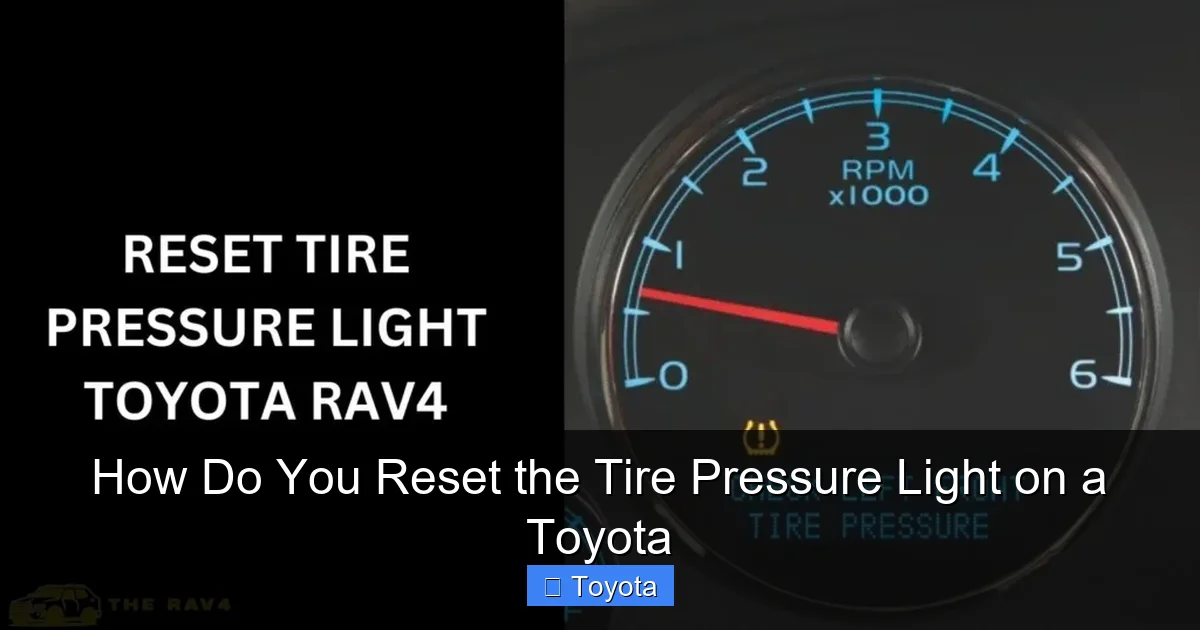
Visual guide about How Do You Reset the Tire Pressure Light on a Toyota
Image source: spcdn.shortpixel.ai
You’ll need a high-quality digital tire pressure gauge. Check pressures when the tires are cold (driven less than a mile). Adjust as needed. Once pressures are correct, the reset can begin. The two primary methods are using a physical TPMS reset button or navigating the vehicle settings menu on the dash display.
Method 1: The Physical Reset Button
Many Toyotas, especially from the 2000s through mid-2010s, have a small, black, recessed button, often located:
- Inside the glovebox (most common location)
- Under the dashboard, to the left of the steering column
- Near the fuse box cover
It may be labeled “TPMS” or have the tire pressure light icon on it. With the ignition turned to the “ON” position (engine off, dash lights on), press and hold this button. You’ll usually hear a beep, and the TPMS light on the dash will blink three times, indicating the reset has started. Release the button. The system will now begin relearning. You must then drive the vehicle as described below.
Method 2: The Multi-Information Display (MID) Menu
Newer Toyotas (roughly 2016 and later) have moved this function to the steering wheel controls and the MID screen. The steps are generally:
- Turn the ignition ON (engine off).
- Use the “Menu” or “Info” button on the steering wheel to scroll through the display options.
- Find the menu for “Vehicle Settings,” “TPMS,” or “Tire Pressure.”
- Select “Initialize TPMS,” “Set Pressure,” or a similarly worded option.
- Confirm the action. The display may show “TPMS Reset in Progress” or the light may blink.
Always consult your owner’s manual for the exact path, as menu structures differ between models (a Camry’s menu isn’t identical to a RAV4’s).
Model-Specific Reset Instructions for Popular Toyotas
Let’s get concrete. Here are the precise steps for some of Toyota’s most common models. Remember, always verify correct tire pressure first!
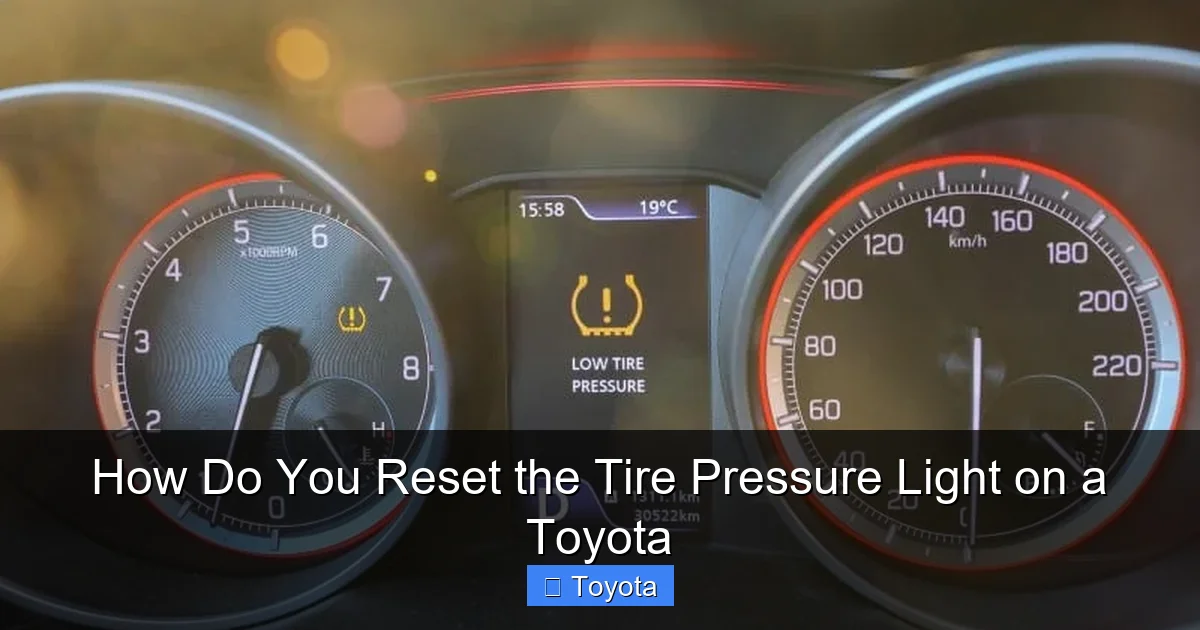
Visual guide about How Do You Reset the Tire Pressure Light on a Toyota
Image source: rxmechanic.com
Toyota Camry (2018-2024)
For recent Camry models, the reset is done via the steering wheel menu.
- Ensure all tires are inflated to the pressure on the driver’s door jamb sticker (typically 32-35 PSI).
- Turn the ignition ON. Do not start the engine.
- Press the “Menu” or “Info” button on the left steering wheel stalk repeatedly until you see “Vehicle Settings” on the multi-information display.
- Use the “Up/Down” arrow buttons (often on the same stalk) to scroll to “TPMS” and press the “Set” button.
- Scroll to “Initialize” or “Register” and press “Set.” A message should confirm the reset.
- The light will blink, then turn off after successful relearning during driving.
Toyota RAV4 (2019-2024)
The RAV4 uses a very similar menu-based system to the Camry.
- Inflate all tires to spec (often 33 PSI for newer models).
- With the car ON (engine off), use the steering wheel “Menu” button to find “Vehicle Settings.”
- Navigate to “TPMS” and select “Initialize.”
- Confirm. The display will show a progress message.
- Drive for 10-15 minutes at speeds above 25 mph to complete the relearn.
Note: If you’ve had a tire repaired or replaced, you may need a professional to perform a “sensor relearn” using a scan tool, as the system needs to know the new sensor’s ID code.
Toyota Corolla (2017-2024)
The Corolla’s process is nearly identical to the RAV4 and Camry for these years.
- Set correct pressures (check door jamb; often 32-33 PSI).
- Ignition ON, engine off.
- Steering wheel “Menu” button → “Vehicle Settings” → “TPMS” → “Initialize.”
- Select “Yes” or “Confirm.”
- Drive to complete.
For older Corollas (pre-2017), look for the physical reset button inside the glovebox.
Toyota Tacoma (2016-2023)
Tacoma owners have a few options. Many have the physical button in the glovebox. Others use the menu.
- With Glovebox Button: Turn ignition ON. Press and hold the TPMS button until the light blinks three times (about 3 seconds). Release. Drive.
- With Menu: On models with the MID, the process is Menu → Vehicle Settings → TPMS → Initialize.
The Tacoma’s other dashboard lights, like the maintenance required indicator, also have their own reset procedures, which are separate from the TPMS.
Toyota Highlander (2014-2023)
Process depends on the generation. 2014-2019 models typically have the glovebox button. 2020+ models use the steering wheel menu. The steps are as described above for each method. The recommended pressure is usually 33 PSI. A key thing to know about the Highlander is that its larger size and heavier weight mean correct tire pressure is extra important for handling and fuel economy, so never ignore this light.
Toyota Tundra (2014-2023)
Like the Highlander, earlier Tundras (2014-2019) often have the glovebox button. Newer Tundras (2022+) with the large touchscreen will have the reset buried in the vehicle settings menu accessible via the touchscreen or steering wheel controls. The pressure spec is typically 35 PSI. Given the Tundra’s towing and hauling capabilities, proper tire pressure is critical for safety and load-bearing capacity.
The Critical Drive Cycle: Why Your Reset Might “Fail”
You followed the steps perfectly. The light blinked, you released the button, and it went out. You feel great. Then, 20 minutes later, it’s back on. What gives? This is the most common point of confusion. The reset process doesn’t instantly turn the light off forever. It tells the system to start a “relearn” or “recalibration” process. During this process, the computer listens for signals from all four wheel sensors and learns their new positions and pressure values. This learning only happens while you’re driving.
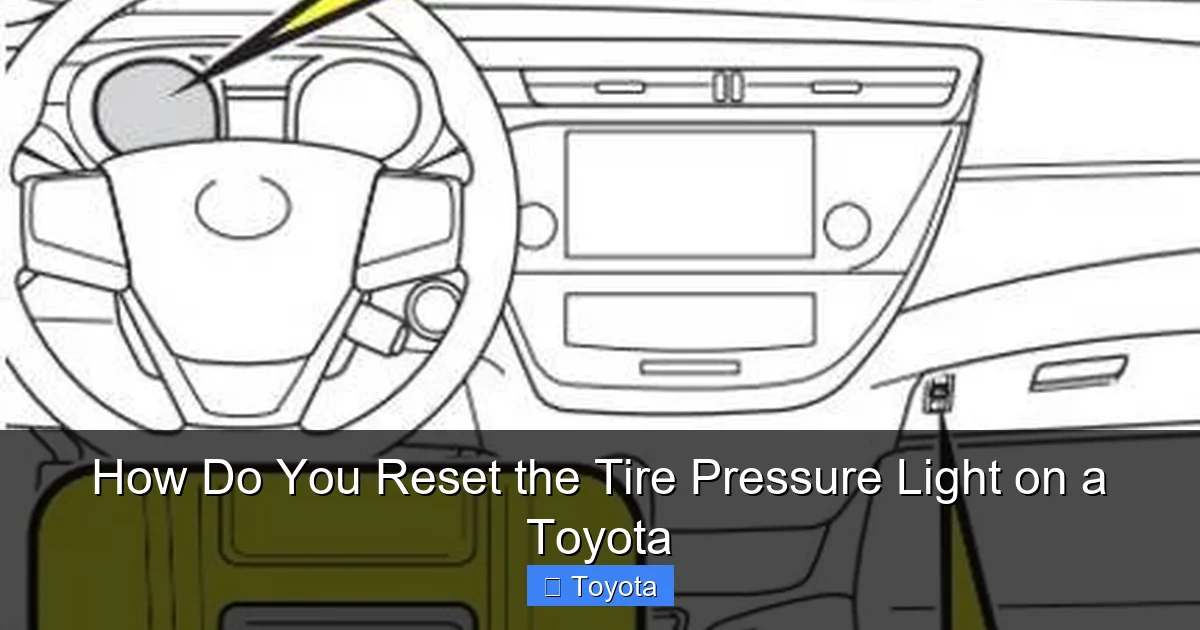
Visual guide about How Do You Reset the Tire Pressure Light on a Toyota
Image source: seventrumpet.com
Here is the standard drive cycle for almost all Toyotas:
- Drive at a steady speed of at least 25 mph (40 km/h).
- Maintain this speed for about 5-10 minutes.
- You may need to complete a few cycles of acceleration and deceleration.
- The light should go out and stay off after this driving period.
If the light comes back on during this drive cycle, it means a sensor is not being received, its pressure is wrong, or it has failed. If it comes back on after a day or two of driving, it means a problem (like a slow leak) has recurred. Other dashboard warning systems, like the airbag light, also often require a drive cycle after a reset, so this is a common theme in modern vehicles.
When Resetting Doesn’t Work: Troubleshooting and Professional Help
You’ve inflated the tires to the perfect PSI. You’ve performed the reset procedure correctly. You’ve driven for 15 minutes at highway speeds. The light is still on, or it came back on the next day. Now what?
Step 1: Re-check All Pressures
Use your own gauge. Check every single tire, including the spare if your vehicle has a full-size spare with a sensor. Compare to the door jamb sticker. Even being 1-2 PSI low can prevent a reset. Temperature changes can cause this discrepancy.
Step 2: Look for Obvious Damage
Inspect each tire for nails, screws, or sidewall cuts. Check the valve stems for cracks or leaks. Sometimes a simple puncture repair is all that’s needed before a reset will stick.
Step 3: Consider a Faulty Sensor
If pressures are perfect and there’s no visible damage, a failed TPMS sensor is the prime suspect. Sensors can fail due to dead batteries, corrosion at the valve stem, or physical impact. Diagnosing which sensor is bad requires a TPMS scan tool that reads the individual sensor IDs and battery levels. This is not something most DIYers have. This is the point to call a professional.
Step 4: The “Dead Battery” Scenario
If your car’s battery was recently disconnected or died, the TPMS module may need a more thorough reset that requires a scan tool to “relearn” all sensor IDs to the vehicle’s computer. A tire shop or dealership can do this quickly.
For any of these issues, a reputable tire center or your Toyota dealership is the place to go. They have the diagnostic tools. Replacing a sensor can cost $50-$150 per wheel for the part and labor, but it’s a necessary repair for safety and to permanently extinguish that light. A persistent battery light is another dashboard warning that often requires professional diagnosis, similar to a stubborn TPMS light.
Proactive Maintenance: Keeping the Light Off for Good
The goal is to never see that light, except for a brief moment when you intentionally reset it. Here’s how to be proactive.
Check Pressures Monthly and Before Long Trips
Don’t wait for the light. Get in the habit of checking all tires with a good gauge once a month. Do it when the tires are cold. This catches slow leaks early and ensures optimal performance, safety, and fuel economy. The correct pressure is on your door jamb sticker, not the tire sidewall.
Understand Seasonal Changes
In the fall, as temperatures drop, proactively add 1-2 PSI to your tires to compensate for the natural pressure loss. You’ll likely prevent the light from ever coming on in the winter.
Be Careful at the Tire Shop
When you get tires rotated, balanced, or repaired, remind the technician that your car has TPMS. They need to be careful not to damage the sensor on the valve stem. After a rotation, the system may need a reset (as described earlier). Some shops include this in their service; others may charge a small fee. It’s worth asking.
Replace Sensors at the End of Their Life
TPMS sensors are not lifetime parts. If you’re told your sensor battery is dead during a routine service, plan to replace it. It’s cheaper to do it when you’re already having other tire work done, as the tire will need to be dismounted to access the sensor.
Use the Correct Sealant
If you use a tire sealant (like “fix-a-flat”) to temporarily seal a puncture, be aware that the goo can coat and damage the TPMS sensor. It’s a temporary fix for an emergency only. You must get the tire properly repaired and the sensor cleaned or replaced as soon as possible.
Conclusion
Resetting the tire pressure light on your Toyota is a simple yet vital part of vehicle ownership. The core principle is universal: fix the problem first, then reset the system. Whether you’re hunting for a physical button inside the glovebox or navigating the digital menus on your steering wheel, the steps are designed to be user-friendly. Always remember the all-important drive cycle afterward—that’s where the magic of relearning happens.
While the process is a great DIY skill, know your limits. A light that won’t stay off after a correct reset and drive cycle is your car’s way of saying, “I need a professional.” Don’t ignore it. Proper tire pressure is non-negotiable for safety, handling, and efficiency. By understanding your Toyota’s TPMS, performing regular checks, and knowing how to reset it correctly, you keep yourself safe on the road and your vehicle running in top condition. Now, go check those pressures!
Frequently Asked Questions
Can I reset the tire pressure light without inflating the tires?
No. The reset procedure will only be accepted by the vehicle’s computer if all monitored tires are at the manufacturer’s specified pressure. Resetting with low pressure is ineffective and unsafe.
How long do I need to drive after resetting the TPMS?
You typically need to drive at a steady speed above 25 mph for 5-10 minutes. This allows the system to receive signals from all sensors and complete its relearning process. The light should go out during or shortly after this drive cycle.
Will disconnecting my car battery reset the tire pressure light?
Disconnecting the battery can sometimes cause the TPMS light to illuminate due to a voltage drop, but it does not perform a proper TPMS reset. You will still need to follow the specific reset procedure (button or menu) after reconnecting and ensuring correct tire pressures.
My tire pressure light is blinking. Is that different from a solid light?
Yes. A solid light usually indicates a low pressure in one or more tires. A blinking light (often for 60-90 seconds after startup) typically indicates a system malfunction, such as a dead sensor battery or a communication failure with one of the sensors. This usually requires professional diagnosis.
Do I need to reset the TPMS after rotating my tires?
On most modern Toyotas, yes. Rotating tires changes the physical location of each sensor. The TPMS needs to learn which sensor is now at which wheel position. The reset procedure (via button or menu) tells the system to start this relearning process. This is especially common on larger vehicles like the Sienna, where tire rotation is a regular maintenance item.
Can a faulty spare tire trigger the TPMS light?
Only if your specific Toyota model is equipped with a TPMS sensor in the spare tire. Many full-size spares have sensors, but many temporary “donut” spares do not. Check your owner’s manual. If your spare has a sensor, it must be inflated to the correct pressure as well.