
What Is the Bmw Dynamic Handling Package?

The BMW Dynamic Handling Package (DHP) is an optional factory upgrade designed to significantly enhance a BMW’s agility, steering precision, and overall driving dynamics. It typically bundles technologies like variable steering ratio, rear-wheel steering, and sport-tuned suspension components. For driving enthusiasts who crave a more connected and responsive feel, especially on winding roads, DHP can be a game-changer. However, it adds a notable cost and may be overkill for drivers who primarily use their BMW for comfortable daily commuting.
You slide behind the wheel of your BMW. The engine hums, the seats hug you just right, and you pull onto your favorite back road. The car feels solid, planted, and precise. But what if it could feel even more alive? What if it could turn tighter at low speeds, feel more stable when you’re carving a fast curve, and communicate every nuance of the road surface through the steering wheel? That, in a nutshell, is the promise of the BMW Dynamic Handling Package. It’s one of those magical options that transforms a great driving machine into an even more special one. But what exactly is it? How does it work? And most importantly, is it worth it for you? Let’s dive deep into the world of BMW’s handling-enhancing technology.
First, a crucial point: the “Dynamic Handling Package” isn’t a single, monolithic part you can bolt on. It’s a carefully coordinated system of technologies that work together under the command of BMW’s central driving dynamics controller. Think of it as the conductor of an orchestra, making sure the steering, suspension, and differential all play in perfect harmony. The goal is simple yet profound: to make the car feel lighter, more agile, and more confidence-inspiring in every driving situation, from a tight city parking spot to a high-speed autobahn merge. It represents BMW’s core philosophy of providing “Sheer Driving Pleasure” by pushing the boundaries of what a production car can do.
Key Takeaways
- Definition: The BMW Dynamic Handling Package is a factory-installed option that improves steering response, cornering stability, and low-speed maneuverability through integrated hardware and software.
- Core Technologies: Its heart is usually Integral Active Steering (variable ratio and rear-wheel steering), often paired with sport-tuned adaptive dampers and specific software calibrations.
- Model Availability: DHP is not universal; it’s offered on select sedans, wagons, and SUVs (like the 3 Series, 5 Series, X3, X5) and availability changes with model years and regional markets.
- Driving Impact: The benefits are most noticeable at low speeds (easier parking, tighter turns) and high speeds (improved stability in lane changes and sweeping corners).
- Cost vs. Value: It commands a several-thousand-dollar premium. Its value is highest for drivers who frequently encounter twisty roads or track their cars; casual drivers may not perceive enough benefit.
- Not a Standalone “M” Package: DHP is distinct from full M Performance or M models, though it can overlap with some M Sport features. It’s a specific handling-focused upgrade.
- Warranty Coverage: When purchased new and installed by the dealer, the Dynamic Handling Package is fully covered under BMW’s new vehicle warranty.
📑 Table of Contents
What Exactly is the BMW Dynamic Handling Package?
At its core, the BMW Dynamic Handling Package (often abbreviated DHP) is an optional equipment bundle focused on optimizing the vehicle’s steering and suspension characteristics. It’s important to understand that BMW doesn’t sell “handling” as a single checkbox. Instead, they package specific, advanced hardware components and the necessary software calibrations into a named option for simplicity on the order sheet. This package is most commonly found on the brand’s rear-wheel-drive-based models, including the 3 Series, 4 Series, 5 Series, 6 Series Gran Turismo, and SUVs like the X3, X4, X5, and X6.
The Philosophy: More Than Just Parts
BMW’s engineering ethos has always centered on a perfect balance between comfort and sportiness. The Dynamic Handling Package tips that balance more firmly toward the sporty end of the spectrum, but without completely sacrificing comfort. It’s about adding a layer of intelligence and adaptability. A standard BMW already handles well. DHP makes it anticipate and react. For example, at a crawl, the system knows you’re likely maneuvering and adjusts the steering to be light and responsive. At 80 mph on the highway, it firms up the steering and suspension for rock-solid stability. This seamless transition is where the magic lies.
How It Differs from a Standard BMW
A BMW without DHP still has a sophisticated chassis. However, its steering ratio is fixed, and the rear wheels don’t turn. The suspension, while often adaptive, is tuned for a broader range of conditions. With DHP, you’re introducing two major game-changers: a variable steering ratio and rear-wheel steering. These two features fundamentally alter how the car responds to your inputs. It’s the difference between a skilled pianist playing a standard upright and a master playing a concert grand with a wider dynamic range and more nuanced expression.
Inside the Package: Key Technologies and Components
So, what’s actually in this package? The exact composition can vary by model year and region, but the pillars are consistently the same. Let’s break down the key players.
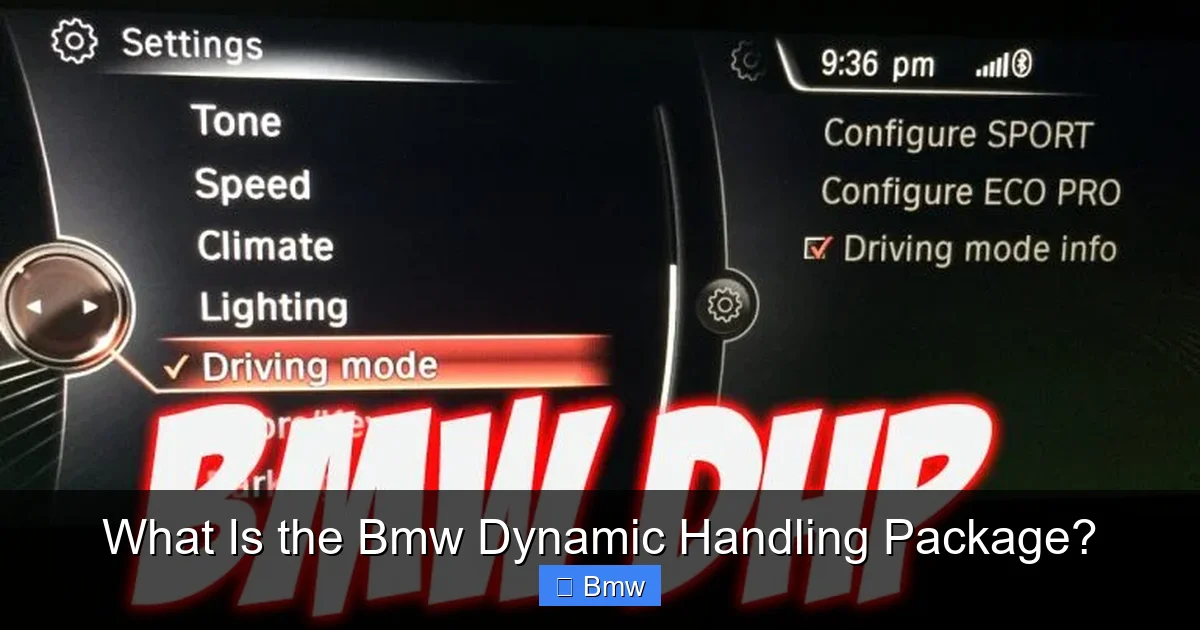
Visual guide about What Is the Bmw Dynamic Handling Package?
Image source: automotorblog.com
1. Integral Active Steering (IAS)
This is the star of the show and the technology most directly associated with the “Dynamic Handling” moniker. IAS is a dual-function system:
- Variable Steering Ratio: An electric motor on the steering column adjusts the ratio between steering wheel turn and wheel turn. At low speeds (like parking), it makes the steering feel quicker and lighter—you need fewer turns lock-to-lock. At high speeds, it slows the ratio down, making the steering more precise and stable, so small corrections don’t send you swerving.
- Rear-Wheel Steering: This is the wow factor. Electric motors on the rear axle can turn the rear wheels a few degrees in the opposite direction of the fronts at low speeds (up to ~50 mph), drastically reducing the turning circle and making the car feel like it’s pivoting on a dime. At higher speeds, the rear wheels turn ever so slightly in the same direction as the fronts, acting like a stabilizing tail fin to improve high-speed lane change stability and cornering predictability.
This combination means your BMW can navigate a tight city street with the ease of a small hatchback and then settle down for a serene, stable cross-country drive.
2. Sport-Tuned Suspension & Adaptive Dampers
DHP almost always includes a more aggressively tuned suspension. This isn’t just about making the ride harsh. It involves stiffer springs, revised bushings, and specifically calibrated adaptive dampers (like the Dynamic Damper Control or M Adaptive suspension). These dampers can adjust their firmness hundreds of times per second. In conjunction with the steering system, they help keep the car flatter in corners and more composed over imperfect surfaces. The software maps for comfort, sport, and sport+ modes are retuned to complement the enhanced steering.
3. Enhanced Software Calibrations & Integration
The hardware is useless without the brain. BMW’s driving dynamics控制系统 (DSC, Dynamic Stability Control) and other systems receive new software algorithms that account for the rear-wheel steering and variable ratio. This ensures that when you push the car hard, the ESC and traction control interventions are smoother and less intrusive, working with the chassis rather than fighting it. The integration is seamless—you, as the driver, shouldn’t feel the individual systems working; you should just feel the car is more capable and predictable.
What’s Usually NOT Included (But People Confuse)
It’s vital to distinguish DHP from other packages:
- M Sport Package: This is primarily aesthetic (body kit, wheels, interior trim) and may include some sportier suspension tuning, but it does NOT include rear-wheel steering or variable ratio steering. You can have an M Sport BMW without DHP.
- M Performance Parts: These are individual aftermarket-style components (like brakes, carbon fiber parts) you can add. They are not the integrated factory DHP system.
- M Differential (M Sport Differential):strong> This is an electronically controlled limited-slip differential that manages power between the rear wheels. It is sometimes bundled with DHP on certain models (like the M340i) but is often a separate option. DHP focuses on steering and suspension; the differential focuses on power delivery.
Which BMW Models Can You Get It On?
Availability is a moving target. BMW decides which models get DHP based on their intended market positioning and engineering feasibility. Generally, it’s reserved for models where sportier handling is a key selling point.

Visual guide about What Is the Bmw Dynamic Handling Package?
Image source: automotorblog.com
Current & Recent Model Lineup (Examples)
As of recent model years, you’ve typically found DHP (or its current nomenclature, which might be bundled under “Dynamic Handling” or specific option codes) on:
- 3 Series / 4 Series (G20/G21/G22/G23): Especially on non-M models like the 330i, M340i, and 430i. It’s a popular upgrade.
- 5 Series / 6 Series Gran Turismo (G30/G31/G32): Available on 530i, 540i, and 6 Series GT models.
- X3 / X4 (G01/G02): A great fit for the SUVs, countering their taller stance with superior agility.
- X5 / X6 (G05/G06): Makes these large SUVs feel surprisingly nimble.
- 7 Series (G11/G12): Often available on the 740i and 750i, transforming the luxury sedan into a supremely capable grand tourer.
Important: It is rarely, if ever, offered on the base-model turbocharged 4-cylinder engines (like the 320i, 420i, 520i in some markets) or on the smallest engine variants. It’s also not available on the full-blown M models (M3, M5, X5 M), as those have their own, more extreme bespoke chassis systems. Always check the specific model year’s brochure or configurator.
The “Bundle” Reality
BMW often packages DHP with other desirable options like the M Sport Package or the Driver Assistance Professional Package. You might not be able to select it as a standalone checkbox. This can increase the overall cost but also means you’re getting a more comprehensively upgraded vehicle. When buying new, your dealer’s inventory guide or the online configurator will show you exactly which packages contain the Dynamic Handling components. Look for terms like “Integral Active Steering,” “Rear Axle Steering,” or “Dynamic Handling Package” in the option descriptions.
The Tangible Benefits: How DHP Transforms Your Drive
All this tech talk is meaningless if it doesn’t create a better driving experience. So, what do you actually *feel*?
Visual guide about What Is the Bmw Dynamic Handling Package?
Image source: automotorblog.com
At Low Speeds: Maneuverability and Ease
This is the most immediately noticeable benefit. The rear-wheel steering, turning the rear wheels opposite the fronts, shrinks the car’s effective turning circle dramatically. Parallel parking becomes a one-motion ballet instead of a multi-step shuffle. U-turns on narrow streets become effortless. The variable steering ratio means you don’t have to saw the wheel back and forth in tight spots; a small input yields a big result. It makes a midsize sedan or SUV feel as manageable as a compact car in the city. For anyone who regularly navigates tight urban environments, this benefit alone can justify the cost in terms of reduced stress and time.
At High Speeds: Stability and Confidence
Once you’re on the highway or a fast country road, the system’s other mode activates. The rear wheels now turn ever so slightly in the same direction as the fronts. This might sound counterintuitive, but it’s like a surfer using the tail of the board to stabilize at high speed. During sudden lane changes, the car dives into the new lane more decisively and with less body roll. In fast, sweeping corners, it feels more planted and predictable, inspiring greater confidence. The variable steering ratio slows down, so a small, precise input on the wheel translates to a tiny, controlled adjustment of the car’s path—perfect for high-speed stability. You’ll feel the car is ” glued” to the road.
On Winding Roads: The Real Difference
This is where DHP shines brightest. On a twisty mountain road or a favorite back-country route, the integration of all systems is palpable. The car feels more agile and eager to turn in. There’s less of that initial “push” or understeer you might feel in a standard setup. The rear wheels help rotate the car, making it feel more neutral and balanced. You can carry more speed through corners because the car is so stable and predictable. The steering provides better feedback and weights up nicely as you load the tires. It transforms the driving experience from simply navigating a road to dancing with it. The connection between driver intent and car action becomes more direct and visceral.
Beyond Sport: Comfort and Efficiency
Interestingly, DHP can also improve ride comfort in certain situations. The rear-wheel steering can help absorb the impact of potholes and railroad tracks by allowing the rear wheels to react independently, reducing the jolt transmitted to the cabin. The system’s intelligence also means the car tracks straight more easily on imperfect highways, reducing driver fatigue on long trips. It’s a holistic upgrade that benefits multiple facets of the drive, not just the track-focused ones.
Is the Dynamic Handling Package Worth the Investment?
This is the million-dollar question. The answer is deeply personal and depends entirely on your priorities, driving style, and budget.
Who Will Appreciate DHP the Most?
- The Enthusiast: If you read car reviews for fun, seek out scenic routes, and enjoy the tactile feedback of a great steering wheel, DHP will likely bring a smile to your face every time you drive.
- The Track Day Participant: While not a full roll cage, DHP’s improvements to turn-in, stability, and control are directly beneficial on a racetrack, shaving tenths off your lap time and building confidence.
- The Owner of a Larger BMW (X5, 6 Series GT): For these bigger, heavier vehicles, DHP does the most dramatic work in making them feel smaller, lighter, and more agile. The transformation is more pronounced than in a already-nimble 3 Series.
- The Driver Who Values Precision: If you value a car that feels like an extension of your hands and feet, the enhanced steering communication and predictability are invaluable.
When You Might Skip It
- The Comfort-First Commuter: If your BMW is primarily a luxurious, comfortable appliance for getting from A to B in traffic, the benefits of DHP will be largely lost on you. The standard ride is already excellent.
- The Budget-Conscious Buyer: The cost is significant, often $2,000 – $4,000+ when bundled. That money might be better spent on premium audio, advanced driver aids, or saved for your next down payment.
- The Resale Value Optimizer: While DHP is a desirable option, it doesn’t add its full cost to the car’s resale value. In some markets, it’s a “nice-to-have” but not a deal-maker for the average used buyer. However, for a knowledgeable enthusiast buyer, it certainly helps.
The Used Car Angle
Here’s a pro tip: buying a used BMW with the Dynamic Handling Package already installed can be fantastic value. The original owner absorbed the steepest part of the depreciation for that option. You get the enhanced driving experience for a much smaller incremental cost over a similar car without it. Always verify the option is genuinely present by checking the window sticker (if available) or having a dealer run the VIN to see the build sheet. This is a smart way to get more car for your money.
A Note on “Feel” vs. Specs
Finally, you must test drive. No article can describe the feeling. Find two identical BMWs on a dealer lot—one with DHP, one without. Drive them back-to-back on the same stretch of road. Pay attention to steering weight at low speed, the effort needed to turn, how the car settles after a corner, and the overall sense of connection. Your personal reaction to that difference will give you the only answer that matters.
Frequently Asked Questions
What exactly is included in the BMW Dynamic Handling Package?
The core components are Integral Active Steering (which provides both variable steering ratio and rear-wheel steering) and specifically tuned adaptive dampers. It also includes the necessary software calibrations to integrate these systems with the car’s driving dynamics controllers. The exact bundle can vary, so always check the specific window sticker or build sheet for your model year.
Which BMW models currently offer the Dynamic Handling Package?
It’s typically available on rear-wheel-drive-based models in the 3 Series, 4 Series, 5 Series, 6 Series Gran Turismo, X3, X4, X5, and X6 lineups. It’s generally not offered on base 4-cylinder models or the full M vehicles. Availability changes frequently, so consult your local BMW dealer or the current year’s official configurator for the most accurate information.
How much does the Dynamic Handling Package cost?
The cost varies widely by model and market. When available as a standalone option, it often ranges from $2,000 to $4,000 USD. However, it’s frequently bundled into larger option packages (like an M Sport or Dynamic Handling package), which can increase the total cost. Always get the exact price from a dealer’s inventory listing for the specific vehicle you’re interested in.
Can I add the Dynamic Handling Package to a used BMW?
For all practical purposes, no. The Dynamic Handling Package requires specific hardware (steering rack, rear steering actuators, wiring harnesses) and software that must be installed at the factory. It cannot be retrofitted after the car has been built. Your only option is to purchase a used BMW that was factory-equipped with the package from the previous owner.
Is the Dynamic Handling Package the same as M Sport?
No. The M Sport Package is largely cosmetic (aerodynamic body kit, M Sport steering wheel, specific wheels, interior trim) and may include a slightly stiffer suspension. It does not include rear-wheel steering or variable steering ratio. You can have a BMW with M Sport trim but without the Dynamic Handling Package. Conversely, in rare cases, a non-M Sport BMW could have DHP. They are separate options, though they are often bundled together.
Does the Dynamic Handling Package affect fuel economy?
Any impact is negligible and likely within the margin of error for EPA ratings. The added electrical load from the steering motors and slightly heavier components might reduce fuel economy by a tiny fraction of a percent, but you will never notice it in real-world driving. The package’s primary trade-off is cost and, for some, a marginally firmer ride in its most aggressive setting, not fuel consumption.
Frequently Asked Questions
What is What Is the BMW Dynamic Handling Package??
What Is the BMW Dynamic Handling Package? is an important topic with many practical applications.
