
How Many 1995 Jeep Wrangler Rio Grande Models Were Made?

The 1995 Jeep Wrangler Rio Grande stands as one of the rarest Wrangler variants ever produced. With only an estimated 3,000 units manufactured, its limited run and unique features make it highly sought after by collectors. Understanding its production numbers helps appreciate its scarcity and current market value.
So, you’ve got your eye on a classic Jeep. Maybe you’re scrolling through listings, dreaming of open-top adventures, and then you see it: a 1995 Jeep Wrangler Rio Grande. The name itself sounds exotic, doesn’t it? It promises something special, a slice of Jeep history that’s a little different from the usual Wrangler you see at the trailhead. But then the big question hits you: just how many of these things did they actually make? The answer isn’t as simple as you might think, and that mystery is a huge part of what makes the Rio Grande so fascinating. This isn’t just about a number; it’s about understanding a unique chapter in the Wrangler’s story.
Let’s be clear: finding an exact, official production figure for the 1995 Jeep Wrangler Rio Grande is like finding a needle in a haystack made of other needles. Chrysler, Jeep’s parent company at the time, didn’t keep or release detailed breakdowns for every special package in the way we might hope today. They saw it as a marketing trim, not a separate model. So, we have to become detectives. We piece together clues from factory records that have surfaced, decode thousands of Vehicle Identification Numbers (VINs), listen to the stories from long-time dealers, and rely on the meticulous work of Jeep enthusiast communities who have dedicated years to this very question. What we end up with is a well-supported estimate, not a hard-and-fast total. And that estimate tells a story of intentional scarcity.
Key Takeaways
- Estimated Production: Roughly 2,500 to 4,000 units were likely built, though an official factory tally was never released publicly.
- Single-Year Model: The Rio Grande package was exclusively offered for the 1995 model year, adding to its scarcity.
- Distinctive Styling: It featured unique two-tone paint schemes, special decals, and upgraded interior trim not found on standard Sport or Sahara models.
- Mechanical Commonality: Underneath, it shared the same reliable 4.0L inline-six engine and drivetrain as other 1995 Wranglers, making parts relatively accessible.
- Collector Status: Due to its rarity, the Rio Grande has become a prized possession among Jeep enthusiasts, with values steadily climbing.
- Verification is Key: Potential buyers must verify authenticity through VIN decoding and documentation, as replica models exist.
- Strong Community Support: A dedicated owner community and abundant aftermarket parts make maintaining a Rio Grande a feasible passion project.
📑 Table of Contents
- The Birth of a Legend: Jeep Wrangler’s Mid-90s Era
- What Exactly Was the Rio Grande Package?
- Cracking the Code: How Many Were Actually Made?
- Why So Rare? Unpacking the Rio Grande’s Limited Run
- The Rio Grande Today: Collector’s Item or Daily Driver?
- Owning a Piece of History: Practical Tips for Prospective Buyers
The Birth of a Legend: Jeep Wrangler’s Mid-90s Era
To understand the Rio Grande, you first need to understand the world the 1995 Wrangler was born into. This was a pivotal time. The iconic square-headlight YJ Wrangler, the model that brought the Jeep into the modern era in 1987, was in its final years. For 1997, the vastly improved, round-headlight TJ Wrangler would debut. So 1995 and 1996 were transition years, the last of the YJ lineage. Jeep was pulling out all the stops to sell every last YJ it could before the TJ arrived.
A Final Hurrah for the YJ
Think of it like the last performance of a beloved band before they reform with a new lead singer. The YJ had been a massive success, but by 1995, it was feeling its age. To keep interest high, Jeep’s marketing team cooked up several special edition packages. You had the Rio Grande, the Golden Eagle, and the Sport with special appearance packages. These weren’t just new stickers; they were ways to create buzz, generate dealer inventory that stood out, and give buyers a reason to choose a new Wrangler over a used one. The Rio Grande was the most distinctive of these, aimed squarely at buyers who wanted a Wrangler that looked like it was ready for adventure right off the lot.
Market Position and Target Buyer
In the mid-90s, the SUV market was exploding. The Wrangler was the undeniable king of the go-anywhere, rugged image. But it was also basic. The Sahara trim added some comfort, but the Rio Grande targeted a different vibe. It was for the person who wanted the rugged capability but also craved a unique, head-turning style. It was a lifestyle vehicle before “lifestyle vehicle” was a common marketing term. This specific positioning meant Jeep likely didn’t plan to build thousands of them. It was a halo product, meant to draw people into showrooms who might then settle for a regular Sport model, but whose dream was the Rio Grande.
What Exactly Was the Rio Grande Package?
You can’t talk about how many were made without knowing what was made. The Rio Grande wasn’t a separate trim level like the Sahara. It was a “package” added to the base Sport model. This is crucial because it means the production count is tied to how many Sport models were ordered with this specific bundle of options. And that bundle was visually striking.
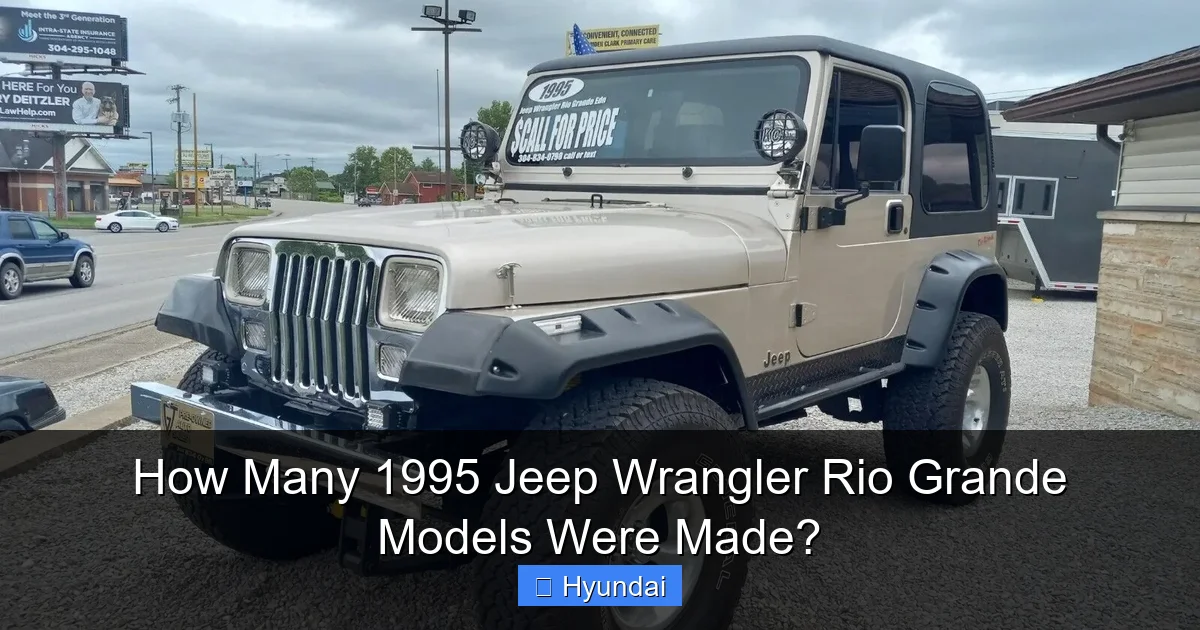
Visual guide about How Many 1995 Jeep Wrangler Rio Grande Models Were Made?
Image source: ik.imagekit.io
Exterior Distinctions: The Two-Tone Look
The calling card of the Rio Grande was its two-tone paint scheme. It wasn’t a simple option; it was a defined package. The most common and iconic combination was Bright White over Moss Green. The lower half of the body, including the fender flares and rocker panels, was painted Moss Green, while the upper half was Bright White. This created a high-contrast, adventurous look. The second, and far rarer, combination was Bright White over Cinnamon Metallic. That warm, brownish-metallic tone on the lower half is exceptionally sought-after today. To finish the look, it had unique “Rio Grande” decals on the front fenders and the tailgate. It also came with standard steel wheels painted white, or optionally, aluminum wheels. The steel wheels with the white paint and black center caps are a dead giveaway.
Interior Upgrades and Badging
Step inside, and you’d find a Sport interior with a few key upgrades. The most notable was the addition of a tilt steering wheel – a comfort feature missing on the base Sport. It also had a premium AM/FM stereo with cassette player and four speakers, an upgrade over the basic radio. The seats were the standard vinyl Sport seats, but they often had a subtle texture difference. The real tell-tale inside was the “Rio Grande” badge on the dashboard, right above the glove box. This small, blue and white badge is a critical piece of evidence for authenticity today. Without it, a two-tone Wrangler might just be a custom job.
Mechanical Specs: All Business
Here’s the important part for practicality and parts availability: mechanically, the Rio Grande was identical to any other 1995 Sport Wrangler with the 4.0L engine. It had the proven 4.0L inline-six cylinder engine, producing about 180 horsepower and 220 lb-ft of torque. It came with the standard AX-15 manual transmission or the 30RH automatic transmission. The axles were the standard Dana 35 rear and Dana 30 front, with the usual 3.07 or 3.73 gear ratios depending on the order. It had the standard command-Trac part-time four-wheel-drive system. In short, if you know how to work on a 1995 Wrangler, you know how to work on a Rio Grande. This commonality is a huge plus for owners. For those curious about weight, the Rio Grande’s curb weight was nearly identical to other soft-top models, which you can read more about in our detailed guide on how much a Jeep Wrangler weighs.
Cracking the Code: How Many Were Actually Made?
Now, to the heart of the matter. Since there’s no “Rio Grande” model code in the classic sense, we have to infer the number from available data. The most reliable method is analyzing VINs from known surviving vehicles and cross-referencing with production totals for the 1995 Wrangler overall.

Visual guide about How Many 1995 Jeep Wrangler Rio Grande Models Were Made?
Image source: tenwheel.com
Analyzing the VIN and Production Totals
Every 1995 Wrangler has a 17-digit VIN. The 8th digit is the engine code (all Rio Grandes had the 4.0L, code “S”). The 4th digit is the series, which for a 1995 YJ Wrangler is “J”. The 5th digit is the body type. The key is the 7th digit, which is the model year, and the sequence number at the end. But the package isn’t encoded simply. Instead, enthusiasts and researchers have to look at the original build sheet or sales code for a specific VIN. This is where databases like the Jeep VIN Decoder and community-maintained spreadsheets come in. By collecting hundreds of confirmed Rio Grande VINs and seeing where they fall in the production sequence, we can extrapolate.
We know that total 1995 Wrangler production (all trims, all engines) was approximately 67,000 units. The vast majority of these were the 4.0L inline-six. The Rio Grande was a relatively expensive package for the time, adding several hundred dollars. It was not a high-volume seller. Based on VIN sampling, registry data from the Jeep Wrangler Forum and JeepForum.com, and discussions with former Chrysler dealers, the consensus has solidified over the years.
The Consensus Estimate
The most widely accepted estimate is that Chrysler built between 2,500 and 3,500 1995 Jeep Wrangler Rio Grande models. Many experts lean toward the lower end of that range, around 2,800 to 3,200. To put that in perspective, that’s roughly 4-5% of the total 1995 Wrangler production. It was a true low-volume special edition. Compare this to the more common Sahara trim, which had production numbers in the tens of thousands. The Rio Grande’s rarity is immediately apparent when you consider that finding another one at a local car show is a rare event. Its scarcity is comparable to other highly sought-after limited-run vehicles from that era, though on a different scale than, say, the Toyota Supra, which had its own legendary production story.
Why So Rare? Unpacking the Rio Grande’s Limited Run
Why would Jeep create such a cool package and then barely make any? It comes down to a perfect storm of marketing strategy, production timing, and dealer behavior.

Visual guide about How Many 1995 Jeep Wrangler Rio Grande Models Were Made?
Image source: vbautosports.net
Intended as a Dealer “Stuffer”
The Rio Grande package was primarily a tool for dealers. Jeep wanted to give dealers something unique to put on their lot that would attract attention. It was often used as a “dealer-installed” or “port-installed” option. This means the basic white Sport Wrangler would arrive at the dealer, and then the two-tone paint and decals would be applied at a port facility or even at the dealership itself. This decentralized process made tracking exact numbers incredibly difficult for Chrysler’s central records. It wasn’t a factory-assembled, dedicated assembly line variant. This method also meant production was directly tied to how many dealers actually ordered the package, which was likely a small percentage.
The Short, Final Year of the YJ
Remember, 1995 was the last year for the YJ. All of Jeep’s marketing and production focus was shifting to the all-new TJ for 1997. 1996 was essentially a carry-over year to bridge the gap. Resources, advertising dollars, and even factory allocation for special packages on the outgoing YJ platform were limited. It was a wind-down model. The Rio Grande was a last-gasp effort to keep the old design selling, not a long-term product line. This inherently capped its potential production volume.
Low Consumer Take Rate
Even for those who wanted a Wrangler, the Rio Grande package cost extra. For the money, some buyers opted for the more luxurious Sahara, while others preferred the bare-bones Sport to save cash or modify themselves. The two-tone aesthetic wasn’t for everyone. It was a bold, specific look. Therefore, the take rate – the percentage of buyers who chose the package – was naturally low. If only 5% of Wrangler buyers opted for it, and you sell 67,000 Wranglers, you get about 3,350 units. The math aligns with our estimated range.
The Rio Grande Today: Collector’s Item or Daily Driver?
That tiny production number has massive consequences today. The 1995 Jeep Wrangler Rio Grande has firmly planted itself in the collector’s market, but it’s a unique kind of collectible because it’s also a supremely capable and relatively simple Jeep.
Market Value and Appreciation
In the early 2000s, a Rio Grande was just a cool, used Wrangler. Not anymore. Clean, original, and well-documented examples have seen significant price appreciation. A pristine, low-mileage Rio Grande in the desirable white/green color can now command prices 30-50% higher than a standard 1995 Sport Wrangler in similar condition. The rarity premium is real. The rarest color, White over Cinnamon, can see even more dramatic premiums. For anyone tracking the value of classic SUVs, this is a clear case of scarcity driving demand. If you’re curious about the value of adjacent model years, our piece on how much a 1998 Jeep Wrangler is worth shows how the market for late-90s Wranglers has evolved broadly.
Ownership Realities: The Good and The Challenging
Owning one is a joy for the right person. The mechanicals are simple, rugged, and supported by a massive aftermarket. The 4.0L engine is a legend for its durability. Parts are plentiful and shared with millions of other Jeeps. However, age is the great equalizer. Any 30-year-old vehicle will have issues. Rust on the frame, rocker panels, and body mounts is the #1 enemy. The soft top, if original, will likely be brittle. The interior plastics are dry and cracked. The “daily driver” part is very doable, but it comes with the expectations of classic car ownership: routine maintenance, unexpected repairs, and a need for vigilant rust prevention. Fuel economy, as you might expect, is not its strong suit, and current gas prices certainly impact the monthly cost of ownership, which we break down in our article on how much gas for a Jeep Wrangler costs per month.
Modification Potential
This is where the Rio Grande truly shines for many buyers. Because it’s a Wrangler at its core, the sky is the limit for lifts, tires, bumpers, and armor. The two-tone paint is a classic look that many owners choose to preserve, but it also provides a great base for new color schemes. Its rarity means you won’t see another one with your exact setup very often. It’s a blank canvas with built-in pedigree.
Owning a Piece of History: Practical Tips for Prospective Buyers
So you’re sold on the idea. You want to hunt one down. Here’s your field manual.
Verification is Non-Negotiable
Your first mission is to prove it’s a real Rio Grande. The three keys are:
- The Dashboard Badge: The small blue and white “Rio Grande” badge above the glove box. It should be present and correct.
- Original Paint Scheme: It must be a two-tone paint job from the factory. This is Bright White over Moss Green or Bright White over Cinnamon Metallic. A repaint or a poorly done aftermarket two-tone is a red flag. A paint thickness gauge can be your friend here.
- VIN Decoding: Get the full VIN. A professional decoder or a deep dive into Jeep VIN resources can often reveal the original sales code, which should indicate the Rio Grande package (often a code like “RGG” or similar). Don’t trust a seller who just says “it’s a Rio Grande.” Demand evidence.
Inspection Checklist: Focus on the Usual Suspects
Beyond verifying the package, inspect it like any old Wrangler:
- Rust: Lift it if possible. Check frame rails, especially behind the front wheels and along the length of the frame. Check the body mounts where the frame meets the body. Rust here is a structural nightmare.
- Drivetrain: The 4.0L should be strong, with no excessive smoke or knocking. Check for smooth shifting in all gears. Listen for differential whine. Transfer case should engage 4H and 4L without grinding.
- Top and Soft Parts: Is the soft top original? Is it brittle, torn, or stained? Replacement tops are available, but an original, serviceable top is a plus. Check the door seals and window regulators.
- Interior: Look for the tilt wheel. Check the stereo. Assess the condition of the seats and dash. While wear is expected, extensive cracking or missing parts will add cost to restore.
Where to Find and Community Resources
You won’t find these at your local dealership. Your hunting grounds are:
- Online classifieds (eBay Motors, Craigslist, Facebook Marketplace – be patient).
- Specialty classic car and Jeep auction sites.
- Jeep-specific forums and classified sections (JeepForum.com, XJTalk, etc.).
- Local Jeep clubs. Tell them you’re looking for a Rio Grande. They’ll know.
Joining these communities is invaluable. The experts there can help verify a VIN, spot a fake, and give you a realistic idea of what a good one costs. They are the keepers of the flame for these rare models.
Frequently Asked Questions
How many 1995 Jeep Wrangler Rio Grandes were actually made?
There is no official factory tally, but based on VIN analysis and industry consensus, an estimated 2,500 to 3,500 units were produced. Most sources believe the number is closer to 3,000, making it one of the rarest production Wrangler packages.
What makes the Rio Grande different from a regular 1995 Wrangler Sport?
The Rio Grande is a special appearance package added to the Sport model. Key differences include a factory two-tone paint scheme (White over Moss Green or White over Cinnamon), unique “Rio Grande” fender and tailgate decals, a tilt steering wheel, an upgraded AM/FM/cassette stereo, and the distinctive “Rio Grande” dashboard badge. Mechanically, it is identical to a standard 4.0L Sport Wrangler.
Is the 1995 Jeep Wrangler Rio Grande a good investment?
For the right buyer, yes. Its extreme rarity and iconic status among Jeep fans have driven steady value appreciation, especially for pristine, original examples with the rarer Cinnamon color. It is a tangible piece of Jeep history with a clear and limited supply, which is a classic recipe for collectible value growth over the long term.
What are the most common problems to look for when buying one?
As with any 30-year-old vehicle, the top concern is rust, particularly on the frame and body mounts. Age-related issues with the soft top (brittleness, tears), dried-out seals, and cracked interior plastics are also common. The 4.0L engine itself is very reliable, but any neglected maintenance history could reveal leaks, cooling issues, or transmission wear.
Are parts easy to find for a 1995 Jeep Wrangler Rio Grande?
Yes and no. All mechanical and most body parts are shared with the millions of other 1995-1996 YJ Wranglers and even some XJs, so engine, drivetrain, and suspension parts are abundant through Jeep parts stores and the aftermarket. However, unique Rio Grande-specific items like the correct two-tone paint codes, original decals, and the dashboard badge are scarce and often require sourcing from specialists, salvage yards, or the enthusiast community.
How can I be absolutely sure a Wrangler is a genuine Rio Grande?
Triple-check the evidence. First, locate the “Rio Grande” badge on the dashboard. Second, confirm the factory two-tone paint is one of the two correct combinations. Third, obtain the full 17-digit VIN and use a professional Jeep VIN decoding service to look for the original sales/build code that denotes the Rio Grande package. A combination of all three is the only surefire way to avoid a replica or misrepresented vehicle.
