
How to Unlock a Ford F-150 with Keys Locked Inside

Finding your keys locked inside your Ford F-150 is a stressful but common issue. This guide covers immediate actions, safe DIY unlock methods, and when to seek professional help to get you back on the road quickly without damage. Understanding your truck’s specific locking system is crucial for choosing the right approach.
Picture this: you’re running late, juggling a coffee and your briefcase. You toss your keys on the passenger seat, grab your gear, and slam the truck door. Click. That familiar, sickening sound of the locks engaging. Your heart plummets as you pat your pockets, only to remember: your keys are sitting in the center console, mocking you from inside the cab of your Ford F-150. It happens to the best of us. That moment of panic is real, but don’t worry. This comprehensive guide will walk you through exactly how to handle this situation, from immediate steps to safe unlock methods, and how to prevent it from happening again. We’ll focus on the practical, low-risk solutions tailored for the F-150’s unique design.
First, take a deep breath. A locked key inside your Ford F-150 is an inconvenience, not a catastrophe. The goal is to regain entry without causing a scratch, a dent, or a $500 repair bill. The best method for you depends on your truck’s year, its locking system, and the tools you have on hand. We’ll break it down simply. Remember, if at any point you feel unsure, calling a professional is the smartest move. It protects your vehicle and your sanity.
Key Takeaways
- Check for a spare key first: Always look for a spare key fob, hidden mechanical key, or a key left with a family member or neighbor before attempting any other method.
- Know your F-150’s lock type: The unlock method depends heavily on whether you have manual door locks or power locks, and the model year (2015-2024 have different systems).
- DIY methods carry risk: Using tools like wedges or coat hangers can scratch paint, damage weather stripping, or harm sensitive electronics if done incorrectly.
- The inflatable wedge is the safest DIY tool: It creates space without sharp edges, minimizing the risk of cosmetic damage compared to metal tools.
- Professional help is often the best choice: A licensed automotive locksmith has specialized tools and knowledge to unlock your F-150 quickly and without risk, usually for a reasonable fee.
- Prevention is key: Develop habits like checking for keys before closing the door, and consider a hidden spare or a key fob with a built-in keypad to avoid future lockouts.
- Never force a door: If the door is jammed or frozen, attempting to pry it open can cause permanent damage to the frame or locking mechanism.
📑 Table of Contents
Understanding Your F-150’s Locking System
Before you grab a coat hanger, you need to know what you’re dealing with. Ford F-150s have evolved significantly over the years, and the locking mechanism dictates your options. There are two primary systems you’ll encounter: manual locks and power locks. Your model year will also influence whether certain tricks work.
Manual vs. Power Door Locks
Manual Locking Systems: Found on older base-model F-150s (typically pre-2015, but check your specific trim). These have a physical lock rod on the door panel that you push up or down with your finger. The good news? If your keys are inside, you can often simply reach through the window gap (if slightly open) and manually push the lock rod up. The bad news? If all windows are fully closed and sealed, this method is impossible without creating a gap first.
Power Locking Systems: Standard on most modern F-150s (2015 and newer). These use an electronic solenoid to lock/unlock. The door lock button is on the door panel. The challenge here is that the lock button is inside the truck, so you can’t simply press it. However, many power-lock systems have a manual override. Look for a small, circular cap on the door handle or key cylinder on the outside. If present, you can insert your key (if you have a spare) and turn it to lock/unlock manually, bypassing the electronics. Some models also have a hidden manual lock lever inside the door panel, accessible only if you can remove the panel—a more complex task.
Key Fob and Keyless Entry Features
Your Ford key fob is more than just a remote. If your F-150 is equipped with Ford’s SecuriLock or Passive Entry systems, there might be a hidden trick. First, try pressing the lock button on your fob while it’s outside the truck. Sometimes, if a door is ajar, the system won’t engage. But if all doors are closed, it will. The key is to see if there’s any way to activate the fob’s unlock signal from outside. This rarely works if the keys are fully inside, but if you have a spare fob in your pocket or purse, use that immediately!
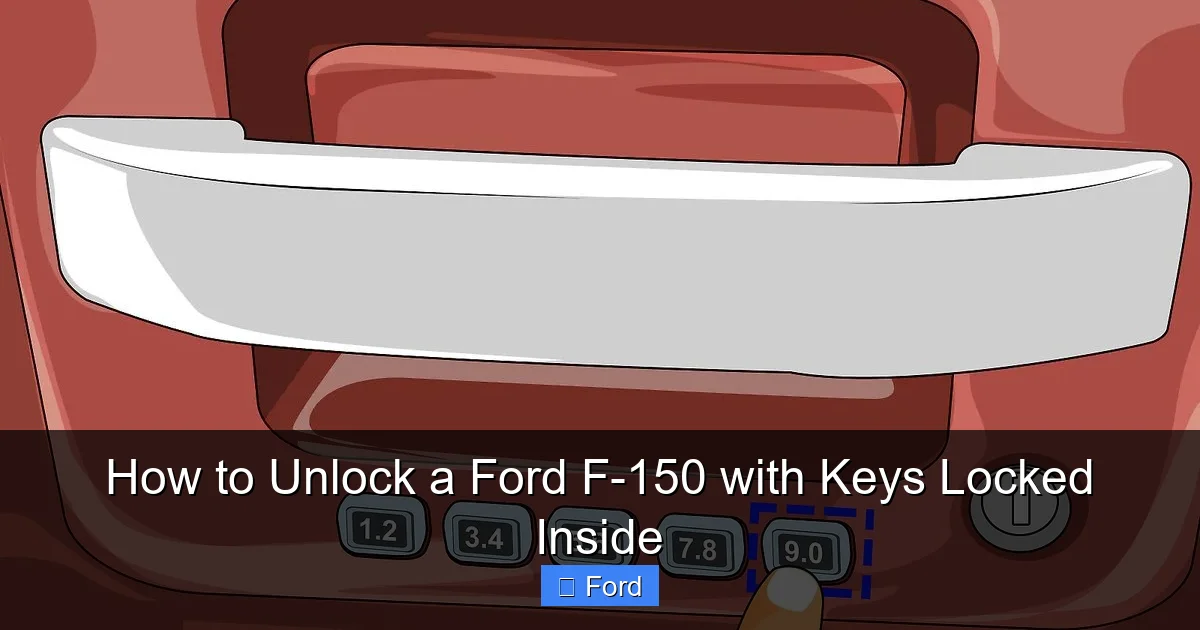
Many F-150s also feature a keypad on the driver’s door (the “Keyless Entry Keypad”). If your truck has this, you’re in luck. You can enter your factory code (found in your owner’s manual or on a card in the glove box) to unlock the doors, even with the primary keys inside. This is often the fastest, damage-free solution. Check your door for a numeric keypad. If it’s there, locate your code and try it.
Model Year Variations (2015-2024)
The 13th generation F-150 (2015-2020) and the current 14th generation (2021-2024) have subtle differences. The 2021+ models have a more flush door handle design, which can make creating a gap with a wedge slightly trickier. The window regulator mechanisms and interior door panel construction also vary. Generally, the principles remain the same, but the tools you use (like wedge thickness) might need adjustment. For the newest trucks with advanced driver-assist systems, be extra cautious around the door’s wiring harnesses when attempting any interior access.
Immediate Steps to Take When Realizing Keys Are Locked Inside
Don’t just start jamming tools into your door. A measured approach prevents damage and saves time. Follow this sequence.
Visual guide about How to Unlock a Ford F-150 with Keys Locked Inside
Image source: vehq.com
Stay Calm and Assess the Situation
Panic leads to poor decisions. Take 60 seconds to breathe. Look at your truck. Are any windows slightly open? Is the sunroof open (if equipped)? Is a tailgate or rear window down? Sometimes, a window is cracked an inch for ventilation. This is your golden ticket. You can often reach through a small window opening and manually unlock the door or even reach the keys. Check all openings thoroughly.
Check for Spare Keys or Key Fobs
This is your first and best solution. Do you have a spare key fob in your gym bag? A magnetic box spare under the bumper? A spare left with a spouse or roommate? Call them immediately. If you have a traditional metal key that fits the door cylinder (some F-150s still have one hidden inside the fob), that can unlock the door directly. Also, if your truck has Ford’s Phone as a Key feature (on newer models with the SYNC 4 system), and your phone is with you and paired, you might be able to unlock it via the FordPass app. This is a fantastic backup if you have it set up.
Consider Safety and Weather Conditions
Is it 100 degrees outside or below freezing? Leaving your truck unattended with windows down could be a security risk or cause interior damage from temperature extremes. Are you on a busy street? If you need to attempt a DIY method, you’ll want to do it quickly and discreetly. If it’s late at night or in an unsafe area, your priority should be calling a professional locksmith or roadside assistance who can come to you, rather than fumbling with tools on the roadside.
DIY Unlock Methods: Step-by-Step Guides
If you’ve exhausted spare key options and need to try yourself, here are the methods, ranked from safest to riskiest. Always work slowly and gently. The goal is to create a small gap in the weather stripping to insert a tool, not to bend the door.
Visual guide about How to Unlock a Ford F-150 with Keys Locked Inside
Image source: wikihow.com
The Inflatable Wedge and Rod Technique (Safest DIY Method)
This is the professional-locksmith-preferred method for a reason. It minimizes paint contact.
- Tools Needed: An inflatable door wedge (available online or at auto stores for ~$15) and a long, thin, non-metallic rod. A plastic automotive lockout tool or even a sturdy, flat plastic ruler can work. Avoid metal if possible.
- Steps:
- Insert the deflated wedge into the top corner of the door frame (where the window meets the roof pillar). Use your fingers to create a tiny initial gap.
- Pump the wedge gently until it’s firm. It will expand, creating a 1-2 inch gap between the door and the frame. Do not over-inflate. You just need enough space to slip your rod through.
- From the top of the door, insert your plastic rod through the gap. Angle it downward toward the door panel.
- Feel for the door lock button. On F-150s with power locks, it’s usually a rubber button on the armrest or door panel. Press it firmly to unlock. You may need to probe around to find it.
- Once unlocked, carefully deflate the wedge and open the door.
Pro Tip: If you don’t have an inflatable wedge, you can use a thin, soft rubber wedge or even a rolled-up towel, but be extremely gentle. The risk of scratching is higher. For a visual demonstration of a similar technique on a different vehicle, our guide on how to unlock a Dodge Charger without a key shows the same principles applied to a sedan.
The String or Plastic Card Method
This classic trick works best on older F-150s with manual lock buttons that protrude from the door panel.
- Tools Needed: A thin, strong string (dental floss works great) or a thin, rigid plastic card (like a credit card, but use an old gift card you don’t mind bending).
- Steps (String Method):
- Create a small loop at one end of the string.
- Work the string through the top gap of the door (you may need to create a tiny gap with your fingers first).
- Loop the string around the lock button (the upward-pointing rod).
- Pull the string upward and outward, like a pulley system, to lift the lock rod and unlock the door.
- Steps (Card Method):
- Insert the card between the window and the weather stripping at the top corner.
- Slide the card down until it hits the door latch mechanism.
- Angle the card to push the latch release inward. You should feel a click and the door unlock.
- Caution: This method is less effective on modern F-150s with complex latches and can bend your card.
This technique relies on simple mechanical leverage. For a detailed walkthrough on a comparable system, see our instructions for how to unlock a Nissan Altima without a key, which uses similar principles.
Using a Coat Hanger or Slim Jim (Use Extreme Caution)
This is the Hollywood method, but it’s the riskiest for modern vehicles.
- Tools Needed: A straightened wire coat hanger or a purchased Slim Jim tool.
- Steps & Warnings:
- Insert the tool between the window and the weather stripping.
- Feel for the door lock rod or the latch mechanism. On older F-150s, you might find a vertical rod you can hook and pull up.
- STOP if you feel resistance. Modern F-150 doors contain wiring for speakers, power locks, and windows. You can easily snag and sever a wire, leading to expensive repairs. You can also damage the delicate linkage inside the door.
- This method is generally not recommended for 2009+ F-150s due to complex internals.
If you insist on trying, go slowly. For a look at how this is done on a simpler system, our article on how to unlock a Toyota Camry without a key illustrates the basic concept, but your F-150’s door is more complex.
When DIY Methods Aren’t Safe or Effective
Sometimes, trying to be a hero costs more than calling a pro. Know when to stop.
Visual guide about How to Unlock a Ford F-150 with Keys Locked Inside
Image source: carglassadvisor.com
Risks of Paint Damage and Scratches
Any tool—metal, plastic, or even an inflated wedge—pressed against your truck’s painted surface can cause marring or scratches, especially if there’s dirt or grit between the tool and the paint. The cost to repair a single door scratch can exceed $300. The inflatable wedge is your best bet to avoid this, but if the gap is already there, inserting anything can rub against the frame.
Potential Harm to Electronic Components
The inside of an F-150 door is a spaghetti junction of wires for the power lock, power window, heated mirror, and side curtain airbags. Poking a rod or hanger inside can disconnect a plug, cut a wire, or short a circuit. This could lead to a dead battery, inoperative windows, or a failed airbag light—each a costly dealer visit to diagnose and fix.
Airbag and Sensor Interference Concerns
The side-impact airbags are housed in the door panels. While unlikely to deploy from prying, you can damage the airbag cover or the sensor wiring. This compromises a critical safety system. Additionally, many F-150s have sensors for the blind-spot monitoring system in the rear quarter panel. Tampering near the door latch area can sometimes affect these sensors.
Professional Solutions: Locksmiths and Dealerships
When in doubt, call a pro. It’s the safest, most reliable way to regain entry.
Mobile Automotive Locksmith Services
This is your best bet. A licensed automotive locksmith will come to your location with specialized, non-marring tools designed for modern vehicles like the F-150. They use lockpick sets, long-reach tools, and can often unlock the door in under 5 minutes. Cost typically ranges from $80 to $150 for a simple lockout. Verify they are insured and specialize in automotive work, not just home locks.
Dealer Assistance and Key Replacement
You can call a Ford dealer. They can send a service technician or, if you have OnStar (see below), they might be able to unlock remotely. Dealerships are reliable but often more expensive ($150-$250) and may take longer to dispatch. They also have the capability to cut and program a new key fob on the spot if needed, which a mobile locksmith can also do.
Roadside Assistance Programs (OnStar, etc.)
If your F-150 is equipped with OnStar (the subscription-based telematics system), you have a powerful option. Call OnStar customer service, verify your ownership, and they can often send a remote unlock signal directly to your truck via its built-in cellular modem. This is usually free for the first few years of ownership and is the most seamless, damage-free solution. Check if your truck has the blue OnStar button in the rearview mirror or a connected services plan. Insurance companies (like State Farm, Allstate) and credit card benefits (like some Visa or Mastercard policies) also frequently offer free or discounted lockout services as a perk. Always check your policy or card benefits first.
Preventing Future F-150 Lockouts
Once you’re back in your truck, take steps to never be locked out again.
Keep a Spare Key in a Magnetic Box or With a Trusted Person
The old-school method is a magnetic key box attached to the underside of the bumper or frame rail. Place it in a spot that’s hidden but accessible. Alternatively, leave a spare with a trusted neighbor, family member, or at your workplace. A traditional metal key (not the fob) is cheap to have cut and can open the door in a pinch.
Utilize the F-150’s Built-in Keypad (If Equipped)
If your F-150 has the door-mounted keypad, memorize the factory code (in your owner’s manual). You can also program a personal code. This is a fantastic backup that requires no key or fob. Consider adding a keypad if your truck doesn’t have one; aftermarket options exist.
Develop Simple Habits to Avoid Lockouts
Create a mental checklist. Before you close the driver’s door, look at the seat. Make it a rule: keys in hand, then close door. If you’re loading cargo, put your keys in your pocket before reaching into the bed. Never place keys on the seat or dashboard. Attach your key fob to your belt loop or bag strap with a lanyard. These tiny habits eliminate the risk entirely.
In conclusion, unlocking a Ford F-150 with keys locked inside is a manageable problem. Start with the no-risk solutions: spare key, keypad, or OnStar. If you must DIY, the inflatable wedge method is your safest bet. Always prioritize the integrity of your truck’s paint, electronics, and safety systems. When in doubt, a professional locksmith is a worthwhile investment that saves you from costly damage. Now that you’re prepared, you can handle this common truck owner’s dilemma with confidence.
Frequently Asked Questions
Can I unlock my F-150 with a smartphone?
Yes, but only if your truck is equipped with FordPass Connect and you have the FordPass app installed with your vehicle linked. This feature allows remote unlocking via cellular signal, provided your truck has an active data subscription and is within cellular range.
Will using a wedge damage my truck’s paint?
It can. Any tool pressed against the paint, especially if there’s dirt present, can cause fine scratches. An inflatable wedge is the safest option as it distributes pressure and has no hard edges. Metal wedges or coat hangers pose a much higher risk of marring the finish.
How much does a locksmith cost for an F-150?
Expect to pay between $80 and $150 for a standard lockout service during regular business hours. After-hours, holidays, or remote locations may incur a premium. Always get a quote upfront. This is often cheaper than repairing DIY damage.
Does my insurance cover lockout service?
Sometimes. Many auto insurance policies include roadside assistance as an optional add-on or built-in benefit. This often covers lockout service. Check your policy documents or call your agent. Credit card benefits also frequently include this service.
What if my F-150 has a push-button start and no physical key?
Even with push-button start, there is almost always a hidden physical key inside the fob. Look for a small button or slot on the fob to release the emergency key. This key will unlock the driver’s door via the traditional key cylinder, which is usually hidden under a trim cover on the door handle. Your owner’s manual will show you exactly how to access and use it.
Are there any tools I should keep in my truck for emergencies?
Yes. Consider keeping a small, high-quality inflatable door wedge in your glove compartment. It’s the safest DIY tool. Also, keep a spare metal key (not the fob) in a magnetic hide-a-key box attached to the underside of your truck in a secure, hidden spot. This provides a reliable backup without the risk of DIY damage.
