
What Is the Difference Between Mazda Cx 5 and Cx 50

The Mazda CX-5 and CX-50 are both excellent compact SUVs, but they target different drivers. The CX-5 prioritizes on-road comfort, refined styling, and a plush ride for everyday urban and family use. The CX-50 trades some of that smoothness for a taller, more rugged stance, standard all-wheel drive, and a adventurous spirit geared toward light off-pavement activities. Your choice hinges on whether you value premium highway manners or versatile, trail-ready capability.
If you’re shopping for a Mazda SUV in 2026, you’ve likely noticed two stars in the compact lineup: the ever-popular CX-5 and the newer, tougher CX-50. They look similar from a distance and share Mazda’s brilliant Skyactiv engine technology, but they are engineered for profoundly different lifestyles. Understanding the difference between Mazda CX-5 and CX-50 is crucial because your choice defines your driving experience for years. This isn’t about which is “better”—it’s about which is better for you. Let’s break down every layer, from the sheet metal to the infotainment screen, so you can drive away confident in your decision.
Key Takeaways
- Core Philosophy: The CX-5 is a road-focused “sports tourer” SUV emphasizing comfort and elegance, while the CX-50 is a “light off-roader” built for adventure with a higher, tougher demeanor.
- Design & Stance: CX-5 has a lower, sleeker, car-like profile. CX-50 sits taller, has cladding, and features a more vertical rear hatch for outdoor gear.
- Powertrain & AWD: Both share similar engines, but CX-50 comes with standard i-Activ AWD and a more robust, off-road-tuned system. CX-5 offers AWD as an option.
- Interior Focus: CX-5’s cabin is louder about luxury materials and a quiet ride. CX-50’s is more utilitarian, with easier-clean surfaces and more standard cargo versatility.
- Pricing & Trims: CX-50 generally starts slightly higher due to standard AWD. CX-5 offers more low-trim, front-wheel-drive value options for budget-conscious buyers.
- Target Driver: Choose CX-5 for premium commuting and family hauls. Choose CX-50 for weekend adventures, bike/ski trips, and those who want SUV toughness.
- 2026 Outlook: Expect mild refreshes for both, with potential hybrid options and incremental tech updates, but their fundamental character differences will remain unchanged.
📑 Table of Contents
- Design Philosophy and Exterior Styling: Elegance vs. Adventure
- Performance and Powertrain: Shared Heart, Different Tuning
- Interior Space, Comfort, and Technology
- Pricing, Trims, and Value Proposition
- Target Audience: Who Should Buy Which?
- 2026 Model Year: What to Expect
- Conclusion: Your Lifestyle is the Compass
Design Philosophy and Exterior Styling: Elegance vs. Adventure
Look at these two SUVs side-by-side, and the first thing you’ll notice is their posture. This is where their core identities diverge.
CX-5: The Elegant Sports Tourer
The CX-5 embodies Mazda’s “Kodo—Soul of Motion” design philosophy at its most refined. Its lines are fluid, graceful, and seemingly in motion even when stationary. The hood is long and low, the greenhouse (the window area) is sleek, and the overall silhouette mimics a sporty wagon more than a traditional boxy SUV. It’s designed to look sophisticated in a suburban driveway or a city street. The stance is planted and confident, but not intimidating. For 2026, minor tweaks to grille textures and wheel designs will keep it fresh, but its fundamental elegant shape remains a masterclass in understated design. If you appreciate the aesthetic of a European luxury SUV but at a more accessible price, the CX-5’s design speaks to you.
CX-50: The Rugged Adventure Companion
The CX-50 was born from Mazda’s partnership with outdoor brand Patagonia and its desire to build a vehicle for “adventure seekers.” Consequently, it looks the part. It sits noticeably taller on its suspension, has substantial black plastic cladding wrapped around the wheel arches and lower sills, and features a more upright, practical rear hatch. The front end is more blunt and muscular, with a larger, more functional grille. The side profile is longer and boxier, maximizing cargo space for gear. This is a vehicle that looks at home with a bike rack on the back or a dirt road in its background. Its design says “let’s go exploring,” not “let’s go to the gala.”
Practical Example: Imagine parking both at a scenic trailhead. The CX-5 will look great, but the CX-50, with its higher clearance and protective cladding, will look like it belongs there, suggesting it’s ready for the journey back to the pavement after a dusty hike.
Under the hood, you’ll find familiar friends. Both SUVs primarily use Mazda’s proven 2.5-liter Skyactiv-G four-cylinder engine. In most trims, it makes 187 horsepower and 186 lb-ft of torque. The CX-50 also offers a more powerful 2.5-liter turbocharged variant (256 hp, 320 lb-ft) across more of its lineup. So where’s the difference between Mazda CX-5 and CX-50 in how they drive? It’s all in the tuning, the weight, and the standard equipment.
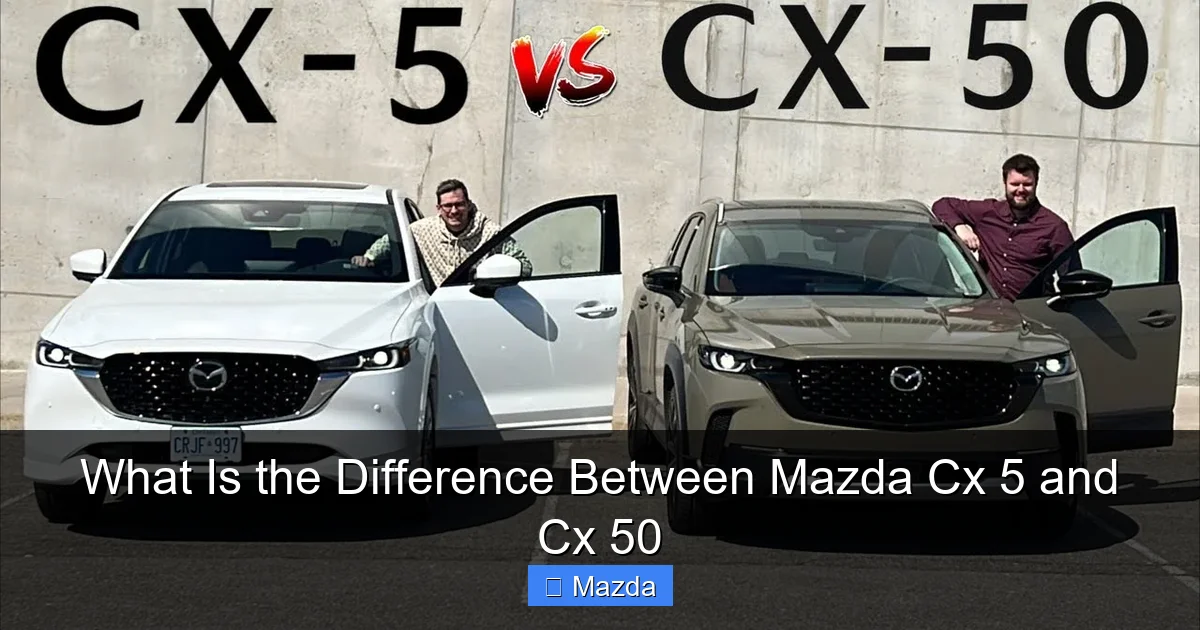
Visual guide about What Is the Difference Between Mazda Cx 5 and Cx 50
Image source: i.ytimg.com
Drivetrain and All-Wheel Drive
This is a critical distinction. In the CX-5, intelligent i-Activ AWD is a fantastic, predictive system, but it’s an option on most trims. The base model is front-wheel drive. The CX-50, however, comes with i-Activ AWD as standard on every single model. Mazda tuned this system specifically for the CX-50’s adventurous intent. It includes a more robust rear differential and a dedicated off-road mode that manages wheel slip on loose surfaces like gravel or mud. For anyone regularly encountering snow, rain, or unpaved roads, the CX-50’s standard, adventure-oriented AWD provides significant peace of mind and capability right out of the gate.
Handling and Ride Quality
The CX-5’s tuning prioritizes a smooth, compliant, and quiet ride. Its steering is light and precise, making it feel agile and car-like in city traffic and on winding highways. It absorbs bumps with a luxury-adjacent grace. The CX-50, with its taller suspension and slightly higher center of gravity, has a firmer, more grounded ride. It feels more substantial and planted during quick maneuvers, but you’ll feel more road imperfections. This is the trade-off for its increased ground clearance (8.3 inches vs. CX-5’s 7.5 inches) and off-road prowess. The CX-50 is stable and confident on a gravel road; the CX-5 would feel less composed there.
Tip: If your idea of “performance” is a relaxed, quiet cruise with the family, the CX-5’s tuning is perfect. If you want a vehicle that feels ready for a rutted forest service road without hesitation, the CX-50’s standard setup is the clear winner.
Interior Space, Comfort, and Technology
Step inside, and the shared Mazda design language is evident—beautiful materials, a driver-centric cockpit, and minimal physical buttons. Yet, the purpose of each space reveals the difference between Mazda CX-5 and CX-50.
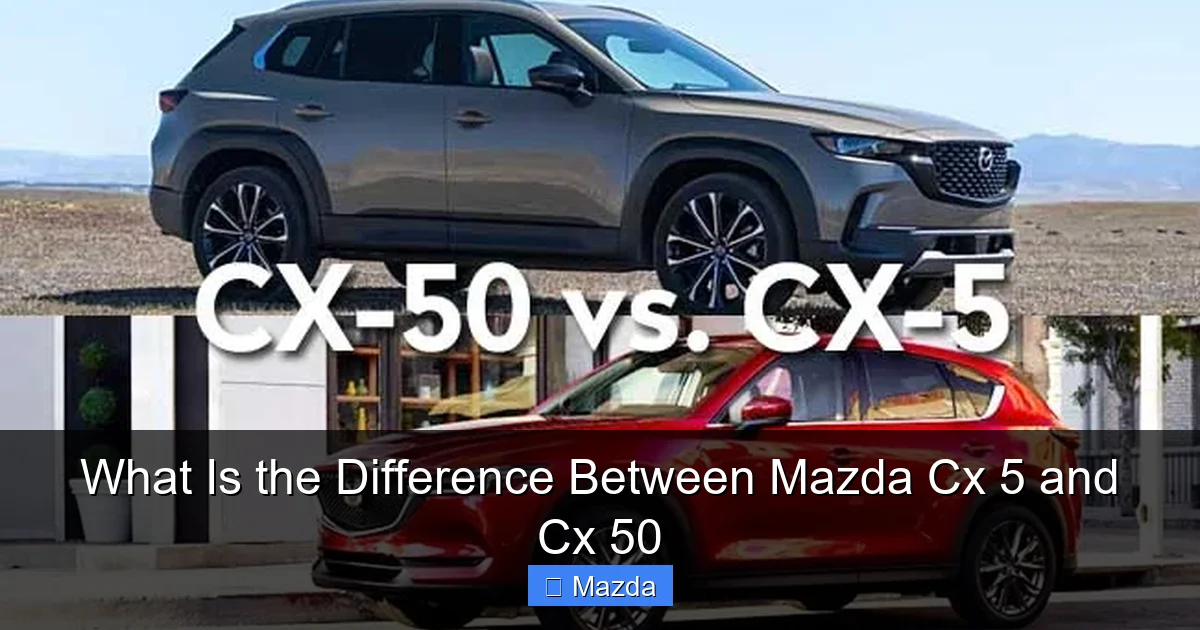
Visual guide about What Is the Difference Between Mazda Cx 5 and Cx 50
Image source: carlogos.org
Cabin Materials and Ambiance
The CX-5’s interior is a showcase of upscale materials. Even in mid-trims, you’ll find soft-touch surfaces, available genuine wood or aluminum trim, and supremely comfortable seats upholstered in premium cloth or leather. The focus is on creating a serene, luxurious environment that shields occupants from the outside world. The CX-50’s interior is equally well-built but purposefully more rugged. It features easier-to-clean, durable materials in the cargo area and on the seatbacks. There are more hard-wearing plastics in strategic places. The overall vibe is “high-quality outdoor gear” rather than “luxury lounge.” For families with kids or pets that frequently bring in mud or snow, the CX-50’s interior philosophy is more practical.
Cargo Versatility and Practicality
This is a huge differentiator. On paper, total cargo volume is similar (CX-5: ~30.9 cu ft behind rear seats, CX-50: ~30.4 cu ft). But the CX-50’s design maximizes usable space. Its taller, more square rear hatch and lower load floor make it dramatically easier to load bulky items like coolers, strollers, or camping gear. The CX-5’s sloping rear glass, while stylish, creates a narrower, deeper cargo well. The CX-50 also offers more standard tie-downs and a more utilitarian cargo shade system. If your lifestyle involves frequent bulk cargo, the CX-50’s practicality advantage is immediately apparent.
Infotainment and Safety Tech
Both SUVs feature Mazda’s excellent 10.25-inch center display running the latest Mazda Connect software. It’s responsive, intuitive, and supports Apple CarPlay and Android Auto (wireless on newer 2026 models). The suite of i-Sensor safety features—including adaptive cruise, blind-spot monitoring, and automatic emergency braking—is comprehensive and standard on all but the absolute base CX-5 trim. Here, the difference is minimal; both offer a top-tier, user-friendly tech experience. For specific maintenance queries, like how to reset the CX-5 service light, the process is identical across both models due to shared engineering.
Pricing, Trims, and Value Proposition
Money matters. Understanding the trim structure and what you get for your dollar is key to the difference between Mazda CX-5 and CX-50.
Entry Point and Standard Features
For the 2026 model year, the CX-5 will likely maintain a lower starting MSRP, primarily because its base model is front-wheel drive. This makes it an exceptional value for buyers who don’t need AWD. The CX-50’s base price is higher because you cannot buy it without the standard i-Activ AWD system. However, this means the CX-50’s entry-level trim is more feature-complete for all-weather capability from day one. You’re paying a premium for that standard AWD and adventure-oriented tuning right from the start.
Top-Trim Comparisons and Value
As you climb the trim ladder (Sport, Carbon Edition, Preferred, Premium, Grand Touring, Signature), prices converge. A top-trim CX-5 Signature and a CX-50 Premium or Turbo Premium will be in a similar ballpark. At this level, the CX-5 cements its luxury feel with Nappa leather, heated/ventilated seats, and more elaborate wood trim. The CX-50’s top trims focus on enhanced capability (like the turbo engine) and outdoor-friendly features like a roof rack and all-weather floor mats. Neither is a “better” value; they offer different value propositions. The CX-5 buys you more tangible luxury materials at the top, while the CX-50 buys you more standard capability and utility.
Regional Note: Pricing varies dramatically by market. For instance, the Mazda CX-5 price in India reflects its positioning as a premium imported model, which may affect the value equation compared to markets where it’s locally built. Always check your local pricing and specification lists.
Target Audience: Who Should Buy Which?
This is the most important section. Let’s match driver profiles to the right SUV.
The Mazda CX-5: For the Urban Connoisseur & Family
Choose the CX-5 if: Your daily life is centered on paved roads—commuting, school runs, grocery trips, and weekend getaways to nice hotels or resorts. You prioritize a whisper-quiet cabin, a supple ride that soaks up potholes, and a sophisticated interior that feels special. You might occasionally drive on a gravel road to a cabin, but it’s not a weekly ritual. You want an SUV that feels like a natural extension of a premium sedan, with a bit more space. You appreciate design elegance and are willing to sacrifice a few inches of ground clearance and a bit of cargo square footage for that superior on-road comfort and style. Think: professionals, empty-nesters, and families who value refinement over raw capability.
The Mazda CX-50: For the Active Lifesyler & Adventure Enthusiast
Choose the CX-50 if: Your lifestyle is defined by “active.” You regularly go biking, hiking, skiing, or camping. You own a kayak or a pop-up camper. Your idea of a fun weekend involves a dirt road or a snowy pass. You need a vehicle that can handle unpaved surfaces with ease, carry messy gear without worrying about the interior, and has standard all-wheel drive for unpredictable mountain weather. You’re willing to accept a slightly firmer ride on the highway in exchange for genuine versatility and a “ready-for-anything” stance. Think: outdoor enthusiasts, young families with a focus on activity, and anyone who wants their SUV to look and feel like a tool for adventure, not just transport.
2026 Model Year: What to Expect
For 2026, neither model is expected to receive a complete ground-up redesign. Instead, anticipate incremental updates that refine their existing characters.
CX-5: The Refined Veteran
Expect the CX-5 to receive its typical mid-cycle refresh. This could mean subtle updates to the grille, new wheel designs, and perhaps a revised infotainment interface with faster processing. Mazda may introduce a mild hybrid system to improve fuel efficiency slightly, but the core 2.5L engine will likely remain. Its role as the comfortable, stylish, and value-oriented choice in the lineup is solidified.
CX-50: The Evolving Adventurer
The CX-50 is younger, so its updates might be more about expanding its appeal. The most anticipated possibility is the introduction of a dedicated plug-in hybrid (PHEV) or full hybrid model, aligning with industry trends and enhancing its efficiency for eco-conscious adventurers. We may also see more standard features moving down into lower trims, like the turbo engine becoming optional on the base model. Its fundamental rugged, capable character will be enhanced, not changed.
The fundamental difference between Mazda CX-5 and CX-50—road luxury vs. adventure utility—is baked into their DNA and will not shift with a 2026 refresh.
Conclusion: Your Lifestyle is the Compass
The Mazda CX-5 and CX-50 are siblings raised in different environments. The CX-5 is the polished, articulate one who excels in the city and on the open road, offering a near-luxury experience. The CX-50 is the sturdy, versatile one with a well-worn backpack, always ready for a detour onto a less-traveled path. They share a brilliant powertrain foundation and a commitment to driver engagement, but their final tuning, standard features, and interior design are tailored for distinct purposes.
To decide, be honest about your driving habits. If 90% of your miles are on tarmac and you crave a serene, stylish cabin, the CX-5 is your champion. If you consistently seek out dirt, snow, or simply want the psychological and physical capability for any road, the CX-50’s standard AWD and rugged packaging are worth the slight compromise in on-road plushness. Test drive both back-to-back on roads that mimic your typical routes. Feel the difference in the ride, the visibility, and the cargo loading. The right answer is the one that best fits the life you actually lead, not just the one you imagine. Both are fantastic vehicles—the best one is the one that matches your adventure.
Frequently Asked Questions
Which Mazda is larger, the CX-5 or CX-50?
Externally, the CX-50 is slightly longer and sits taller with more ground clearance. Internally, passenger space is very similar, but the CX-50’s boxier rear hatch and lower load floor make its cargo area feel more practical and easier to use for bulky items.
Do they have the same engine and fuel economy?
They share the base 2.5L engine, so fuel economy is nearly identical (around 24-25 mpg combined). However, the CX-50 more commonly offers the turbocharged engine option across more trims, which has lower fuel economy but much higher power. The CX-50’s standard heavier AWD system can also shave a fraction of an mpg off the base model’s figures.
Can the Mazda CX-50 really go off-road?
Yes, but with context. It’s not a hardcore rock-crawler. Its off-road mode, standard AWD with a rear differential, and 8.3 inches of ground clearance make it highly competent for dirt roads, gravel paths, snowy trails, and rutted forest service roads. It’s designed for “light off-pavement” adventures, not Moab-style rock gardens.
Is the CX-50 more expensive than the CX-5?
Yes, typically. The CX-50’s base price is higher because all-wheel drive is standard. A similarly equipped CX-50 (with AWD) will cost more than a base CX-5. However, comparing like-for-like trims (e.g., both with AWD and similar engines), the price gap narrows significantly, with the CX-50 often commanding a small premium for its standard capability.
Which is more reliable, CX-5 or CX-50?
Both share the vast majority of their mechanical components—engines, transmissions, core chassis architecture. Therefore, long-term reliability is expected to be very similar. The CX-5 has a longer sales history, providing more historical data, but the CX-50 is built on the same proven platforms. Proper maintenance is the biggest factor for both.
I mainly drive in the city with two kids. Which should I choose?
For pure urban family duty, the CX-5 is likely the better fit. Its smoother, quieter ride will make school runs and traffic more pleasant. The more elegant interior feels more special, and its slightly lower step-in height can be easier for child seats. The CX-50 is still a great family vehicle, but its firmer ride and more utilitarian cabin are minor compromises if off-road capability is not a priority.