
How Many Quarts of Oil Does a Toyota Tundra 5.7l V8 Take?

The Toyota Tundra with the 5.7L V8 engine requires 8.5 quarts (8.0 liters) of oil when performing a standard oil and filter change. This capacity is consistent across most model years from 2007 to the present, but always verify with your owner’s manual. Using the correct oil viscosity, typically 0W-20 or 5W-20 depending on the year, and a high-quality filter is just as critical as the correct volume for protecting your powerful V8.
Key Takeaways
- Standard Capacity: The 5.7L V8 in the Toyota Tundra takes 8.5 quarts (8.0 liters) of oil during a routine oil and filter change.
- Model Year Consistency: This 8.5-quart capacity is standard for the vast majority of 5.7L V8 Tundras from the 2007 model year onward, including the latest generations.
- Oil Type is Crucial: Using the correct oil viscosity is non-negotiable. Most post-2010 models require 0W-20 synthetic, while some earlier models specify 5W-20. Check your manual.
- Filter Changes Matter: The 8.5-quart figure assumes you are replacing the oil filter. A new filter holds about 0.25-0.5 quarts itself, so not changing it will leave you slightly over capacity.
- Always Verify: While the spec is stable, the single most important step is to consult your vehicle’s official owner’s manual for the definitive capacity and oil specification for your specific VIN.
- Check with the Dipstick: The final arbiter of correct oil level is the engine dipstick. After filling, always follow the manual’s procedure to check the level on the dipstick when the engine is warm and on level ground.
- Dry Fill vs. Service Fill: The “8.5 quarts” is the service fill (with filter). A “dry fill” (after a complete rebuild or engine removal) requires significantly more oil, around 10-11 quarts, to fill the entire crankcase.
📑 Table of Contents
- Why Knowing Your Tundra’s Exact Oil Capacity is Non-Negotiable
- The Golden Number: 5.7L V8 Oil Capacity Decoded
- More Than Quarts: The Critical Role of Oil Type and Viscosity
- Your Step-by-Step Guide to a Perfect 5.7L V8 Oil Change
- Common Pitfalls and Expert Tips for Tundra Owners
- Beyond the Basics: Connecting to Your Truck’s Health
- Conclusion: Your Tundra’s Heartbeat
Why Knowing Your Tundra’s Exact Oil Capacity is Non-Negotiable
You pop the hood of your Toyota Tundra, that mighty 5.7-liter V8 purring (or rumbling) beneath the steel. It’s time for an oil change. You grab your trusty 5-quart jug of synthetic, a new filter, and get to work. But what if you need more than two jugs? What if you underfill or overfill? Getting the precise oil volume right isn’t just about avoiding a mess on your garage floor; it’s about the long-term health and performance of one of the most hardworking engines on the market. The Toyota Tundra’s 5.7L V8, known for its robust power and towing capacity, is a workhorse. It demands respect, and that starts with the lifeblood circulating through its bearings, camshafts, and pistons: engine oil. Using too little oil leads to catastrophic friction, overheating, and engine seizure. Using too much oil causes aeration, foaming, increased pressure, and can damage seals or even lead to hydrolock. The sweet spot is the manufacturer’s specified capacity, which for this engine, is a well-documented figure. But it’s not just a number on a page; understanding what that number means, when to use it, and how to verify it is the hallmark of a true Tundra owner who cares for their truck.
This guide will leave no bolt unturned. We’ll dive deep into the exact quarts your 5.7L V8 needs, explore why that number is what it is, discuss the critical companion topics of oil type and filter selection, and walk you through the process so you can confidently perform this service yourself or understand exactly what your mechanic should be doing. Whether you have a 2007 first-generation Tundra or a 2024 hybrid-assisted model, this information is vital. Think of it as the definitive owner’s manual supplement for your Tundra’s lubrication system.
The Golden Number: 5.7L V8 Oil Capacity Decoded
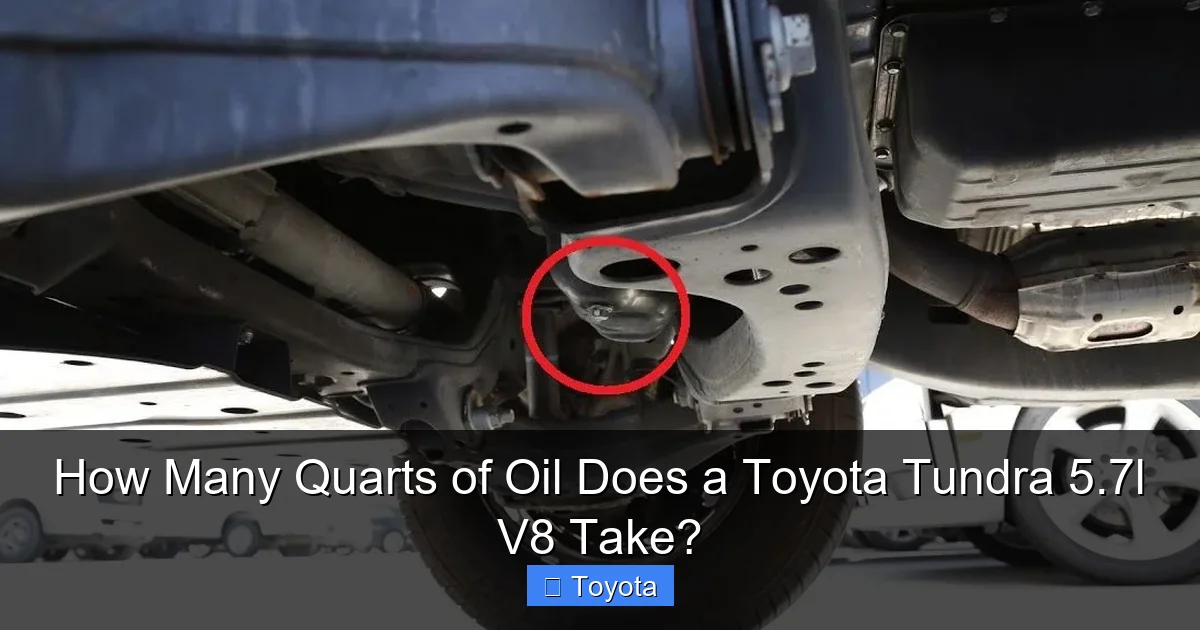
Let’s cut to the chase. For the overwhelming majority of Toyota Tundra models equipped with the 5.7-liter V8 engine (engine code 3UR-FE), the manufacturer’s specified oil capacity for a standard oil and filter change is 8.5 quarts (8.0 liters). This figure has remained remarkably consistent since the engine’s introduction in the 2007 Tundra. It applies to the first-generation (2007-2013), second-generation (2014-2021), and the current third-generation (2022+) models.
Visual guide about How Many Quarts of Oil Does a Toyota Tundra 5.7l V8 Take?
Image source: cimg1.ibsrv.net
What “Service Fill” Really Means
The term “8.5 quarts” is officially called the “service fill.” This means it’s the amount of oil you should add to the engine when you are performing a routine oil change that includes replacing the oil filter. The oil filter itself is not empty; it contains a small reservoir of oil from the previous run. A new, clean oil filter will typically hold between 0.25 and 0.5 quarts of oil to prime itself and ensure immediate oil flow upon startup. The 8.5-quart specification accounts for this filter capacity. If you were to change the oil but not the filter, you would be adding 8.5 quarts to an engine that already has about 0.3-0.5 quarts sitting in the old filter, resulting in an overfilled condition. Always change the filter with the oil.
The “Dry Fill” Scenario
You might also see a higher capacity listed in some technical documents, often around 10-11 quarts. This is the “dry fill” or “engine rebuild” capacity. This is the total volume of oil needed to completely fill the engine’s oil passages, galleries, and sump from a completely drained state, such as after a full engine teardown or if you drain the oil but do not replace the filter (which still retains some oil). For your standard maintenance, you will never use the dry fill figure. The 8.5-quart service fill is your target.
Year-by-Year Verification: Is It Always 8.5?
While 8.5 quarts is the standard, a truly meticulous owner always verifies. Minor variations can occur due to changes in oil pan design, drain plug location, or filter manufacturer specs across a 15+ year production run. For absolute certainty, your first resource is the owner’s manual for your specific model year. The second is the oil filler cap itself; many Tundra caps are clearly labeled with the capacity. You can also use an online VIN decoder or consult a Toyota dealership’s parts department. For context, here is a quick reference:
- 2007-2013 (First Gen): 8.5 quarts (8.0L) with filter. Oil: 5W-20 (early) or 0W-20 (later).
- 2014-2021 (Second Gen): 8.5 quarts (8.0L) with filter. Oil: 0W-20.
- 2022-Present (Third Gen): 8.5 quarts (8.0L) with filter. Oil: 0W-20. (Note: The hybrid-assisted i-FORCE MAX version of the 5.7L has the same capacity).
This consistency is great news for Tundra owners. You can confidently buy two 5-quart jugs and one 1-quart bottle, or three 3-quart jugs, for every oil change.
More Than Quarts: The Critical Role of Oil Type and Viscosity
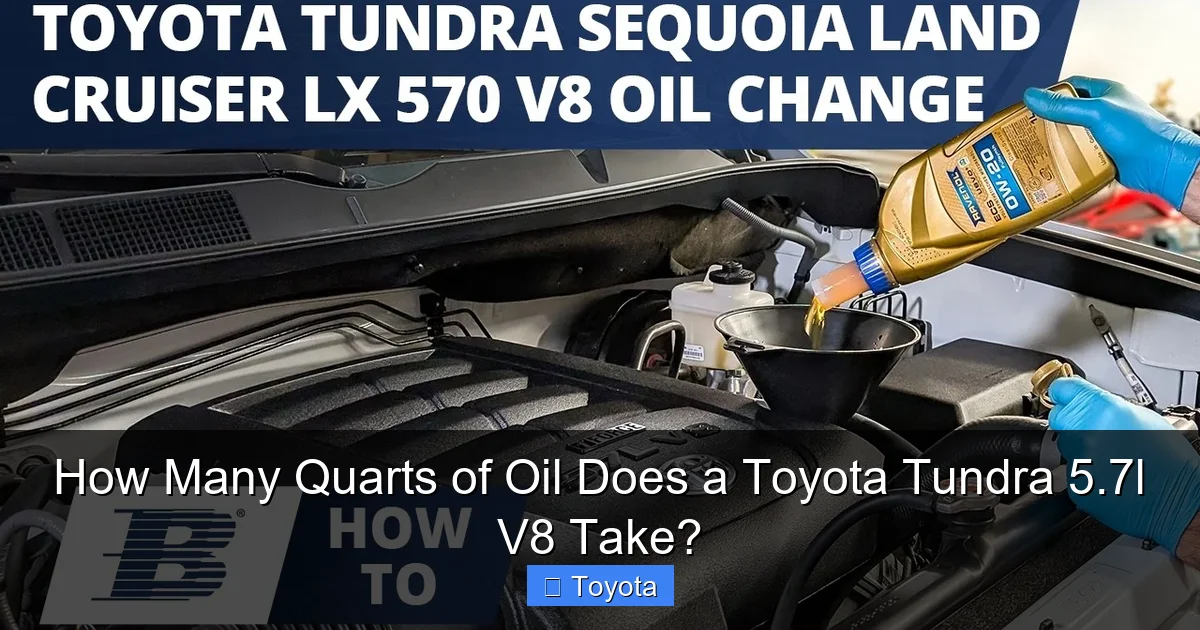
Knowing the volume is only half the battle. Pouring the wrong type of oil into your 5.7L V8 is like giving a marathon runner a sugary soda instead of water and electrolytes—it might work for a minute, but disaster is coming. Toyota’s engineering for this engine is tightly coupled with specific lubricant standards. Using the incorrect oil can void your powertrain warranty, reduce fuel economy, increase wear, and trigger check engine lights related to variable valve timing systems (like VVT-i), which are sensitive to oil flow and pressure.
Visual guide about How Many Quarts of Oil Does a Toyota Tundra 5.7l V8 Take?
Image source: i.ytimg.com
Decoding the Sticker: 0W-20 vs. 5W-20
You’ll see two primary viscosity recommendations for the 5.7L Tundra over the years:
- 0W-20: This is the current standard for most post-2010 Tundras. The “0W” means it flows like a single-weight oil at cold startup temperatures (the “W” stands for winter), providing exceptional cold-start protection. The “20” indicates its viscosity at operating temperature (100°C/212°F). 0W-20 is a lower-viscosity oil designed to improve fuel efficiency by reducing internal engine friction. It is almost always a full synthetic.
- 5W-20: This was common in the early years of the 5.7L (2007-2009ish). It’s slightly thicker at cold startup than 0W-20 but meets the same hot viscosity. It’s also typically a synthetic blend or full synthetic. If your manual calls for 5W-20, do not substitute 0W-20 without explicit approval from Toyota specifications for your model year.
The API and Toyota/Lexus Specifications: Your Oil’s Resume
Beyond the “0W-20” label, look for these crucial certifications on the oil container. They are the industry’s way of saying the oil meets rigorous testing standards.
- API SP: The latest American Petroleum Institute standard for gasoline engines. It provides excellent protection against low-speed pre-ignition (LSPI) in turbocharged engines (not relevant to the naturally aspirated 5.7L, but a good general benchmark) and wear protection.
- ILSAC GF-6: The International Lubricant Standardization and Approval Committee standard, which is essentially the same as API SP for fuel economy requirements.
- Toyota Genuine Motor Oil: Oil that meets Toyota’s own proprietary specifications, often denoted by codes like Toyota TSNM 0W-20 or simply meeting Toyota/Lexus specifications. This is the safest bet.
For a Tundra 5.7L, you want an oil that meets API SP or SN/SN Plus/SN Resources (for older manuals) and the ILSAC GF-6 or GF-5 standard. The best choice is a high-quality full synthetic that explicitly states it meets Toyota’s requirements. Brands like Mobil 1, Pennzoil Platinum, Castrol EDGE, and of course, Toyota Genuine Motor Oil are excellent choices. If you’re looking at other models for comparison, understanding the oil capacity for a Toyota Camry shows how specifications can vary even within a brand, reinforcing the need to check your specific model.
Your Step-by-Step Guide to a Perfect 5.7L V8 Oil Change
Armed with 8.5 quarts of the correct 0W-20 (or 5W-20) full synthetic oil and a premium oil filter, you’re ready. Here is a detailed, safety-first procedure.
Visual guide about How Many Quarts of Oil Does a Toyota Tundra 5.7l V8 Take?
Image source: tailoredtrucks.com
Pre-Service Checklist: Gather Your Tools
Before you even slide under the truck, have everything at hand. This prevents frustration and ensures the job is done correctly.
- Oil: 8.5 quarts of correct viscosity full synthetic.
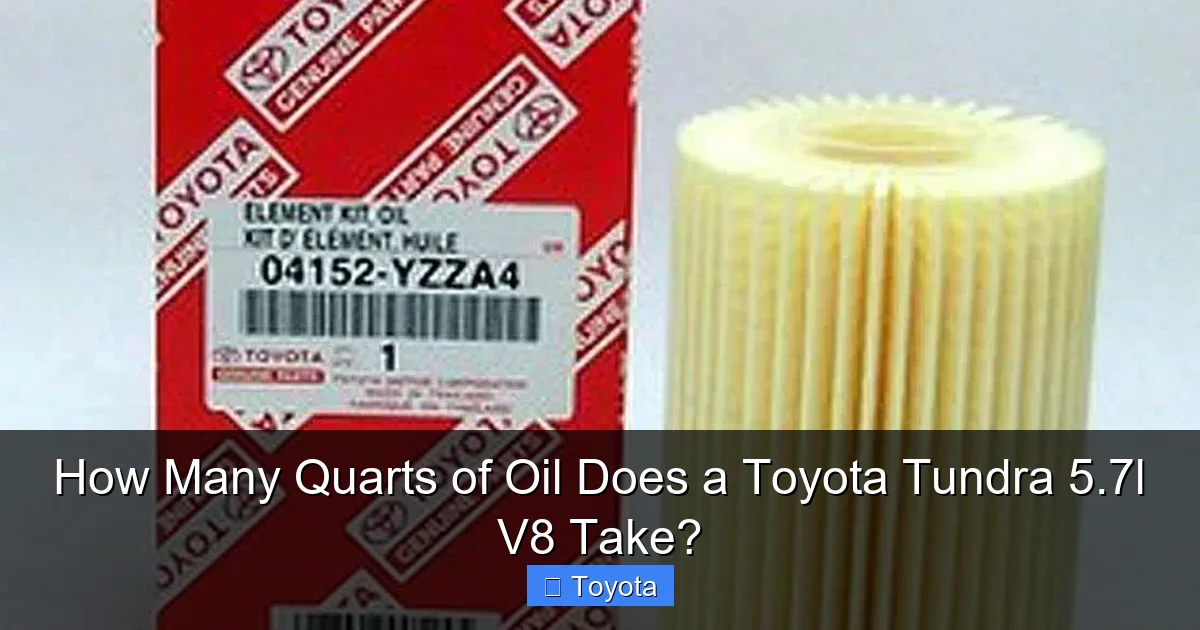
- Oil Filter: A high-quality filter that meets or exceeds Toyota specifications. Popular brands include Toyota Genuine, WIX XP, Fram Ultra, Mobil 1 M1, and K&N. Check the part number for your specific year (e.g., Toyota part 90915-YZZF4 for many models).
- Tools: Socket wrench and socket for the oil drain plug (typically 14mm or 17mm), oil filter wrench (if needed, as many Tundras use a cartridge-style filter that requires a special wrench), drain pan (at least 10-quart capacity), funnel, rubber gloves, safety glasses, and a good set of ramps or jack stands. Never rely on the factory jack alone.
- Consumables: New drain plug washer/gasket (crucial! Toyota often uses a crush washer that should be replaced every time), shop towels, and a container for the old oil.
The Process: Draining, Replacing, and Filling
- Warm the Engine: Run the engine for 5-10 minutes to warm the oil. Warm oil flows faster and carries more contaminants out. Let the truck cool for 10-15 minutes so the oil is hot but not scalding, and you can safely work.
- Lift and Secure: Drive the Tundra onto level ramps or use a jack and jack stands on solid frame rails. Ensure it’s stable. Remove the skid plate if it obstructs the oil pan and filter.
- Drain the Oil: Place your large drain pan under the oil pan. Use the correct socket to remove the drain plug. Be prepared for a strong, hot stream. Let it drain completely (10-15 minutes). The oil flow will slow to a drip.
- Replace the Drain Plug Washer: This is a step many skip with disastrous results. Remove the old crush washer from the drain plug. Install a new, correct-size washer. Hand-thread the plug back in, then torque it to the manufacturer’s specification (usually around 30 ft-lbs, but check your manual). Do not overtighten.
- Replace the Oil Filter: The 5.7L V8 typically uses a cartridge-style filter located on the front of the engine, not a spin-on canister. You will need a special socket or wrench (often 64mm or 22-flute) to remove the filter housing cap. Carefully unscrew it. The old filter cartridge will be inside. Remove it and wipe the housing and cap clean with a lint-free cloth. Lubricate the new filter’s o-ring with a tiny dab of fresh oil. Install the new cartridge, reinstall the cap, and torque it to spec (often 18 ft-lb, check manual).
- Fill with New Oil: Remove the oil filler cap on the valve cover. Place a clean funnel. Slowly pour in 7.5 quarts of fresh oil. This initial fill is less than the total to allow for checking. Wait 2-3 minutes for the oil to settle in the pan.
- Check the Level: Pull the dipstick, wipe it clean, reinsert it fully, and pull it again. Check the oil level. It should be between the “L” (Low) and “F” (Full) marks, ideally at or near the “F” mark. If it’s below “L,” add oil in 0.25-quart (1/4 quart) increments, rechecking each time. The goal is to get it exactly on the “F” mark when the engine is warm, on level ground, and has been off for a few minutes. You will likely need to add the remaining 0.5 to 1.0 quarts to reach full.
- Final Steps: Replace the filler cap. Start the engine and let it idle for 30-60 seconds. Check for leaks around the drain plug and filter housing. Turn off the engine, wait a minute, and re-check the dipstick level. Top off if necessary to the “F” mark. Dispose of old oil and filter properly.
This methodical approach prevents the common mistake of blindly dumping in 8.5 quarts without verification. Factors like a slightly tilted truck, a different filter brand holding a bit more or less, or a tiny bit of old oil left in the engine can change the final required amount by a few ounces. The dipstick is your final, absolute authority.
Common Pitfalls and Expert Tips for Tundra Owners
Even with the best intentions, mistakes happen. Here’s how to avoid the most common pitfalls and ensure your 5.7L V8 stays healthy for hundreds of thousands of miles.
Mistake #1: Ignoring the Dipstick and Blindly Trusting the Spec
The 8.5-quart figure is a starting point, not a final command. As mentioned, always use the dipstick to confirm. Overfilling by even a quart can cause aeration, where the spinning crankshaft churns the oil into a frothy, ineffective foam that can’t lubricate properly and causes pressure issues. Underfilling by a quart is a direct path to bearing wear. Trust the stick.
Mistake #2: Using the Wrong Oil Filter
A cheap, low-quality filter can have a poor sealing surface, a bypass valve that opens too early, or filter media that doesn’t trap fine particles. This negates the benefit of your expensive synthetic oil. Stick to reputable brands. If you switch filter brands, be aware that a different filter might have a slightly different internal capacity, which is another reason to verify the dipstick level after filling.
Mistake #3: Forgetting the Crush Washer
Reusing the old, flattened drain plug washer is a leading cause of slow, maddening oil leaks. The crush washer is designed to seal once when tightened to torque. It is a single-use item. Always use a new one. It’s a $0.50 part that saves you from a stained garage floor and a potential safety issue.
Mistake #4: Using Conventional Oil or the Wrong Viscosity
The 5.7L V8 is a high-performance engine with tight tolerances and advanced systems like VVT-i. It is designed for modern, low-viscosity synthetic oils. Using older 10W-30 or 5W-30 conventional oil can increase wear, reduce fuel economy, and potentially cause sludge buildup over time. Follow the manual to the letter. If you own other vehicles, you might be used to different capacities; for instance, a Toyota Tacoma with a different engine will have its own specific needs.
Expert Tip: The Hybrid i-FORCE MAX Model
The 2022+ Tundra offers the i-FORCE MAX hybrid-assisted powertrain, which pairs the 5.7L V8 with an electric motor/generator. The engine itself is fundamentally the same 3UR-FE V8, and its oil capacity remains 8.5 quarts. The hybrid system has its own separate fluid (hybrid system fluid), but it does not change the engine oil requirement. The same oil change procedure applies.
Expert Tip: Oil Change Intervals
With modern full synthetic oil, the traditional 3,000-mile rule is obsolete. Toyota’s official recommendation for the 5.7L V8 under “normal” driving conditions is typically 10,000 miles or 12 months. However, if your driving is predominantly “severe” (lots of short trips, extreme temperatures, heavy towing, dusty conditions, or extensive idling), you should shorten this interval to 5,000-7,500 miles. The truck’s maintenance reminder system (if equipped) will also calculate oil life based on your driving habits. When in doubt, err on the side of caution and change it sooner.
Beyond the Basics: Connecting to Your Truck’s Health
Oil is just one part of a complex system. The oil capacity figure is meaningless if the oil can’t do its job. The oil pump must deliver it under pressure, the passages must be clean, and the oil must stay within its effective temperature range.
This is why using a high-quality oil filter is so important. A clogged filter bypass valve will open under extreme pressure, allowing unfiltered oil to circulate, but it also means the filter isn’t doing its job. A restricted filter increases pressure load on the pump. Similarly, the oil’s viscosity is chosen to provide the correct film strength at both startup (cold) and operating (hot) temperatures. Using a thicker oil than specified in winter can cause hard starting and increased wear during the critical first few seconds. Using a thinner oil than specified in summer can lead to inadequate film strength under high load and temperature, such as when towing a heavy trailer up a mountain pass.
Think of your Tundra’s lubrication system as a city’s water supply. The oil capacity is the size of the reservoir. The oil viscosity is the thickness of the pipes. The filter is the water treatment plant. The oil pump is the main pumping station. All must work in harmony. A failure in one area compromises the whole system. This holistic view helps you understand why following all specifications—capacity, viscosity, filter quality, and interval—is essential for the legendary reliability of the 5.7L V8.
Conclusion: Your Tundra’s Heartbeat
The answer to “how many quarts” is beautifully simple for the Toyota Tundra 5.7L V8: 8.5 quarts with a filter change. This consistency across model years is a gift to owners. But as we’ve explored, the real answer is more nuanced. The number is your starting point, your baseline for purchasing oil. The true answer lies in the ritual: warming the engine, draining the old lifeblood, replacing the crush washer and filter with quality parts, and then, most importantly, methodically checking and adjusting the level with the dipstick until it reads perfectly on the “F” mark. Combine that ritual with the correct 0W-20 or 5W-20 full synthetic oil that meets API SP and Toyota specs, and you are performing one of the most vital maintenance tasks for your truck.
Your Tundra’s 5.7L V8 is an engineering marvel of durability and power. It asks for very little in return: clean air, good fuel, and clean oil at the right level. By respecting the 8.5-quart specification and the process behind it, you are not just changing oil; you are actively preserving the heart of your truck, ensuring it can haul, tow, and adventure for years to come. Now, grab your tools, your 8.5 quarts, and give your Tundra the care it deserves. For other common Toyota maintenance questions, from Tacoma oil type to more general guides, our library is a valuable resource for every Toyota owner.
Frequently Asked Questions
What happens if I overfill my Tundra’s 5.7L V8 with oil?
Overfilling by more than about 0.5-1 quart can cause the crankshaft to whip through the oil sump, creating foam or aeration. Aerated oil cannot properly lubricate, leads to increased engine wear, causes erratic oil pressure, and can damage seals or even create conditions for hydrolock. Always check the dipstick after an initial fill.
Can I use 5W-30 oil in my 5.7L Tundra if 0W-20 is specified?
It is not recommended. The engine is designed and calibrated for the specific flow characteristics of 0W-20. Using a thicker oil like 5W-30, especially in cold weather, can increase wear during startup, reduce fuel economy, and potentially cause issues with the VVT-i system. Always use the viscosity specified in your owner’s manual.
Is the oil capacity different if I have a TRD Pro or Limited trim?
No. The oil capacity is determined by the engine block and oil pan design, not the trim level. All Tundra trims with the 5.7L V8 engine have the same 8.5-quart service fill capacity. Differences in trim affect features like suspension, interior, and wheels, not the engine’s internal lubrication volume.
How do I know if my oil filter is the correct one for my Tundra?
The safest way is to use the exact part number listed in your owner’s manual or provided by a Toyota parts department. You can also use the part number from your old filter as a reference when buying a new one. Reputable aftermarket brands (WIX, Fram, Mobil 1, K&N) will list compatibility by year, make, model, and engine. Double-check this before purchasing.
My dipstick shows low oil after a change, but I added 8.5 quarts. What’s wrong?
This is common and usually not a leak. Possible reasons include: 1) The truck was not on perfectly level ground when you checked. 2) You did not wait long enough for the new oil to drain fully from the filter and engine galleries into the pan after filling. 3) The new oil filter you used holds slightly more or less oil than the specification assumed. Add oil slowly in small increments (1/4 quart at a time) with the engine off, rechecking the dipstick each time, until it reaches the “F” mark.
Does changing the oil myself affect my Toyota warranty?
No. Performing your own maintenance, including oil changes, does void the warranty as long as you follow the specifications in the owner’s manual (correct oil type, capacity, filter, and interval) and keep records of the service (like receipts for oil and filter). However, any damage caused by improper service (e.g., using wrong oil, overfilling, stripping the drain plug) would not be covered. Keep good records.
