
Why Is My Jeep Fan Running So Loud?

A loud cooling fan in your Jeep is rarely normal and often points to a specific problem. It could be a faulty coolant temperature sensor, a failing electric fan motor or clutch, a stuck relay, or even low coolant. Ignoring the noise risks overheating and severe engine damage. This guide breaks down the causes, helps you diagnose the issue, and outlines your repair options to get your Jeep running quietly and cool again.
Key Takeaways
- The cooling fan is critical for engine health: It prevents overheating, especially when idling or in traffic. A loud fan means it’s working overtime or failing.
- Common causes are often electrical: Faulty relays, bad coolant temperature sensors, or wiring issues cause fans to run constantly or erratically.
- Mechanical failure is also possible: On models with a fan clutch (especially older Jeeps), a seized clutch makes the fan roar like a helicopter.
- Low coolant can trigger the fan: If your coolant level is low, the sensor thinks the engine is hot and keeps the fan running.
- Diagnosis starts simple: Check coolant levels, listen for the fan’s sound type, and scan for diagnostic trouble codes (DTCs) before assuming the worst.
- Driving with a constantly loud fan is risky: It indicates the cooling system is under stress, which can lead to a breakdown or expensive engine damage.
- Some fixes are DIY-friendly: Replacing a relay or sensor is often a simple, inexpensive fix. Motor/clutch replacement is more involved.
📑 Table of Contents
- Why That Roaring Noise Matters: Your Jeep’s Cooling System 101
- The Two Types of Jeep Cooling Fans: Knowing What You Have
- Top 7 Reasons Your Jeep Fan Is Running Loud (And How to Identify Them)
- Step-by-Step Diagnostic Plan: Finding the Source of the Noise
- Can You Drive It? When to Park and Call for Help
- Repair Options: From DIY to Professional
- Prevention: Keeping Your Jeep’s Cooling System Happy
- Conclusion: Don’t Ignore the Roar
Why That Roaring Noise Matters: Your Jeep’s Cooling System 101
You’re sitting at a stoplight, engine idling, and you hear it: a deep, roaring, almost helicopter-like sound coming from the front of your Jeep. Or maybe it’s a high-pitched electric whine that just won’t quit. That’s your cooling fan. And it’s trying to tell you something important. In a Jeep, especially one that’s seen trails, tow duty, or just daily driving in traffic, the cooling system is its lifeline. The fan’s job is to pull air through the radiator when you’re not moving fast enough for natural airflow to cool the hot engine coolant. When it’s running loud, it’s usually because the fan’s control system thinks the engine is dangerously hot, or because a mechanical component has failed. Ignoring this noise is like ignoring a fire alarm—it might just be a burnt toast, but it could also be a real fire. In this case, the “fire” is overheating, which can warp cylinder heads, blow head gaskets, and destroy your engine. Let’s break down exactly why your Jeep fan is running so loud and what you can do about it.
The Two Types of Jeep Cooling Fans: Knowing What You Have
Before we diagnose, you need to know which type of fan system your Jeep uses. This is the first big divide in troubleshooting.

Visual guide about Why Is My Jeep Fan Running So Loud?
Image source: images.app.ridemotive.com
Mechanical Engine Cooling Fans with a Fan Clutch
Common on older Jeep models (like many TJ, XJ, and earlier JK/JLU models with certain engines) and some heavy-duty trucks, this system uses a belt-driven fan attached directly to the engine’s water pump pulley. The key component is the fan clutch. This viscous coupling unit is designed to “slip” at cooler temperatures, allowing the fan to spin slower and quietly. When engine temperature rises, the clutch locks up, making the fan spin at near-engine speed for maximum cooling. A loud, roaring fan that sounds like a turbine is the classic sign of a failed fan clutch. The clutch has seized solid, so the fan is now locked to the engine and spinning at full RPM all the time, regardless of temperature. This creates massive drag on the engine, reducing power and fuel economy, and making that terrifying noise.
Electric Radiator Cooling Fans
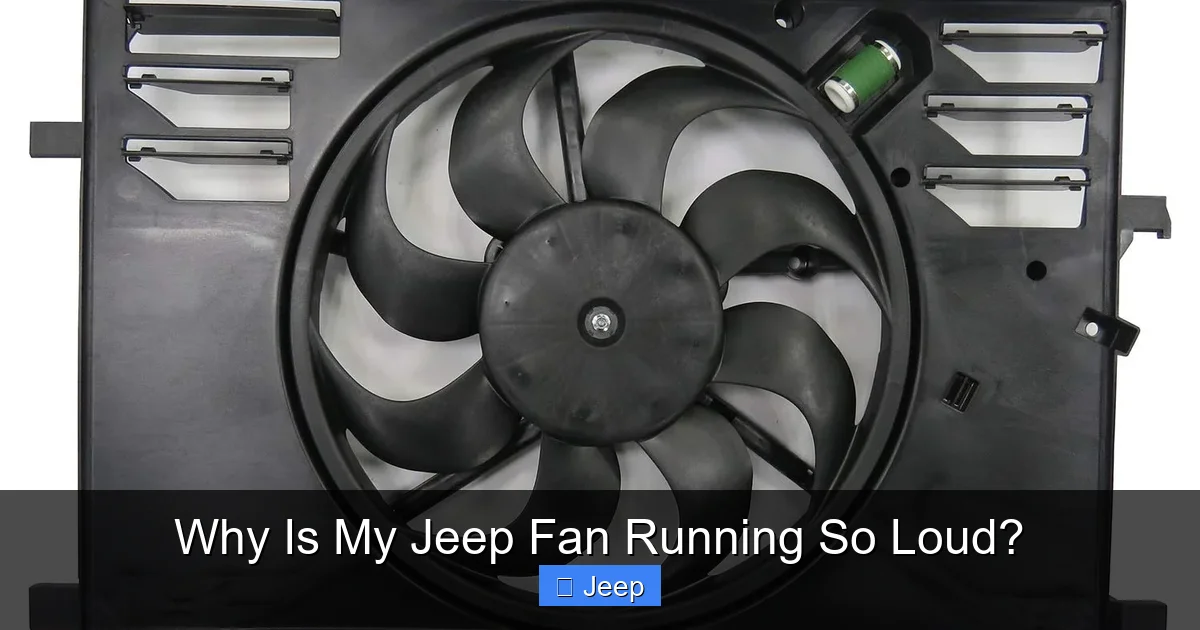
Most modern Jeeps (late-model JK/JLU Wranglers, Grand Cherokees, Gladiators, and nearly all newer models) use one or two electric fans mounted to the radiator. These are controlled by the engine control module (ECM) based on inputs from sensors. The fan(s) should only run at high speed when needed—usually when the AC is on or coolant gets too hot. If your electric fan is running loud constantly, even when the engine is cold, the problem is almost certainly in the control circuit. This could be a shorted wire, a stuck relay, a faulty coolant temperature sensor, or a failed fan motor itself that’s drawing excessive current.
Top 7 Reasons Your Jeep Fan Is Running Loud (And How to Identify Them)
Now let’s get into the nitty-gritty. Here are the most common culprits, how they sound, and initial ways to check them.
Visual guide about Why Is My Jeep Fan Running So Loud?
Image source: koala.sh
1. Failed Fan Clutch (Mechanical Fan Systems)
Symptom: A loud, roaring, deep rumble that changes slightly with engine RPM. You might also notice a drop in performance, especially when accelerating, as the engine works harder to spin the solid fan. The fan will be spinning very fast even when the engine is cold.
Diagnosis: With the engine cold and off, try to spin the fan blade by hand. It should turn with some resistance but relatively freely. If it’s locked solid or has extreme binding, the clutch is shot. Also, inspect the clutch for oil leaks (you’ll see a dark, greasy film). A leaking clutch is a failed clutch.
2. Faulty Coolant Temperature Sensor (CTS) or Sensor Wiring
Symptom: The fan runs constantly at high speed, even on a cold start. The engine temperature gauge (if equipped) might show normal or low temp despite the fan screaming. This sensor tells the computer how hot the engine is. If it fails and sends a constant “overheat” signal, the computer will command the fan on full blast to protect the engine.
Diagnosis: Use an OBD2 scanner to check for codes like P0115-P0119 (Engine Coolant Temperature Circuit). You can also test the sensor’s resistance with a multimeter when cold and hot—it should change smoothly. Visually inspect the sensor and its wiring for damage, corrosion, or loose connections. A quick search online for your specific Jeep model’s CTS location is worthwhile.
3. Bad Fan Relay(s) or Fuse
Symptom: The fan may run continuously, or it might not run at all when it should. A relay that has welded its contacts closed will send constant power to the fan. This is a very common and inexpensive fix.
Diagnosis: Locate the fan relay(s) in the power distribution box under the hood (your owner’s manual shows the map). Swap the suspected fan relay with an identical one for a non-critical function (like the horn relay, if same type). If the problem follows the relay, replace it. Also, check the corresponding fuse. Listen for a faint click from the relay when the fan comes on; no click can indicate a control circuit issue.
4. Stuck or Failed Fan Motor (Electric Fans)
Symptom: A very loud, high-pitched whining, grinding, or screaming noise from the fan itself. The motor bearings may be worn out. The fan might also run intermittently or not at all if the motor is shorting.
Diagnosis: With the engine off and key on, turn the AC to max. Both fans should engage. If one is louder than the other, that’s the culprit. You can sometimes disconnect the electrical connector for the suspect fan and see if the noise stops (be careful, fan blades are sharp). A motor that draws too much current can also cause a loud noise and may pop the fuse.
5. Low Coolant or Air in the Cooling System
Symptom: The fan runs more than usual, possibly loudly, because the coolant level sensor or temperature sensor is reading incorrectly due to low fluid. Air pockets can also cause false hot readings.
Diagnosis: This is the easiest check. With the engine cold, open the radiator or coolant reservoir cap. Is the coolant level at the “Full Cold” mark? If it’s low, top it up with the correct coolant mix. If it’s very low, you have a leak that must be found. Also, look for milky oil (a sign of a head gasket leak) or sweet-smelling smoke (a sign of a leak onto the hot exhaust).
6. Faulty A/C Pressure Switch or System Overload
Symptom: The fan runs loudly and constantly, but only when the A/C is on. The A/C system has its own pressure sensor that can command the fan to run at high speed to condense refrigerant. If that switch fails “on,” the fan will run with the A/C.
Diagnosis: Does the loud fan noise stop when you turn the A/C off? If yes, the problem is likely in the A/C circuit—a bad pressure switch, overcharged system, or clogged condenser. You’ll need A/C-specific diagnostics.
7. Aftermarket Accessory Interference or Wiring Short
Symptom: A new light bar, winch, or poorly installed accessory might have tapped into the wrong wire, causing a short that keeps the fan relay engaged. The fan noise might correlate with using that accessory.
Diagnosis: Think back to any recent electrical work. Disconnect accessory fuses one by one to see if the fan behavior changes. Inspect wiring harnesses near the radiator for chafed or pinched wires.
Step-by-Step Diagnostic Plan: Finding the Source of the Noise
Don’t just guess. Follow this logical sequence to pinpoint the problem.
Visual guide about Why Is My Jeep Fan Running So Loud?
Image source: thecarhow.com
Step 1: The Visual and Fluid Check
Always start here. With the engine cold, check coolant level and condition. Look for obvious leaks around the radiator, hoses, water pump, and fan clutch (if equipped). Check your engine oil. Does it look normal, or is it milky/frothy? Milky oil is a major red flag for a serious head gasket leak, which often causes overheating and fan overwork.
Step 2: Listen and Identify the Fan Type
Pop the hood and have someone start the engine (do not touch moving parts!). Can you see a large, blade-style fan directly attached to the engine? That’s mechanical. Do you see one or two electric fans mounted on the radiator core? That’s electric. The sound is also telling: a deep, belt-driven roar vs. a high-pitched electric whine.
Step 3: Scan for Codes
Borrow or buy a basic OBD2 scanner. Plug it in and read for any stored codes. Codes related to coolant temperature (P0115-P0119), fan circuits (P0480-P0483), or A/C (P0530-P0533) are huge clues. Even if the check engine light isn’t on, there may be pending codes. This is often the fastest way to a diagnosis. For more complex electrical issues, a professional scan tool that can view live sensor data is invaluable.
Step 4: Relay and Fuse Swap Test (Electric Fans)
As described above, swap the fan relay with a known-good one. This takes five minutes and solves many problems. Check the fan fuse while you’re at it.
Step 5: Sensor and Wiring Inspection
Locate the coolant temperature sensor (usually on the thermostat housing or cylinder head). Disconnect it and see if the fan behavior changes. Note: On many Jeeps, disconnecting the CTS will cause the fan to turn on as a fail-safe. If it was already on, it might turn off. This test varies by model. Consult a forum for your specific Jeep year/engine. Also, wiggle the sensor’s wiring while the engine is running to see if the fan surges—this indicates a broken wire inside the insulation.
Can You Drive It? When to Park and Call for Help
This is the most critical question. If your temperature gauge is in the red or hot zone, or if you see steam/smell coolant, DO NOT DRIVE. Shut off the engine immediately and let it cool. You are minutes away from catastrophic damage.
If the fan is loud but your temperature gauge is reading solidly in the normal range (typically halfway between cold and hot), you might be able to drive a short distance to a repair shop, but you are taking a significant risk. The loud fan is a symptom that the system is struggling. A traffic jam or hot day could push it over the edge. If you must move the vehicle, drive slowly, keep the RPMs low to reduce engine heat, and monitor the gauge like a hawk. If it starts to climb, pull over and shut off.
For a mechanical fan clutch that’s seized, you are also losing power and fuel economy. While not an immediate overheat risk on a cool day in open highway driving, it’s still a failing component that needs replacement soon.
In summary: Loud fan + normal temp gauge = cautious, short-distance drive to diagnose. Loud fan + high temp gauge = tow truck.
Repair Options: From DIY to Professional
Your repair path depends on your skill, tools, and the diagnosed problem.
The Simple Fixes You Can Do Yourself
If the diagnosis points to a bad relay, blown fuse, or low coolant, these are beginner-friendly fixes. Relays and fuses are usually in the engine bay fuse box. Just match the part number and plug in the new one. Topping off coolant is trivial, but you must find and fix the leak if it’s low. Replacing a coolant temperature sensor is also often a simple bolt-on job (drain a little coolant first!). These parts typically cost $15-$50.
The Intermediate Project: Fan Clutch or Electric Fan
Replacing a fan clutch on a mechanical system requires socket sets, possibly a torque wrench, and careful reassembly. You’ll need to remove the fan shroud and sometimes the radiator to get access. It’s a messy job (coolant, old belts) but very doable with basic tools and a service manual. Cost for a quality clutch: $80-$200.
Replacing an electric fan motor or assembly involves disconnecting electrical connectors, removing bolts, and carefully maneuvering the heavy fan unit out. The main challenge is often access—the radiator may need to be partially or fully removed. This is a great project for an intermediate DIYer. A new fan motor/assembly runs $150-$400+.
When to Call a Professional
Call a mechanic if: you suspect a head gasket failure (milky oil, white exhaust smoke, compression test needed); you have no idea how to diagnose the electrical circuit; the problem is an A/C pressure switch or system issue; or you simply don’t have the time, tools, or confidence for the job. A professional diagnosis with advanced scan tools can save you from buying the wrong part. They can also pressure-test the cooling system for leaks and perform a thorough inspection.
Prevention: Keeping Your Jeep’s Cooling System Happy
The best fix is a problem that never happens. A healthy cooling system is quiet and efficient.
- Regular Coolant Flushes: Follow your manufacturer’s service interval (often every 30,000-50,000 miles or 3-5 years). Old coolant loses its anti-corrosive properties and can gel, causing blockages and making the fan work harder.
- Inspect Belts and Hoses: Look for cracks, bulges, or wear on all serpentine belts (including the one driving the mechanical fan) and radiator hoses. Replace them proactively.
- Check for Leaks: Periodically glance at the ground under your parked Jeep for green or orange puddles. Check the coolant reservoir level when the engine is cold every few months.
- Clean the Radiator and Condenser: Bugs, leaves, and dirt act as an insulator. Use a gentle hose spray (low pressure) from the inside out to clean the fins. A clogged radiator makes the fan run more often and louder.
- Address Small Problems Immediately: That slight temperature spike in traffic? The occasional whiff of coolant? The slowly dropping coolant level? These are warnings. Get them checked before they strand you.
For more on general overheating issues, which are often the root cause of fan problems, you can read our detailed guide on common causes of car overheating. It covers radiator issues, thermostats, and water pumps that all contribute to cooling system stress.
Conclusion: Don’t Ignore the Roar
That loud fan in your Jeep is your engine’s desperate cry for help. It’s a symptom, not the disease itself. The root cause could be a $30 relay or a $500 fan clutch. It could be low coolant or a $3,000 head gasket repair. The key is to listen, investigate systematically, and act before the temperature gauge climbs into the danger zone. Start with the simplest checks—coolant level, fuses, and listening for the sound type. A quick OBD2 scan can provide invaluable clues. By understanding your Jeep’s cooling system and addressing the noise promptly, you protect your investment, avoid costly breakdowns, and keep your Jeep ready for whatever adventure—or commute—lies ahead. Remember, a quiet cooling system is a healthy cooling system.
Frequently Asked Questions
Is it safe to drive my Jeep with the cooling fan running loudly all the time?
It depends on your temperature gauge. If the gauge shows normal operating temperature, you may drive a short distance cautiously. However, if the gauge is high or in the red, you must stop immediately to avoid severe engine damage. A constantly loud fan indicates the cooling system is struggling and could fail at any moment.
How much does it typically cost to fix a loud Jeep cooling fan?
The cost varies wildly. A simple relay or fuse fix might cost $20-$50 for the part. A coolant temperature sensor replacement could be $50-$150 in parts and labor. A fan clutch for a mechanical system is $150-$400 installed. An electric fan motor replacement ranges from $300-$800+ depending on the model and labor time. Always get a diagnosis first.
Can a loud cooling fan cause my Jeep to lose power or gas mileage?
Yes. A mechanically locked fan clutch creates a huge parasitic load on the engine, sapping horsepower and fuel economy. An electric fan running constantly draws significant electrical current, putting extra load on the alternator and engine. Both conditions will make your Jeep feel sluggish and drink more fuel.
What’s the difference between a bad fan clutch and a bad electric fan motor?
A bad fan clutch (mechanical) makes a deep, roaring, turbine-like noise that changes with engine RPM and is present even when cold. A bad electric fan motor makes a high-pitched whining, grinding, or screaming noise and may only run when the AC is on or the engine gets hot. You can often see the mechanical fan belt-driven, while electric fans are mounted on the radiator.
My Jeep fan is loud but the temperature gauge is normal. What should I check first?
First, check your coolant level when the engine is cold. Low coolant is a common trigger. Second, scan for any stored diagnostic trouble codes (OBD2). Third, locate your fan relays and swap the suspected one with a known-good relay of the same type. This simple step fixes many “fan always on” problems. Also, visually inspect for any recent electrical work that might have caused a short.
Could a loud fan be related to my Jeep’s A/C system?
Absolutely. On many Jeeps, the cooling fan(s) also run when the A/C is on to help condense refrigerant. If the A/C pressure switch is faulty and stuck “on,” it will command the fan to run continuously whenever the A/C is engaged, which can be loud. If the loud fan only happens with the A/C on, this is a prime suspect.
