
Can You Put a Hitch on a Jeep Compass?

Yes, you can absolutely install a hitch on a Jeep Compass. It’s a popular upgrade for this versatile compact SUV, enabling trailer towing, bike racks, and cargo carriers. The process involves selecting the correct hitch class for your model year and engine, ensuring proper installation, and understanding your vehicle’s specific towing capacity. Professional installation is highly recommended for safety and to maintain your warranty.
So, you’ve got a trusty Jeep Compass. It’s the perfect compact SUV for daily commutes, weekend adventures, and everything in between. But maybe you’ve found yourself eyeing a little pop-up camper, a utility trailer for DIY projects, or a nice bike rack for family outings. The big question pops up: Can you put a hitch on a Jeep Compass? The short, exciting answer is a resounding yes! Adding a hitch is one of the most practical and transformative upgrades you can make to your Compass, unlocking a world of utility.
But, as with any vehicle modification, the details matter. It’s not just about bolting something on the back. You need the right hitch for your specific model year and engine, a proper understanding of your towing limits, and a safe installation. Whether you’re a seasoned DIYer or prefer to leave it to the pros, this guide will walk you through every single step, consideration, and tip. We’ll turn that question into a confident “Yes, and here’s exactly how.”
Key Takeaways
- Compatibility: Almost all Jeep Compass model years (from the 2007 debut to current) can have a hitch installed, but the specific hitch type and towing capacity vary by year and engine (2.0L, 2.4L, or turbo).
- Hitch Class Matters: Most Compasses use a Class II (1-1/4″ receiver) or Class III (2″ receiver) hitch. The class determines your maximum tongue weight and trailer weight.
- Professional Install Recommended: While DIY kits exist, professional installation ensures correct wiring, torque specs, and frame contact, preventing damage and safety issues.
- Towing Capacity is Key: Never exceed your Compass’s published Gross Combined Weight Rating (GCWR). A 2023 Compass with the 2.4L engine has a max tow rating of 2,000 lbs.
- Wiring is Essential: For any trailer or lit rack, you’ll need a proper wiring harness to integrate with your Compass’s electrical system for brake lights and turn signals.
- Aftermarket vs. OEM: Quality aftermarket hitches from brands like Curt, Draw-Tite, or Reese are often more affordable and equally robust compared to Mopar’s OEM option.
- Impact on Systems: A correctly installed hitch should not interfere with parking sensors or the rearview camera, but always verify fitment before final installation.
📑 Table of Contents
- Understanding Jeep Compass Hitch Compatibility
- Types of Hitches Available for the Jeep Compass
- The Installation Process: DIY or Professional?
- Towing Capacity and Weight Distribution: Don’t Guess, Know
- Beyond Towing: Other Hitch-Mounted Accessories
- Maintenance and Long-Term Care for Your Hitch
- Conclusion: Yes, You Can—And You Should Do It Right
Understanding Jeep Compass Hitch Compatibility
The Jeep Compass has been in production since 2007, spanning two generations. While the core concept remains the same—a compact, capable crossover—the underpinnings have changed. This means the hitch compatibility isn’t a one-size-fits-all situation. The good news is that for virtually every model year, a hitch solution exists. The key is matching the hitch to your vehicle’s specific configuration.
Model Year and Generation Differences
The first generation (2007-2016) and the second generation (2017-present) have different frame designs and bumper structures. This primarily affects the type of hitch that bolts directly to the vehicle’s frame rails. For example:
- First Gen (2007-2016): Often uses a “step-bar” or “bumper-mounted” style hitch that attaches to the factory bumper support, or a full frame-mounted receiver hitch. The 2.4L World Engine models typically have a 1,000-1,500 lb towing capacity, while the 2.0L diesel (in some markets) and later 2.4L Tigershark engines saw slight increases.
- Second Gen (2017-Present): These models have a more integrated rear bumper design. The most common and recommended solution is a full receiver hitch that bolts to the frame, often requiring the removal or modification of the rear bumper cover’s lower section. Towing capacity for the standard 2.4L Tigershark engine is 2,000 lbs when properly equipped. The available 2.0L turbocharged engine (in some trims/markets) may have a similar or slightly higher rating, but you must confirm your specific vehicle’s door jamb sticker.
Pro Tip: Always start your hitch search by checking the yellow tire information label on your driver’s side door jamb. It lists your vehicle’s exact Maximum Trailer Weight and Maximum Tongue Weight. This is your legal and safe limit, not a suggestion.
The Critical Role of Your Engine
Your Compass’s engine is the heart of its towing capability. A 2.4L naturally aspirated engine and a 2.0L turbo have different power bands and cooling capacities. The manufacturer sets the towing limit based on the engine’s ability to maintain speed on grades, handle the extra load on the drivetrain, and keep the transmission and engine within safe operating temperatures. Never assume all Compasses can tow the same amount. A 2015 Compass with the 2.4L might be rated for 1,000 lbs, while a 2023 Compass Trailhawk with the same displacement is rated for 2,000 lbs due to engineering updates. Your door jamb sticker is the final authority.
Types of Hitches Available for the Jeep Compass
Once you know your Compass is capable (it is!), you choose the hitch type. For the Compass, you’ll primarily encounter two categories: receiver hitches and bumper hitches. The choice is almost always a receiver hitch for safety and versatility.
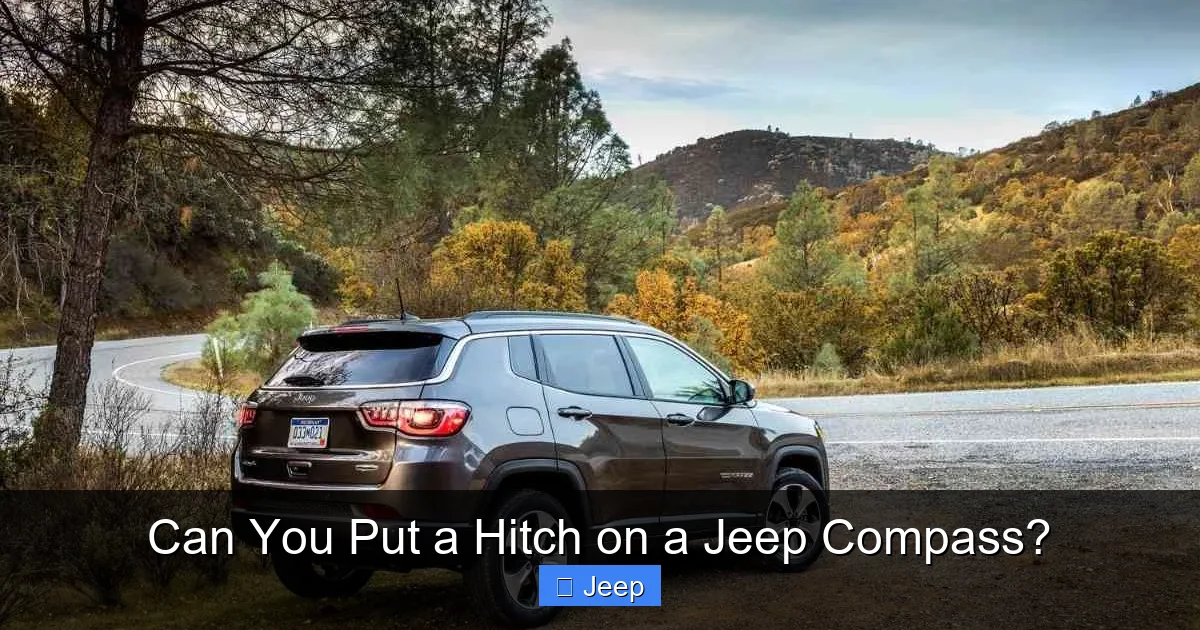
Visual guide about Can You Put a Hitch on a Jeep Compass?
Image source: fourwheeltrends.com
Receiver Hitches: The Gold Standard
This is the classic “ball mount” style hitch. It consists of a square tube (the receiver) that mounts to your vehicle’s frame, into which you slide a ball mount of the appropriate size and weight capacity.
- Class II (1-1/4″ receiver): This is the most common for the Jeep Compass. It’s suitable for light-duty towing up to 3,500 lbs gross trailer weight (though your Compass’s limit will be lower) and tongue weights up to 300-350 lbs. Perfect for small utility trailers, lightweight pop-ups, and bike/cargo carriers. Brands like Curt, Draw-Tite, and Reese offer excellent Class II options for all Compass years.
- Class III (2″ receiver): Less common on the Compass but available for some model years, especially if you have the higher-output engine. It offers more strength for heavier trailers (up to 5,000-6,000 lbs) and larger tongue weights (500-600 lbs). You must verify your vehicle’s frame can support this heavier-duty hitch and that your towing limit aligns with it.
Why a Receiver Hitch? It provides a clean look, allows for easy removal of the ball mount when not towing (improving ground clearance and rear visibility), and is compatible with a huge range of accessories beyond just a ball mount—like cargo carriers, bike racks that slide into the receiver, and even small winch mounts.
Bumper Hitches: A Less Common Alternative
Some older Compass models (particularly early first-gen) have aftermarket “bumper-mounted” hitches that bolt directly to the rear bumper assembly. These are generally not recommended for several reasons:
- They place more stress on the bumper and its mounting points, which are not designed for significant lateral or vertical loads.
- They often have lower weight capacities.
- They can interfere with the rear bumper’s appearance and function.
- They are rarely the best solution for a vehicle like the Compass, which has a unibody design with a separate frame rail structure that a receiver hitch can bolt into directly.
If you see a bumper hitch for your Compass, it’s usually a sign that a full receiver hitch wasn’t readily available at the time, or it’s for very light-duty use only. For safety and longevity, a frame-mounted receiver hitch is the superior choice.
The Installation Process: DIY or Professional?
This is the million-dollar question. Can you install a hitch on your Jeep Compass yourself? The answer is: it depends on your skill, tools, and comfort level.
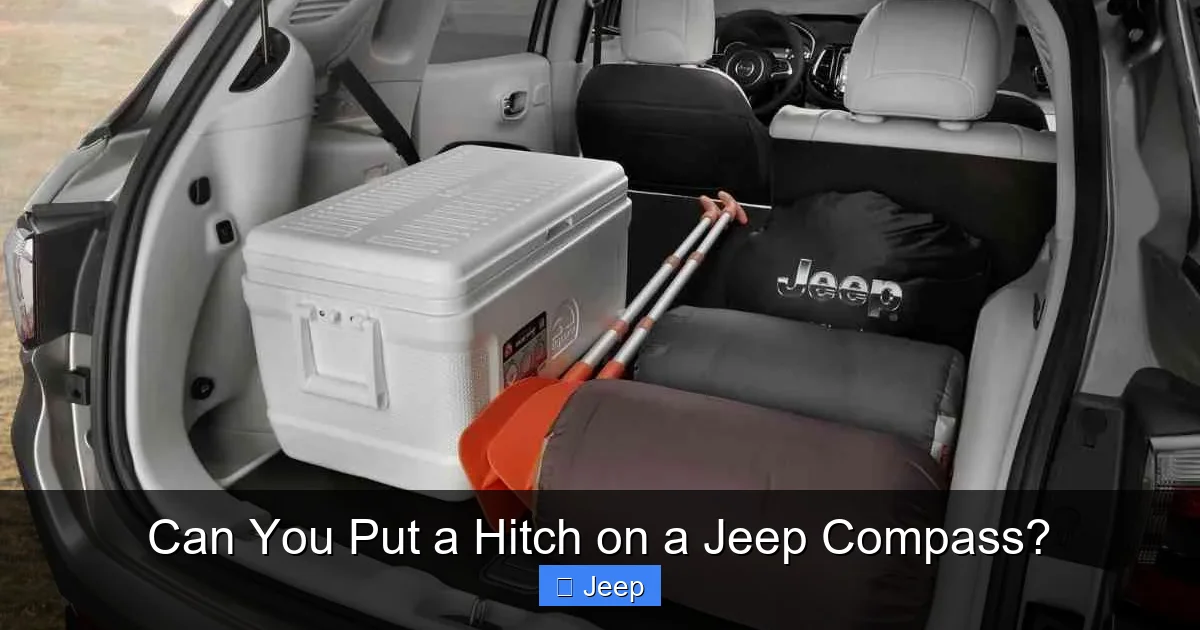
Visual guide about Can You Put a Hitch on a Jeep Compass?
Image source: fourwheeltrends.com
What a Typical Installation Involves
A standard hitch installation for a Compass is a multi-step process:
- Vehicle Preparation: Raising the rear of the vehicle securely on jack stands or a lift. Removing the rear bumper cover (on most second-gen models) to access the frame rails. This often involves removing plastic clips and sometimes bolts hidden under the vehicle.
- Frame Modification (Sometimes): On many second-gen Compasses (2017+), the hitch bolts to the frame rails in the location where the factory rear bumper reinforcement bar sits. This often requires carefully cutting or removing a section of the plastic bumper valence and sometimes modifying the metal bumper reinforcement bar to make room for the hitch’s cross tube. This is the most intimidating step for DIYers.
- Hitch Positioning and Bolting: Lifting the heavy hitch into place, aligning it with the pre-existing or newly accessed frame bolt holes, and torquing all bolts to the manufacturer’s specification (often 80-100 ft-lbs). Using the correct grade of bolt (usually grade 10.9 or 12.9) is critical.
- Wiring Harness Installation: This is a separate but equally important task. You need to tap into your vehicle’s wiring to power your trailer’s lights. A quality harness will use a “T-connector” that plugs into your Compass’s harness behind the tail light assemblies, requiring no cutting or splicing of factory wires. This part is generally simpler than the hitch mounting.
- Reassembly and Test: Reinstalling the bumper cover (with any necessary modifications), lowering the vehicle, and thoroughly testing all trailer light functions with a circuit tester.
When to DIY and When to Call a Pro
Consider DIY if: You have solid mechanical experience, a full set of tools (impact wrench, torque wrench, socket set, sawzall/reciprocating saw for bumper modification), a safe workspace, and you’ve meticulously studied the specific instructions for your exact hitch model and Compass year. Watching multiple installation videos for your specific vehicle is mandatory.
Call a Professional if: The idea of cutting your bumper or crawling under the car makes you nervous. You don’t have the right tools. You want the peace of mind of a warranty on the installation. Your Compass is still under its factory warranty, and you want to ensure the modification doesn’t void it (a properly installed aftermarket hitch typically won’t, but improper installation could). Services like U-Haul, local trailer shops, and even many dealerships offer professional hitch installation, often for a very reasonable fee when you purchase the hitch from them. For most people, professional installation is the smart, safe, and time-saving choice.
Towing Capacity and Weight Distribution: Don’t Guess, Know
This is the most serious part of the equation. Your Jeep Compass is a compact SUV, not a heavy-duty truck. Understanding and respecting its limits is non-negotiable for safety and vehicle health.

Visual guide about Can You Put a Hitch on a Jeep Compass?
Image source: fourwheeltrends.com
Finding Your Real Towing Capacity
As emphasized, your door jamb sticker is the bible. Look for the “Maximum Trailer Weight” and “Maximum Tongue Weight.” The trailer weight is the total weight of the trailer plus its cargo (the “gross trailer weight” or GTW). The tongue weight is the downward force the trailer exerts on the hitch ball. A good rule of thumb is tongue weight should be 10-15% of the total trailer weight.
For example, if your Compass is rated for 2,000 lbs GTW and 200 lbs tongue weight, a 1,500 lb trailer loaded with 500 lbs of cargo would be a 2,000 lb total—at your max. You’d have no room for error. It’s always safer to tow well below your max rating to account for wind, hills, and unexpected cargo.
The Importance of Weight Distribution Hitches
For trailers approaching the upper half of your Compass’s towing capacity (generally over 1,000-1,200 lbs), a weight distribution hitch (WDH) becomes crucial. A standard ball mount simply transfers the trailer’s tongue weight directly onto the rear axle of your Compass. This can cause the front end to lighten up, reducing steering control and braking effectiveness, and can sag the rear suspension.
A WDH uses spring bars to distribute a portion of that tongue weight across the front axle of your Compass and the axles of the trailer. This levels the vehicle, restores proper steering and braking, and creates a much safer, more stable towing experience. Check your Compass’s owner’s manual—some manufacturers require a WDH for trailers over a certain weight. Even if not required, it’s a highly recommended upgrade for anything beyond a very light utility trailer.
Beyond Towing: Other Hitch-Mounted Accessories
Don’t think a hitch is only for pulling a trailer. For many Compass owners, the primary use is for other fantastic accessories that enhance their vehicle’s utility for daily life and adventure.
Bike Racks and Cargo Carriers
This is the most popular alternative use. A hitch-mounted bike rack can carry 2-5 bikes securely and is far easier to load and unload than a roof rack, especially for heavier mountain bikes. It keeps bikes out of the way of rear doors and avoids roof height restrictions. Similarly, a hitch-mounted cargo carrier (like a basket or enclosed box) adds significant cargo space without compromising interior room or fuel economy as much as a roof rack would. These accessories typically use the same 1-1/4″ or 2″ receiver and have their own weight limits (often 150-300 lbs), which you must also respect in addition to your hitch’s capacity.
Considerations for Accessory Use
When using a hitch for accessories, remember:
- Total Weight: The weight of the loaded bike rack or cargo carrier counts as tongue weight. A loaded cargo carrier with 150 lbs of gear plus the carrier’s own 30 lbs is 180 lbs of tongue weight. This must be under your Compass’s maximum tongue weight rating.
- Access Lights: If a cargo carrier blocks your rear tail lights, you must install a lighting kit or use a carrier with built-in lights and a wiring harness that plugs into your hitch’s wiring.
- Reverse Sensors/Camera: Some accessories can obstruct your factory backup sensors or camera. Always check fitment and be prepared to temporarily disable sensors or rely on your mirrors.
Maintenance and Long-Term Care for Your Hitch
Once your hitch is installed, a little maintenance goes a long way to ensure it remains safe and functional for years.
Regular Inspection is Key
At least twice a year (before towing season and after), give your hitch a thorough look:
- Check all bolts for tightness. Vibration can loosen them over time. Use a torque wrench to ensure they are to spec.
- Inspect the hitch receiver and ball mount for cracks, excessive rust, or wear.
- Examine the wiring harness connections for corrosion, frayed wires, or loose plugs. Clean terminals with electrical contact cleaner.
- Look at the area where the hitch contacts the frame. There should be no gaps, and any included rubber or plastic isolators should be intact to prevent road noise and galvanic corrosion between the steel hitch and your vehicle’s frame.
Cleaning and Corrosion Prevention
Your hitch lives in a harsh environment—exposed to road salt, mud, and debris. Keeping it clean is more than cosmetic.
- Wash the hitch regularly, especially after driving on salted roads. Pay attention to the inside of the receiver tube where dirt and moisture collect.
- After washing, dry it thoroughly. Applying a light coat of lubricant (like a silicone spray) to the inside of the receiver tube can help prevent rust and make inserting/removing the ball mount easier.
- If you live in a corrosive environment (coastal areas, heavy winter salt), consider a hitch with a premium powder-coat finish. You can also touch up any chips in the paint with automotive primer and paint to prevent rust from starting.
Important Safety Note: Never lubricate the ball surface or the coupler socket. These must remain clean and dry for the trailer to lock securely and safely. Lubricant here can cause dangerous slippage.
Conclusion: Yes, You Can—And You Should Do It Right
So, we’ve answered the core question: Can you put a hitch on a Jeep Compass? Absolutely. It’s a straightforward and highly beneficial modification. The path to success involves three critical steps: know your exact towing capacity from your door jamb sticker, select a high-quality receiver hitch (Class II is most common) from a reputable brand that fits your specific model year, and have it installed correctly—ideally by a professional.
Your Compass is a capable, flexible vehicle. Adding a hitch doesn’t change its fundamental nature; it simply unlocks its potential to carry your gear, your bikes, or a small trailer. It turns your daily driver into a weekend adventure rig or a practical utility hauler. Just remember that with great utility comes great responsibility. Respect the weight limits, ensure your wiring is perfect, and maintain your hitch. Do that, and you’ll enjoy the added versatility of your hitch-equipped Jeep Compass for years and miles to come, opening up a whole new range of possibilities for what you and your SUV can do together.
Frequently Asked Questions
Will installing a hitch void my Jeep Compass warranty?
Generally, no. A properly installed, OEM-spec or high-quality aftermarket hitch should not void your vehicle’s warranty. However, any damage directly caused by the hitch or towing (e.g., a bent frame from an overloaded trailer) would not be covered. Always check with your dealer for your specific policy.
Can I install the hitch myself, or should I hire a professional?
While detailed instructions exist, installation often requires lifting the vehicle, modifying the rear bumper valence, and precise torqueing. For most owners, professional installation is the safer, faster, and warranty-friendly choice, typically costing $100-$300 for labor when you buy the hitch from the installer.
What is the maximum weight I can tow with my Jeep Compass?
This varies by model year and engine. The most common rating for recent 2.4L models is 2,000 lbs gross trailer weight and 200 lbs tongue weight. You must check the yellow sticker on your driver’s door jamb for your vehicle’s exact, legal ratings. Never guess or rely on general internet figures.
Should I get an OEM (Mopar) hitch or an aftermarket one?
High-quality aftermarket hitches from brands like Curt, Reese, or Draw-Tite are engineered specifically for your Compass, often at a lower cost than Mopar. They are perfectly safe and reliable. OEM hitches guarantee a perfect fit but are usually more expensive. For most, a premium aftermarket hitch is the best value.
Will a hitch block my rearview camera or parking sensors?
A properly fitted receiver hitch for your Compass should not obstruct the factory camera or sensors, as it mounts below the bumper line. However, a large ball mount or a cargo carrier could. Always check the clear view before driving with any accessory attached.
Can I use my Compass hitch for off-roading with a winch or recovery points?
No. The rear hitch is not designed for the extreme angles and forces of off-road recovery. Using it as a primary recovery point can cause severe damage to your vehicle’s frame or the hitch itself. For off-roading, use dedicated front and rear recovery points rated for that purpose.
