
Why Does My Tesla Smoke When Charging?

Why Does My Tesla Smoke When Charging? is an essential topic that provides valuable insights and practical knowledge for anyone interested in learning more about this subject.
You just plugged in your Tesla for a nice, overnight charge. Maybe you’re topping it up before a road trip or just getting ready for your daily commute. You walk back inside, feeling good about your eco-friendly choice, and then you see it. A wisp of smoke, or maybe something more concerning, drifting from around the charge port or under the car. Your heart skips a beat. Why does my Tesla smoke when charging? It’s a frightening sight, especially for an EV owner who expects quiet, clean operation. Panic is a natural first reaction, but before you call 911 or imagine the worst, take a breath. Not all smoke is an emergency, and understanding what you’re actually seeing is the critical first step.
This phenomenon is one of the more alarming things that can happen with an electric vehicle because it’s so unexpected. We’re conditioned to think of EVs as simple, with fewer moving parts and no exhaust. Seeing smoke violates that expectation. The truth is, your Tesla, like any complex machine, has systems that work hard during charging, and sometimes those systems can overheat or fail. The “smoke” is often a symptom, not the disease itself. Let’s break down exactly what’s happening, why it might be happening to your car, and what you absolutely must do about it. Your safety and your car’s health depend on a clear head and the right information.
Key Takeaways
- Understanding Why Does My Tesla Smoke When Charging?: Provides essential knowledge for making informed decisions
- Practical applications: Can be applied in various real-world scenarios
- Key benefits: Offers significant advantages when properly implemented
- Important considerations: Requires attention to specific details and best practices
- Future implications: Continues to evolve and impact related fields
📑 Table of Contents
- What You’re Actually Seeing: Smoke, Steam, or Something Else?
- The Usual Suspects: Why Your Tesla Might Smoke During Charging
- Immediate Actions: What to Do If You See Smoke
- How Tesla’s Safety Systems Are Designed to Protect You
- Diagnosing the Issue: From Home Checks to the Service Center
- Preventing Future Incidents: Smart Charging Habits
- Conclusion: Knowledge is Power (and Safety)
What You’re Actually Seeing: Smoke, Steam, or Something Else?
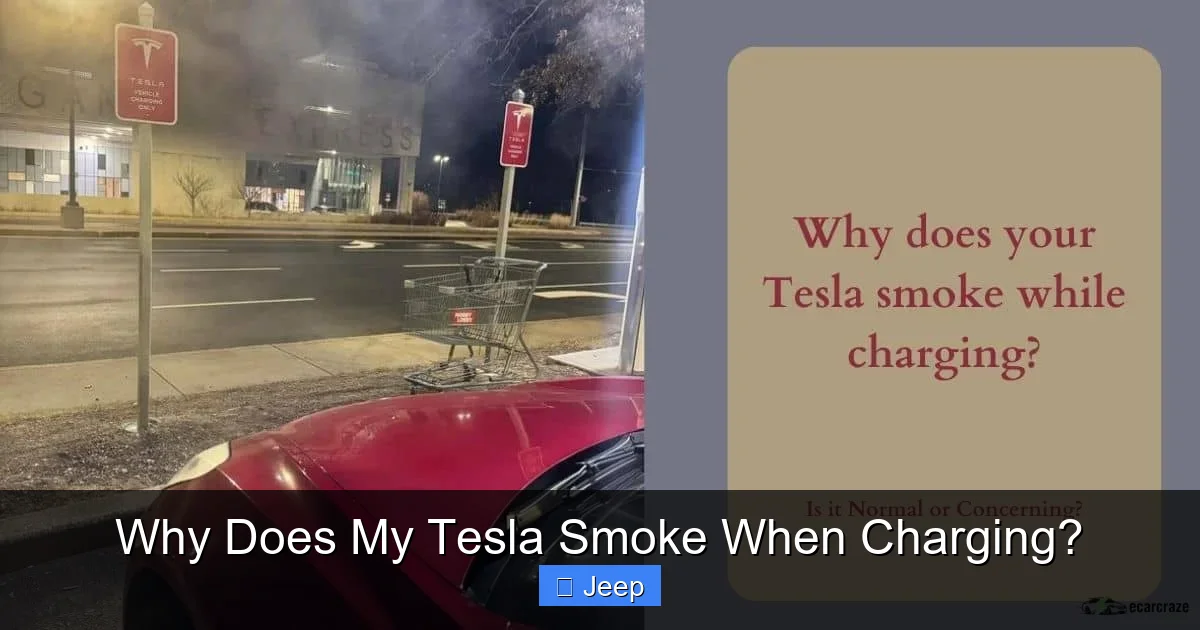
The first and most important distinction is to identify what is coming from your vehicle. Our brains see a gray cloud and scream “SMOKE! FIRE!” but it might not be that at all. During charging, especially fast charging, Tesla’s thermal management system works overtime. It’s designed to keep the battery within its optimal temperature range, which often means pumping coolant and running powerful fans. Under heavy load, it’s possible for that system to produce vapor.
The Steamy Culprit: Condensation
The most common and harmless sight is actually steam or water vapor. When the battery pack or the charging components get very warm, they can cause moisture in the surrounding air to condense. If you charge in a humid environment, like a garage after a rainstorm, this effect is amplified. You might see a light, white vapor that dissipates quickly and has no smell. This is usually not a cause for concern. It’s similar to seeing your breath on a cold morning, just happening under your car. However, it’s always wise to monitor it. If the “steam” becomes thicker, persistent, or is accompanied by a smell, it’s time to investigate further.
The Real Smoke: Burning Signs
Actual smoke is a sign of something burning. This is the serious scenario. The color and smell are your clues:
- White/Gray Smoke (Sweet Smell): This can indicate coolant burning. Tesla’s battery cooling system uses a specific coolant. A leak onto hot components (like the charger, motor, or exhaust-like components in the thermal system) can create this. It’s a sign of a leak in the cooling loop.
- Blue/Gray Smoke (Acrid, Electrical Smell): This is the most dangerous. It points to an electrical fire. Insulation on wires, components in the charge port, or, in the worst case, a battery cell undergoing thermal runaway (a violent, uncontrolled chemical reaction) can produce this. A burning plastic or electronics smell is a major red flag.
- Black Smoke (Sooty, Full-Burning Smell): This is less common in an EV but could indicate an external source, like something flammable under the car that has ignited from heat (e.g., a plastic bag, leaves). It’s rare but possible.
Any persistent, colored smoke with a distinct odor requires immediate action. When in doubt, treat it as a fire emergency.
The Usual Suspects: Why Your Tesla Might Smoke During Charging
So, what causes these burning scenarios? Modern Teslas are packed with sensors and safety systems, but failures can happen. Here are the most common root causes, from the more frequent to the extremely rare but severe.
Visual guide about Why Does My Tesla Smoke When Charging?
Image source: ecarcraze.com
Thermal Management System Overload or Failure
Your Tesla’s battery pack is a giant, high-voltage lithium-ion battery. It loves a specific temperature range, usually between 60°F and 100°F (15°C – 40°C). Charging, especially at a Supercharger, generates immense heat. The car’s cooling system—a liquid loop with a pump, radiator, and coolant—works tirelessly to pull that heat away. If this system has a problem, heat builds up. A failing coolant pump, a blocked or leaking coolant line, or a malfunctioning fan can cause the battery or power electronics to overheat. This overheating can then cause nearby components (plastic shrouds, wiring insulation, gaskets) to burn, producing smoke. It’s a cascade failure. You might also notice the car’s range dropping unusually fast or the charging speed throttling dramatically before you see smoke, as the car tries to protect itself by reducing power.
Battery Cell Issues or Thermal Runaway
This is the nightmare scenario every EV owner fears, but it is statistically extremely rare. A single lithium-ion battery cell can fail due to a manufacturing defect, physical damage (from a prior accident or road debris), or an internal short circuit. If one cell goes into thermal runaway, it releases flammable electrolyte gases and generates intense heat. This can spread to adjacent cells. The smoke from this is typically white/gray initially (from electrolyte burning) and can be profuse. The car’s battery management system (BMS) is designed to detect this and isolate the faulty module, but it can’t always stop the initial reaction. If you see a large amount of smoke, especially from under the car, and it smells sweet or chemical, evacuate immediately and call the fire department, informing them it’s an electric vehicle fire.
Charging Equipment Problems (The “Other” Side)
The problem might not be in your car at all. It could be the source of the electricity. This is why using certified, high-quality charging equipment is non-negotiable.
- Faulty Wall Connector or Mobile Connector: A damaged cable, corroded pins, or an internal fault in the charging adapter can cause arcing or overheating right at the port. You might see smoke or sparks specifically at the point where the connector meets the car.
- Home Electrical Issues: An overloaded circuit, a loose connection in your home’s electrical panel, or faulty wiring in the outlet can create a hazard that manifests when the high current of EV charging is drawn. The smoke might appear at the wall outlet or the electrical panel.
- Supercharger Station Malfunction: While rare, the high-power cabinets at Supercharger sites are complex. A fault there can send improper power to your car. Tesla’s onboard systems usually protect against this, but a major fault could cause damage. If smoking occurs only at a specific Supercharger stall, report it to Tesla immediately.
Contaminants or External Factors
Sometimes, the cause is outside the car’s core systems. A small animal may have nested in the wheel well or undercarriage, and the heat from charging or the brakes after a drive could ignite nesting material. Road debris like a plastic bag can get trapped in the rear wheel well and melt onto hot brake components. Always do a quick visual check under and around your parked car if you smell something unusual. This is a good habit for any vehicle, as issues like overheating at idle can also be caused by debris blocking airflow.
Immediate Actions: What to Do If You See Smoke
This is the most critical section. Your reaction in the first 60 seconds matters most. Do not panic, but act decisively and safely.
Visual guide about Why Does My Tesla Smoke When Charging?
Image source: ecarcraze.com
- STOP CHARGING IMMEDIATELY. If it’s safe to do so (no flames, thick smoke), walk to the car and press the button on the key fob or the charging connector release button (the flashlight-looking button on the charger handle) to disconnect the charger. Do not yank the cable. If the connector is very hot or you see active arcing, do not touch it.
- EVACUATE AND ASSESS. Move yourself, passengers, and pets to a safe distance—at least 100 feet away. Do not re-enter the vehicle or the immediate area to grab belongings. Take a moment from a safe spot to assess: Is there actual flame? How much smoke? What is the smell? This information is vital for emergency services.
- CALL 911. If there is any flame, thick smoke, or a strong acrid/chemical smell, call emergency services immediately. Tell the dispatcher it is an electric vehicle. EV fires require specific tactics and lots of water; firefighters need to know. Do not assume it will go out on its own.
- CALL TESLA ROADSIDE ASSISTANCE. Once you are safely away and emergency services are en route if needed, call Tesla. They will guide you through next steps and dispatch their own team if required. Have your VIN ready.
- DO NOT OPEN THE HOOD OR TRUNK. Introducing oxygen to an electrical or battery fire can make it worse. Let professionals handle it.
If the smoke is a very light, wispy vapor with no smell that stops as soon as you unplug, you may have a non-emergency situation. Still, do not resume charging. Schedule a service appointment. It’s better to be safe and have a technician inspect the cooling system and charge port.
How Tesla’s Safety Systems Are Designed to Protect You
It’s easy to feel vulnerable, but remember that Tesla has layered safety systems specifically to prevent and mitigate charging incidents. Understanding these can provide some peace of mind.
Visual guide about Why Does My Tesla Smoke When Charging?
Image source: koala.sh
The Battery Management System (BMS) – The Brain
The BMS is the sophisticated computer network monitoring every cell in your battery pack. It constantly checks voltage, temperature, and health. During charging, it’s the BMS that tells the charger how much power each module can accept. If it detects a cell overheating, it will try to reduce the charging current. If a cell fails catastrophically, the BMS can attempt to isolate that cell or module from the rest of the pack, containing the damage. This is why full battery fires, while devastating, are still very rare—the BMS often stops a single cell failure from becoming a pack-wide event.
Thermal Fuses and Physical Barriers
The battery pack is divided into sections separated by firewalls. Within the pack, there are thermal fuses that physically melt and disconnect sections if temperatures get dangerously high. There’s also a robust, aluminum-alloy battery enclosure designed to contain a thermal event for a significant period, giving occupants time to escape and preventing fire from entering the passenger cabin immediately.
Charging Communication Protocol
Your Tesla and the charging station (whether your wall connector or a Supercharger) are in constant digital communication. They exchange data about voltage, current, and temperature thousands of times per second. If the car detects any anomaly from the charger—or vice versa—the connection is severed instantly. This is a powerful safeguard against faults originating from the grid or the charging equipment.
These systems work brilliantly most of the time. When they don’t, it’s usually because a fault developed faster than the systems could react, or a component failed in a way that bypassed protections. This is where the Why does my Tesla smoke when charging? question gets its answer: a failure in one of these critical areas.
Diagnosing the Issue: From Home Checks to the Service Center
Assuming the immediate danger has passed, the next step is diagnosis. This is a job for Tesla Service, but you can provide them with crucial information.
Your Preliminary Investigation (Safely!)
Once the car is cool and safe, you can do a visual inspection from the outside. Do not open the front trunk or any panels. Look for:
- At the Charge Port: Are there any signs of melting, discoloration, or corrosion on the pins or the surrounding plastic? Is the connector or cable damaged?
- Under the Car: Can you see any fresh leaks (green, orange, or pink fluid is coolant; clear fluid is likely water condensation)? Are there any melted or charred plastic components under the rear bumper or wheel wells? Look for soot or burn marks.
- Smell: Carefully, from a distance, try to identify the lingering smell. Sweet? Burning plastic? Ozone (sharp, metallic)? This is a key diagnostic clue.
- Check the Tesla App: Go to the ‘Service’ section. Does your car have any active alerts? Common pre-smoke alerts might be “Charging Reduced,” “Battery Needs Service,” or “Coolant System Fault.” Take screenshots of any messages.
What Tesla Service Will Look For
When you schedule a service, be prepared to describe exactly what you saw, smelled, and when it happened. The technicians will likely:
- Run a full diagnostic scan of the battery management system, thermal control system, and charging system. This will pull error codes that pinpoint faulty sensors, pumps, or circuits.
- Perform a pressure test on the cooling system to check for leaks.
- Visually inspect the charge port internals, the high-voltage cabling, and the battery pack (often requiring removal of the rear underbody panels).
- Check the data logs from the specific charging session if it was at a Supercharger. Tesla can see the exact power curve and temperatures during your charge.
The repair could range from a simple coolant top-up and a faulty fan replacement to the more extreme (and rare) replacement of a battery module. The diagnostic data is what tells the story. This process is similar to diagnosing other complex electrical issues, like when a Dodge Ram cranks but won’t start—it all comes down to reading the computer’s clues.
Preventing Future Incidents: Smart Charging Habits
While you can’t prevent every single point failure, you can drastically reduce your risk with smart charging practices. Think of this as preventive maintenance for your EV’s most stressed system.
Charge Smart, Not Just Hard
- Avoid Extreme State-of-Charge (SoC) Charging for Daily Use: It’s fine to charge to 100% for a trip, but daily charging to the absolute max stresses the battery and generates more heat. Aim for an 80-90% daily limit for longevity and cooler operation. Tesla’s “Daily” charging limit setting is your friend.
- Precondition the Battery for Fast Charging: If you’re heading to a Supercharger, navigate to it in your Tesla. The car will automatically preheat or cool the battery to the ideal temperature for fast charging, making the process more efficient and less thermally stressful. A pre-warmed battery accepts charge faster and with less internal resistance heat.
- Ensure Adequate Ventilation: If you charge in a closed garage, especially in hot weather, consider opening the garage door or a window. The car’s cooling system pulls in ambient air. Good airflow helps it dissipate heat more effectively.
Maintain Your Charging Equipment
- Inspect Your Connector Regularly: Look for cracks, fraying, or corrosion on your mobile connector or wall connector cable. Check the pins for debris or damage. Clean them gently with a dry, soft brush if needed.
- Use Genuine or Certified Equipment: Never use cheap, uncertified third-party adapters or cables, especially for high-current (48A+) home charging. They are a common source of overheating and fire. Stick with Tesla’s gear or reputable brands like Lectron or Grizzl-E that are UL-listed.
- Check Your Home Electrical: Have a licensed electrician inspect your home’s charging circuit periodically, especially if you notice any warmth at the outlet or breaker. This ties into general home electrical safety, which is also relevant to preventing other automotive issues like overheating when the AC is on due to strained electrical systems.
Listen and Smell
Get to know the normal sounds of your Tesla while charging. A soft hum from the front trunk area (where the charger and pump are) is normal. Unusual grinding, clicking, or excessive fan noise is not. Similarly, know that a very light, clean “new car” or “electronics” smell is normal. A burnt sugar, burning plastic, or ozone smell is not. Early detection is your best defense.
Conclusion: Knowledge is Power (and Safety)
Seeing smoke from your Tesla while it’s charging is a visceral wake-up call. It shatters the illusion of effortless, simple motoring and confronts you with the raw, high-energy physics happening beneath the surface. The answer to why does my Tesla smoke when charging? is rarely simple, but it usually traces back to one of a few key areas: thermal management failure, a battery cell fault, or a problem with the charging equipment itself. The vast majority of the time, it’s a cooling system issue—a leak or a failed pump—that leads to overheating and the subsequent burning of non-battery components. True battery fires, while highly publicized, remain exceptionally uncommon.
Your path forward is clear. First and always, prioritize safety: unplug if possible, evacuate, and call for help if there’s any doubt. Second, become a keen observer of your car’s normal behavior. Third, practice preventive charging habits that reduce stress on the battery and cooling system. Finally, trust but verify with professional service. Tesla’s network of technicians has the tools to diagnose these complex issues accurately. While this experience is unsettling, it’s also an opportunity to learn more about your vehicle and become a more informed, proactive owner. The future of driving is electric, and with a little knowledge, you can enjoy it safely and confidently. Remember, when it comes to smoke and your Tesla, it’s always better to be overly cautious than to ignore a potential warning sign.
Frequently Asked Questions
Why does my Tesla smoke when charging?
Smoke during charging is often caused by normal condensation vapor from the battery pack warming up, especially in cold, humid conditions. However, a persistent or burning smell indicates a serious electrical issue that requires immediate attention. You should stop charging, move to a safe location, and contact Tesla Support.
Is it normal for my Tesla to emit vapor while charging?
Yes, it can be normal to see thin, white vapor or steam, particularly during the first charge of the day in cold weather. This is typically just condensation from the battery pack warming up and should dissipate quickly. If the vapor is thick, colored, or has a strong odor, it is not normal.
What should I do if my Tesla smokes during a Supercharger session?
If you see or smell smoke while Supercharging, immediately end the charging session via the touchscreen or app. Safely unplug the charge cable, move away from the vehicle, and call Tesla Roadside Assistance or emergency services. Do not attempt to drive the vehicle or open the front trunk.
Can a Tesla charge port cause smoking?
A smoking charge port is usually related to a poor electrical connection, a faulty adapter, or debris causing arcing. This is a fire hazard and you must stop charging instantly. Inspect the port and connector for damage or contamination, but do not use the vehicle until inspected by Tesla.
Does the Tesla adapter cause smoking when charging at home?
A faulty or incompatible third-party adapter, or a worn-out Tesla-provided adapter, can overheat and smoke due to high resistance. Always use genuine Tesla adapters in good condition. If an adapter gets hot or smokes, discontinue use immediately and order a replacement from Tesla.
How can I tell the difference between condensation smoke and a dangerous fire?
Condensation is thin, white, and odorless, disappearing within minutes. A dangerous fire produces thick, colored (black, blue) smoke, often accompanied by a sharp burning smell of plastic or electronics, popping sounds, or visible flames. When in doubt, treat it as an emergency and evacuate.
