
How to Put a Jeep Gladiator in 4-wheel Drive

Putting your Jeep Gladiator in 4-wheel drive is a simple but crucial skill for off-road adventures and poor weather. The process depends on whether your Gladiator has the part-time Command-Trac or heavy-duty Rock-Trac system. Generally, you stop the vehicle, shift into neutral, and use the electronic console lever or manual transfer case lever to select 4-High or 4-Low. Always remember you can only engage 4-Low from a complete stop and in neutral, and never use 4-High on dry pavement for extended periods.
So, you’ve got yourself a mighty Jeep Gladiator. That’s a truck built to tackle just about anything nature can throw at it, from rocky mountain trails to deep, snowy backroads. But all that capability is locked away until you know how to unleash it. Understanding how to put your Jeep Gladiator in 4-wheel drive isn’t just a neat party trick; it’s a fundamental piece of knowledge for any owner who plans to use their truck for its intended purpose. It separates the casual pavement princess from the true adventure seeker. Getting it wrong can lead to a frustrating day stuck in the mud or, worse, expensive damage to your truck’s vital components. Don’t worry, though. The process is designed to be user-friendly, and once you do it a couple of times, it becomes second nature. This guide will walk you through everything, from identifying your system to the exact steps for each mode, with plenty of tips and warnings to keep you and your Gladiator safe and sound.
First things first, let’s clear up a common point of confusion. The Jeep Gladiator comes with one of two primary 4×4 systems: the Command-Trac and the Rock-Trac. While both get power to all four wheels, they are engineered for different levels of severity. The Command-Trac is the standard, part-time system perfect for most owners who face occasional snow, sand, or light trails. The Rock-Trac is the heavy-duty, off-road-focused system with a ultra-low crawl ratio, found on the Rubicon and other off-road packages, designed for conquering the most extreme terrain. The steps to engage each are similar but have critical differences, especially regarding 4-Low. We’ll break them down separately. Think of this as your complete owner’s manual supplement, written in plain English.
Key Takeaways
- Know Your System: Identify if your Gladiator has the Command-Trac (part-time) or Rock-Trac (heavy-duty, with a crawl ratio) transfer case, as engagement procedures differ slightly.
- 4-High vs. 4-Low: Use 4-High for slippery roads, sand, or moderate off-road at normal speeds. Use 4-Low for severe off-road, rock crawling, or deep mud/snow, which multiplies torque but limits speed.
- The Neutral Requirement: You must have the transmission in Park (P) or Neutral (N) to shift into or out of 4-Low. For 4-High, many modern Gladiators allow “shift-on-the-fly” while moving slowly.
- Speed Matters: You can engage 4-High while driving at a steady, slow speed (typically under 55 mph). You must be stopped to engage or disengage 4-Low.
- Listen and Feel: A successful engagement is often accompanied by a mechanical clunk and a change in engine note. The 4WD indicator light on the dashboard will illuminate.
- Pavement is for 2WD: Driving on dry, high-traction pavement in 4-High or 4-Low causes “wheel binding” or “crow hop,” damaging your drivetrain. Use 2WD for normal roads.
- Disengage Properly: To return to 2WD, shift back to 2H while moving (for 4H) or from a stop in neutral (for 4L). The process is as important as engagement to avoid damage.
📑 Table of Contents
- Understanding Your Gladiator’s 4×4 Systems: Command-Trac vs. Rock-Trac
- How to Engage 4-High (4H) on a Jeep Gladiator
- How to Engage 4-Low (4L) on a Jeep Gladiator
- How to Disengage 4-Wheel Drive and Return to 2WD
- Practical Scenarios: When and How to Use Each Mode
- Common Mistakes, Myths, and Troubleshooting
Understanding Your Gladiator’s 4×4 Systems: Command-Trac vs. Rock-Trac
Before you touch a lever or button, you need to know what you’re working with. Pop the hood or check your window sticker. The system dictates the procedure and, more importantly, the limitations. Using the wrong method for your system can be ineffective or damaging.
The Command-Trac Part-Time System
The Command-Trac is a reliable, electronically controlled part-time 4×4 system. It’s designed for use on low-traction surfaces like snow, ice, mud, sand, and loose gravel. It does not have a center differential that allows for full-time use on dry pavement. When you select 4-High (4H), the front and rear driveshafts are locked together at a 50/50 torque split. This is fantastic for traction but means the front and rear wheels must rotate at the same speed. On dry pavement, they can’t, leading to tire scrub and drivetrain windup. This system is typically found on Sport, Overland, and Willys editions. It uses an electronic switch on the dashboard or center console to command the transfer case motor.
The Rock-Trac Heavy-Duty System
The Rock-Trac is the undisputed king of off-road in the Gladiator lineup, standard on the Rubicon and available on other trims with the Off-Road Group. Its claim to fame is the incredible 4.10:1 crawl ratio in 4-Low, achieved through a combination of the transfer case and axle ratios. This gives you immense slow-speed control for technical rock crawling. The Rock-Trac transfer case is more robust and often features a manual lever (though some have electronic push-buttons). Crucially, the Rock-Trac’s 4-Low engagement procedure almost always requires the vehicle to be at a complete stop and the transmission in Neutral. The mechanical nature of this system demands it. Knowing which system you have is your first and most important step.
How to Engage 4-High (4H) on a Jeep Gladiator
This is the mode you’ll use most frequently. 4-High gives you all-wheel traction while still allowing you to drive at normal highway speeds. It’s perfect for snowy roads, rainy highways, or sandy beaches. The good news? Engaging 4-High is incredibly simple in a modern Gladiator and can often be done while driving.

Visual guide about How to Put a Jeep Gladiator in 4-wheel Drive
Image source: jeepxpert.com
The “Shift-On-The-Fly” Method (Most Common)
For both Command-Trac and many Rock-Trac models with electronic controls, the process is designed for convenience. Here is the standard procedure:
- Step 1: Drive at a steady, moderate speed. The optimal range is typically between 10 mph and 55 mph. You do not need to stop.
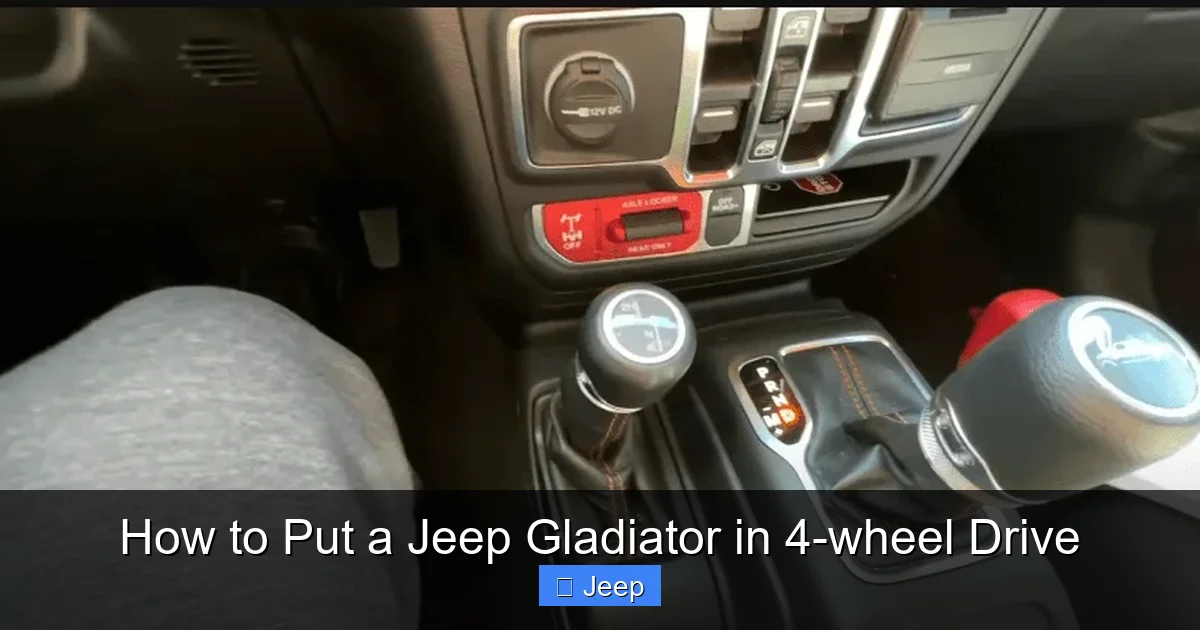
- Step 2: Locate your 4×4 control. This is usually a rotary dial or push-button array on the center console near the shifter or on the dashboard. Common labels are “2H,” “4H,” and “4L.”
- Step 3: While keeping your eyes on the road, firmly press or turn the selector to 4H.
- Step 4: You will hear a faint whirring or clicking from under the vehicle as the transfer case motor engages. The 4H indicator light (usually a yellow or orange icon of a truck with all wheels highlighted) will illuminate on your instrument cluster or the switch itself. That’s it! You’re now in 4-High.
Pro Tip: It’s good practice to do your first few engagements while the vehicle is stationary, just to get a feel for the control and listen to the mechanism. But the system is built for on-the-fly use. If you have a manual transfer case lever (common on older Gladiators or specific Rubicon models), you would need to come to a complete stop, put the transmission in Neutral, and then move the lever from 2H to 4H.
Important Notes for 4-High
Remember, 4-High is not for dry pavement. The wheel binding we mentioned earlier will cause a distinct binding sensation, unusual tire wear, and a groaning noise from the drivetrain, especially when turning. If you feel this, shift back to 2H immediately. Also, your fuel economy will drop noticeably in 4H because you’re spinning more drivetrain components. Use it only when needed. For a deeper dive into maximizing your truck’s capabilities in various conditions, understanding how different systems compare can be helpful, much like learning how to engage AWD in a Subaru Outback, which is a full-time system with different rules.
How to Engage 4-Low (4L) on a Jeep Gladiator
This is the heavy artillery. 4-Low multiplies your engine’s torque, giving you immense pulling power and incredibly slow, controlled speeds for crawling over rocks, fording deep water, or pulling a stuck friend out of a pit. However, it comes with strict rules. Engagement is different and requires more care.
Visual guide about How to Put a Jeep Gladiator in 4-wheel Drive
Image source: cardcow.com
The Mandatory Stop and Neutral Procedure
For virtually all Jeep Gladiators, engaging 4-Low is a stop-and-go procedure. Here’s the exact sequence:
- Step 1: Bring your Gladiator to a complete stop. Your speedometer should read 0 mph.
- Step 2: Depress the brake pedal firmly to keep the vehicle from rolling.
- Step 3: Shift your automatic transmission into Neutral (N). For a manual, press the clutch and shift into neutral. This is the non-negotiable step. The transmission must be out of gear.
- Step 4: Now, activate your 4×4 control. If you have an electronic switch/dial, press the button or turn the knob to select 4L. If you have a manual lever, you will need to physically move it from the 4H or 2H position into the 4L position. This will likely require more force than the 4H move.
- Step 5: You will hear a much louder, more mechanical clunk or grind as the transfer case’s low-range gears mesh. The 4L indicator light (often a different color, like red) will illuminate. It’s a very distinct sound and feel.
- Step 6: Once the light is on and you feel the engagement, you can shift your transmission back into Drive (D) (or 1st/2nd gear for a manual) and proceed.
Critical Warning: Never attempt to shift into 4L while moving or with the transmission in Park. You will likely hear a horrific grinding sound and potentially destroy your transfer case. If your vehicle is rolling, use the brake to stop it first.
Using 4-Low: The “Crawl” Concept
Once in 4-Low, your Gladiator’s personality changes. The engine revs higher at any given speed. You’ll use your brakes more frequently to control speed on descents rather than riding them constantly. The goal is to use the throttle delicately to “crawl” over obstacles. Your maximum speed in 4-Low is limited—typically you shouldn’t exceed 25-30 mph, and that’s on a flat, hard surface. On trails, speeds are much lower. Remember, this is for low-speed torque, not highway cruising. The principles of low-range driving are universal across heavy-duty trucks, similar to the considerations when learning how to engage 4WD on a Dodge Ram 2500, which also features a robust low-range system.
How to Disengage 4-Wheel Drive and Return to 2WD
Getting out of 4WD is just as important as getting into it. You should disengage 4WD as soon as you return to normal, high-traction surfaces to save fuel and prevent drivetrain wear.
Visual guide about How to Put a Jeep Gladiator in 4-wheel Drive
Image source: jeepoffroads.com
Exiting 4-High (4H)
This is easy. While driving at a steady speed (again, the 10-55 mph sweet spot), simply select 2H on your control dial or switch. You’ll hear the motor whirring again, and the 4H light will go out while the 2H light may illuminate. The vehicle will seamlessly return to standard rear-wheel drive. No need to stop or shift to neutral.
Exiting 4-Low (4L)
This requires the same careful procedure as entry. You must come to a complete stop.
- Step 1: Stop the vehicle completely.
- Step 2: Depress the brake pedal.
- Step 3: Shift the transmission into Neutral (N).
- Step 4: Select 2H (or 4H if you want to stay in a higher range) on your control. With a manual lever, move it back to the 2H position.
- Step 5: You’ll hear the distinct clunk as the low-range gears disengage and the high-range gears engage. The 4L light will go out.
- Step 6: Shift back into Drive (D) and continue.
Common Mistake: Some owners, after a long day on the rocks, forget they are in 4-Low and start driving on the highway. This is dangerous and damaging. The vehicle will feel sluggish, rev high at low speeds, and make abnormal noises. Always make a conscious check of your 4WD indicator light when you start the truck and when you transition from trail to road.
Practical Scenarios: When and How to Use Each Mode
Knowing the mechanics is one thing; knowing *when* to use them is what makes you a skilled Gladiator operator. Let’s walk through some real-world situations.
Scenario 1: A Snowy Morning Commute
The roads are covered in packed snow and ice. Your stock all-season tires are struggling for bite. Action: Before you leave the driveway, while stopped, engage 4-High. This will give you maximum traction from a standstill and while climbing snowy hills. Stay in 4H for the entire slippery commute. Once you hit the cleared, dry pavement of the city, shift back to 2H. The system’s ability to engage on the fly means you could wait until you’re on the main road, but doing it in your quiet neighborhood is better.
Scenario 2: A Sandy Beach or Dune
You’re at the beach, and the sand is deep and soft. Action: Lower your tire pressure (a key tip for sand driving!), then engage 4-High before you hit the deep stuff. The constant traction of 4H will help you maintain momentum, which is critical in sand. You may need to use a higher gear (like “3” in your automatic) to keep RPMs up and prevent bogging down. Stay in 4H until you are back on firm, packed sand or pavement.
Scenario 3: Technical Rock Crawling
You’re at an off-road park facing a steep, rocky staircase. Action: Stop at the base. Engage 4-Low using the stop/neutral procedure. Select a low gear (1st or “L” on your automatic). Now you have maximum torque multiplication. Use the “crawl” technique: very light throttle, letting the engine’s low-end power do the work, and use your brakes to control speed on descents. Your Gladiator will feel like a slow-motion tank, precisely what you need for placing tires on rocks. Disengage 4L only when you’re back on a smooth, high-traction section of the trail.
Common Mistakes, Myths, and Troubleshooting
Even with the best instructions, things can go wrong. Let’s address some frequent issues and debunk a few myths.
“I Can’t Get It Into 4-Low!”
This is the most common frustration. If your transfer case refuses to engage 4L, check these things in order:
- Are you at a complete stop? This is the #1 reason. The vehicle must be 0 mph.
- Is the transmission in Neutral? For automatic, the shifter must be in “N,” not “P.” Park is for parking; neutral is for transfer case shifts.
- Are your tires spinning excessively? If one wheel is breaking loose, the system might not engage. Lightly apply the brakes to transfer a tiny bit of torque and help the gears mesh.
- Is your battery voltage low? A weak battery can prevent the transfer case motor from having enough power to move the gears. A jump start might solve it.
- Is the vehicle on an incline? A severe slope can sometimes prevent engagement. Try to find a level spot.
Myth: You Should “Exercise” Your 4WD System Monthly
This is a half-truth. It’s a good idea to engage 4-High every few months on a slippery surface (like a wet grassy field or snowy parking lot) and make a few turns to ensure the system is functional. This circulates lubricant and keeps the seals from drying. However, you should not engage it on dry pavement just for the sake of it. The “exercise” should happen on a proper low-traction surface.
Warning Signs of a Problem
If you experience these, get your truck checked:
- A persistent, loud grinding or clunking noise when shifting into 4H or 4L.
- The 4WD indicator light flashes but never stays solid.
- You feel severe vibration or “binding” in 4H on a surface you know should be okay (like wet pavement).
- The transfer case lever (if manual) feels loose or has excessive play.
These can indicate worn transfer case components, a faulty shift motor, or a problem with the front axles. Driving with a malfunctioning 4WD system can leave you stranded when you need it most. For other common automotive issues, like how to put a car in neutral with a dead battery, having a baseline of knowledge helps in emergencies.
Frequently Asked Questions
Can I shift from 2H to 4H while driving on the highway?
Yes, you can. The Jeep Gladiator’s 4-High mode is designed for “shift-on-the-fly” use at steady speeds, typically between 10 mph and 55 mph. It’s safe and intended for situations like encountering sudden snow on a highway.
Do I need to be stopped to shift into 4-Low?
Absolutely. You must come to a complete stop, depress the brake, and shift your automatic transmission into Neutral (N) before selecting 4-Low. Attempting to engage 4-Low while moving will cause severe grinding and damage.
What happens if I drive in 4-High on dry pavement?
Driving on dry, high-traction pavement in 4-High causes “wheel binding” or “crow hop.” The front and rear drivetrains, locked together, fight against each other during turns. This creates a jerking sensation, damages tires, and puts extreme stress on the transfer case, front axle, and driveshafts. Avoid it.
How fast can I drive in 4-Low?
You should not exceed 25-30 mph in 4-Low, and that’s only on a flat, straight, hard surface. 4-Low is for slow-speed torque, not speed. On trails, your speed will be much lower, dictated by the terrain. Driving too fast in 4-Low can overheat the transfer case.
My 4WD light is on, but I don’t feel any power to the front wheels. Why?
An illuminated 4WD light means the system *thinks* it’s engaged, but there may be no actual power transfer. This can be caused by a broken front axle CV shaft, a faulty front differential, or a problem with the transfer case not actually moving the gears. You need to diagnose if it’s an electrical indicator issue or a mechanical failure.
Can I use 4-Low for towing a trailer on slippery roads?
No. For slippery-road towing, use 4-High. 4-Low is for extreme off-road at very low speeds. Using 4-Low at higher speeds (even 20 mph) for an extended period while towing will overheat your transfer case. Stick to 4H for any towing where you need extra traction.
