
Why Is My Mileage Blinking on My Jeep Renegade?

A blinking mileage display on your Jeep Renegade is not a minor glitch—it’s a critical warning sign from your vehicle’s computer indicating a serious, active fault. This almost always points to a problem within the drivetrain system, commonly a faulty transmission sensor, a failing Transmission Control Module (TCM), or a major discrepancy in vehicle speed data. Unlike a steady light, the blinking signifies the issue is currently happening and poses an immediate safety risk. You should stop driving as soon as safely possible and have the vehicle diagnosed with a professional scan tool to read the specific trouble codes. Ignoring this warning can lead to sudden transmission failure, unsafe driving conditions, and extremely expensive repairs.
That little trip meter on your dashboard, the one that usually calmly shows your miles per gallon or distance traveled, has suddenly started to flash or blink at you. Your heart skips a beat. In a Jeep Renegade, this isn’t just a quirky little bug—it’s your vehicle’s most urgent shout for help. A blinking mileage display is one of the most severe dashboard warnings you can receive, second only to a red oil pressure or engine temperature light. It represents a fundamental breakdown in communication between your vehicle’s vital sensors and its brain. This guide will walk you through exactly what this terrifying signal means, the most likely culprits behind it, and the exact steps you must take to protect your Renegade and your safety. We’ll talk in plain language, no mechanic jargon left unexplained, so you can walk into any repair shop informed and confident.
Key Takeaways
- It’s a Serious Active Fault: A blinking mileage display means the vehicle’s computer has detected a real-time, critical mismatch in speed data, not a past stored code.
- Transmission is the Prime Suspect: The vast majority of cases link directly to the transmission system, including sensors, the TCM, or fluid issues.
- Immediate Action is Required: Driving with this warning active can cause catastrophic transmission damage. Pull over safely and have the vehicle towed for diagnosis.
- OBD-II Scan is Mandatory: You cannot fix this without reading the specific diagnostic trouble codes (DTCs) from the TCM or PCM using a professional scan tool.
- Common Triggers Include: Faulty Vehicle Speed Sensor (VSS), Wheel Speed Sensor (WSS) issues, wiring harness damage, low/burnt transmission fluid, or TCM software glitches.
- Do Not Attempt a Simple Reset: The light will only blink again until the underlying mechanical or electrical fault is physically repaired.
- Prevention is Key: Regular transmission fluid changes and proactive sensor inspections during servicing can help avoid this alarming scenario.
📑 Table of Contents
- What Does a Blinking Mileage Display Actually Mean?
- The Most Common Culprits Behind the Blinking Light
- How to Diagnose the Problem: A Step-by-Step Guide
- Immediate Actions: What to Do When the Miles Start Flashing
- Prevention and Long-Term Care for Your Renegade’s Drivetrain
- The Cost of Ignoring the Blinking Warning
- Conclusion: Your Renegade is Talking to You—Listen
What Does a Blinking Mileage Display Actually Mean?
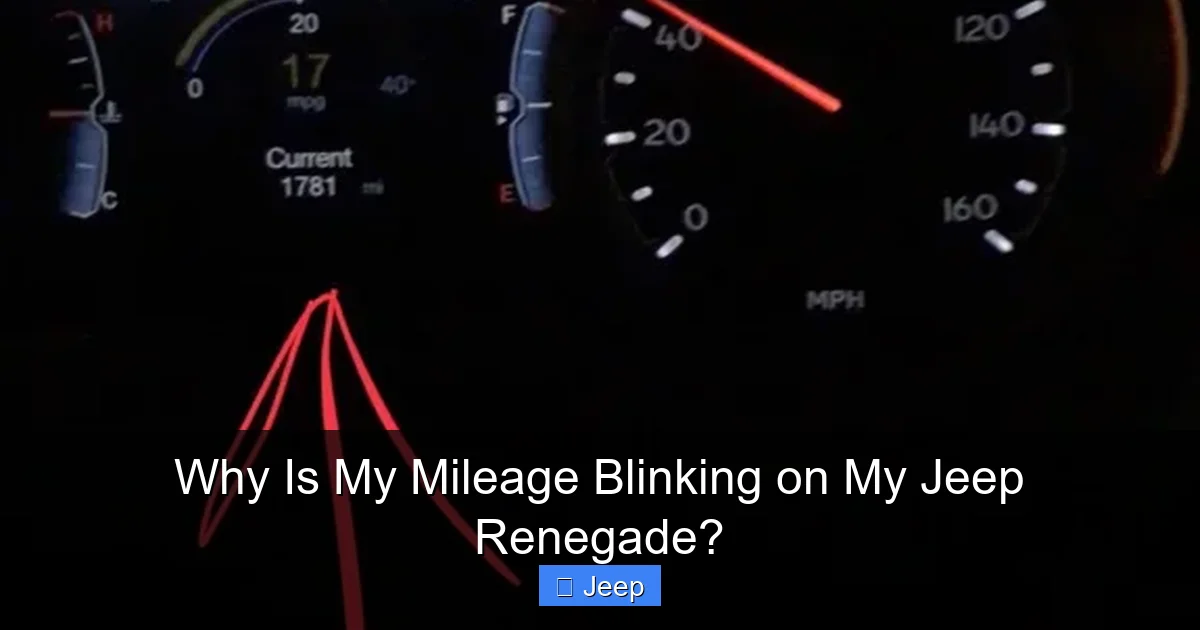
First, let’s clarify what we’re talking about. On your Jeep Renegade, the instrument cluster has a small digital screen, often part of the Driver Information Display (DID), that cycles through different readouts: trip odometer, fuel economy, distance to empty, etc. When this display begins to blink or flash rapidly—especially the “0.0” or the numbers themselves—it has switched modes from an informational display to a critical warning system.
This blinking is a direct, coded message from the vehicle’s Powertrain Control Module (PCM) or Transmission Control Module (TCM). The computer is telling you: “I am receiving impossible or missing data about the vehicle’s speed from my sensors. I cannot trust the information, and therefore, I am warning you that the drivetrain is in a potentially unstable or dangerous state.” It’s a fail-safe mode. The system knows that if it can’t accurately determine how fast the vehicle is going, it cannot properly manage transmission shifts, stability control, or anti-lock brakes. So, it alerts you and often locks the transmission into a single, safe gear (like 2nd or 3rd) to prevent further damage, a state known as “limp mode.”
This is fundamentally different from a steady, illuminated mileage display or a check engine light. A steady light often indicates a past fault that has been stored in memory. The blinking light means the fault is active and current. The problem is happening right now as you drive. This immediacy is what makes it so urgent.
The Core Communication Breakdown
To understand the blink, you need to understand the conversation. Your Renegade’s computer needs to know the vehicle’s speed for dozens of functions: when to shift gears, when to engage four-wheel drive, when to trigger stability control, and even for the speedometer itself. It gets this data from a primary sensor, often called the Vehicle Speed Sensor (VSS) or Output Shaft Speed Sensor, located on the transmission. This sensor’s signal is also shared with other modules. If that signal is erratic, drops out, or reports a speed that contradicts what other sensors (like the wheel speed sensors for ABS) are saying, the computer panics. The blinking mileage is its panic signal. It’s essentially saying, “I don’t know how fast we’re going, and that’s a huge problem.”
The Most Common Culprits Behind the Blinking Light
Now that we know the computer is screaming about bad speed data, where does that bad data come from? Here are the most frequent offenders in the Jeep Renegade, in order of likelihood.
Visual guide about Why Is My Mileage Blinking on My Jeep Renegade?
Image source: images.platforum.cloud
1. Faulty Vehicle Speed Sensor (VSS) or Output Shaft Speed Sensor
This is the number one suspect. This sensor is a magnetic or Hall-effect sensor mounted on the transmission that reads a reluctor ring on the output shaft. It generates an AC voltage signal whose frequency corresponds directly to the output shaft speed, and thus, road speed. Over time, these sensors can fail internally, their wiring can fray due to heat and movement, or the connector can corrode. A weak or intermittent signal from a failing VSS is a classic trigger for the blinking mileage and a simultaneous check engine light (often with codes like P0500 – Vehicle Speed Sensor Intermittent/No Signal).
2. Wheel Speed Sensor (WSS) or ABS Sensor Problems
Your Renegade has a Wheel Speed Sensor at each wheel for the ABS and Traction Control systems. These sensors also feed speed data to the PCM/TCM. If one or more of these sensors is damaged, has a broken tone ring, or has a wiring issue, it can send corrupted or conflicting speed data. The computer receives, for example, a signal from the front left wheel saying you’re going 60 mph, but the VSS says 45 mph, and the right rear says 0 mph. This major discrepancy causes the system to go into alert mode, blinking the mileage. A common related issue is damage to the wiring harness that runs to the sensors, which can be rubbed or chafed by suspension components.
3. Transmission Control Module (TCM) or Software Glitches
The TCM is the dedicated computer that manages your Renegade’s automatic transmission. Sometimes, the problem isn’t the data coming in, but the brain processing it. A software glitch or a failing TCM itself can misinterpret good sensor signals, thinking they are erroneous. This is less common than sensor failures but can be more complex to diagnose. In some model years, a TCM software update from the dealer may resolve the issue if it’s a known programming bug that causes false positives.
4. Electrical Gremlins and Wiring Harness Damage
Modern vehicles are networks of wires. A single chafed, shorted, or corroded wire in the speed sensor circuit can create an intermittent open or short circuit. This is especially true in the Renegade, where wiring looms can be routed near hot exhaust components or moving suspension parts. Grounding issues are also a prime suspect. A poor ground connection for the sensor or the TCM can cause all sorts of phantom signals. A thorough visual inspection of the wiring from the transmission VSS and all four wheel speed sensors back to their connectors is a critical diagnostic step.
5. Low, Dirty, or Burnt Transmission Fluid
While less common as a direct cause of a blinking mileage (it more commonly causes harsh shifts or slipping), severely degraded transmission fluid can lead to internal transmission problems that affect sensor readings or TCM logic. If the fluid is so old it has lost its lubricating and hydraulic properties, internal components can wear, potentially affecting the reluctor ring the VSS reads or causing pressure fluctuations that confuse the TCM. Always check fluid level and condition as part of the diagnostic process. Low fluid level is a definite red flag.
How to Diagnose the Problem: A Step-by-Step Guide
You’ve seen the blink. You’ve felt the dread. Now what? Diagnosis is not a guess-and-check game. It’s a systematic process. Here is the professional approach, which you can use to understand what a mechanic should be doing.
Visual guide about Why Is My Mileage Blinking on My Jeep Renegade?
Image source: koala.sh
Step 1: The OBD-II Scanner Is Your Best Friend
This is non-negotiable. You must plug a scan tool into the OBD-II port (under the dashboard, near the driver’s knee). But here’s the crucial part: you need a scanner that can read Transmission Control Module codes, not just engine codes. Many basic “code readers” from auto parts stores only access the PCM (engine) network. You need a more advanced tool or a professional mechanic with a dealer-level scanner (like the wiTECH for Fiat/Chrysler vehicles) to access the TCM. The codes stored here will be your roadmap. Common transmission-related codes that accompany a blinking mileage include:
- P0500: Vehicle Speed Sensor Circuit Malfunction
- P0700: Transmission Control System Malfunction
- P0706: Transmission Range Sensor Circuit Range/Performance
- P0715-P0720: Various Input/Output Speed Sensor codes
- U0XXX: Network communication codes between modules
If you have a good scanner and it shows no codes, that points even more strongly to a severe wiring issue or a module that is failing in a way that doesn’t set a code—which is very dangerous and requires immediate, deep electrical diagnostics.
Step 2: Visual and Physical Inspection
Before you touch a wrench, look. Start at the transmission. Locate the Vehicle Speed Sensor (your Renegade’s service manual or a quick online search for “Jeep Renegade VSS location” will show you). Is the sensor plug securely connected? Is the connector cracked, corroded, or water-filled? Is the wiring leading to it intact, or does it look rubbed, pinched, or melted? Follow the wiring harness as far as you can. Then, inspect each wheel speed sensor (behind the brake caliper). Check for broken wires or damaged sensor heads. Also, check your transmission fluid level with the engine running and warm, as per the owner’s manual procedure. Note the color and smell. It should be bright red and smell slightly sweet. If it’s dark brown/black and smells burnt, that’s a major problem.
Step 3: Testing Sensor Signals and Resistance
If the visual check doesn’t reveal an obvious problem, you need to test the sensors. With a multimeter, you can check the resistance of the VSS and WSS sensors (refer to service manual specs, typically 500-2000 ohms). An open circuit (infinite resistance) or a short to ground (0 ohms) means a dead sensor. More advanced testing involves checking the AC voltage signal produced by the VSS while cranking the engine or slowly driving the vehicle (this requires a helper and is unsafe to do alone). This is where professional expertise is invaluable.
Step 4: Checking for Technical Service Bulletins (TSBs)
Manufacturers often issue TSBs when they identify a recurring, non-safety-related problem with a specific model year and component. Your Jeep dealer can run your VIN to see if any apply. There have been TSBs for various Renegade models related to wiring harness routing for wheel speed sensors that can cause damage, or TCM software updates. Knowing about a TSB can save you days of diagnostic frustration and confirm the repair is covered under warranty if applicable.
Immediate Actions: What to Do When the Miles Start Flashing
This is the most important section. Your safety and the survival of your transmission depend on your next moves.

Visual guide about Why Is My Mileage Blinking on My Jeep Renegade?
Image source: automotivesimple.com
1. Do Not Panic, But Do Not Ignore It. The blinking is a warning, not a death sentence for your transmission… yet. It’s telling you to stop before more damage occurs.
2. Safely Pull Over and Stop Driving. As soon as you have a safe opportunity, signal, and move to the shoulder or a parking lot. Turn off the engine. The “limp mode” (if engaged) is the transmission’s last-ditch effort to protect itself by limiting you to one or two gears. Driving in this mode is possible for a short distance to get off the road, but it is not designed for normal driving. Continuing to drive at highway speeds in 2nd or 3rd gear will over-rev the engine, cause extreme heat, and can cause the transmission to fail completely within minutes or miles.
3. Check the Obvious (Safely). With the engine off, check your transmission fluid dipstick. Low fluid is a quick, easy fix if that’s the issue, but it also means you have a leak that must be found and repaired. Do not try to add fluid and continue driving if the level is extremely low; the damage may already be done. Also, give the area around the transmission and wheels a quick visual once-over for any obviously hanging wires or major leaks.
4. Call for Professional Help. This is not a DIY fix for a beginner. The problem is complex and electrical/electronic in nature. Your best and safest course of action is to have your Renegade towed to a trusted transmission shop or a Jeep dealership. Explain to them: “My mileage display is blinking, and the vehicle is in limp mode.” This tells them exactly what they’re dealing with before they even see the car.
5. Do Not Reset the Light. Some people think disconnecting the battery will fix it. It will not. The light will simply return as soon as the fault is detected again, which will be immediately upon driving. This wastes time and risks destroying the transmission.
Prevention and Long-Term Care for Your Renegade’s Drivetrain
While some failures are sudden and unavoidable, many can be prevented with proactive care.
Stick to a Strict Transmission Fluid Service Schedule
This is the single most important maintenance item for your automatic transmission. Jeep’s official recommendation for the Renegade’s transmission fluid (often labeled as “WS” fluid) varies by year and driving conditions, but a safe rule of thumb is to have it inspected every 30,000 miles and changed every 60,000-80,000 miles, especially if you do a lot of towing, hauling, or severe driving (extreme heat, stop-and-go traffic). Fresh fluid maintains proper hydraulic pressure, lubricates intricate parts, and helps sensors operate correctly. Burnt fluid is a leading cause of internal wear that can eventually affect sensor readings.
Be Mindful of Sensor and Wiring Vulnerability
The wheel speed sensors and their thin wiring harnesses are exposed to the elements and road debris. When having your brakes serviced, ask the technician to inspect the condition of the sensor wires and connectors. When off-roading or driving on rough roads, be aware that you’re subjecting these components to more stress. A pre-mudding inspection of these areas is wise.
Address Other Dashboard Warnings Immediately
An illuminated TPMS (tire pressure) light, while less urgent, can sometimes be related to the same wheel speed sensor network. A persistent check engine light, even if the car seems fine, should be scanned immediately. A small problem in one system can cascade and cause a fault in another. Catching a loose gas cap or a failing oxygen sensor early prevents stress on other modules. If you see other lights, investigate why your tire pressure light might be on or get a general engine scan to rule out contributing factors.
Use Quality Parts and Software Updates
If a sensor does need replacing, use an OEM (Fiat/Chrysler) or high-quality equivalent. Cheap aftermarket sensors can fail prematurely and cause the same problem again. If your mechanic suggests a TCM software update, it’s often a good idea to have it performed, as it can improve shift quality and system monitoring.
The Cost of Ignoring the Blinking Warning
Let’s be brutally honest about the financial risk. If you choose to “just drive it” and see what happens, you are playing roulette with a multi-thousand-dollar component. The cost to diagnose the issue properly (scanning, inspecting, testing) might be $150-$300. The cost to replace a faulty Vehicle Speed Sensor might be $200-$500 (part + labor). The cost to repair a damaged wiring harness is variable but usually manageable. The cost to replace a transmission that has been destroyed by running in limp mode or with bad data is $4,000 to $8,000 or more. The blinking light is the free, last-minute warning that gives you the chance to choose the $300 repair over the $6,000 one. Heed it.
Conclusion: Your Renegade is Talking to You—Listen
That blinking mileage display on your Jeep Renegade is one of the clearest and most urgent messages your car can send. It is not a suggestion; it is a command to stop and investigate. The root cause is almost always a problem with speed data—a sensor, a wire, or the computer that processes the signal. Your path forward is clear: stop driving safely, get a professional diagnosis with a advanced scan tool that reads the transmission module, and repair the specific fault identified. This is a problem where guessing or hoping it goes away will only lead to disaster. By understanding what the blink means and acting with swift, informed urgency, you protect your investment, ensure your safety, and can get back to enjoying your Renegade on the road where it belongs.
Frequently Asked Questions
What does it mean when my mileage is blinking on my Jeep Renegade?
It means your vehicle’s computer has detected a serious, active problem with the speed sensor data. This puts the transmission into a protective “limp mode” and indicates a fault in the drivetrain system that requires immediate professional diagnosis.
Is it safe to drive my Jeep Renegade with a blinking mileage display?
No. It is not safe. The vehicle is likely in a limited “limp mode” gear. Continuing to drive, especially at high speeds, can cause severe and permanent damage to the transmission. You should pull over safely and have the vehicle towed for repair.
What are the most common reasons for this blinking light?
The most common causes are a faulty Vehicle Speed Sensor (VSS), a damaged Wheel Speed Sensor (WSS) or its wiring, a problem with the Transmission Control Module (TCM), or a significant wiring harness issue. Low or degraded transmission fluid can also be a contributing factor.
Can I fix the blinking mileage myself?
Only if you have advanced automotive diagnostic skills and tools. The fix requires accurately diagnosing the problem via a professional-grade OBD-II scanner that can read transmission codes, then testing sensors and circuits. For most owners, this is a job for a qualified transmission specialist or dealership.
Will disconnecting the battery turn off the blinking light?
Temporarily, yes. But the light will return immediately once you drive the vehicle again because the underlying fault is still present. This does not fix the problem and only wastes time while risking further damage.
How much does it typically cost to fix a blinking mileage issue?
The cost varies wildly by the cause. Replacing a single faulty speed sensor might cost $200-$500. Repairing a wiring harness could be $300-$800. If the problem was ignored and the transmission failed, the cost jumps to $4,000-$8,000+. Early diagnosis is always cheaper.
