
When Should I Use Sport Mode in a Jeep Cherokee?

Sport Mode in your Jeep Cherokee transforms the vehicle’s personality by sharpening throttle response, holding gears longer, and tightening steering for a more engaging drive. It’s ideal for highway merging, navigating twisty roads, towing, or whenever you want a more responsive feel. However, it increases fuel consumption and isn’t suited for slippery conditions or daily city traffic where efficiency is key. Understanding its impact on your engine, transmission, and drivetrain is key to using it effectively.
So, you’ve got a Jeep Cherokee. Maybe it’s your trusty family hauler, your adventure mobile, or your daily driver. You’ve noticed that little “Sport” button on the shifter or dash, and you’ve been curious. What does it actually do? And more importantly, when should you use Sport Mode in a Jeep Cherokee? Let’s pop the hood on that question and break it down in plain English.
Think of your Cherokee’s normal “Auto” or “Normal” driving mode as a polite, efficient chauffeur. It’s always thinking about fuel economy, shifting up at the first opportunity to keep the engine humming quietly and sipping gas. Sport Mode, on the other hand, is like telling that chauffeur to get a little spirited. It’s not about turning your SUV into a race car—the Cherokee’s roots are in practicality—but it definitely wakes things up. It’s a software remap that changes how your vehicle’s heart (the engine) and nervous system (the transmission) communicate, often tweaking the steering and even the suspension if your Cherokee is equipped with an adaptive system.
My goal here is to give you a real-world, no-nonsense guide. We’ll talk about what changes under the hood, the perfect scenarios to flip that switch, and when you should absolutely leave it alone. By the end, you’ll know exactly how to use this feature to make your driving experience more enjoyable and appropriate for the road ahead. Let’s dive in.
Key Takeaways
- Use Sport Mode for highway driving and passing: It provides quicker acceleration for confident merging and overtaking.
- Engage it on winding, scenic roads: The transmission holds lower gears for better engine braking and power out of corners.
- Consider it for towing or hauling: It helps maintain power and reduces gear hunting when climbing hills with a load.
- Avoid Sport Mode in snow, ice, or heavy rain: The more aggressive throttle and shift points can reduce traction and stability on slippery surfaces.
- Expect lower fuel economy: The engine revs higher and shifts later, which burns more gas, especially in city traffic.
- It changes steering feel and sometimes suspension: On some models, steering weights up and adaptive suspensions firm up for better control.
[FEATURED_IMAGE_PLACEHOLDER]
📑 Table of Contents
What Exactly Is Sport Mode in a Jeep Cherokee?
Before we talk about the “when,” we need a solid grasp of the “what.” Sport Mode isn’t a mechanical modification; it’s an electronic personality adjustment. Jeep’s engineers wrote a different set of instructions for the vehicle’s computer (the Powertrain Control Module, or PCM) to follow when you activate it. Here’s what typically changes:
The Throttle Response Remap
This is the most noticeable change. In normal mode, pressing the gas pedal a quarter of the way might only open the throttle 20%. It’s a gradual, linear relationship designed for smoothness. In Sport Mode, that same pedal press might open the throttle 40% or more. The computer interprets your input as more urgent, so the engine responds with more power immediately. It makes the Cherokee feel quicker and more eager, even if the peak horsepower number on the spec sheet hasn’t changed.
Transmission Shift Logic Overhaul
This is the core of the experience. The transmission control module gets new instructions: shift later and downshift sooner. Instead of upshifting at 2,500 RPM to save fuel, it might wait until 3,500 or 4,000 RPM. It also becomes more proactive, downshifting when you touch the brake or tip into a corner to keep the engine in its power band. For vehicles with the ZF 9-speed automatic (common in later model Cherokees), this can mean more aggressive use of the lower gears and a more connected feel. You’ll often see the tachometer needle climb higher before a shift, and you’ll feel the car “hunker down” for acceleration.
Steering and Suspension Tweaks
On many modern Cherokee models, especially those with the available adaptive damping suspension (like the Trailhawk or certain Limited trims), Sport Mode can also firm up the dampers for less body roll in corners. Additionally, the electric power steering (EPS) system is recalibrated to provide more weight and feedback at higher speeds, giving you a more “connected” feel to the road. It’s not a wildly heavy steering like a sports car, but a noticeable, satisfying increase in effort and precision.
It’s crucial to understand that these changes are about feel and responsiveness, not about creating more peak power. You’re simply accessing the power your engine already has in a more immediate and engaging way. If you’re curious about how other manufacturers implement similar systems, you can see a comparison of how Sport Mode works in a Toyota Camry, which uses a similar electronic remap strategy for its own goals.
The Perfect Times to Slap It Into Sport
Now for the fun part: the scenarios where Sport Mode truly shines and makes your Cherokee feel like it’s in its element. These are the times you’ll get the most benefit and enjoyment out of the feature.
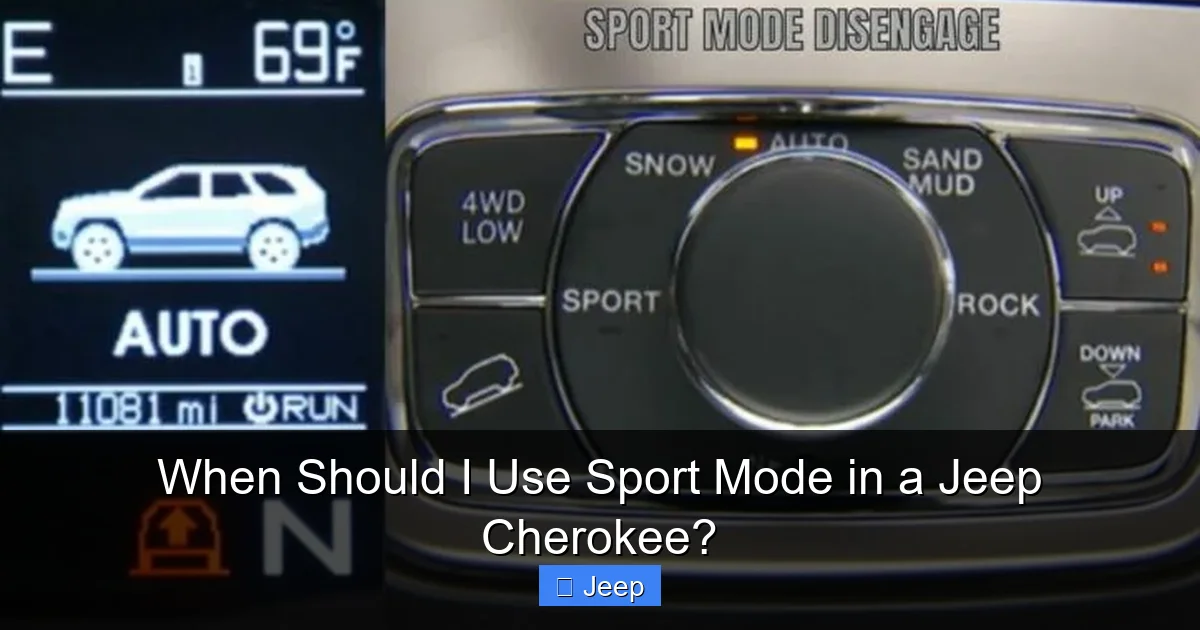
Visual guide about When Should I Use Sport Mode in a Jeep Cherokee?
Image source: jeepabc.com
Highway Merging and Passing
This is, in my opinion, the single best use case for Sport Mode. Imagine you’re on a 70 mph highway, and you need to merge onto a faster-flowing lane or pass a slow-moving truck. In Normal mode, you press the pedal, there’s a slight delay as the transmission downshifts, and then—finally—you get the surge of power. It can feel hesitant and unsafe when you need acceleration now.
With Sport Mode engaged, that hesitation disappears. The transmission is already holding a lower gear or downshifts instantly. The throttle is more responsive. That same pedal press delivers immediate, confident acceleration. It transforms a white-knuckle, anxious merge into a smooth, controlled maneuver. For situations where safety depends on having power on demand, Sport Mode is your friend. If you frequently drive on interstates or highways with heavy traffic, you’ll find yourself reaching for that button regularly. It’s a similar principle to the ECT Power mode in a Toyota Tacoma, which is designed for that same on-demand performance.
Winding, Scenic Roads
Got a favorite backcountry route? A road that hugs a mountain or snakes through hills? Sport Mode is your co-pilot for fun. When you’re driving a twisty road, you want the engine to be in the sweet spot of its power band as you exit a corner. In Normal mode, the transmission might upshift too early, leaving you in a high gear with low RPMs and a sluggish feel as you straighten the wheel.
Sport Mode keeps the revs higher. It’s more likely to downshift when you lift off the throttle or brake, providing engine braking to help slow the car and keeping the engine ready to pounce as you accelerate out. The firmer steering feedback (if equipped) also helps you place the car precisely through a sequence of corners. You feel more connected to the road and the vehicle’s actions. It turns a mundane commute into a bit of an adventure. For a similar driving feel in a different type of vehicle, check out how to use Subaru’s Sport Mode, which also sharpens throttle response for dynamic driving.
Towing or Hauling a Heavy Load
If you’re using your Cherokee to pull a trailer, a boat, or a heavy cargo carrier, Sport Mode can be a valuable tool. A loaded vehicle puts a significant strain on the transmission, which can lead to constant “gear hunting”—constantly shifting up and down as it struggles to maintain speed, especially on inclines.
Sport Mode helps by locking the transmission into lower gears for longer. It reduces the frequency of shifts, providing more consistent power delivery when climbing hills and better engine braking when descending. This not only feels more stable and controlled but can also help prevent the transmission from overheating under a sustained load. You’re essentially telling the vehicle, “I know we’re heavy, keep the power ready.” Always consult your owner’s manual for specific towing guidelines, but using Sport Mode for challenging terrain with a trailer is a common recommendation from many manufacturers.
When You Just Want a More Engaging Feel
Sometimes, there’s no practical reason. You’re on a clear, dry road, and you just want your daily driver to feel a little more alive. Maybe you’re having a long, solo drive and want to enjoy the act of driving itself. Sport Mode provides that extra bit of feedback—the sharper throttle, the higher revs, the weighted steering—that can make even a routine trip feel more special. It’s about driver engagement. Use it on a Sunday drive to break the monotony of commuting. Just remember to switch back to Normal for your next stop-and-go traffic jam to save your sanity and your fuel tank.
When Sport Mode Isn’t Your Friend
Sport Mode is a fantastic tool, but like any tool, using it for the wrong job can be ineffective or even problematic. Here are the key situations where you should keep it in Normal, Eco (if equipped), or Snow mode.
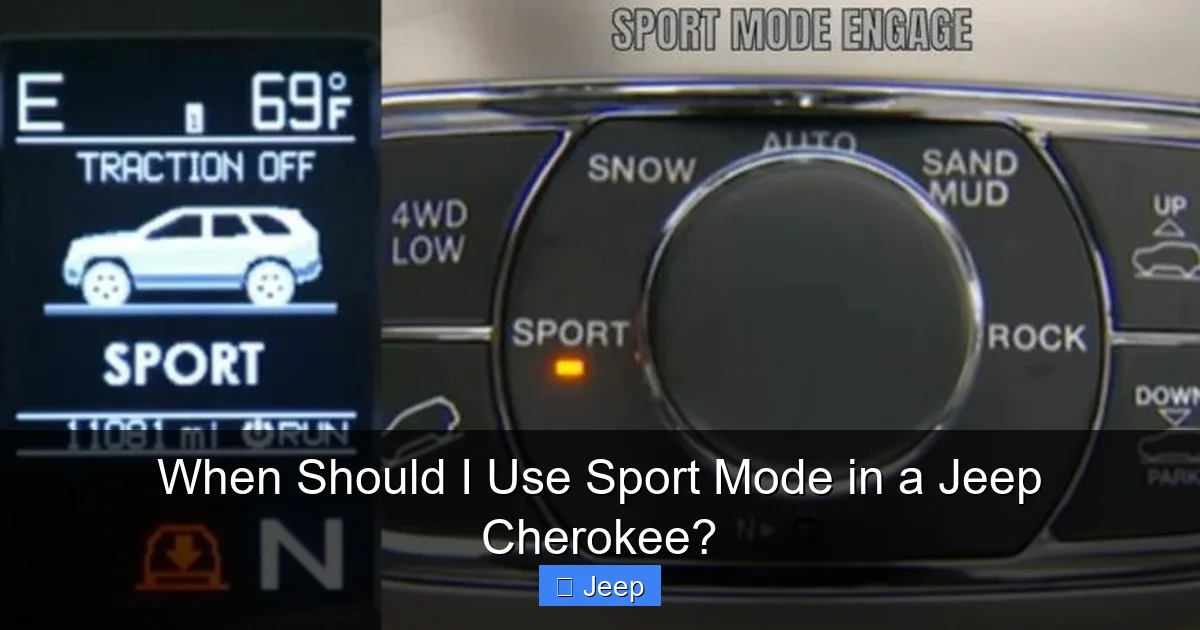
Visual guide about When Should I Use Sport Mode in a Jeep Cherokee?
Image source: jeepabc.com
Slippery Conditions: Snow, Ice, and Heavy Rain
This is the most critical rule. Do not use Sport Mode on slippery surfaces. The very characteristics that make it fun—the aggressive throttle response and late upshifts—become hazards in low-traction scenarios. A sudden, heavy application of the throttle in Sport Mode is much more likely to break the tires loose and cause a spin compared to the gradual, controlled power delivery of Normal mode. The transmission’s tendency to hold lower gears can also lead to wheel spin when you’re trying to get moving smoothly on ice or snow.
For winter driving, your Cherokee likely has a dedicated “Snow” or “Snow Mode” (sometimes part of the Selec-Terrain system). This mode softens the throttle response, starts in 2nd gear from a stop to reduce torque, and adjusts the shift points for maximum traction and smoothness. That is the correct mode for slippery conditions. If you don’t have a specific snow mode, simply leave it in Normal. For a deeper dive into systems designed for low-traction driving, you can read about how Subaru’s X-Mode works, which is a system specifically engineered for slippery terrain.
Stop-and-Go City Traffic
Using Sport Mode in bumper-to-bumper traffic is a recipe for frustration and poor fuel economy. The transmission, trying to hold lower gears, will constantly be at higher RPMs. You’ll feel more shuddering and lurching as it struggles to find a smooth shift point at very low speeds. The sharp throttle makes smooth, gradual starts difficult. You’ll be working the brake pedal more and listening to a louder engine for no reason. Save Sport Mode for the open road and switch back to Normal or Eco mode for your daily crawl through the city. Your ears, your passengers, and your fuel gauge will thank you.
When Maximum Fuel Economy is the Goal
Let’s be clear: Sport Mode will reduce your miles per gallon. Period. The engine is working harder and revving higher. If you’re on a long road trip and want to eke out every last mile from a tank of gas, or if you’re simply trying to be as efficient as possible for environmental or cost reasons, keep it in Normal or Eco mode. The fuel savings can be significant, especially in mixed driving. For general advice on maintaining your vehicle’s efficiency, understanding basics like when to change your oil is just as important as driving mode selection.
Driving on Very Steep, Sustained Descents
Here’s a nuanced point. While Sport Mode’s engine braking is great for winding roads, on a very long, steep mountain descent, you might actually want to use a different strategy. Holding a low gear in Sport Mode can keep engine RPMs very high for a prolonged period, which can lead to excessive heat. For controlled descents, it’s often better to use the manual shift mode (if your Cherokee has it) to select a specific low gear (like “L” or a numbered gear) and let the transmission hold it, or simply use normal brakes with careful modulation. Know your terrain.
How to Engage and Disengage Sport Mode
The process is blissfully simple, but it varies slightly by model year and trim. Here’s the general rulebook:
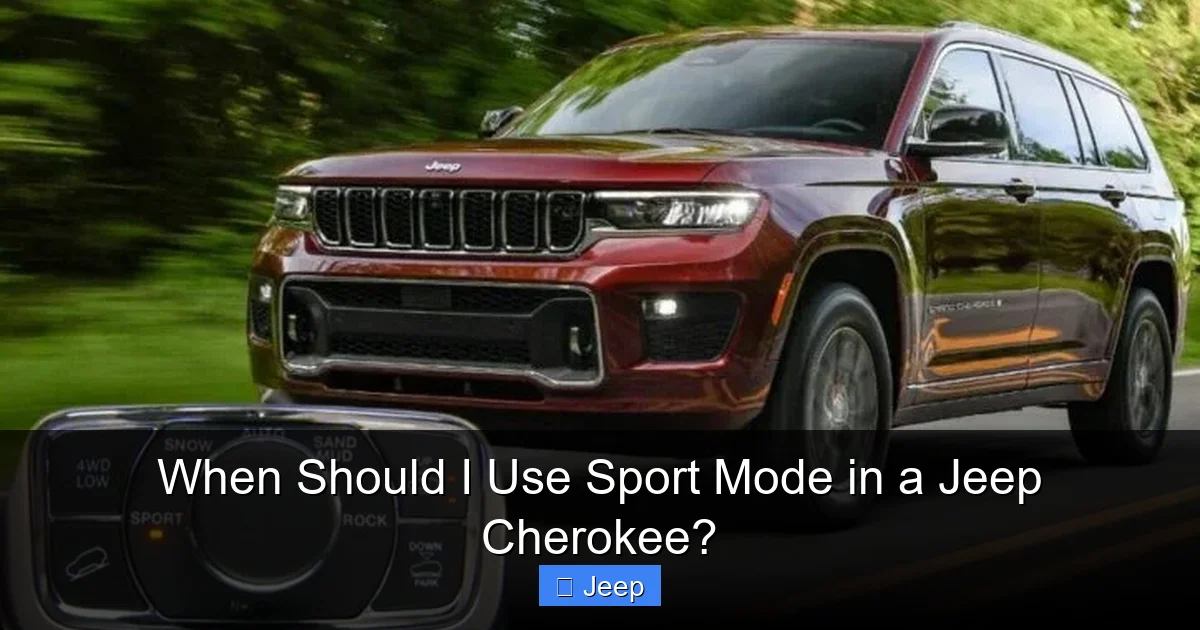
Visual guide about When Should I Use Sport Mode in a Jeep Cherokee?
Image source: jeepabc.com
- Location: The Sport Mode button is almost always on the gear selector itself—the lever you use to choose Park, Drive, Reverse, etc. It’s typically a small button labeled “Sport” or with a checkered flag icon, located on the shift knob or on the stalk behind the wheel (if you have paddle shifters). On some models with a rotary electronic shifter, it might be a button on the center console near the shifter.
- How to Activate: The vehicle must be in “Drive” and moving (or at least at a very slow crawl). Press the Sport button. You should see an indicator light on your instrument cluster—usually a small “S” inside a box, a checkered flag, or the word “SPORT” lighting up on the driver information screen. The change is immediate; you’ll feel the throttle sharpen and the transmission hold gears.
- How to Deactivate: Simply press the button again. The “S” or “SPORT” light will go out, and the transmission will return to its normal, more economical shift pattern. You can do this at any time while driving—it’s a seamless, real-time switch.
- Manual Shift Mode (Paddle Shifters): If your Cherokee has steering wheel paddle shifters, using them will often automatically put the transmission into a temporary “Sport-like” manual mode, overriding the current drive mode setting. When you stop using the paddles for a few seconds, it will revert to the programmed behavior of your selected mode (Normal or Sport).
Consult your owner’s manual for the exact location and any model-specific quirks. It’s a one-touch operation designed for instant use.
Sport Mode vs. Other Driving Modes
Most modern Cherokees offer more than just Normal and Sport. Understanding the full suite helps you choose the right tool. Here’s a quick comparison:
- Normal (Auto): The balanced, default setting. Optimized for a smooth ride and decent fuel economy. Perfect for 90% of daily driving.
- Eco Mode: The fuel-sipper. It dulls throttle response, programs the transmission to upshift earlier, and may adjust the climate control to save power. Use it for long highway cruises or when you’re really trying to save gas. It makes the feel even more relaxed than Normal.
- Sport Mode: The performer. Sharper throttle, later shifts, firmer steering/suspension. For when you want responsiveness and engagement.
- Snow Mode (or part of Selec-Terrain): The traction specialist. Softens throttle, starts in 2nd gear, holds gears lower to prevent spin. This is your mode for ice and snow, not Sport.
- Sand/Mud/Rock (Selec-Terrain): These are off-road focused modes that alter 4WD system behavior, throttle, and transmission for specific terrain. They are not replacements for Sport Mode on pavement, though you might use Sport in conjunction with “Auto” on Selec-Terrain for a more responsive feel on gravel roads.
Think of it this way: Eco is for saving pennies, Normal for all-around comfort, Sport for driver engagement, and Snow for safety. They are distinct programs for distinct goals.
Pro Tips for Maximizing Your Sport Mode Experience
Now that you know the “what” and “when,” here are some advanced tips to get the most out of it:
Use It for Downshifting Before Corners
Don’t just wait for the transmission to downshift on its own. As you approach a series of curves, lightly tap the brake pedal. In Sport Mode, this often triggers an automatic downshift to prepare the engine for acceleration out of the corner. You can also use the manual paddle shifters to select a lower gear yourself before the turn. This practice gives you perfect control and maximizes your momentum through the bends.
Listen to the Engine
Part of the fun is the audible feedback. With Sport Mode holding gears longer, you’ll hear the engine note rise and fall with your speed. Use your ears as a gauge. If the engine sounds strained or is revving extremely high (say, above 4,500 RPM consistently) while maintaining a steady highway speed, you might be in a gear that’s too low for efficient cruising—switch back to Normal.
It’s Not a Magic Power Button
Remember, Sport Mode doesn’t add horsepower. It just makes the existing power more accessible. Don’t expect a Cherokee with the 2.4L 4-cylinder engine to suddenly feel like a V6. The change is in responsiveness, not in ultimate capability. Manage your expectations based on your specific engine.
Combine It with the Right Tires
All the electronic tuning in the world won’t help if your tires are bald or all-season tires on a hot summer day. For the best performance—whether in Sport Mode or not—ensure your tires are in good condition and appropriate for the season. High-performance all-seasons or summer tires will let you feel the benefits of the sharper throttle and steering much more clearly.
And finally, experiment! Find a safe, empty stretch of road. Drive it in Normal, then in Sport. Feel the difference in how the car accelerates, how it shifts, and how the steering feels. Personal experience is the best teacher.
Conclusion: Your Cherokee’s Secret Weapon
Sport Mode in your Jeep Cherokee is a simple yet powerful feature that lets you tailor the vehicle’s character to your mood and the road ahead. It’s the difference between a passive appliance and an engaging tool. Use it confidently on highways for safe passing, on winding roads for a smile, and when towing for stability. But respect its nature: avoid it on ice and in traffic jams.
The genius is in its simplicity—a single button press that instantly transforms the driving dynamics. It’s not about beating the system; it’s about using the system to make your driving more appropriate, more enjoyable, and sometimes, just more fun. So go ahead, give it a try on your next open-road adventure. Just remember to switch back when the snow starts to fall or you hit the city limits. Your Cherokee is a versatile machine, and understanding features like Sport Mode is key to unlocking its full, multi-faceted potential.
Frequently Asked Questions
Does using Sport Mode damage my Jeep Cherokee’s engine or transmission?
No. Sport Mode uses programming that the vehicle’s engine and transmission are designed to handle. It simply holds gears longer and revs the engine higher within its normal operating range. The components are built to withstand these conditions regularly. The only “damage” might be to your fuel economy or your ears if you overuse it!
Will Sport Mode make my Cherokee faster in a straight line?
It will make it feel faster and more responsive due to the sharper throttle and reduced shift lag. The 0-60 mph time might improve by a fraction of a second because you’re accessing the power more directly. However, it does not increase the engine’s peak horsepower or torque ratings.
Can I leave my Cherokee in Sport Mode all the time?
You can, but you probably shouldn’t. You’ll experience significantly worse fuel economy, a louder and less refined ride in traffic, and you’ll miss out on the smooth, efficient behavior of Normal or Eco mode for daily driving. It’s best used selectively for specific driving situations.
Does Sport Mode work in 4WD or off-road?
Yes, the Sport Mode programming affects the drivetrain regardless of the Selec-Terrain setting. However, for serious off-road use, you’ll typically select a terrain-specific mode like “Mud” or “Rock.” Some drivers use “Auto” on Selec-Terrain combined with Sport Mode for a more responsive feel on gravel or dirt roads, but dedicated off-road modes are generally preferred for low-traction challenges.
Why is my Cherokee shifting so high in Sport Mode?
This is normal. The transmission is programmed to upshift at a higher RPM to keep the engine in its power band. If it’s shifting at what seems like an excessively high RPM (e.g., 4,500 RPM) while cruising at a steady 70 mph, it might be because you have a strong headwind, are going uphill, or your vehicle is heavily loaded. The transmission is trying to maintain speed. If the behavior seems erratic or the RPMs are extremely high with no load, have the transmission checked by a dealer.
Does Sport Mode affect all-wheel drive (AWD) behavior?
Indirectly, yes. By changing throttle response and shift points, it can influence how power is sent to the wheels. A more aggressive throttle application can cause the AWD system to send power to the rear wheels more quickly. However, the fundamental AWD clutch pack or coupling operation is governed by the Selec-Terrain system (if equipped). Sport Mode doesn’t change the fundamental AWD coupling strategy, but it changes the context in which that system operates. For a detailed look at how different modes affect AWD systems, you can explore resources on Subaru’s X-Mode, which is a more comprehensive terrain management system.
