
Does Jeep Stand for Just Enough Essential Parts?

The idea that “Jeep” is an acronym for “Just Enough Essential Parts” is a persistent and satisfying myth, but it’s completely false. The name’s true origin is murkier, likely stemming from WWII military slang for the new, versatile reconnaissance vehicle. While the acronym is clever, it ironically undersells the robust, over-engineered nature of real Jeeps, which are famous for having more than enough essential parts to tackle extreme terrain and last for decades.
Key Takeaways
- The “Just Enough Essential Parts” acronym is a popular myth with no historical basis. Jeep’s name origin is tied to military slang, not an engineering philosophy.
- Jeep’s actual engineering philosophy is one of over-engineering and robustness. Vehicles are built with heavy-duty components specifically to exceed “essential” needs for durability and off-road capability.
- The myth persists because it sounds clever and superficially aligns with Jeep’s simple, functional image. It’s a classic case of retroactive naming (backronym).
- Real Jeep reliability and longevity come from parts that are far from “just enough.” Components like solid axles, heavy-duty frames, and proven drivetrains are designed for punishment.
- Understanding the myth vs. reality helps appreciate Jeep’s genuine legacy. It’s a story of wartime necessity and civilian adventure, not minimalist manufacturing.
📑 Table of Contents
- The Alluring Simplicity of a Myth
- The True, Messy Origin of the Name “Jeep”
- Jeep Engineering: The Reality of “More Than Enough”
- Cultural Impact: How the Myth Gained Traction
- What “Just Enough” Would Actually Mean for a Jeep (And Why It Would Fail)
- The Jeep Lifestyle: Where “Essential” Parts Become “Everything”
- Conclusion: Jeep Stands for Legend, Not an Acronym
The Alluring Simplicity of a Myth
If you’ve spent any time around cars, trucks, or internet forums, you’ve almost certainly heard it. The claim that “Jeep” is not just a name, but an acronym: Just Enough Essential Parts. It’s a brilliant piece of automotive folklore. It sounds plausible, doesn’t it? It ties the brand’s famously utilitarian, no-frills image to a clever, almost philosophical, engineering principle. It suggests a vehicle stripped of all non-essential complexity, a pure machine for a singular purpose.
But here’s the truth: it’s 100% a myth. A wonderfully sticky, satisfying myth, but a myth nonetheless. The real story of where the name “Jeep” comes from is far less tidy and far more interesting, rooted in the chaotic slang of World War II. Debunking this acronym isn’t just about setting the historical record straight; it’s about understanding what a Jeep really is. The reality of Jeep’s design and construction is, in fact, the polar opposite of “just enough.” They are celebrated for being over-built, over-capable, and engineered with a redundancy and strength that makes them legendary. Let’s drive into the facts, separate myth from reality, and see why a genuine Jeep has far more than just enough essential parts.
The True, Messy Origin of the Name “Jeep”
To understand why “Just Enough Essential Parts” is wrong, we must first look at where the name actually came from. The history is shrouded in wartime anecdote and competing claims, but one thing is clear: it began as slang, not an acronym.

Visual guide about Does Jeep Stand for Just Enough Essential Parts?
Image source: 0701.static.prezi.com
WWII Slang and the “Peep” vs. “Jeep” Debate
The vehicle we know as the Jeep originated as the U.S. Army’s need for a lightweight, versatile reconnaissance car. Early prototypes from companies like Willys-Overland and Ford were tested in 1940-41. Soldiers and test drivers had various nicknames for them. The most common theory is that “Jeep” was a derivation of “GP,” the military designation for “Government Purpose” or “General Purpose” vehicle. The story goes that soldiers slurred “G.P.” into “Jeep.” However, many historians and military archivists argue this is a retroactive explanation.
A more compelling narrative points to the Eugene the Jeep character from the 1930s Popeye cartoons. Eugene was a small, mischievous, incredibly versatile creature that could do anything. When soldiers saw the new, spry, and incredibly capable little reconnaissance vehicle, the nickname “Jeep” stuck because it was Eugene the Jeep—a small thing that could go anywhere and do anything. Test driver and reputed “Jeep father” Irving “Red” Housman reportedly referred to the Willys Quad as a “Jeep” in a 1941 press demo, and the name simply took hold. The “GP” story is likely a convenient, logical-sounding backronym created after the name was already famous.
What’s undeniable is that by the time the Willys MB and Ford GPW were in mass production for the war, “Jeep” was the universal term for the vehicle. It was never an official corporate acronym. It was soldier slang that became a global brand. The “Just Enough Essential Parts” story is a classic backronym—a phrase invented later to fit an existing word, because it sounds good.
Why the Myth is So Persistent
This myth endures for a few psychological reasons. First, it’s intellectually satisfying. It provides a neat, causal explanation for a quirky name. Second, it superficially aligns with the Jeep aesthetic. Especially in its early, bare-bones military form, a Jeep looked like it had nothing extra. No fancy trim, no heavy luxuries. It looked like “just enough.” Third, in an era of increasingly complex, computerized vehicles, the idea of a simple, essential-machine car is romantic. The myth sells an ideal of mechanical purity that resonates with enthusiasts. But as we’ll see, the reality of the mechanicals tells a different story—one of deliberate, heavy-duty over-engineering.
Jeep Engineering: The Reality of “More Than Enough”
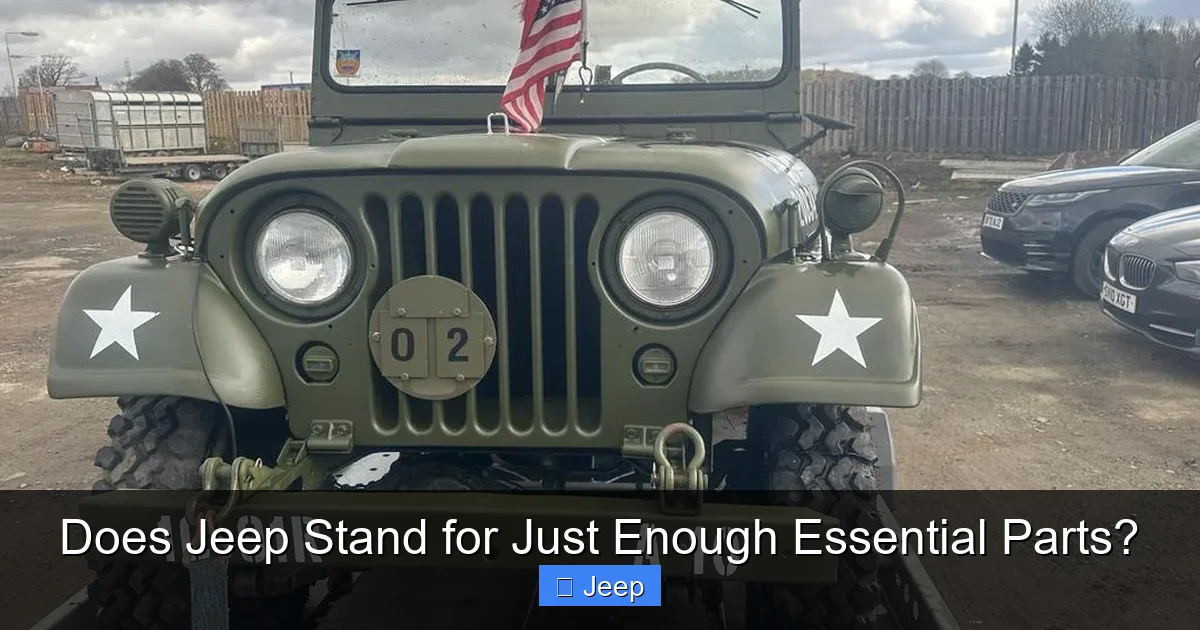
Let’s shift from the name to the nuts and bolts. If “Just Enough Essential Parts” were a real engineering philosophy, Jeeps would be fragile, minimalist boxes. The opposite is true. From their inception, Jeeps have been defined by robustness, redundancy, and over-specification. The goal was never minimalism; it was survivability and capability in the harshest conditions.
Visual guide about Does Jeep Stand for Just Enough Essential Parts?
Image source: jlwsolutionsltd.com
Solid Axles: The Anti-“Minimalist” Choice
One of the most defining features of the classic Jeep Wrangler (and many other Jeep models) is the solid front and rear axle. In the automotive world, this is a deliberately heavy-duty, old-school choice. Independent suspension is more complex, offers a smoother ride, and better handling on pavement. So why does Jeep cling to solid axles off-road? Because they are incredibly strong, simple, and durable.
A solid axle is a single, rigid tube connecting both wheels. It’s a brute-force solution. It can handle massive torque from the engine, extreme articulation from the suspension, and direct, high-impact forces from rocks and ruts without the complexity and potential failure points of independent suspension CV joints and half-shafts. For a vehicle designed to crawl over boulders and tow heavy loads, a solid axle isn’t “just enough”—it’s a deliberate over-build. It adds weight and complexity in its own way (needing stronger axle housings), but it does so for ultimate strength and reliability, not minimalism. This philosophy extends to heavy-duty Dana axles, known for their bulletproof construction.
Heavy-Duty Frames and Body-on-Frame Construction
Jeep Wranglers and Gladiators are body-on-frame vehicles. The ladder frame is a separate, heavy steel chassis to which the body is bolted. This is the opposite of unibody construction (where the body itself is the structural frame), which is lighter and more efficient for on-road driving. Body-on-frame is inherently less “minimalist”—it uses more steel, is heavier, and is more costly to manufacture.
But for a Jeep, it’s non-negotiable. This construction provides exceptional torsional rigidity for twisting off-camber situations, makes the vehicle vastly more resistant to body damage from impacts, and provides a solid mounting point for heavy-duty suspension components and accessories. It’s a design that prioritizes durability and repairability (you can straighten a bent frame; you can’t easily fix a crushed unibody) over efficiency. It’s a philosophy of “more than enough” structural integrity.
The “Essential” Parts Are Actually Very Complex
Look under a Jeep Wrangler. The “essential” parts for its 4×4 capability—the transfer case, front/rear differentials, and axles—are not minimalist components. They are complex, heavy, and built with high-strength materials. The iconic Jeep transfer case (like the NP-231 or newer electronic units) is a robust piece of machinery designed to split power 50/50 or variably, handle massive torque, and survive in extreme environments. It’s packed with gears, bearings, and seals. This isn’t “just enough”; it’s over-specified for reliability.
Similarly, the powertrains—from the classic AMC inline-six to the modern Pentastar V6 and turbocharged 4xe hybrids—are chosen for low-end torque and durability, not peak horsepower. They are paired with heavy-duty transmissions (like the Aisin AS68RC in diesel models or the robust 8-speed automatic) built to handle abuse. The “essential” drivetrain in a Jeep is a collection of exceptionally sturdy, often over-built, components. The goal is to have no single point of failure under stress, which is the antithesis of a minimalist “just enough” approach.
Cultural Impact: How the Myth Gained Traction
So how did a completely false acronym become so widely believed? It’s a perfect storm of marketing, branding, and human psychology. The Jeep brand itself has sometimes leaned into the simplicity narrative, which inadvertently fueled the myth.
Visual guide about Does Jeep Stand for Just Enough Essential Parts?
Image source: hurstworks.co.uk
The “Simple, Honest Machine” Brand Persona
Jeep’s marketing has long celebrated its rugged, honest, and capable nature. Slogans like “Only thing that can stop a Jeep is a Jeep” or the emphasis on “go anywhere, do anything” create an image of a pure, uncomplicated tool. In this context, the “Just Enough Essential Parts” acronym feels like a perfect summary of that persona. It’s a backronym that fits the story we want to believe. The brand’s early vehicles were mechanically simpler than many luxury cars of their era, lacking things like power steering (on early models) or air conditioning. This relative simplicity made the acronym seem plausible to generations of owners.
The Power of the Internet and Forums
In the pre-internet age, such myths circulated in magazines and word-of-mouth. The internet, especially automotive forums and social media groups, supercharged it. A compelling, concise piece of “ trivia” is highly shareable. It gets repeated in comment sections, blog posts, and casual conversations. It becomes an “everyone knows” fact, rarely questioned because it feels right. Correcting it requires digging into historical sources, which most casual fans won’t do. The myth is sticky because it’s a good story.
Contrast with Real Automotive Acronyms
When we look at real automotive acronyms, the contrast is stark. They are usually dry, technical, and corporate. SR on a Nissan means “Sport and Roadster.” SXT on a Dodge is a trim level name with no official meaning, but it’s believed to stand for “Standard Extra” or similar. MDX for Acura is a model designation. LT on a tire means “Light Truck.” These are functional, internal designations. A poetic, philosophical phrase like “Just Enough Essential Parts” is not how corporations name things; it’s how folklore names things. The fact that Jeep’s name isn’t an acronym at all makes the fake one stand out even more as pure invention.
What “Just Enough” Would Actually Mean for a Jeep (And Why It Would Fail)
Let’s play a thought experiment. What if Jeep’s engineers actually followed a “Just Enough Essential Parts” philosophy? What would that Jeep look like, and would it still be a Jeep?
The Minimalist Jeep: A Theoretical Failure
A true “just enough” Jeep would be a study in compromise. It would have the lightest possible frame—thin-walled steel, perhaps even aluminum—saving weight but sacrificing torsional strength. The suspension would use the smallest, lightest possible components—thin-walled tubes, minimal bushings. The axles would be the smallest diameter and thinnest wall tubing that could theoretically handle the torque. The transfer case would be a lightweight, two-speed unit with minimal internal machining. The engine would be a high-revving, lightweight four-cylinder with just enough torque to move the vehicle on flat ground.
The result? A vehicle that might be light and fuel-efficient on a highway, but would quickly torsionally twist on a rocky trail, snap axle tubes under load, destroy transfer case gears on a steep climb, and overheat while trying to crawl over sand. It would lack the low-end grunt needed for serious off-roading. It would be fragile. It would break. It would not be a Jeep. The “essential” parts for a true off-road vehicle are, by necessity, heavily built. There is no “just enough.” There is only “strong enough to survive the worst we can throw at it, with margin for error.”
Real Jeep Parts: Built with Margin and Redundancy
Real Jeeps are built with this margin. Take the Dana 44 axle, a mainstay in Wranglers. It’s a robust, mid-size axle. But for the more powerful Rubicon models, Jeep uses the even heavier-duty Dana 44 with electronic locking differentials and larger axle shafts. For the Gladiator and Grand Cherokee, they use the massive Dana 60 and other heavy-duty axles. This is not minimalism; it’s scaling the component to the vehicle’s intended use with a safety factor.
Look at the suspension. The Rubicon’s heavy-duty Dana 44s are paired with Fox brand monotube shocks—performance-grade, rebuildable components designed for extreme duty. The frame has additional gussets and reinforcement in key areas. The skid plates are thick steel. Even something as simple as a wheel is typically a heavy-duty steel or very strong alloy. Every critical component is selected for durability first. The philosophy is clear: build it once, build it strong, and it will last. This is the opposite of “just enough.”
The Jeep Lifestyle: Where “Essential” Parts Become “Everything”
Here’s where the myth gets an ironic twist. While the factory Jeep is the opposite of minimalist, the aftermarket and Jeep owner culture often embraces a “just enough” or “simplify” philosophy—but in a different way. For many Jeep owners, the appeal is the ability to remove the non-essential parts that the factory did include.
The “Minimalist” Off-Road Build: Stripping Back
Hardcore off-road enthusiasts often talk about “lightening the rig.” They might remove:
- Heavy factory bumpers for lighter, more functional ones.
- Sound deadening, insulation, and interior panels to save weight and improve cooling.
- Air conditioning, power seats, and other luxury features to reduce electrical load and complexity.
- Even doors and the roof for the ultimate open-air, weight-saving experience.
In this context, the “essential parts” are the engine, transmission, axles, and frame. Everything else is optional weight. This is the closest the Jeep world comes to the “Just Enough Essential Parts” idea: a stripped-down, pure machine for a specific, hardcore purpose. But note: this is an owner modification, not a factory design principle. The factory gives you a heavily reinforced, fully equipped base from which you can optionally strip away non-essentials for extreme performance. The starting point is always “more than enough.”
Accessories and the “Jeep as a Blank Canvas”
This leads to the massive aftermarket industry for Jeeps. The very robustness and simplicity of the core platform make it a perfect blank canvas. Owners can add heavy-duty bumpers, winches, rock sliders, lift kits, and larger tires—all of which add weight and stress. The factory Jeep is designed to accommodate this added stress with its strong frame and drivetrain. A vehicle built on a “just enough” philosophy would fail catastrophically under the weight and stress of a typical off-road build.
Consider the need for a lift kit. To fit larger tires for better off-road capability, you need more suspension travel and clearance. This puts additional angles and stresses on CV joints, driveshafts, and steering components. A minimally built vehicle would have these components fail immediately. A Jeep’s components are robust enough to handle the added stress of a moderate lift. For major lifts, you often need aftermarket strengthening parts (like new control arms or driveshafts), but the factory provides a strong enough foundation to start from. This is a testament to its over-engineered core.
Conclusion: Jeep Stands for Legend, Not an Acronym
So, does Jeep stand for “Just Enough Essential Parts”? No. It stands for something far more tangible and impressive: a legacy of wartime ingenuity, civilian adventure, and mechanical fortitude. The name is a piece of living slang from 1941, a testament to a vehicle that was so useful and ubiquitous it earned a nickname that became its identity.
The reality of a Jeep is not one of minimalist compromise, but of brute-force adequacy. It is engineered with a deliberate surplus of strength. Its solid axles, body-on-frame construction, heavy-duty drivetrain components, and over-specified suspension are all chosen to provide a massive margin of safety and durability. They are built to survive the unexpected rock, the deep water ford, the steep hill, and the decades of use that follow. A “just enough” Jeep would be a fragile, short-lived thing. A real Jeep is a “more than enough” Jeep.
The next time you hear the acronym, you can share the real story—the tale of Eugene the Jeep, the GP designation debate, and the soldiers who gave a vehicle its immortal name. And when you look at a Jeep Wrangler struggling up a rocky trail or a Gladiator hauling a heavy load, remember that its capability comes from a philosophy of building in strength, not cutting it away. Its parts aren’t “just enough.” They’re exactly what’s needed to earn that legendary status, and then some.
Frequently Asked Questions
Is “Just Enough Essential Parts” a real acronym for Jeep?
No, it is a complete myth and a backronym. The name “Jeep” originated as U.S. Army slang during World War II, likely from the “Eugene the Jeep” cartoon character or a slurred version of the “GP” (General Purpose) vehicle designation. It was never an official corporate acronym.
What does the “GP” in Jeep’s early military designation stand for?
The official military designation for the Willys MB and Ford GPW was “GP,” which stood for “Government Purpose” or “General Purpose.” The popular story is that soldiers pronounced “G.P.” as “Jeep.” However, many historians believe the cartoon character “Eugene the Jeep” was the more direct inspiration for the nickname.
If the acronym is false, why do so many people believe it?
The myth is persistent because it sounds clever and fits the Jeep’s image as a simple, utilitarian vehicle. It’s a satisfying, easy-to-remember story that provides a neat explanation for an unusual name. The internet and automotive forums have amplified it as “common knowledge” trivia, despite having no factual basis.
Does Jeep’s design philosophy focus on minimalism?
Absolutely not. Jeep’s engineering philosophy is one of over-engineering and robustness. Key components like solid axles, heavy-duty body-on-frame construction, and strong drivetrains are chosen for maximum durability and off-road capability, which requires building parts that are stronger and heavier than “just enough.” The goal is survivability with a large safety margin.
Are modern Jeeps still as robust as the original military models?
Modern Jeeps, especially the Wrangler and Gladiator, retain the core robust engineering principles of the original: solid axles, body-on-frame, and heavy-duty running gear. While they have more comforts and technology, the foundational components are still built to high strength standards for off-road use, making them far from “minimalist” in construction.
Where can I learn more about Jeep’s actual history and specifications?
For historical facts, reputable sources include the National WWII Museum, military vehicle archives, and books by historians like David Doyle. For modern engineering details, official Jeep brand websites and technical reviews from trusted automotive publications provide accurate specifications and design explanations. You can also explore guides on specific models, like the best lift kits for a Jeep Gladiator, to see the robust factory components they’re built upon.
