
What Is Service Passive Entry on a Jeep Renegade?

The “Service Passive Entry” warning on a Jeep Renegade means the vehicle’s keyless entry system has detected a malfunction and requires diagnosis. This system allows you to unlock and start the vehicle without removing the key fob from your pocket or bag. Common triggers include a weak key fob battery, damaged door handle antennas, wiring issues, or software glitches. While the vehicle may still be drivable, you will likely need to use the physical key blade temporarily. Addressing the issue promptly ensures full convenience and security function restoration.
Key Takeaways
- It’s a System Fault Warning: The message indicates a specific problem within the Passive Entry/Passive Start (PEPS) system, not a general service reminder.
- Common Culprit is the Key Fob: A dying key fob battery is the most frequent and simplest cause, often resolved by a quick battery replacement.
- Antennas & Wiring are Prime Suspects: The door handles contain antennas; damage, corrosion, or broken wires to these antennas is a very common hardware failure.
- You Can Still Drive, But With Inconvenience: The engine will start normally once the key fob is inside the vehicle, but you may need to use the hidden manual key to unlock doors.
- Diagnosis Requires Special Tools: A mechanic needs a diagnostic scanner to read the specific fault code from the vehicle’s Body Control Module (BCM).
- Repair Costs Vary Widely: Simple fixes like a battery are cheap; replacing a door handle antenna module or repairing wiring can cost several hundred dollars.
- Weather and Interference Play a Role: Extreme cold can weaken key fob signals, and large metal objects or other RF devices can temporarily disrupt the system.
[FEATURED_IMAGE_PLACEHOLDER]
📑 Table of Contents
How Passive Entry Works on Your Jeep Renegade
Before we dive into the problem, let’s appreciate the magic. Jeep’s Passive Entry system, often called PEPS (Passive Entry/Passive Start), is designed for seamless convenience. The idea is simple: as long as your key fob is somewhere on your person—in your pocket, purse, or backpack—the car recognizes you. You simply touch the door handle’s capacitive sensor (the little ridge on the back of the handle) to lock or unlock it. No button pressing, no fumbling. Once inside, you press the ignition button without ever removing the fob.
This wizardry happens through low-frequency radio communication. Your Jeep Renegade has multiple antennas hidden in and around the vehicle. The most critical ones are embedded in the outer door handles (front and rear). There’s also an antenna inside the vehicle, typically near the ignition/start button or center console. These antennas constantly emit a gentle, low-power field, like an invisible bubble around the car. When your key fob, which has a matching transponder chip, enters this bubble, it wakes up and exchanges a coded handshake with the vehicle’s Body Control Module (BCM). The BCM verifies the correct key and then unlocks the doors when you touch the handle sensor. The same process, but with a different antenna field inside the car, allows for push-button starting.
It’s a sophisticated ballet of radio waves and digital cryptography. And like any complex electronic system, it has many points where the dance can stumble. The “Service Passive Entry” warning is your Jeep’s way of saying, “Hey, something in that ballet isn’t working right, and I need a mechanic to check the choreography.”
The Network of Antennas
The system relies on a network of typically four to six antennas. The front door handles each have one. The rear door handles often have them as well, especially on models with rear power locks. There’s a “low-frequency” antenna inside the cabin, usually under the center console trim or near the shifter, which is responsible for detecting the key fob’s presence for starting. A trunk antenna may also be present for passive unlocking of the liftgate. All these antennas connect via wiring looms to the Body Control Module (BCM), the central computer that manages all these body electrical functions.
Decoding the “Service Passive Entry” Warning
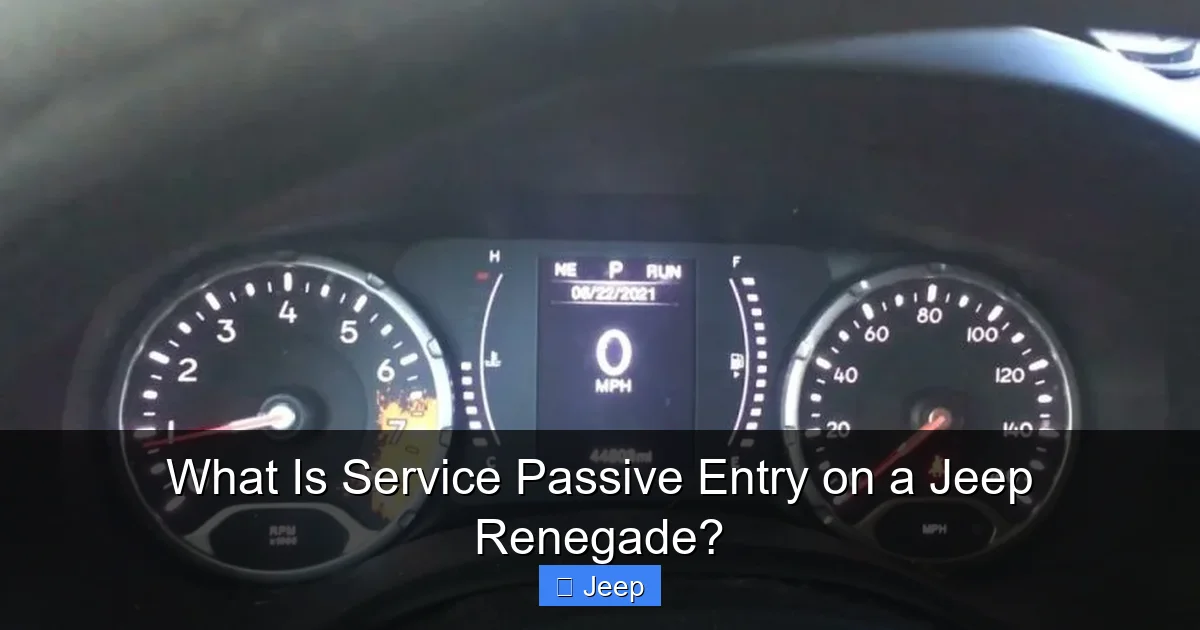
When this message illuminates on your instrument cluster—often accompanied by a corresponding icon of a key or a car with a key—it’s not a suggestion. It’s a definitive diagnostic trouble code (DTC) stored in the BCM. The system has performed a self-test and found a component or communication pathway outside of its acceptable parameters.
Visual guide about What Is Service Passive Entry on a Jeep Renegade?
Image source: vehiclers.com
It’s crucial to understand what this warning is NOT. It is not the same as a “Key Not Detected” or “Key Fob Not Found” message. Those are active, real-time failures where the system simply cannot see your key fob at that moment. The “Service” warning means the system has logged a persistent or hard fault that needs professional attention, even if the key fob is currently working. You might be able to unlock and start the car normally for days after the warning appears, but the underlying issue remains and will likely worsen.
The severity can vary. Sometimes, it’s a soft fault that resets after a drive cycle. More often, it’s a hard fault that will persist until the faulty component is repaired or replaced. The system may still provide basic functionality, but convenience features like the foot-activated rear hatch (if equipped) or the ability to lock the car by pressing the handle sensor may be disabled.
What You’ll Experience
When the warning is active, you’ll notice the loss of the “passive” part of the system. You’ll have to press the lock or unlock button on your key fob manually to operate the doors. The push-button start will still work as long as the key fob is inside the vehicle, because the interior antenna often remains functional even if the door handle antennas fail. However, in some cases, a major BCM or wiring fault can disrupt the entire system, requiring you to insert the physical emergency key (hidden inside your fob) into the door lock cylinder to gain entry. This is why it’s a “Service” warning and not just an annoyance—it signifies a degradation of your vehicle’s security and convenience systems.
Most Common Causes of a Service Passive Entry Fault
Now, let’s get our hands dirty (metaphorically) and explore the usual suspects. A technician will follow a diagnostic tree, but knowing the common causes can help you understand their process and potential repair bills.

Visual guide about What Is Service Passive Entry on a Jeep Renegade?
Image source: vaistech.com
1. The Lowly Key Fob Battery
This is the number one cause, and the easiest fix. The key fob’s coin cell battery (usually a CR2032) powers the transponder and the internal RF circuit. As it weakens, the signal strength diminishes. The vehicle’s antennas might still detect it at very close range (inside the car) but not when you approach the door handle. The system logs a fault for “Key Fob Not Detected” or a similar communication error. Replacing the battery is a simple, inexpensive DIY task. Always use a high-quality battery and ensure the fob’s contacts are clean.
2. Damaged or Faulty Door Handle Antenna Modules
This is the most common *hardware* failure. The antenna modules are molded into the plastic of the door handle. They are susceptible to damage from:
- Water Intrusion: The door handle seals can fail over time, allowing water to seep in and corrode the delicate antenna coil or its connection points.
- Physical Impact: A door ding or impact can crack the handle housing or stress the internal antenna.
- Wear and Tear: The constant flexing of the handle during use can eventually fatigue the tiny solder joints or wires inside.
A failed front driver or passenger door handle antenna will trigger a specific fault code, such as “Antenna 1/2 Circuit Open.” The fix is to replace the entire door handle assembly, which contains the antenna module. This is a more involved repair requiring door panel removal.
3. Wiring Harness Issues
The flexible wiring that runs from the door handle into the door jamb (the “door harness”) is a known failure point. Every time the door opens and closes, this wire bundle bends and flexes. Over years, the copper strands inside can break, especially at the point where the harness is clamped or routed. A broken wire will cause an “open circuit” fault. Diagnosing this requires checking continuity on the specific wire for the affected antenna, which often means removing the door panel and inspecting the harness closely. Repair involves splicing in a new section of wire or replacing the entire harness segment.
4. Faulty or Misprogrammed Key Fob
Sometimes the key fob itself is the problem. The internal transponder chip can fail, or the fob may have lost its programming to the vehicle. This can happen after a battery replacement if the fob’s memory is corrupted, or due to a physical shock. A new or used fob must be specifically programmed to the vehicle’s BCM using a dealer-level scan tool. You cannot simply swap fobs; they must be “paired” with the car.
5. Body Control Module (BCM) Failure
This is the least common but most expensive possibility. The BCM is the brain that processes all the antenna signals. If it fails internally, it can’t communicate with the antennas or interpret the signals. A failing BCM might set multiple unrelated body electrical faults. Replacement requires a new, properly programmed BCM and is a dealer-only or highly specialized independent shop procedure.
6. Software Glitches or “Gremlins”
Like any computer, the BCM’s software can have bugs. Sometimes, a simple system reset (disconnecting the negative battery cable for 10-15 minutes) can clear transient faults. Other times, a software update (re-flash) from the dealer is needed to fix known communication bugs between the BCM and the antenna modules.
Diagnostic Steps: What a Technician Will Do
When you take your Renegade in, the technician won’t just guess. They will follow a logical process. Here’s an inside look at their workflow, which can help you ask informed questions.

Visual guide about What Is Service Passive Entry on a Jeep Renegade?
Image source: jeepinside.com
Step 1: Scan for Codes
The first and most critical step is connecting a diagnostic scanner to the vehicle’s OBD-II port. The technician will read all stored fault codes from the Body Control Module (BCM). They are looking for specific codes like:
- P1A00 – Antenna Circuit (Driver Door): Open, short, or communication error.
- P1A01 – Antenna Circuit (Passenger Door): Same as above.
- P1A02 – Key Fob Not Detected: General communication failure.
- B1A00 – Keyless Entry Module Failure: Points to a module issue.
The exact code tells them which part of the system is unhappy. If multiple antenna codes are present for all doors, it might point to a BCM or main power/ground issue rather than individual door handles.
Step 2: Visual and Physical Inspection
Armed with the code, the tech will physically inspect. For a driver door antenna code, they’ll likely:
- Remove the driver door interior panel.
- Visually inspect the antenna module in the handle for cracks, corrosion, or water damage.
- Check the wiring harness that runs from the handle to the door jamb for any chafed, pinched, or broken wires. They’ll flex the harness while monitoring for an intermittent connection.
- Check the connector plugs for bent pins or corrosion.
This hands-on inspection is where many problems are found.
Step 3: Component Testing
Using a multimeter or specialized scan tool data, they can test the resistance of the antenna coil (it should read a specific low ohms value) and check for voltage and ground at the connector when the system is active. This confirms if the antenna itself is bad or if the problem is upstream (wiring, BCM).
Step 4: Programming and Verification
After replacing a faulty component (like a door handle or fob), it must be programmed or “taught” to the vehicle. A new door handle antenna module often needs to be added to the BCM’s configuration list. A new key fob must be added to the vehicle’s security system. Finally, the technician will test all functions: touch-to-lock/unlock on all doors, passive walk-away lock, and push-button start with the fob in various locations (pocket, bag, outside the car).
Repair Options and Cost Expectations
So, you have a diagnosis. What are your options, and what will it cost? Prices vary dramatically by region, shop type (dealer vs. independent), and the specific failure.
The DIY Route: Battery and Reprogramming
If the diagnosis is a weak key fob battery, this is a $5-10 DIY fix. You simply pry open the fob, replace the CR2032 battery, and reassemble. If the fob lost its programming, you *might* be able to reprogram it yourself using a sequence of button presses and ignition cycles described in your owner’s manual (not all Renegades support this). If not, a locksmith or dealer can do it for $50-$100.
The Independent Shop Route: Wiring and Handles
For a damaged door harness or faulty antenna module, a reputable independent shop is often the best value. Replacing a front door handle assembly (which includes the antenna) typically costs $250 – $500 in parts and 1-2 hours of labor. The part itself is dealer-only or from Mopar, so aftermarket options are limited. Labor involves removing the door panel, disconnecting the airbag (if equipped), and swapping the handle. Repairing a broken wire in the harness is cheaper in parts but may take similar diagnostic and repair time. Total for a single door handle replacement at an independent shop often lands in the $400 – $800 range.
The Dealer Route: Modules and BCMs
For BCM failures or complex programming, the dealer is usually necessary. They have the proprietary software (wiTECH) and security access to perform these tasks. A new BCM can cost $800 – $1,200+ for the part alone, plus 2-4 hours of programming and setup labor. This can easily push a BCM replacement to $1,500 – $2,500. For a door handle, the dealer will charge a higher labor rate (often $120-$150/hr) and may use a more expensive OEM part, so expect a bill 20-40% higher than a good independent shop.
Warranty and Recalls
Always check with your dealer using your VIN to see if there is an extended warranty or recall related to the passive entry system. FCA (now Stellantis) has had various service campaigns for door handle antenna issues on some models. If your vehicle is still under the original 5-year/60,000-mile basic warranty or a specific extended coverage, the repair could be free.
Prevention and Proactive Care
While you can’t prevent all failures, you can minimize the risk and extend the life of your Passive Entry system.
Key Fob Care
Your fob is a sensitive electronic device. Don’t toss it on a hard surface, expose it to extreme heat (like on a dashboard in summer), or let it get submerged. If you spill a drink on it, dry it immediately. Get in the habit of replacing the battery every 2-3 years as preventative maintenance, even if it seems fine. A weak battery stresses the system. Keep a spare battery in your glove box.
Door Handle Hygiene
The capacitive sensors on the handle need to be clean and dry to function properly. Wipe them down regularly with a damp cloth. Avoid using harsh chemicals or silicone-based sprays directly on the handle sensor area, as residue can interfere with the capacitive touch. Ensure the door seals are clean and not full of debris, as this helps prevent water from being forced into the handle cavity during car washes or heavy rain.
Minimize Signal Interference
The low-frequency signals used are relatively robust, but strong interference can cause temporary “Key Not Detected” messages that might log faults. Be mindful of where you store the key fob. Avoid placing it directly on or near:
- Large metal objects (toolboxes, filing cabinets).
- Other electronic devices (laptops, tablets, phones with strong cases).
- Aftermarket radar detectors or toll transponders mounted on the windshield near the key fob’s usual resting spot.
If you carry the fob in a thick, metal-reinforced wallet, that can block the signal. Try a different pocket or a dedicated fob holder made of fabric or plastic.
Listen and Feel
When you approach your Renegade with the fob, you should often hear a soft “chirp” or see the side mirrors fold out (if equipped) as the car wakes up and recognizes you. If this happens less frequently or only when you’re very close to the door, it’s an early warning sign of a weakening signal, likely from a dying battery or a beginning antenna fault. Catching it early can save you from a full system failure warning later.
Conclusion: A Fixable but Important Issue
The “Service Passive Entry” warning on your Jeep Renegade is not a catastrophic alert, but it is a clear signal that one of your vehicle’s most convenient and modern features is compromised. Ignoring it means reverting to the old-school method of using a physical key and manually locking/unlocking—a significant step backward in daily usability. More importantly, a faulty system could potentially leave you stranded if the interior start antenna also fails, or it could indicate an underlying electrical issue that might affect other systems.
The path to resolution is straightforward: get a proper diagnostic scan to identify the fault code, and then address the specific component—be it a $5 battery, a $400 door handle, or a more involved wiring repair. Always seek a reputable technician, preferably one familiar with Jeep/Chrysler products. Given the nature of the system, a dealer or well-equipped independent shop with the right scan tool is essential. By understanding how the system works and the common failure points, you can approach the repair with confidence, ask the right questions, and ensure your Renegade’s keyless convenience is restored to its intended, seamless state.
Frequently Asked Questions
Can I reset the Service Passive Entry warning myself?
You can try a basic reset by disconnecting the negative battery terminal for 10-15 minutes to clear any transient codes. However, if the underlying fault persists, the warning will return. A proper reset requires a scan tool to clear the codes after the repair is made.
Is it safe to drive my Renegade with this warning?
Yes, it is generally safe to drive. The engine will start normally as long as the key fob is inside the vehicle. The primary risk is inconvenience—you may be locked out if you rely solely on the passive handles and the system fails completely. Always carry the physical emergency key blade.
How much does it typically cost to fix?
Costs range from under $20 for a key fob battery to over $1,500 for a Body Control Module replacement. The most common repair, a door handle antenna module replacement, typically costs between $400 and $800 at an independent repair shop.
Could a dead key fob battery alone cause this warning?
Yes, absolutely. A severely depleted key fob battery is the most common cause. Always replace the key fob battery first as a diagnostic step before assuming a more expensive component has failed.
Can weather or my location affect this system?
Extreme cold can weaken the key fob’s battery and signal strength. Heavy snow or ice buildup on the door handles can also temporarily interfere with the capacitive touch sensors. Persistent issues in cold weather often point to a weakening battery or a marginal connection that fails in the cold.
Should I try to fix a door handle antenna myself?
We do not recommend it for most people. Replacing a door handle requires removing the interior door panel, which can be tricky and risks damaging the panel, airbag components (if equipped), or the window regulator. It also requires subsequent programming of the new antenna module to the BCM, which requires a scan tool. Professional installation is highly advised.
