
What Does No Bus Mean on a Dodge Ram 1500

Seeing “No Bus” on your Dodge Ram 1500’s dashboard can be alarming, but it’s often a communication issue between onboard computers. This message typically points to a problem with the vehicle’s CAN bus network—a system that lets modules like the PCM, TCM, and instrument cluster talk to each other. With the right diagnosis, most causes are fixable at home or with minimal professional help.
If you’ve ever turned the key in your Dodge Ram 1500 and seen the dreaded “No Bus” message flash across the instrument cluster, you’re not alone. It’s one of the most confusing and frustrating error messages a truck owner can encounter. One minute your Ram is running fine, and the next—nothing. No gauges, no warning lights, just a blank or partially lit dash with “No Bus” staring back at you. You might wonder: Is my truck bricked? Did the computer die? Do I need a tow to the dealer?
The good news? In most cases, “No Bus” doesn’t mean your truck is permanently broken. Instead, it’s a signal that something has interrupted the communication between your vehicle’s electronic control modules (ECMs). Think of your Ram’s onboard network like a team of coworkers in an office. If the internet goes down, they can’t share files, send emails, or coordinate tasks—even if each person is still at their desk. Similarly, “No Bus” means the Controller Area Network (CAN bus)—the digital highway that lets your powertrain control module (PCM), transmission control module (TCM), anti-lock brake system (ABS), and other modules talk to each other—has gone silent.
This issue is especially common in Dodge Ram 1500 models from the late 2000s through the mid-2010s, particularly the 4th generation (2009–2018). These trucks rely heavily on networked electronics for everything from engine management to infotainment. When that network fails, even basic functions like starting the engine or reading fuel levels can be affected. But don’t panic. With a systematic approach, most “No Bus” problems can be diagnosed and fixed—often without a trip to the dealership or a $1,000 repair bill.
Key Takeaways
- “No Bus” means a loss of communication on the CAN bus network: Your truck’s computers aren’t talking to each other, often due to wiring, power, or module issues.
- Common causes include blown fuses, bad grounds, or a faulty PCM: Start your diagnosis by checking fuses and ground connections before replacing expensive parts.
- A weak or dead battery can trigger “No Bus”: Low voltage disrupts communication—test your battery and charging system first.
- Corroded or damaged OBD-II port pins are a frequent culprit: Inspect the diagnostic port for dirt, moisture, or bent pins that block signals.
- Aftermarket accessories can interfere with the CAN bus: Alarms, remote starters, or poorly installed electronics may disrupt communication.
- Scan tools help pinpoint the issue: Use an OBD2 scanner to check for U-codes (network communication codes) and live data.
- Most “No Bus” problems are fixable without a dealership: With basic tools and patience, many owners resolve this issue themselves.
📑 Table of Contents
What Does “No Bus” Actually Mean?
At its core, “No Bus” is a shorthand warning that your Dodge Ram 1500’s onboard computer systems have lost communication with each other. The term “bus” refers to the Controller Area Network (CAN bus), a robust communication protocol used in modern vehicles to allow different electronic modules to exchange data. In your Ram, dozens of modules—including the PCM, TCM, body control module (BCM), instrument cluster, and even the radio—are connected via this network.
When everything is working properly, these modules constantly share information. For example, the PCM tells the instrument cluster how fast the engine is running, while the TCM sends gear position data so the dash can display “D” or “R.” If the CAN bus fails, this conversation stops. The result? The instrument cluster may go dark, warning lights may not illuminate, and the truck might not start—even if the engine turns over.
It’s important to note that “No Bus” is not the same as “No Communication” with a scan tool. You might still be able to plug in an OBD2 scanner and get some data, but the internal network between modules is down. This distinction helps mechanics and DIYers narrow down the root cause.
How the CAN Bus Works in Your Ram 1500
The CAN bus in your Dodge Ram uses two wires—CAN High (usually orange/white) and CAN Low (usually orange/black)—that run throughout the vehicle. These wires form a twisted pair, which helps reduce electrical interference. Each module connects to this network and listens for messages addressed to it. Because the system is designed for reliability, a single module failure usually doesn’t take down the entire network—unless that module shorts the bus or there’s a wiring issue.
In normal operation, the PCM acts as the central hub, coordinating communication between other modules. If the PCM loses power, ground, or its connection to the CAN bus, the whole system can go silent. That’s why “No Bus” often appears when the PCM is compromised—but it’s not the only possible cause.
Why “No Bus” Is More Than Just a Dashboard Glitch
While “No Bus” might seem like a minor annoyance, it can have real consequences for your truck’s operation. Without module communication, critical systems may not function properly. For instance:
– The engine may crank but not start because the PCM can’t verify sensor data.
– The transmission might default to limp mode or fail to shift.
– Safety systems like ABS or airbags may be disabled.
– The fuel gauge, speedometer, and warning lights won’t work.
In some cases, the truck may still run but with reduced performance or increased emissions. In others, it won’t start at all. That’s why it’s essential to address “No Bus” promptly—not just for convenience, but for safety and reliability.
Common Causes of “No Bus” on a Dodge Ram 1500
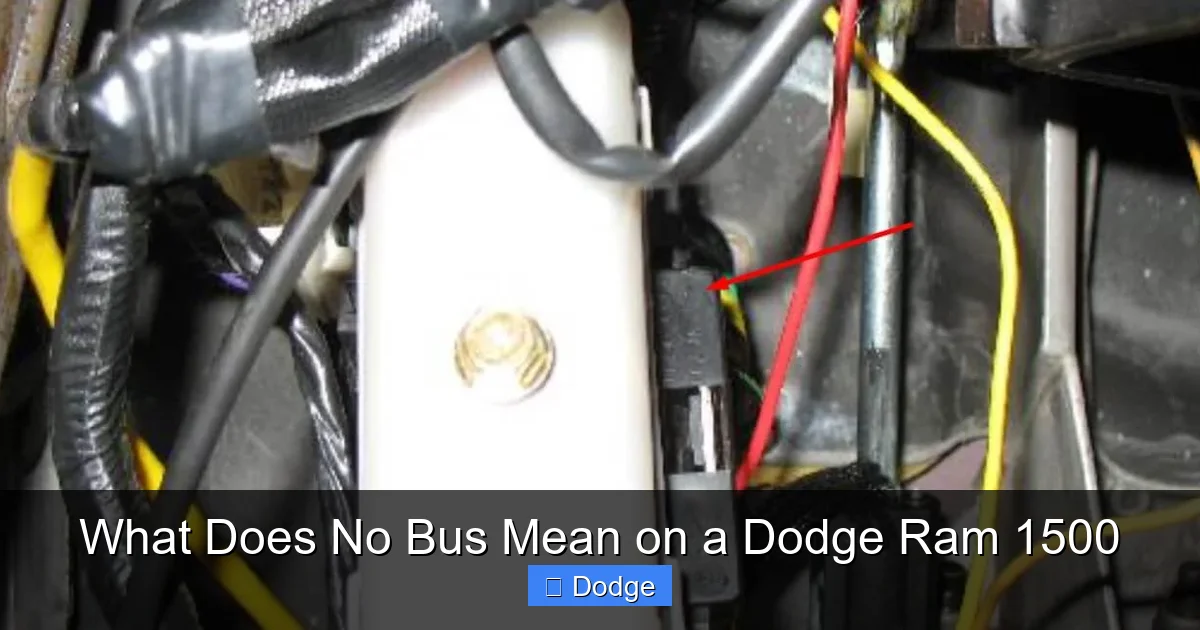
Visual guide about What Does No Bus Mean on a Dodge Ram 1500
Image source: psychoautos.com
Now that you understand what “No Bus” means, let’s dive into the most common reasons it appears. The good news is that many of these causes are relatively easy to check and fix—especially if you’re comfortable with basic automotive troubleshooting.
1. Blown Fuses or Faulty Relays
One of the first things to check is your fuse box. The PCM and other critical modules rely on specific fuses to receive power. If one of these fuses blows—due to a short circuit, power surge, or aging component—the affected module may go offline, disrupting the CAN bus.
In your Ram 1500, key fuses to inspect include:
– **Fuse 10 (10A)** – Powers the PCM keep-alive memory.
– **Fuse 15 (20A)** – Supplies power to the PCM and fuel pump relay.
– **Fuse 30 (10A)** – Powers the instrument cluster.
– **Fuse 34 (10A)** – Powers the CAN bus communication circuit.
Check both the under-hood fuse box (near the battery) and the interior fuse panel (usually under the dashboard on the driver’s side). Use a test light or multimeter to verify continuity. If a fuse is blown, replace it—but also investigate why it blew. Repeated blown fuses often point to a deeper electrical issue.
Relays can also fail. The fuel pump relay, for example, is tied to the PCM and CAN bus. A stuck or faulty relay can disrupt communication. Swap it with a known-good relay (like the horn relay) to test.
2. Weak or Dead Battery
It might sound simple, but a weak or dying battery is one of the most overlooked causes of “No Bus.” Modern vehicles like the Ram 1500 require stable voltage to maintain communication between modules. If the battery voltage drops below 11.5 volts—especially during cranking—the PCM and other modules may reset or shut down entirely.
Signs of a weak battery include:
– Slow cranking
– Dim headlights
– Electrical glitches (e.g., radio resetting, power windows moving slowly)
– “No Bus” appearing after the truck sits for a few days
Use a multimeter to test your battery voltage with the engine off (should be 12.4–12.7V) and with the engine running (should be 13.7–14.7V). If the voltage is low, charge the battery and retest. If it won’t hold a charge, replace it. Also, check the battery terminals for corrosion—clean them with a wire brush if needed.
3. Poor Ground Connections
Grounds are just as important as power. If a module doesn’t have a solid ground connection, it can’t communicate properly—even if it’s receiving power. In the Ram 1500, common ground points include:
– **G100** – Near the battery, on the inner fender
– **G101** – On the engine block, near the starter
– **G201** – Under the dashboard, near the steering column
– **G300** – On the transmission housing
Over time, these ground straps can corrode, loosen, or break. Inspect them for rust, fraying, or loose bolts. Clean the contact points with sandpaper and tighten the connections. A poor ground at G100 or G101 is especially likely to cause “No Bus” because it affects the PCM directly.
4. Faulty OBD-II Port or Wiring
The OBD-II port (located under the dashboard, near the driver’s knee) is the gateway to your truck’s diagnostic system. It’s also directly connected to the CAN bus. If the port is damaged, corroded, or has bent pins, it can disrupt communication.
Common issues include:
– **Bent or corroded pins** – Especially pins 6 (CAN High) and 14 (CAN Low)
– **Loose wiring** – The harness behind the port can become disconnected
– **Moisture or dirt** – Spills or humidity can cause shorts
Carefully inspect the OBD-II port. Use a flashlight to check for bent pins or debris. If you see corrosion, clean it with electrical contact cleaner and a soft brush. You can also unplug the harness behind the port (with the battery disconnected) and inspect the wiring for damage.
5. Failed PCM or TCM
If all else fails, the problem may lie with a faulty module—most commonly the PCM or TCM. These modules are expensive, so they should be a last resort. However, if the PCM has internal damage (e.g., from water intrusion, overheating, or voltage spikes), it may stop communicating on the CAN bus.
Symptoms of a bad PCM include:
– “No Bus” that persists after checking fuses, grounds, and battery
– Inability to communicate with the PCM using a scan tool
– Engine cranks but won’t start, with no spark or fuel
Before replacing the PCM, verify that it’s receiving power and ground. Use a wiring diagram to test the pins. Also, check for Technical Service Bulletins (TSBs) related to your model year—Chrysler has issued several for PCM-related “No Bus” issues.
The TCM (usually integrated into the transmission in newer Rams) can also cause problems if it fails. Look for transmission-related codes (like P0700) alongside “No Bus.”
6. Aftermarket Electronics Interference
Have you recently installed a remote start, alarm, or aftermarket radio? These devices can interfere with the CAN bus if not installed correctly. Poorly wired accessories may draw power from the wrong circuit or create electrical noise that disrupts communication.
Common culprits include:
– Remote starters tapped into the ignition or PCM wiring
– Alarms with faulty sensors or grounding issues
– Aftermarket stereos with improper CAN bus integration
If “No Bus” appeared after an installation, disconnect the new device and see if the problem resolves. If it does, have the accessory professionally reinstalled or use a CAN bus-compatible interface module.
How to Diagnose “No Bus” Step by Step
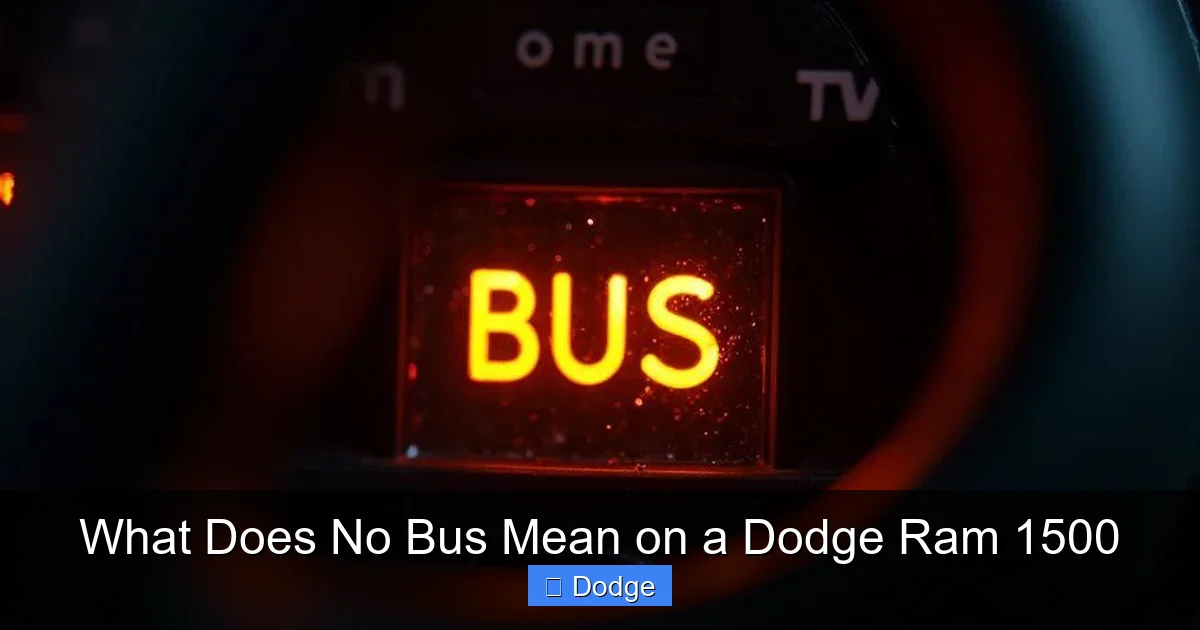
Visual guide about What Does No Bus Mean on a Dodge Ram 1500
Image source: garagesee.com
Diagnosing “No Bus” doesn’t require a mechanic’s degree—just a methodical approach. Here’s a step-by-step guide to help you pinpoint the issue.
Step 1: Check the Battery and Charging System
Start with the basics. Use a multimeter to test:
– Battery voltage (engine off): Should be 12.4–12.7V
– Battery voltage (engine running): Should be 13.7–14.7V
– Voltage drop across terminals: Should be less than 0.2V
If the battery is weak, charge or replace it. If the alternator isn’t charging, have it tested.
Step 2: Inspect Fuses and Relays
Locate the fuse boxes and check the following:
– Fuse 10, 15, 30, and 34 (as listed earlier)
– Fuel pump relay
– Ignition relay
Replace any blown fuses and test relays by swapping with known-good ones.
Step 3: Test Ground Connections
Use a multimeter to check resistance between the battery negative terminal and key ground points (G100, G101, etc.). Resistance should be near 0 ohms. Clean and tighten any loose or corroded connections.
Step 4: Inspect the OBD-II Port
Look for:
– Bent or missing pins (especially 6 and 14)
– Corrosion or moisture
– Loose wiring behind the port
Clean the port and ensure the harness is securely plugged in.
Step 5: Use a Scan Tool
Plug in an OBD2 scanner and see if you can communicate with any modules. If you get “No Response” or “Link Error,” the CAN bus is down. Look for U-codes (e.g., U0100, U0101), which indicate lost communication with specific modules.
Some advanced scanners can monitor live CAN bus traffic. If you see no activity on CAN High and Low, the issue is likely wiring or a module shorting the bus.
Step 6: Check for Aftermarket Devices
Disconnect any recently installed electronics. If “No Bus” disappears, the accessory is the culprit.
Step 7: Test the PCM and TCM
If all else fails, test the PCM for power and ground. If it’s receiving power but not communicating, it may need replacement. The same applies to the TCM.
Can You Fix “No Bus” Yourself?
Visual guide about What Does No Bus Mean on a Dodge Ram 1500
Image source: garagesee.com
Absolutely—many “No Bus” issues are DIY-friendly. With basic tools (multimeter, test light, screwdrivers) and a little patience, you can resolve most causes without a dealership visit.
Tools You’ll Need
– Multimeter
– Test light
– Fuse puller
– Wire brush or sandpaper
– Electrical contact cleaner
– OBD2 scanner (basic or advanced)
Safety Tips
– Always disconnect the battery before working on electrical systems.
– Avoid shorting wires or touching live circuits.
– Use insulated tools to prevent accidental shocks.
When to Call a Professional
Seek help if:
– You’re uncomfortable working with electronics
– The issue persists after checking all common causes
– You suspect a failed PCM or TCM (these often require programming)
Preventing “No Bus” in the Future
Once you’ve fixed the issue, take steps to prevent it from happening again:
– Keep the battery terminals clean and tight.
– Avoid overloading the electrical system with aftermarket accessories.
– Use a battery maintainer if the truck sits for long periods.
– Inspect wiring harnesses during routine maintenance.
Conclusion
Seeing “No Bus” on your Dodge Ram 1500 can be stressful, but it’s rarely a death sentence for your truck. In most cases, it’s a communication breakdown caused by something simple—a blown fuse, a weak battery, or a corroded ground. By understanding how the CAN bus works and following a logical diagnostic process, you can often resolve the issue yourself.
Start with the basics: check your battery, fuses, and grounds. Inspect the OBD-II port and look for aftermarket interference. Use a scan tool to gather clues. And if all else fails, consider a faulty PCM or TCM—but only after ruling out everything else.
With the right approach, “No Bus” doesn’t have to mean “no hope.” Your Ram can be back on the road—and communicating properly—in no time.
Frequently Asked Questions
What does “No Bus” mean on a Dodge Ram 1500?
“No Bus” means the Controller Area Network (CAN bus) communication between your truck’s electronic modules has failed. This prevents systems like the engine, transmission, and dashboard from sharing data, often causing starting issues or a blank instrument cluster.
Can a dead battery cause “No Bus” on a Ram 1500?
Yes, a weak or dead battery can trigger “No Bus” because low voltage disrupts communication between modules. Always test your battery and charging system first when this message appears.
How do I fix “No Bus” on my Dodge Ram?
Start by checking fuses, battery voltage, and ground connections. Inspect the OBD-II port for damage, and use a scan tool to look for communication codes. Most issues are fixable with basic tools.
Is “No Bus” the same as “No Communication” with a scan tool?
Not exactly. “No Bus” refers to internal module communication failure, while “No Communication” means the scan tool can’t talk to any module. You might still get some data even with “No Bus.”
Can aftermarket accessories cause “No Bus”?
Yes, poorly installed alarms, remote starters, or stereos can interfere with the CAN bus. If “No Bus” appeared after an installation, disconnect the device to test.
Do I need to replace the PCM if I get “No Bus”?
Not necessarily. Only consider PCM replacement after checking fuses, grounds, battery, and wiring. A faulty PCM is a last-resort diagnosis and often requires professional programming.
