
Nissan Altima Won’t Start: Common Reasons

If your Nissan Altima won’t start, don’t panic—there are several common causes you can troubleshoot before calling a mechanic. From a dead battery to faulty ignition switches, understanding these issues can save you time and money. With the right knowledge, many of these problems are fixable at home or with minimal professional help.
Key Takeaways
- Dead or weak battery: The most frequent cause of a no-start condition; check voltage and connections.
- Faulty starter motor: A clicking sound often indicates a failing starter that needs replacement.
- Ignition switch problems: Worn or damaged switches can prevent the engine from cranking.
- Fuel system issues: Clogged fuel filters or a failing fuel pump may stop fuel delivery to the engine.
- Bad spark plugs or ignition coils: These can prevent combustion even if the engine turns over.
- Security system glitches: The immobilizer or key fob may block startup if not recognized properly.
- Corroded or loose wiring: Electrical connections under the hood can degrade over time, disrupting power flow.
📑 Table of Contents
- Introduction: Why Won’t My Nissan Altima Start?
- 1. Dead or Weak Battery: The #1 Culprit
- 2. Faulty Starter Motor: When the Engine Won’t Crank
- 3. Ignition Switch Problems: The Hidden Saboteur
- 4. Fuel System Failures: No Gas, No Go
- 5. Ignition System Failures: No Spark, No Start
- 6. Security System and Key Fob Issues
- Conclusion: Don’t Let a No-Start Ruin Your Day
Introduction: Why Won’t My Nissan Altima Start?
You’re running late for work, you hop into your Nissan Altima, turn the key—or press the start button—and… nothing. No engine turnover, no crank, just silence. Or maybe it cranks but doesn’t fire up. Frustrating? Absolutely. But before you panic and assume the worst, know this: most “Nissan Altima won’t start” scenarios have logical, often fixable explanations.
The Nissan Altima is one of the most popular midsize sedans on the road, known for its reliability and fuel efficiency. But like any vehicle, it’s not immune to mechanical or electrical hiccups. Whether you drive a 2010 model or a brand-new 2024 Altima, the reasons your car refuses to start often fall into a few predictable categories. The good news? Many of these issues don’t require a trip to the dealership or a hefty repair bill. With some basic troubleshooting, you might be able to get back on the road in under an hour.
In this guide, we’ll walk you through the most common reasons your Nissan Altima won’t start—from simple fixes like a dead battery to more complex problems like fuel pump failure. We’ll keep it practical, easy to understand, and focused on real-world solutions. Whether you’re a DIY enthusiast or just want to know what your mechanic is talking about, this article has you covered.
1. Dead or Weak Battery: The #1 Culprit
Let’s start with the obvious: if your Nissan Altima won’t start, the battery is the first place to look. In fact, a dead or weak battery is responsible for the majority of no-start complaints across all vehicle models—including the Altima. Car batteries typically last 3–5 years, and extreme temperatures (both hot and cold) can shorten their lifespan.
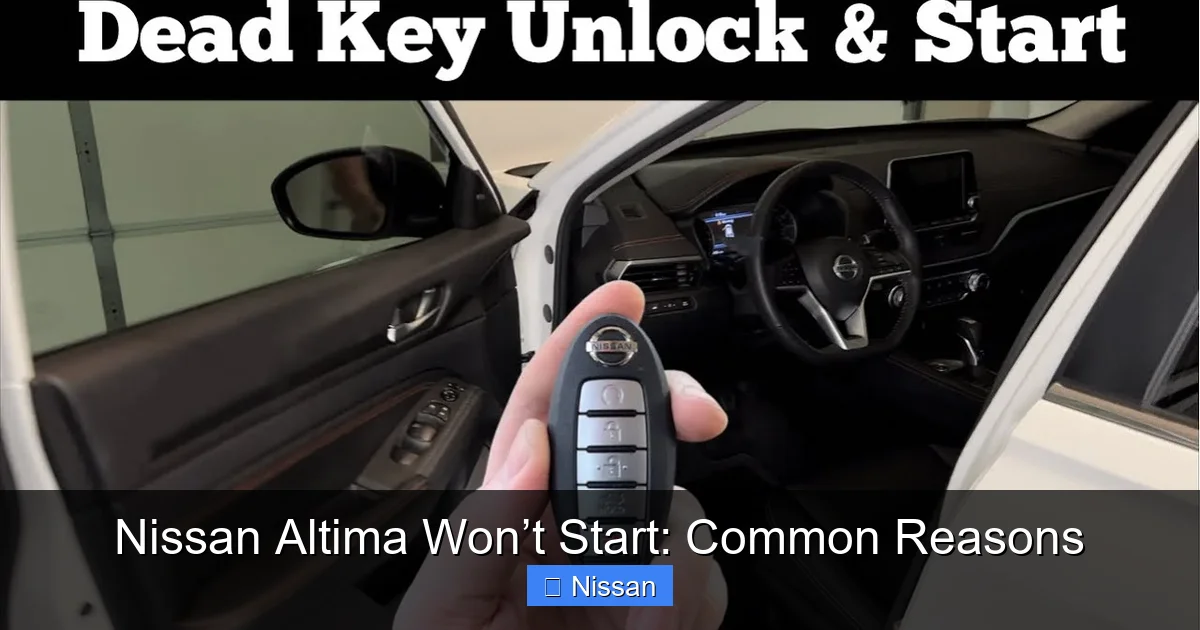
Visual guide about Nissan Altima Won’t Start: Common Reasons
Image source: i.ytimg.com
Signs of a Dead Battery
How can you tell if the battery is the problem? Look for these telltale signs:
- The dashboard lights flicker or don’t come on at all when you turn the key.
- You hear a rapid clicking sound when trying to start the car—this is the starter solenoid trying (and failing) to engage.
- The engine doesn’t crank at all, or cranks very slowly.
- Electrical accessories like the radio, power windows, or interior lights are dim or unresponsive.
If you experience any of these, your battery is likely drained or failing. But don’t assume it’s completely dead—sometimes a weak battery can still power lights but not provide enough current to turn the starter motor.
How to Test Your Battery
You don’t need a mechanic to check your battery. A simple multimeter test can tell you if it’s holding a charge. Here’s how:
- Turn off the car and all electrical accessories.
- Set your multimeter to DC voltage (usually marked as “V” with a straight line).
- Touch the red probe to the positive terminal (+) and the black probe to the negative terminal (–).
- A healthy battery should read between 12.4 and 12.7 volts. Anything below 12.2 volts is considered weak, and under 11.8 volts likely means it’s dead.
If your battery is low, try jump-starting the car using jumper cables and another vehicle. If the Altima starts and runs fine afterward, the battery may just need a recharge. But if it dies again soon after, the battery is probably shot and needs replacement.
Preventing Battery Issues
To avoid future battery problems, follow these tips:
- Turn off lights and accessories when the engine is off.
- Avoid short trips that don’t allow the alternator to fully recharge the battery.
- Have your battery tested annually, especially before winter.
- Clean battery terminals regularly to prevent corrosion, which can block electrical flow.
Pro tip: If your Altima sits unused for days or weeks (common with remote work or travel), consider using a battery maintainer or trickle charger to keep it topped up.
2. Faulty Starter Motor: When the Engine Won’t Crank
If your battery is fine but your Nissan Altima still won’t start, the next suspect is the starter motor. The starter is an electric motor that physically turns the engine over when you turn the key or press the start button. If it fails, the engine won’t crank—even with a fully charged battery.
Common Symptoms of a Bad Starter
How do you know if the starter is the problem? Watch for these signs:
- You hear a single loud click when turning the key, but the engine doesn’t turn over.
- Grinding or whirring noises during startup attempts.
- The engine cranks very slowly or inconsistently.
- Intermittent starting—sometimes it works, sometimes it doesn’t.
A single click is especially telling. That sound usually means the starter solenoid is receiving power but the motor itself isn’t engaging. This could be due to worn brushes, a seized motor, or internal electrical failure.
Testing the Starter
Testing a starter is more involved than checking a battery, but it’s doable with basic tools. Here’s a simplified approach:
- Locate the starter motor—it’s usually mounted on the side of the engine, near the transmission.
- Check the battery voltage again to confirm it’s not the issue.
- Have someone turn the key while you listen near the starter. A healthy starter should make a solid “engage” sound and spin the engine.
- If you hear nothing or just a click, use a multimeter to test for power at the starter’s main terminal when the key is turned. If power is present but the motor doesn’t run, the starter is likely faulty.
Keep in mind: sometimes the issue isn’t the starter itself but the starter relay or ignition switch. If you’re unsure, it’s best to consult a professional mechanic for diagnosis.
Replacing the Starter
Replacing a starter on a Nissan Altima is a moderate DIY job if you’re comfortable with basic automotive work. It typically involves:
- Disconnecting the battery (safety first!).
- Removing the air intake or other components blocking access.
- Unbolting the starter (usually 2–3 bolts).
- Disconnecting the electrical connections.
- Installing the new starter and reassembling.
Starter replacement costs vary, but expect to pay $150–$400 for the part and another $100–$200 for labor if done professionally. Aftermarket starters are often cheaper than OEM (original equipment manufacturer) parts and work just as well.
3. Ignition Switch Problems: The Hidden Saboteur
You might not think about the ignition switch often, but it plays a critical role in starting your Nissan Altima. This small component sends power from the battery to the starter, fuel system, and ignition system when you turn the key or press the start button. If it fails, your car simply won’t respond—even with a good battery and starter.
How the Ignition Switch Works
In older Altima models (pre-2013), the ignition switch is mechanical—you physically turn a key to engage it. In newer models with push-button start, the switch is electronic and relies on a sensor to detect the key fob and send a signal to start the car.
In both cases, the switch must complete an electrical circuit to allow the engine to crank. If the contacts inside wear out or get dirty, that circuit breaks—and your Altima won’t start.
Symptoms of a Failing Ignition Switch
Ignition switch problems can be tricky because they often mimic other issues. Look for these clues:
- The car doesn’t respond at all when you turn the key or press the start button.
- Dashboard lights come on, but there’s no crank or click.
- The engine starts intermittently—sometimes it works, sometimes it doesn’t.
- Accessories like the radio or power windows don’t work when the key is in the “on” position.
- In push-button models, the car doesn’t recognize the key fob even when it’s inside.
One classic sign: jiggling the key or steering wheel while trying to start the car makes it work. This suggests the ignition switch is loose or worn.
Diagnosing and Fixing Ignition Switch Issues
Testing the ignition switch requires checking for power at various points in the starting circuit. This is best done with a wiring diagram and a multimeter. However, if you suspect the switch is faulty, replacement is often the most reliable fix.
For keyed ignitions, the switch is usually located behind the steering column cover. For push-button models, the issue might be with the start button itself or the key fob sensor. In some cases, reprogramming the key fob can resolve the problem.
Replacement costs vary: a new ignition switch might cost $50–$150, while labor can add another $100–$200. If your Altima has a push-button start, dealerships may charge more due to programming requirements.
4. Fuel System Failures: No Gas, No Go
Even if your engine cranks, your Nissan Altima won’t start if fuel isn’t reaching the combustion chamber. The fuel system includes the fuel pump, fuel filter, fuel injectors, and fuel pressure regulator. Any of these components can fail and prevent your car from starting.
How the Fuel System Works
When you turn the key to the “on” position, the fuel pump primes the system by sending fuel from the tank to the engine. The fuel filter cleans the fuel, and the injectors spray it into the cylinders at the right time. If any part of this chain breaks, combustion can’t happen—even if the engine is turning over.
Common Fuel System Problems
Here are the most likely fuel-related causes of a no-start condition:
- Failed fuel pump: The pump may stop working due to electrical issues, wear, or overheating. You might hear a humming sound from the fuel tank when you turn the key—if you don’t, the pump could be dead.
- Clogged fuel filter: Over time, dirt and debris can block the filter, restricting fuel flow. This is more common in older Altimas or cars that use low-quality fuel.
- Faulty fuel injectors: Injectors can get clogged or fail electrically, preventing fuel from spraying into the engine.
- Low fuel pressure: A failing pressure regulator or leak in the fuel line can reduce pressure below the level needed for combustion.
Diagnosing Fuel Issues
To check if fuel is the problem, listen for the fuel pump priming when you turn the key to “on” (you should hear a brief hum from the rear of the car). If you don’t hear it, the pump may be faulty.
You can also use a fuel pressure gauge to test the system. Most Altimas require 45–60 psi of fuel pressure. If it’s too low, the pump, filter, or regulator may need replacement.
Another trick: try spraying a small amount of starting fluid into the air intake. If the engine starts briefly and then dies, it confirms a fuel delivery issue.
Preventing Fuel System Problems
To keep your fuel system healthy:
- Use high-quality gasoline and avoid filling up at sketchy stations.
- Replace the fuel filter every 30,000–60,000 miles (check your owner’s manual).
- Avoid running the car on very low fuel—this can cause the pump to overheat.
- Have the fuel system inspected during routine maintenance.
5. Ignition System Failures: No Spark, No Start
Even with fuel and air, your engine needs a spark to ignite the mixture. If the ignition system fails, your Nissan Altima will crank but not start. The ignition system includes spark plugs, ignition coils, and the crankshaft position sensor.
Spark Plugs and Ignition Coils
Spark plugs create the spark that ignites the fuel-air mixture. Over time, they wear out and can cause misfires or no-start conditions. Ignition coils (or coil packs) provide the high voltage needed to fire the plugs. If a coil fails, one or more cylinders won’t fire.
Symptoms of ignition problems include:
- Engine cranks but doesn’t start.
- Rough idle or misfires when the car does run.
- Check Engine Light with codes like P0300 (random misfire) or P0301–P0306 (cylinder-specific misfires).
Replacing spark plugs every 30,000–100,000 miles (depending on type) and coils as needed can prevent these issues.
Crankshaft Position Sensor
This sensor tells the engine computer when to fire the spark plugs. If it fails, the computer doesn’t know when to ignite the fuel, and the engine won’t start. A faulty sensor often triggers a Check Engine Light and may cause stalling or poor performance.
Testing requires a scan tool, but replacement is straightforward and typically costs $50–$150 for the part.
6. Security System and Key Fob Issues
Modern Nissan Altimas come with advanced anti-theft systems. If the car doesn’t recognize your key fob or detects a security breach, it may refuse to start—even if everything else is working.
Immobilizer System
The immobilizer prevents the engine from starting unless the correct key or fob is present. If the system malfunctions, you might see a flashing security light on the dashboard or get a “Key Not Detected” message.
Solutions include:
- Replacing the key fob battery.
- Reprogramming the fob.
- Using the physical key to unlock the door and start the car (if equipped).
- Resetting the system by disconnecting the battery for 10–15 minutes.
Conclusion: Don’t Let a No-Start Ruin Your Day
When your Nissan Altima won’t start, it’s easy to feel overwhelmed—but most causes are common and often fixable. Start with the battery, then move through the starter, ignition, fuel, and security systems. With a little patience and the right tools, you can often solve the problem yourself.
Remember: regular maintenance is the best way to avoid no-start issues. Keep your battery charged, replace worn parts on schedule, and pay attention to warning signs. And if you’re ever unsure, don’t hesitate to consult a trusted mechanic. Your Altima is built to last—don’t let a small hiccup keep you parked.
Frequently Asked Questions
Why won’t my Nissan Altima start even though the battery is new?
A new battery doesn’t rule out other issues. The problem could be a faulty starter, bad ignition switch, or fuel system failure. Check for clicking sounds, fuel pump noise, or dashboard warning lights to narrow it down.
Can a bad alternator cause my Altima not to start?
Yes, but indirectly. A failing alternator won’t charge the battery, leading to a dead battery over time. If your car starts but dies shortly after, the alternator may be the culprit.
How do I know if my fuel pump is bad?
Listen for a humming sound from the fuel tank when you turn the key to “on.” If you don’t hear it, or if the engine cranks but won’t start, the fuel pump may be faulty. A fuel pressure test can confirm this.
Why does my Altima crank but not start?
This usually points to a fuel, ignition, or sensor issue. Check spark plugs, fuel pressure, and the crankshaft position sensor. Starting fluid can help confirm if it’s a fuel delivery problem.
Can a dead key fob prevent my Altima from starting?
Yes, especially in push-button models. Replace the fob battery or use the physical key to start the car. Some Altimas have a backup start procedure—check your owner’s manual.
Is it safe to jump-start my Nissan Altima?
Yes, as long as you follow proper jump-starting procedures. Connect the cables in the correct order (positive to positive, negative to ground), and avoid touching the clamps together. Disconnect in reverse order once the car starts.
