
Has Audi Ever Been a Wordle Word?

Audi has never been an official Wordle word. Despite its five-letter structure and global recognition, the German automaker hasn’t made the cut in the New York Times’ curated Wordle answer list. This article explores why, how Wordle selects words, and what it means for car brands like Audi and Suzuki.
Key Takeaways
- Audi has never appeared as a Wordle answer: Despite fitting the five-letter format, Audi hasn’t been featured in the official Wordle word list since the game’s launch in 2021.
- Wordle favors common, everyday English words: The game prioritizes words that are familiar to a broad audience, often excluding brand names, even well-known ones like Audi.
- Brand names are generally excluded: Wordle avoids proper nouns, including car brands, to maintain fairness and linguistic neutrality.
- Suzuki shares a similar fate: Like Audi, Suzuki—another major automaker—has never been a Wordle word, despite being five letters long.
- Wordle’s word selection is intentional and curated: The New York Times maintains a strict list of acceptable answers, focusing on vocabulary rather than pop culture or branding.
- Players can still guess brand names: While not official answers, users are free to try words like “Audi” or “Suzuki” as guesses during gameplay.
- The absence of car brands sparks curiosity: Fans often wonder why iconic names don’t appear, leading to discussions about language, branding, and game design.
📑 Table of Contents
- Introduction: The Wordle Phenomenon and the Curious Case of Audi
- Understanding Wordle’s Word Selection Process
- Audi: A Five-Letter Brand That Fits the Format
- The Broader Context: Why Brand Names Are Excluded
- Suzuki and the Automotive Wordle Gap
- Could Audi Ever Become a Wordle Word?
- Conclusion: The Wordle Word That Isn’t
Introduction: The Wordle Phenomenon and the Curious Case of Audi
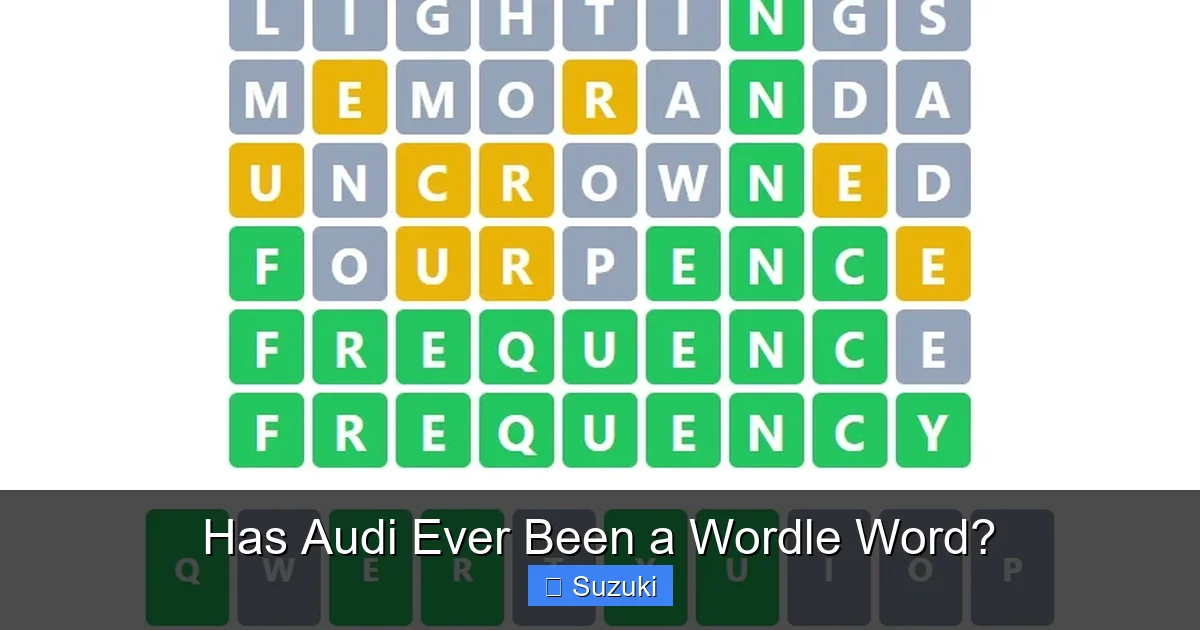
In late 2021, a simple yet addictive word puzzle took the internet by storm. Wordle, created by software engineer Josh Wardle, quickly became a daily ritual for millions around the world. The game’s appeal lies in its simplicity: players have six attempts to guess a hidden five-letter word, with color-coded feedback guiding each guess. Green means correct letter in the right spot, yellow means the letter is in the word but misplaced, and gray means the letter isn’t in the word at all.
What started as a personal project for Wardle’s partner evolved into a global sensation, eventually acquired by The New York Times in early 2022. Since then, Wordle has maintained its charm through consistency—one puzzle per day, no ads, and a carefully curated list of answers. But with millions of players guessing thousands of words daily, a natural question arises: has every possible five-letter word been considered? More specifically, has a brand as globally recognized as Audi ever made the cut?
Audi, the German luxury automobile manufacturer, is a household name. Known for its sleek designs, innovative technology, and the iconic four-ring logo, Audi has been a symbol of automotive excellence for over a century. Its name is short, five letters long, and easy to spell—seemingly perfect for a Wordle answer. Yet, despite these ideal characteristics, Audi has never appeared as the daily Wordle word. This raises an intriguing puzzle within a puzzle: why hasn’t Audi been chosen, and what does that tell us about how Wordle selects its words?
Understanding Wordle’s Word Selection Process
Visual guide about Has Audi Ever Been a Wordle Word?
Image source: wordle-unlimited.io
To understand why Audi hasn’t been a Wordle word, we need to dive into how the game’s vocabulary is chosen. Wordle doesn’t use a random generator or pull from a dictionary at large. Instead, it relies on a pre-selected list of 2,309 possible answers, meticulously curated by the game’s creators. This list was designed to include words that are common enough for most English speakers to know, but not so obscure that they feel unfair or frustrating.
The Criteria for Wordle Answers
The selection process prioritizes several key factors:
– **Common Usage:** Words must be frequently used in everyday English. Think “table,” “light,” or “house”—words that appear in conversations, books, and media.
– **Familiar Spelling:** The word should be spelled in a way that’s intuitive and consistent with standard English rules. No tricky spellings or silent letters that confuse players.
– **Neutrality:** Wordle avoids proper nouns, slang, jargon, and brand names to keep the game accessible and fair for a global audience.
– **No Plurals or Verb Tenses:** The game typically avoids words ending in “s” or past tense forms (like “walked”) to prevent confusion and maintain consistency.
These rules help explain why Audi—despite being a real, pronounceable, five-letter word—hasn’t made the list. While “Audi” is a real word in the sense that it’s a brand name, it’s still a proper noun. And in the world of Wordle, proper nouns are generally off-limits.
The Role of Brand Names in Wordle
Brand names, no matter how famous, are almost always excluded from Wordle’s answer list. This includes companies like Apple, Nike, Tesla, and yes, Audi. The reasoning is both linguistic and practical. Wordle aims to test general vocabulary, not brand recognition. Including brand names could give an unfair advantage to players from certain countries or industries, skewing the game’s fairness.
For example, someone working in the automotive industry might instantly guess “Audi” if it appeared, while someone unfamiliar with cars might never think of it. This imbalance goes against Wordle’s core philosophy: a level playing field for all.
Moreover, brand names often carry cultural or commercial weight that doesn’t align with Wordle’s neutral, educational tone. The game is meant to be a fun mental exercise, not a marketing platform. Allowing brand names could open the door to sponsorships or commercial influence, which the New York Times has wisely avoided.
Audi: A Five-Letter Brand That Fits the Format
Visual guide about Has Audi Ever Been a Wordle Word?
Image source: droidgamers.com
At first glance, Audi seems like a natural fit for Wordle. It’s exactly five letters long—the perfect length for the game. It’s easy to spell: A-U-D-I. No silent letters, no tricky combinations. It’s also globally recognized, especially in countries with strong automotive cultures like Germany, the United States, and Japan.
Why Audi Seems Like a Wordle Candidate
Let’s break down why Audi appears to meet many of Wordle’s surface-level requirements:
– **Length:** Five letters—check.
– **Spelling:** Simple and phonetic—check.
– **Pronunciation:** Clear and consistent—check.
– **Recognition:** Millions know the name—check.
In fact, if you were to ask a group of people to name a five-letter car brand, Audi would likely top the list. It’s shorter than “Honda” or “Mazda,” and more globally recognized than “Acura” or “Lexus.” So why hasn’t it been chosen?
The answer lies in the distinction between a “word” and a “brand name.” While “Audi” is a word in the dictionary of automotive enthusiasts, it’s not considered a common English word in the linguistic sense. It doesn’t describe an object, action, or concept—it’s a proper noun referring to a specific company.
Comparing Audi to Other Car Brands
Let’s look at other car brands to see how they fare in the Wordle universe:
– **Honda:** Five letters, but also a brand name. Never been a Wordle answer.
– **Mazda:** Five letters, brand name. Not in the Wordle list.
– **Tesla:** Five letters, but often associated with Elon Musk and electric vehicles. Still a brand name—never used.
– **Suzuki:** Five letters, Japanese automaker. Also never appeared.
Interestingly, “Suzuki” shares many traits with Audi: it’s a globally recognized brand, five letters long, and easy to spell. Yet, like Audi, it hasn’t been featured in Wordle. This reinforces the pattern: car brands, regardless of popularity, are not considered valid Wordle answers.
The Broader Context: Why Brand Names Are Excluded
Visual guide about Has Audi Ever Been a Wordle Word?
Image source: mywordle.net
The exclusion of brand names like Audi and Suzuki from Wordle isn’t arbitrary—it’s a deliberate design choice rooted in fairness, accessibility, and linguistic integrity.
Fairness Across Cultures and Industries
Wordle is played by people from all walks of life, in dozens of countries. A player in rural India might not know what an Audi is, while someone in Munich might guess it instantly. Including brand names could create an uneven playing field, where knowledge of Western consumer brands gives certain players an advantage.
This isn’t just about cars. Think about tech brands like “Apple” or “Sony,” fashion labels like “Nike” or “Adidas,” or food brands like “Coca” or “Pepsi.” All are five letters, all are famous, but none have ever been Wordle answers. The game’s creators want to ensure that success is based on vocabulary, not brand awareness.
Maintaining Linguistic Neutrality
Wordle is, at its core, a language game. It’s designed to celebrate the richness of the English language, not commercial branding. By sticking to common nouns, verbs, and adjectives, the game stays true to its educational roots.
Imagine if “Google” were a Wordle answer. It’s a verb now—“to google something”—but it’s still a brand. Should that count? The line becomes blurry. To avoid confusion, Wordle draws a clear boundary: no brand names, no exceptions.
The Risk of Commercial Influence
Allowing brand names could open the door to sponsorships or paid placements. What if Audi offered The New York Times a million dollars to feature “Audi” as a Wordle answer? It’s a hypothetical, but one that highlights the importance of maintaining editorial independence.
By excluding brand names, Wordle preserves its integrity as a pure word game—free from commercial pressure or bias.
Suzuki and the Automotive Wordle Gap
While this article focuses on Audi, it’s worth noting that Suzuki—another major player in the automotive world—faces the same Wordle fate. Suzuki, the Japanese manufacturer known for motorcycles, cars, and outboard motors, is also a five-letter brand name that has never appeared in the game.
Suzuki’s Global Presence
Suzuki has a strong presence in Asia, Europe, and South America. Its vehicles are known for affordability, reliability, and fuel efficiency. In countries like India, Suzuki dominates the small car market through its partnership with Maruti. Yet, despite this widespread recognition, “Suzuki” has never been a Wordle answer.
Why Suzuki Isn’t a Wordle Word
Like Audi, Suzuki is a proper noun—a brand name, not a common English word. It doesn’t describe a general concept or object. While “suzuki” might appear in dictionaries as a surname or place name, it’s not part of everyday vocabulary.
Moreover, Suzuki’s spelling—S-U-Z-U-K-I—includes a “Z” and a “K,” which are less common in Wordle answers. The game tends to favor words with more frequent letters like E, A, R, I, O, T, N, and S. Words with “Z,” “Q,” “X,” or “J” are rarer, making them less likely to be chosen.
The Bigger Picture: Car Brands and Wordle
The absence of both Audi and Suzuki from Wordle highlights a broader trend: the game’s deliberate avoidance of automotive terminology. You won’t find words like “tire,” “engine,” “brake,” or “wheel” as answers either—not because they’re brand names, but because they’re too specific or technical.
Wordle prefers general, versatile words that can be used in multiple contexts. “Light,” “house,” “water,” “sound”—these are words everyone knows and uses daily. Car parts or brand names don’t fit that mold.
Could Audi Ever Become a Wordle Word?
Given the current rules and selection criteria, it’s highly unlikely that Audi will ever appear as a Wordle answer. But let’s explore the possibilities.
Changes in Wordle’s Policy
If The New York Times were to revise its word selection guidelines—perhaps to include more modern or culturally relevant terms—brand names might become eligible. However, this would be a significant shift in philosophy. Wordle’s charm lies in its simplicity and neutrality. Introducing brand names could alienate players who value the game’s current integrity.
The Rise of “Audi” as a Common Word
In theory, if “Audi” were to enter the English language as a common noun or verb—like “Google” has—it might eventually qualify. For example, if people started saying “I audied that report” to mean “I reviewed it with precision,” the word could gain linguistic legitimacy. But this is speculative and unlikely in the near future.
Special Themed Versions
The New York Times has introduced themed versions of Wordle, such as “Wordle for Kids” or “Wordle for Spanish.” In a hypothetical “Wordle for Cars” or “Wordle for Brands,” Audi might finally make an appearance. But these would be spin-offs, not the main game.
Conclusion: The Wordle Word That Isn’t
So, has Audi ever been a Wordle word? The answer is a definitive no. Despite its perfect five-letter length, global recognition, and easy spelling, Audi has never appeared as the daily Wordle answer. The same goes for Suzuki and most other car brands.
This isn’t a reflection of Audi’s importance or popularity—it’s a testament to Wordle’s thoughtful design. The game prioritizes common English vocabulary, fairness, and linguistic neutrality. Brand names, no matter how famous, are excluded to maintain a level playing field for all players.
While it might be disappointing for Audi enthusiasts who dream of guessing “A-U-D-I” and seeing four green letters, the absence of brand names is what makes Wordle special. It’s a game about words, not brands. It’s about language, not logos.
So the next time you play Wordle and consider guessing “Audi” or “Suzuki,” remember: you’re free to try. But don’t be surprised if those letters turn gray. The real joy of Wordle isn’t in guessing famous names—it’s in the thrill of the puzzle, the satisfaction of a correct guess, and the daily reminder of how rich and surprising the English language can be.
And who knows? Maybe one day, in a special edition or a fan-made version, Audi will finally get its moment in the green square spotlight. But for now, it remains a word that’s famous—but not a Wordle word.
Frequently Asked Questions
Has Audi ever been a Wordle word?
No, Audi has never appeared as an official Wordle answer. Despite being a five-letter word and a globally recognized brand, it hasn’t been included in the New York Times’ curated list of Wordle solutions.
Why aren’t car brands like Audi or Suzuki used in Wordle?
Wordle avoids proper nouns, including brand names, to maintain fairness and linguistic neutrality. The game focuses on common English words that are familiar to a broad audience, not commercial or cultural references.
Can I guess “Audi” when playing Wordle?
Yes, you can guess “Audi” or any other word during gameplay. However, it will only be correct if it matches the day’s hidden answer, which it never has been to date.
What makes a word eligible for Wordle?
Wordle answers are common, everyday English words that are five letters long, easy to spell, and widely recognized. They avoid proper nouns, slang, plurals, and brand names.
Will brand names ever be allowed in Wordle?
It’s unlikely under the current guidelines. The New York Times prioritizes vocabulary over branding, and changing this would alter the game’s core philosophy.
Are there any car-related words in Wordle?
While specific car parts like “tire” or “wheel” are rare, general words like “drive” or “speed” have appeared. However, brand names and technical terms are typically excluded.
