
What Size Tire Is a 295/70r17

A 295/70R17 tire is a large, rugged all-terrain or mud-terrain tire commonly used on trucks, SUVs, and off-road vehicles. It features a 295mm tread width, 70% aspect ratio, and fits 17-inch wheels, offering excellent ground clearance and traction.
If you’ve ever glanced at the side of a tire and seen something like “295/70R17” and wondered what it all means, you’re not alone. Tire sizing can look like a secret code at first glance—especially when you’re trying to figure out if a tire will fit your truck or SUV. But once you break it down, it’s actually pretty straightforward. So, what size tire is a 295/70R17? In simple terms, it’s a large, robust tire designed for heavy-duty vehicles that need extra grip, ground clearance, and durability—especially off the beaten path.
This tire size is a favorite among off-road enthusiasts, truck owners, and adventure seekers. Whether you’re tackling muddy trails, rocky terrain, or just want a more aggressive look for your vehicle, the 295/70R17 offers a great balance of performance and presence. But beyond the cool factor, understanding the exact dimensions, load capacity, and compatibility of this tire is crucial before making a purchase. Getting the right fit ensures safety, optimal handling, and long-term value.
In this guide, we’ll dive deep into what the numbers in “295/70R17” really mean, how this tire performs in real-world conditions, which vehicles it fits best, and what to consider before upgrading. Whether you’re a seasoned off-roader or a first-time tire shopper, this article will give you the knowledge you need to make an informed decision.
Key Takeaways
- Tire Dimensions: A 295/70R17 tire has a tread width of 295 millimeters, a sidewall height that is 70% of the width, and fits a 17-inch wheel diameter.
- Overall Diameter: The total diameter is approximately 33.3 inches, making it ideal for lifted trucks and off-road builds.
- Load and Speed Ratings: Most 295/70R17 tires carry a load index of 128–131 (up to 3,750–4,300 lbs) and speed ratings from Q (99 mph) to S (112 mph).
- Vehicle Compatibility: Commonly used on Ford F-150, Ram 1500, Toyota Tundra, and Jeep Gladiator, especially with leveling kits or lifts.
- Tire Type: Typically found in all-terrain (AT) or mud-terrain (MT) designs, balancing on-road comfort and off-road capability.
- Fuel Efficiency & Wear: Wider footprint may reduce fuel economy slightly but improves grip and stability on rough terrain.
- Replacement Tips: Always check clearance, speedometer calibration, and suspension compatibility before upgrading to this size.
📑 Table of Contents
Breaking Down the 295/70R17 Tire Size
Let’s start by decoding the tire size: 295/70R17. At first glance, it looks like a random string of numbers and letters, but each part tells you something important about the tire’s dimensions and construction.
The first number, 295, refers to the **tread width** in millimeters. That means the tire is 295 millimeters wide from sidewall to sidewall when mounted and inflated to the recommended pressure. To put that in perspective, that’s about 11.6 inches—quite wide compared to standard passenger car tires, which are often around 205–245mm. This extra width gives the tire a larger contact patch with the road (or trail), improving traction, especially on loose or uneven surfaces.
Next is the number 70, which is the **aspect ratio**. This is the height of the tire’s sidewall expressed as a percentage of the tread width. So, 70% of 295mm equals about 206.5mm. In simpler terms, the sidewall is roughly 8.1 inches tall. A higher aspect ratio like 70 means a taller, more flexible sidewall, which can absorb bumps better and provide a smoother ride—ideal for off-roading or rough roads.
The letter “R” stands for **radial construction**, which is the standard for modern tires. Radial tires have layers of fabric and steel belts running radially across the tire, offering better fuel efficiency, heat dissipation, and tread life compared to older bias-ply designs.
Finally, the number 17 indicates the **wheel diameter** in inches. This tire is designed to fit a 17-inch wheel rim. It’s a popular size for trucks and SUVs because it offers a good balance between strength, ride comfort, and availability of tire options.
Calculating the Overall Diameter
One of the most important measurements when choosing a tire is the **overall diameter**—how tall the tire is from the ground to the top. This affects everything from speedometer accuracy to clearance under the fenders.
To calculate the diameter of a 295/70R17 tire, you can use this formula:
> Overall Diameter = (Sidewall Height × 2) + Wheel Diameter
First, convert the sidewall height from millimeters to inches. We already know the sidewall is 70% of 295mm, which is 206.5mm. Divide that by 25.4 (the number of millimeters in an inch) to get approximately 8.13 inches.
Now, multiply by 2 (since there’s a sidewall on the top and bottom):
8.13 × 2 = 16.26 inches
Add the wheel diameter (17 inches):
16.26 + 17 = **33.26 inches**
So, the overall diameter of a 295/70R17 tire is roughly **33.3 inches**. That’s significantly larger than a standard passenger car tire (usually around 26–28 inches) and even bigger than many factory truck tires. This extra height gives your vehicle more ground clearance, which is a major advantage when driving over rocks, logs, or deep ruts.
Why Diameter Matters
You might be wondering—why does diameter matter so much? Well, a larger tire changes how your vehicle behaves in several ways.
First, it affects your **speedometer and odometer readings**. If you install tires that are taller than stock, your vehicle will actually be traveling faster than the speedometer indicates. For example, if your speedometer says 60 mph, you might actually be going 63 mph. This can lead to unintentional speeding and inaccurate mileage tracking. Most modern vehicles can be recalibrated via the onboard computer or a tuner, but it’s something to keep in mind.
Second, a taller tire increases **ground clearance**, which is crucial for off-roading. More clearance means you’re less likely to scrape the undercarriage on obstacles. It also improves approach, departure, and breakover angles—key metrics for navigating steep inclines and declines.
However, larger tires can also put more stress on your vehicle’s **suspension, drivetrain, and brakes**. The added weight and rotational mass can reduce acceleration, increase braking distance, and wear out components faster if not properly supported.
Load Capacity and Speed Rating
Visual guide about What Size Tire Is a 295/70r17
Image source: tireblogger.com
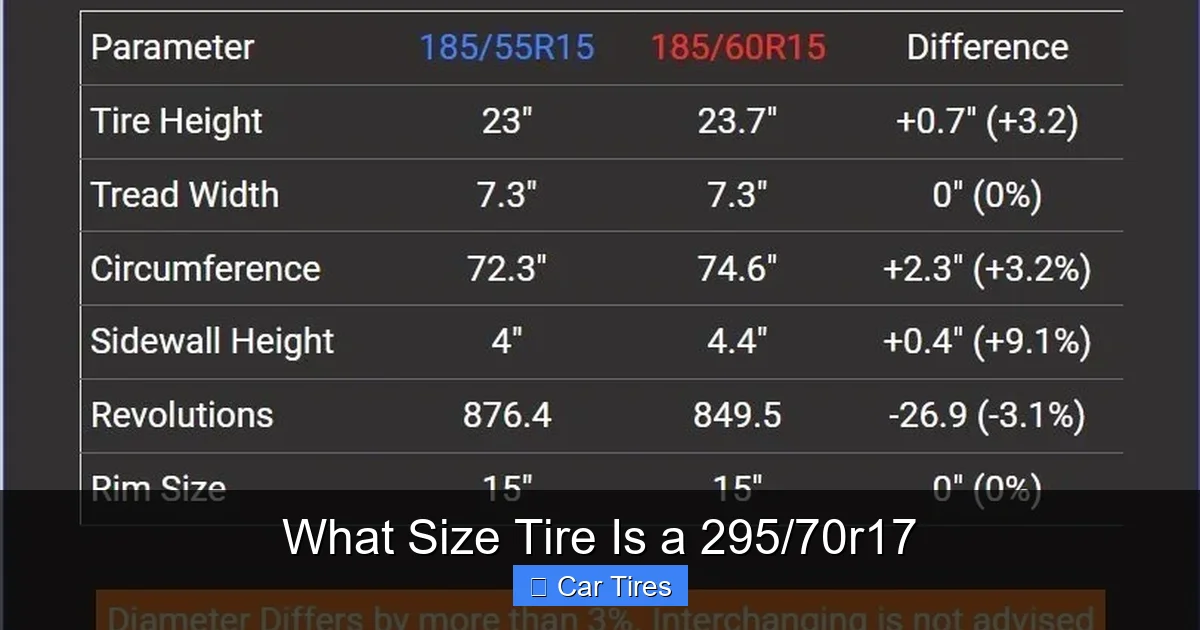
When shopping for tires, especially large ones like the 295/70R17, it’s essential to check the **load index** and **speed rating**. These numbers tell you how much weight the tire can safely carry and how fast it can go without failing.
Most 295/70R17 tires come with a load index ranging from **128 to 131**. Here’s what that means:
– Load Index 128 = 3,750 pounds per tire
– Load Index 129 = 3,890 pounds
– Load Index 130 = 4,080 pounds
– Load Index 131 = 4,300 pounds
Since most vehicles use four tires, a load index of 131 means the set can support up to **17,200 pounds**—more than enough for heavy-duty trucks, campers, or vehicles towing trailers.
The **speed rating** is usually marked with a letter, such as Q, R, S, or T. For 295/70R17 tires, common ratings include:
– Q = Up to 99 mph
– R = Up to 106 mph
– S = Up to 112 mph
– T = Up to 118 mph
Most all-terrain and mud-terrain tires in this size are rated S or T, which is more than sufficient for highway driving. However, if you plan to drive at high speeds regularly (like on long highway trips), make sure your tires are rated accordingly. Never exceed the speed rating, as it can lead to overheating and blowouts.
Understanding Ply Rating and Durability
Another factor to consider is the **ply rating** or **load range**, often indicated by letters like C, D, or E. These correspond to the tire’s strength and how much air pressure it can handle.
– Load Range C = 6-ply rating, max pressure ~50 psi
– Load Range D = 8-ply rating, max pressure ~65 psi
– Load Range E = 10-ply rating, max pressure ~80 psi
For a 295/70R17 tire, you’ll most commonly find Load Range E, which is ideal for heavy trucks and off-road use. The higher ply rating means the tire can handle heavier loads and rougher conditions without failing. It also allows for lower air pressure when off-roading, which increases the tire’s footprint and improves traction on sand, mud, or rocks.
However, running lower pressures requires careful monitoring. Too little air can cause the tire to unseat from the rim or overheat. Always use a quality tire pressure monitoring system (TPMS) and check pressures regularly, especially when switching between on-road and off-road use.
Vehicle Compatibility and Fitment
Visual guide about What Size Tire Is a 295/70r17
Image source: calculatorshub.net
Now that we know the specs, let’s talk about which vehicles can actually use a 295/70R17 tire. This size is popular, but not every truck or SUV can accommodate it without modifications.
Common Vehicles That Fit 295/70R17
Here are some of the most popular models that can run this tire size, either from the factory or with minor upgrades:
– **Ford F-150 (2009–2023):** Especially the 4×4 models with a leveling kit or 2-inch lift. The F-150 has generous wheel wells, making it a great candidate.
– **Ram 1500 (2009–2023):** The Ram’s suspension design allows for larger tires, particularly on the Rebel or TRX trims. A leveling kit may be needed for full clearance.
– **Toyota Tundra (2007–2023):** Known for its ruggedness, the Tundra handles 295/70R17 tires well, especially with a 2–3 inch lift.
– **Chevrolet Silverado 1500 (2007–2023):** Similar to the Ram, it can fit this size with a leveling kit or mild lift.
– **GMC Sierra 1500:** Shares the same platform as the Silverado, so fitment is nearly identical.
– **Jeep Gladiator (2020–2023):** Designed for off-roading, the Gladiator can easily accommodate 295/70R17 tires, especially with the factory Rubicon suspension.
– **Nissan Titan (2004–2023):** With a leveling kit, the Titan can run this size without major issues.
Modifications Needed for Fitment
Even if your vehicle isn’t listed above, you might still be able to fit a 295/70R17 tire—but it may require some modifications.
The most common upgrade is a **leveling kit**, which raises the front suspension by 1.5 to 3 inches to match the rear height and create more clearance. This is often enough for trucks that sag slightly in the front due to the engine weight.
For more aggressive fitment, a **2–4 inch lift kit** may be necessary. This raises the entire vehicle, providing extra space for larger tires and improving off-road capability. However, lifts can affect ride quality, steering geometry, and warranty coverage, so they should be installed by a professional.
Another consideration is **wheel offset and backspacing**. A wheel with too much positive offset (pushed outward) can cause the tire to rub against the fender or suspension components. Conversely, too much negative offset (pushed inward) can stress wheel bearings. Most 295/70R17 setups work best with wheels that have a +10 to +25 offset and 5.5 to 6 inches of backspacing.
Rubbing and Clearance Issues
Even with a lift or leveling kit, **tire rubbing** can still occur—especially during full suspension compression or sharp turns. Common rubbing spots include:
– Front fender liners
– Rear wheel well edges
– Control arms or sway bars
To prevent this, many owners install **fender flares** or trim the factory liners. Some also use **wheel spacers** to push the tire outward slightly, but spacers should be used cautiously and only with high-quality, hub-centric designs.
Always test-fit the tires before committing. Take your vehicle for a drive over bumps, make tight turns, and check for any contact. If you hear scraping or see scuff marks, adjustments are needed.
Tire Types: All-Terrain vs. Mud-Terrain
Visual guide about What Size Tire Is a 295/70r17
Image source: tireslover.com
Not all 295/70R17 tires are created equal. The two most common types are **all-terrain (AT)** and **mud-terrain (MT)**, each designed for different driving conditions.
All-Terrain Tires
All-terrain tires are the most popular choice for daily drivers who also want off-road capability. They feature a balanced tread pattern with moderate voids (gaps between tread blocks) that provide good traction on dirt, gravel, and light mud, while still offering a quiet, comfortable ride on pavement.
Examples of top all-terrain tires in this size include:
– **BFGoodrich All-Terrain T/A KO2** – Known for durability and excellent sidewall strength.
– **Toyo Open Country A/T III** – Offers great wet traction and long tread life.
– **Goodyear Wrangler Duratrac** – Aggressive look with excellent snow and mud performance.
These tires typically last 50,000–70,000 miles, depending on driving habits and rotation schedules. They’re ideal for people who drive mostly on roads but want the option to explore trails on weekends.
Mud-Terrain Tires
Mud-terrain tires are built for serious off-roading. They have large, aggressive tread blocks with deep voids designed to dig into mud, sand, and rocks. The trade-off is increased road noise, reduced tread life (often 30,000–50,000 miles), and a harsher ride on pavement.
Popular mud-terrain options include:
– **BFGoodrich Mud-Terrain T/A KM3** – Excellent in deep mud and rocky terrain.
– **Nitto Trail Grappler** – A hybrid design that balances mud performance with on-road manners.
– **Mickey Thompson Baja Boss M/T** – Built for extreme conditions with reinforced sidewalls.
Mud-terrains are best suited for dedicated off-road vehicles or those who frequently drive in harsh environments. If you’re mostly commuting, an all-terrain tire is usually the better choice.
Hybrid and Specialty Tires
Some manufacturers offer **hybrid tires** that blend features of both AT and MT designs. These aim to deliver off-road capability without sacrificing too much on-road comfort. Examples include the **Nitto Ridge Grappler** and **Toyo Open Country R/T**.
There are also **winter/snow-specific tires** in this size, such as the **Nokian Hakkapeliitta LT3**, designed for extreme cold and icy conditions.
Performance, Fuel Economy, and Wear
Upgrading to a 295/70R17 tire isn’t just about looks—it affects how your vehicle performs in everyday driving.
Handling and Stability
The wider tread and taller sidewall of a 295/70R17 tire improve **lateral grip** and **stability**, especially on uneven terrain. You’ll notice better control when cornering off-road or driving on gravel roads. However, on pavement, the larger contact patch can make the steering feel slightly heavier, and the taller sidewall may introduce a small amount of flex during aggressive maneuvers.
Fuel Economy Impact
Larger, heavier tires require more energy to rotate, which can reduce **fuel efficiency**. Expect a drop of 1–3 miles per gallon (mpg), depending on driving conditions and tire type. Mud-terrain tires, with their aggressive tread and heavier construction, typically have the biggest impact.
To minimize fuel loss, keep your tires properly inflated, rotate them regularly, and avoid excessive idling. Some drivers also switch to lighter wheels (like forged aluminum) to offset the tire weight.
Tread Life and Maintenance
Tread life varies widely based on tire type, driving habits, and alignment. All-terrain tires generally last longer than mud-terrains due to their harder rubber compounds and less aggressive tread.
To maximize lifespan:
– Rotate tires every 5,000–7,000 miles
– Maintain proper inflation (check monthly)
– Get regular wheel alignments
– Avoid hard braking and rapid acceleration
Uneven wear patterns—like cupping or feathering—can indicate alignment issues or worn suspension components. Address these promptly to avoid premature tire failure.
Installation, Balancing, and Safety Tips
Installing larger tires isn’t as simple as swapping them out. Proper installation and maintenance are key to safety and performance.
Professional Installation
Always have your tires installed by a **certified technician** who understands lifted or modified vehicles. They’ll ensure the tires are mounted correctly, balanced, and checked for clearance issues.
Improper mounting can lead to vibration, uneven wear, or even tire separation at high speeds.
Balancing and Vibration
Larger tires are more sensitive to imbalance. Even small weights can make a big difference. If you feel vibration at highway speeds, have the tires rebalanced. Some shops use **road force balancing**, which simulates real driving conditions for more accurate results.
Speedometer Calibration
As mentioned earlier, taller tires change your effective gear ratio. This means your speedometer will read slower than your actual speed.
For example, if your stock tires were 31 inches tall and you upgrade to 33.3-inch 295/70R17s, your speedometer will be off by about 7%. At a displayed 60 mph, you’re actually going 64 mph.
To fix this, use a **speedometer recalibration tool** or have it adjusted at a shop. Many modern trucks allow this through the onboard computer or a handheld tuner like those from Hypertech or DiabloSport.
Safety Considerations
Never exceed the tire’s load or speed rating. Overloading can cause blowouts, especially when towing or carrying heavy gear.
Also, avoid mixing tire sizes or types on the same axle. This can cause drivetrain damage, especially in 4WD vehicles.
Finally, inspect your tires regularly for cuts, bulges, or embedded objects. Off-roading increases the risk of sidewall damage, which can be dangerous if ignored.
Conclusion
So, what size tire is a 295/70R17? It’s a large, capable tire designed for trucks and SUVs that demand strength, traction, and ground clearance. With a 295mm width, 70% aspect ratio, and 17-inch wheel fitment, it delivers a total diameter of about 33.3 inches—perfect for off-road adventures and rugged daily driving.
This tire size strikes a great balance between performance and practicality, especially when paired with the right vehicle and modifications. Whether you choose an all-terrain for mixed use or a mud-terrain for extreme conditions, the 295/70R17 offers impressive capability.
Just remember: bigger isn’t always better without the right setup. Check clearance, recalibrate your speedometer, and maintain your tires properly to get the most out of your investment. With the right knowledge and care, a 295/70R17 tire can be a game-changer for your vehicle’s performance and style.
Frequently Asked Questions
What does 295/70R17 mean?
The 295/70R17 tire size means the tread width is 295 millimeters, the sidewall height is 70% of that width, and it fits a 17-inch wheel. The “R” indicates radial construction.
What is the overall diameter of a 295/70R17 tire?
The overall diameter is approximately 33.3 inches, making it significantly taller than standard passenger tires and ideal for increased ground clearance.
Will a 295/70R17 tire fit my truck without a lift?
It depends on your vehicle. Some trucks, like the Ford F-150 or Ram 1500, can fit this size with a leveling kit, but others may require a 2–3 inch lift to avoid rubbing.
How much does a 295/70R17 tire weigh?
Most 295/70R17 tires weigh between 60 and 80 pounds, depending on the brand and type (all-terrain vs. mud-terrain).
Can I use 295/70R17 tires for daily driving?
Yes, especially if you choose an all-terrain tire. They offer a good balance of off-road capability and on-road comfort for daily use.
Do I need to recalibrate my speedometer with 295/70R17 tires?
Yes, because the larger diameter changes your effective gear ratio. Recalibration ensures your speedometer and odometer readings remain accurate.