
How to Protect a Car Cover From UV Damage

Quick Answer
To protect a car cover from UV damage, use an outdoor-rated, UV-resistant cover and keep it clean, dry, securely fitted, and out of direct sun whenever practical. Regular inspections matter because UV exposure gradually weakens many polymer-based fabrics, so compare your cover’s condition with the construction and fit considerations highlighted in current car cover testing.
Best UV-protection steps
- Choose outdoor fabric: Confirm that the manufacturer specifically rates the cover for outdoor UV exposure.
- Use available shade: A carport, garage, canopy, or shaded parking spot reduces the cover’s total solar exposure.
- Keep it clean: Wash the cover according to its care label because dirt and contamination can accelerate wear.
- Secure the fit: Stop excessive flapping that stresses sun-weakened seams, hems, and fabric.
- Inspect regularly: Look for fading, brittleness, thinning, powdering, weak elastic, and small tears.
- Avoid random sprays: Use a UV protectant only when the cover manufacturer confirms compatibility with its fabric or coating.
One simple rule
- The easiest way to extend cover life is to reduce unnecessary sunlight rather than trying to restore badly degraded fabric later.
A car cover spends its life protecting your vehicle, which means it takes the sunlight, heat, wind, and weather that would otherwise reach the car. That punishment can slowly damage the cover itself.
I pay closest attention to the roof, hood, trunk, mirror pockets, seams, and elastic hems. Those areas often reveal UV deterioration before a large tear appears.
This guide explains how to protect a car cover from UV damage, which preventive methods make sense, and when an aging cover should be replaced.
In This Guide
- What Does UV Damage Do to a Car Cover?
- How Do You Protect a Car Cover From UV Damage?
- Should You Spray UV Protectant on a Car Cover?
- How Often Should You Clean and Inspect a Car Cover?
- Which Car Cover Features Matter Most in Strong Sun?
- When Should You Replace a UV-Damaged Car Cover?
- Frequently Asked Questions
What Does UV Damage Do to a Car Cover?
UV damage gradually changes the chemical and physical properties of many synthetic materials used outdoors. The cover may fade first, then become dry, stiff, thin, brittle, or easier to tear.
Definition: UV degradation, or photodegradation, is material deterioration caused when ultraviolet radiation triggers chemical changes in polymers and coatings.
Research from the National Institute of Standards and Technology shows that ultraviolet exposure and temperature can contribute to polymer embrittlement and changes in mechanical properties. A car cover’s exact response depends on its own material formulation and construction.
- Fading: The exposed surface loses color or develops an uneven, washed-out appearance.
- Stiffness: Material that once folded easily starts feeling dry or rigid.
- Thinning: Roof and hood sections may feel lighter or less substantial than shaded sections.
- Powdering: Some aging coatings or materials may leave residue when rubbed.
- Small tears: Weak fabric can split around mirrors, seams, straps, and other tension points.
- Elastic failure: Sun and heat can contribute to aging around elastic hems and retention components.
UV exposure also works alongside heat, moisture, and mechanical movement. A weakened cover that flaps every afternoon may fail sooner than one installed securely in a sheltered location.
The cover does not need to look destroyed before protection becomes questionable. Significant thinning or brittle fabric is enough reason for a closer inspection.
How Do You Protect a Car Cover From UV Damage?
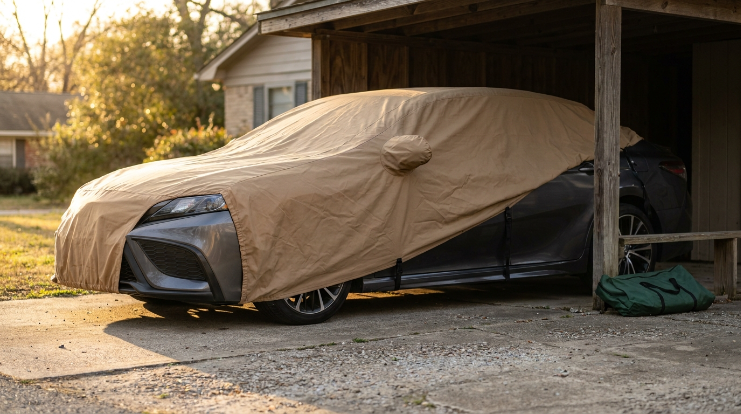
The most effective approach is reducing cumulative sun exposure while using a cover specifically engineered for outdoor conditions. Maintenance helps, but it cannot turn an indoor dust cover into a durable outdoor cover.
1. Start with a UV-resistant outdoor cover
Check the manufacturer’s specifications rather than relying on words such as “heavy duty.” Look specifically for outdoor use, UV resistance, weather resistance, and appropriate vehicle sizing.
- Outdoor-use rating
- UV-resistant fabric or coating
- Secure elastic hems or retention straps
- Breathable or moisture-managing construction
- Paint-friendly inner surface
- Correct sizing for your vehicle
As of 2026, independent car-cover testing still shows meaningful differences in construction, fit, fastening systems, and weather protection. Price or layer count alone does not tell the whole story.
2. Give the cover shade whenever you can
Shade is one of the simplest UV-control strategies because it reduces the sunlight reaching the cover in the first place. A garage provides the most complete protection, but even partial shade can reduce exposure during part of the day.
The EPA UV Index scale classifies 6-7 as high exposure and 8 or above as very high to extreme. The scale is designed for human sun safety, but it is still a useful indicator of how intense local UV conditions can become.
- Use a garage or carport when available.
- Choose parking that becomes shaded near midday.
- Rotate long-term parking locations if one side receives constant sun.
- Avoid leaving an unused cover spread outside when it could be stored indoors.
3. Stop the cover from flapping
A UV-aged cover becomes more vulnerable when wind repeatedly bends and pulls it. Good fit reduces stress on the fabric, stitching, mirror pockets, and elastic hems.
Install every strap or fastening component according to the manufacturer. Don’t improvise with metal hooks or hardware that could strike the vehicle.
4. Store the cover properly when you’re not using it
Don’t leave the cover in direct sunlight after removing it from the car. Fold or roll it once it is clean and completely dry.
- Keep it away from direct sun.
- Store it dry.
- Avoid hot exhaust components.
- Don’t leave it sitting in mud or standing water.
- Keep sharp tools away from the fabric.
Section Takeaway: The best UV defense is prevention. Use an outdoor-rated cover, reduce unnecessary sun exposure, control wind movement, and store the cover indoors when it isn’t protecting the vehicle.
Should You Spray UV Protectant on a Car Cover?
Only use a UV-protectant product when the car-cover manufacturer says that treatment is compatible with its material. A random fabric spray can change water resistance, breathability, color, texture, or the vehicle-facing surface.
This is one area where I would not experiment. Replacing a deteriorated coating is cheaper than correcting residue or staining on automotive paint.
Check the care label first
Some covers rely on factory-applied coatings or treatments. Adding another chemical layer may interfere with the way that material manages water and moisture.
- Find the cover’s brand and material.
- Read the manufacturer’s cleaning and treatment instructions.
- Confirm whether aftermarket fabric protection is allowed.
- Use only a compatible product.
- Test it on a small inconspicuous area when instructed.
- Allow the cover to dry completely before reinstalling it.
Never assume household waterproofing spray is safe for automotive covers. The manufacturer’s instructions should outrank generic online advice.
Can UV spray restore damaged fabric?
No spray should be expected to restore structural strength to fabric that has already become brittle, thin, cracked, or torn. Once the underlying material has deteriorated, replacement may be the safer choice.
Think of approved UV treatments as preventive maintenance rather than structural repair. They cannot rebuild weakened fibers or failed seams.
How Often Should You Clean and Inspect a Car Cover?
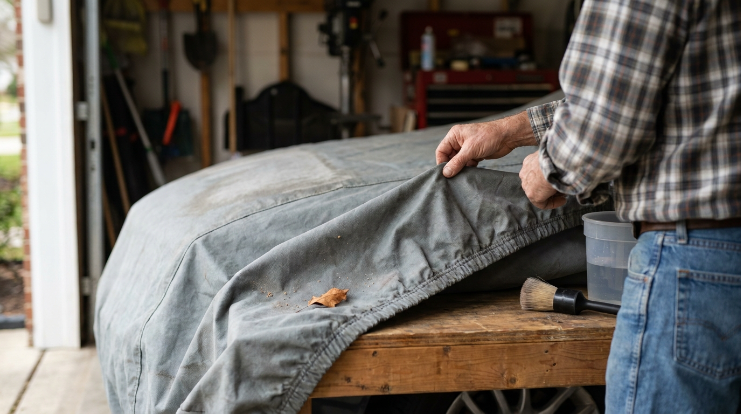
There is no universal cleaning interval for every car cover. Usage, local dust, rain, tree debris, pollution, sunlight, and manufacturer instructions should determine the schedule.
I prefer condition-based maintenance. A cover parked under trees or in a dusty outdoor lot deserves more attention than one used inside a garage.
| Condition | What to Check | Recommended Response |
|---|---|---|
| After strong sun exposure | Roof, hood, trunk, color, flexibility | Compare exposed sections with shaded lower panels |
| After high wind | Seams, straps, elastic hems, mirror areas | Repair approved minor damage or replace weakened parts |
| When visibly dirty | Dust, sap, bird droppings, grime | Clean according to the manufacturer’s care instructions |
| Before long-term storage | Moisture and contamination | Clean if needed and store completely dry |
| When fabric feels different | Brittleness, thinning, residue, tearing | Stop relying on badly degraded areas |
How should you clean it?
Follow the cover maker’s instructions because washing methods vary by material. Don’t automatically put a large automotive cover into a washing machine or dryer.
Use only cleaning products approved for that fabric. Harsh detergents, bleach, solvents, and excessive heat can damage some materials or coatings.
General exterior maintenance also matters because placing any cover over gritty paint can increase rubbing. The broader Consumer Reports maintenance and car-care guidance is a useful reference for keeping the vehicle itself in good condition.
Which Car Cover Features Matter Most in Strong Sun?
There is no single material that is automatically best for every climate. The safest choice is the material and construction that a reputable manufacturer specifically rates for your outdoor conditions.
Focus on documented UV resistance, fit, strength, moisture management, and expected use instead of choosing from marketing claims alone.
| Cover Feature | Why It Matters in Sun | What to Verify |
|---|---|---|
| UV-resistant construction | Designed to tolerate prolonged solar exposure | Manufacturer specifically states UV or outdoor protection |
| Secure fit | Reduces wind-driven flexing and stress | Correct length, width, body shape, and retention system |
| Breathability | Helps manage moisture beneath the cover | Outdoor-use instructions and moisture-management claims |
| Durable seams | High-stress points must remain intact as material ages | Stitching around mirrors, corners, straps, and hems |
| Paint-friendly interior | Limits unwanted contact against the finish | Inner material specified for automotive paint contact |
Does cover color affect UV durability?
Color alone does not tell you how UV-resistant a car cover is. Pigments, UV stabilizers, coatings, fiber type, thickness, and overall construction can all affect weathering.
Don’t assume a silver cover is automatically superior to a dark cover or vice versa. Manufacturer testing and outdoor-use specifications provide better evidence.
Are more layers always better?
No. A multi-layer construction may offer useful weather protection, but layer count does not automatically prove superior UV resistance.
When comparing covers, start with the intended environment. The general maintenance information from Edmunds also reinforces a useful ownership principle: choose care practices based on the specific vehicle and product rather than one universal schedule.
When Should You Replace a UV-Damaged Car Cover?
Replace the cover when degradation prevents it from staying intact, fitting securely, or providing consistent protection. Large tears are obvious, but severe thinning and brittleness can be warning signs before complete failure.
- Fabric tears easily: Light pulling causes new splits or enlarges existing damage.
- Large thin areas appear: Sun-facing panels feel noticeably weaker than protected areas.
- Material becomes brittle: The cover cracks, creases sharply, or loses normal flexibility.
- Seams keep failing: Repairs no longer solve repeated separation around stress points.
- Elastic no longer holds: The cover cannot maintain a secure fit around the vehicle.
- Coating deteriorates: The surface flakes, powders, or loses the performance claimed by its manufacturer.
- UV protection is uncertain: The cover has deteriorated enough that you no longer trust it for prolonged outdoor storage.
Don’t judge replacement only by calendar age. Two identical covers can deteriorate at different rates when one spends every day in intense sun and the other stays beneath a carport.
Temperature also matters alongside ultraviolet exposure. NIST research on polymer weathering shows that more aggressive temperature and UV conditions can accelerate material changes.
My practical test is simple. If I can no longer install the cover without worrying about another tear, I stop treating it as dependable outdoor protection.
Frequently Asked Questions
Can the sun destroy a car cover?
Yes. Prolonged ultraviolet exposure can contribute to fading, embrittlement, loss of flexibility, and weakening in many polymer-based materials. How quickly that occurs depends on the cover’s construction, UV stabilizers, climate, temperature, exposure time, and maintenance.
How can I make an outdoor car cover last longer?
Use a UV-resistant outdoor-rated cover, park in shade when practical, keep the cover clean and dry, secure it against wind, and store it away from sunlight when removed. Inspect exposed panels and seams regularly so you can catch deterioration early.
Can I put UV protectant spray on my car cover?
Only if the cover manufacturer approves that type of treatment. Some sprays may change water resistance, breathability, appearance, or coatings, so don’t apply a generic protectant without checking material compatibility first.
How do I know if my car cover has UV damage?
Common warning signs include fading, chalkiness, stiff fabric, thinning, powdery residue, weak seams, damaged elastic, and fabric that tears more easily than before. Compare heavily exposed roof and hood sections with more shaded lower areas.
Will keeping a car cover clean prevent UV damage?
Cleaning cannot stop UV radiation, but proper maintenance can prevent other contaminants from adding unnecessary wear. Follow the manufacturer’s cleaning instructions and avoid harsh chemicals or high heat unless specifically permitted.
Does parking in shade help a car cover last longer?
Yes, reducing direct solar exposure reduces the amount of UV and solar heat the cover receives. A garage or carport offers stronger protection, but even partial shade can reduce total daily exposure.
Should I repair or replace a sun-damaged car cover?
A small localized tear may be repairable if the manufacturer recommends a repair method and the surrounding fabric remains strong. Replace the cover when widespread brittleness, thinning, failing seams, or repeated tearing shows that the material itself has deteriorated.
Final Takeaway: Protecting a car cover from UV damage starts before damage appears. Buy an outdoor-rated UV-resistant cover, minimize unnecessary sunlight, keep it clean and secure, and replace it once the fabric loses dependable strength.
As of 2026, I would trust documented outdoor performance and regular condition checks over marketing claims about layer count or vague “all-weather” labels. Your car cover is a sacrificial barrier, so taking care of that barrier helps it keep protecting the vehicle underneath.