
How to Dry a Car Cover Fast: Safe Methods That Work

Quick Answer
The fastest safe way to dry a car cover is to remove excess water first, hang or spread the cover where air reaches both sides, and use a fan to increase airflow. Avoid high dryer heat unless the cover’s care label specifically permits machine drying, because materials and coatings vary between covers. Car and Driver’s car cover guidance also recommends following the manufacturer’s cleaning directions and storing covers in a cool, dry place.
Fast drying steps
- Shake off water: Remove loose droplets before hanging the cover.
- Blot wet areas: Press clean microfiber towels against saturated sections without aggressive rubbing.
- Open it fully: Avoid leaving the wet cover folded, rolled, or bunched together.
- Add airflow: Place a household fan nearby to move air continuously across the fabric.
- Flip the cover: Turn it once the exposed side feels mostly dry.
- Check the label: Use a clothes dryer only when the manufacturer specifically allows it.
Before storing it
- Check seams, elastic hems, folds, and thick reinforced areas for hidden dampness before packing the cover away.
A soaked car cover can take frustratingly long to dry when it’s left in a heap. I’ve found that airflow and surface area make a much bigger difference than simply putting the cover somewhere warm.
This 2026 guide explains how to dry a car cover fast without damaging its fabric, waterproof treatment, elastic, or inner lining.
In This Guide
What Is the Fastest Way to Dry a Car Cover?
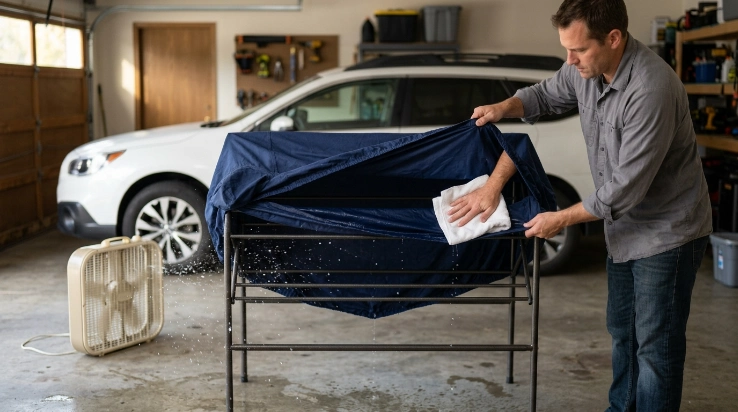
The fastest practical method combines water removal, maximum exposed surface area, and steady airflow. You want moisture leaving the fabric instead of remaining trapped between layers.
A car cover is a removable protective fabric barrier designed to shield a parked vehicle from contaminants or weather exposure, depending on its construction.
1. Remove as much loose water as possible
Start by lifting the cover away from the vehicle and giving it several gentle shakes. Do this over a clean surface where the inner lining won’t touch dirt.
If one section feels saturated, press a clean microfiber towel against it. Blotting removes water without twisting the material aggressively.
2. Hang the cover completely open
Drape the cover over a strong clothesline, large drying rack, or several clean supports. Spread it widely enough that large wet sections aren’t pressed against each other.
I avoid throwing a wet cover over one narrow railing. That creates a thick folded section exactly where I want the most airflow.
3. Put a fan on it
A household pedestal or box fan can speed evaporation by moving humid air away from the surface. Point it across the cover rather than concentrating everything on one tiny section.
- Open the cover: Expose as much fabric as your space allows.
- Create a gap: Keep the two sides from sticking together.
- Run steady airflow: Use a fan when natural air movement is weak.
- Turn it: Flip the cover so the hidden side receives equal airflow.
- Inspect thick areas: Seams and elastic sections often stay damp longer.
4. Don’t store it just because the surface feels dry
Run your hand along seams, hems, mirror pockets, and reinforced panels. Water can remain inside these thicker areas after the main fabric feels dry.
Car and Driver specifically advises keeping a cover in a cool, dry place when it’s not being used. That makes complete drying important before you fold it for storage.
Section Takeaway: Remove loose water first, maximize exposed fabric, and keep air moving. That combination usually dries a wet cover faster than heat alone.
Which Car Cover Drying Method Works Best?
Fan-assisted air drying is my preferred method for most covers because it increases evaporation without introducing unnecessary heat. The best method still depends on how wet the cover is and where you’re working.
| Drying Method | Relative Speed | Best Use | Main Limitation |
|---|---|---|---|
| Hanging with natural airflow | Moderate | Warm, dry, breezy conditions | Slow in humid or still air |
| Hanging plus household fan | Fast | Garage, porch, or utility room | Needs enough room to spread the cover |
| Microfiber blotting plus fan | Fastest practical approach for a soaked cover | Heavy rain or freshly washed covers | Requires clean, absorbent towels |
| Machine dryer | Potentially fast | Only covers whose care labels permit it | Heat may harm incompatible materials |
| Folded or bunched drying | Slow | Not recommended | Traps moisture between layers |
When I’ve dealt with a rain-soaked outdoor cover, I first let the water drain from the lowest edge. I then blot the heaviest sections before positioning a fan several feet away.
That simple setup avoids forcing the fabric through a drying process its manufacturer may not approve.
Can You Put a Car Cover in the Dryer?
You can machine-dry some car covers, but only when the manufacturer explicitly permits it. Never assume every polyester, multilayer, waterproof, or lined cover can handle the same temperature.
Car covers can include coatings, membranes, elastic hems, straps, soft linings, and laminated layers. Excessive heat may affect one component even when the main fabric appears unharmed.
Check these instructions first
- Dryer permission: Confirm that tumble drying is allowed.
- Temperature: Follow the listed heat setting exactly.
- Cycle: Use the manufacturer’s recommended drying cycle.
- Cover size: Make sure the cover can tumble freely rather than remaining packed tightly.
- Special coatings: Follow any separate instructions for waterproof or water-resistant treatments.
If the care instructions are missing, air drying is the safer default. I wouldn’t gamble an expensive fitted cover just to save a little drying time.
Car and Driver also recommends checking a cover’s directions carefully before machine washing. That same manufacturer-first approach makes sense when you’re choosing a drying method.
Should You Dry a Car Cover Indoors or Outside?
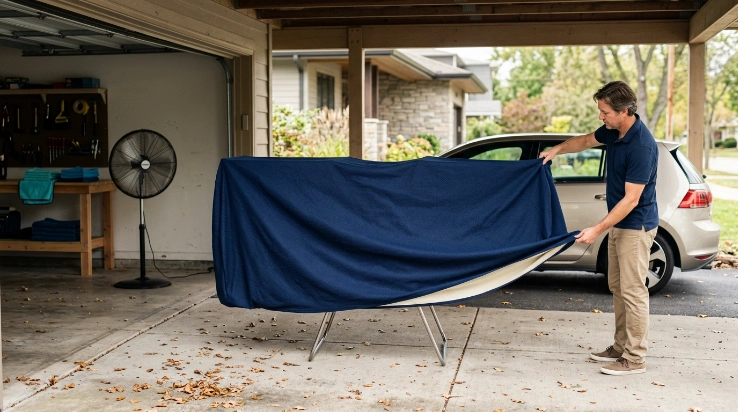
Either location can work. Choose the place with the best combination of clean surroundings, low humidity, airflow, and enough space to open the cover.
Outdoor drying
A breezy shaded area can work well because moving air carries moisture away. Keep the inner surface off grass, pavement, soil, and dirty fences.
Direct sun may dry some materials quickly, but prolonged exposure isn’t automatically suitable for every cover. Follow the manufacturer’s care instructions when they restrict direct sunlight or heat.
Indoor drying
A garage can be excellent when you add a fan and maintain ventilation. It becomes less effective when the room already feels damp or humid.
Kelley Blue Book’s vehicle storage guidance emphasizes minimizing prolonged moisture exposure when storing vehicles. The same principle explains why I don’t leave a saturated cover sitting inside a closed garage.
- Choose outdoors when: The weather is dry, clean, and breezy.
- Choose indoors when: Rain, dirt, pollen, or unpredictable weather threatens the drying cover.
- Add a fan when: Air movement is weak in either location.
- Avoid dirty surfaces: Don’t let the paint-facing side touch the ground.
How Do You Prevent Mold and Mildew?
The most important step is simple: don’t fold and store the cover while it’s damp. Moisture trapped inside tightly packed fabric creates the conditions that produce musty odors and biological growth.
Consumer Reports recommends breathable car covers to help reduce moisture buildup around a covered vehicle. Breathability also matters when you’re trying to manage moisture during regular cover use.
Inspect before folding
Feel the cover rather than judging dryness only by appearance. A dark fabric can look completely dry while a seam or folded hem remains damp.
- Check seams: Multiple fabric layers can hold water longer.
- Check elastic: Gathered hems create folds where moisture can hide.
- Check pockets: Mirror and antenna areas may collect water.
- Smell the cover: A persistent musty odor deserves attention before storage.
- Store it dry: Use a clean storage bag only after the entire cover passes your inspection.
If a cover already smells musty, follow its manufacturer-approved washing instructions before putting it back on clean paint. Don’t improvise with harsh household chemicals unless the manufacturer permits them.
Keeping the cover clean matters for paint protection too. Car and Driver notes that debris stored inside a cover can later scratch the vehicle when the material moves across the finish.
What Mistakes Make a Car Cover Dry More Slowly?
Most slow-drying problems come from trapped layers or poor airflow rather than a lack of heat. Fix those two problems before looking for a more aggressive drying method.
Leaving the cover crumpled
A wet cover piled on the garage floor exposes only the outer layers to air. Moisture inside the pile has nowhere efficient to go.
Folding it while it’s still damp
Folding reduces exposed surface area and puts wet layers directly against each other. Wait until the cover is dry before packing it away.
Putting it back on the vehicle wet
A wet cover can keep moisture against or around the vehicle instead of letting everything dry freely. Give both the vehicle and cover time to dry before combining them again.
This matters because moisture management is an important part of vehicle storage. Consumer Reports has also warned about choosing covers that avoid trapping moisture around a vehicle.
Using extreme heat without checking instructions
A heat gun, space heater, or high dryer setting isn’t my shortcut of choice. Concentrated heat can be unnecessary and may conflict with the cover manufacturer’s instructions.
Drying the cover on dirty ground
This may dry the fabric while creating a different problem. Dirt, sand, or grit can transfer to the paint-facing side.
Consumer Reports’ car-washing guidance stresses using nonabrasive materials around automotive paint. Keeping the inner cover surface clean follows the same contamination-control principle.
- Don’t wring aggressively: Drain and blot instead.
- Don’t bundle it: Open the entire cover.
- Don’t rush storage: Check thick sections first.
- Don’t add uncontrolled heat: Follow the care label.
- Don’t contaminate the lining: Keep it away from dirty floors and ground surfaces.
Frequently Asked Questions
How long does a car cover take to air dry?
There isn’t one reliable drying time because cover thickness, humidity, temperature, airflow, water saturation, and construction all affect the result. A thin cover in moving dry air can dry much faster than a heavy multilayer cover in a humid garage.
Can I use a fan to dry my car cover?
Yes. A household fan is one of the simplest ways to increase airflow without exposing the cover to high heat.
Open the cover fully and reposition it as needed so both sides receive moving air.
Can I dry a car cover in direct sunlight?
That depends on the cover’s material and manufacturer instructions. Sun can increase drying speed, but extended ultraviolet and heat exposure may not be appropriate for every fabric, coating, or elastic component.
Should I put a wet car cover back on my car?
I recommend drying the cover first whenever practical. A wet cover can keep moisture near the vehicle and makes it harder to confirm that both the paint and the cover’s inner surface are clean and dry.
Can I use a hair dryer on a wet car cover?
I wouldn’t use concentrated hot air unless the manufacturer specifically approves that type of heat. A regular fan provides broader airflow and avoids creating a small high-temperature area on the fabric.
How do I know when a car cover is completely dry?
Check more than the large flat panels. Feel seams, elastic hems, mirror pockets, reinforced corners, and any section where multiple fabric layers meet.
If those areas feel cool or damp compared with the rest of the cover, continue drying.
How should I store my car cover after drying it?
Fold or roll the completely dry cover with the clean inner surface protected from the ground. Store it in its bag or another clean container in a cool, dry location.
A little patience before storage can save you from odors, trapped moisture, and a dirty inner lining later. My routine is simple: shake, blot, open, ventilate, flip, inspect, then store.
If you remember one rule, make it this one: airflow beats aggressive heat. Dry the cover completely, follow its care label, and keep the paint-facing surface clean before it goes back onto your vehicle.