
Car Cover Buyer Mistakes: 11 Costly Errors to Avoid

Quick Answer
The biggest car cover buyer mistakes are choosing the wrong size, buying for the wrong environment, ignoring breathability, overlooking wind security, and assuming thicker automatically means better. Before buying, match the cover to your vehicle, parking conditions, climate, and usage frequency; Car and Driver’s 2026 car-cover testing also highlights fit, weather protection, ease of use, and proper storage as important considerations.
Mistakes to avoid first
- Wrong size: Loose fabric can flap while an undersized cover may pull against mirrors, spoilers, and seams.
- Wrong environment: A lightweight indoor dust cover isn’t automatically suitable for outdoor rain, sun, or wind.
- Poor breathability: Moisture needs a way to escape after humidity, condensation, or unexpected dampness gets underneath.
- Dirty installation: Dirt trapped between the fabric and paint can become abrasive when the cover moves.
- Weak security: Outdoor covers need a reliable method of staying positioned during changing weather.
- Marketing-first shopping: Focus on fit, construction, intended environment, and manufacturer instructions rather than layer counts alone.
Before checkout
- Confirm year, make, model, body style, measurements, accessories, parking location, storage method, and return terms.
I’ve seen car-cover shopping treated like buying an oversized bedsheet. Find something roughly the right length, choose the thickest-looking material, and call it done.
That approach misses what matters. A good cover has to work with your specific vehicle, environment, paint condition, and parking routine.
As of 2026, buyers also face a huge range of universal, semi-custom, custom-fit, multi-layer, indoor, and outdoor covers. This guide breaks down the mistakes I’d avoid before spending money on any of them.
In This Guide
- What are the biggest car cover buyer mistakes?
- Why is choosing the wrong car cover size a mistake?
- Should a car cover be waterproof or breathable?
- Can the wrong car cover scratch your paint?
- Which car cover features actually matter?
- What should you check before buying a car cover?
- Frequently asked questions
What Are the Biggest Car Cover Buyer Mistakes?
The biggest mistake is buying a cover based on one attractive feature instead of considering the whole job. Size, material, breathability, lining, wind resistance, storage environment, and installation habits work together.
A car cover is a removable protective barrier designed to shield a parked vehicle from contaminants or environmental exposure. Different designs may prioritize dust, sunlight, precipitation, wind, or indoor storage protection.
That distinction matters. The best cover for a garaged sports car could be a poor choice for a daily-driven SUV parked outdoors.
| Buyer mistake | Why it matters | Better approach |
|---|---|---|
| Buying the wrong size | Creates loose or stretched areas | Verify exact fitment and dimensions |
| Ignoring indoor vs. outdoor use | Protection may not match exposure | Shop for the parking environment |
| Focusing only on waterproofing | Moisture can still form underneath | Consider water protection and breathability |
| Ignoring wind movement | Loose fabric may flap and shift | Look for secure hems and tie-downs |
| Covering dirty paint | Trapped debris can rub against the finish | Cover a clean, dry vehicle |
| Ignoring the inner surface | Rough material contacts paint directly | Inspect lining and seam construction |
| Trusting layer count alone | More layers don’t automatically equal better suitability | Evaluate materials and intended use |
| Forgetting accessories | Spoilers, antennas, racks, and mirrors affect fit | Check the vehicle’s complete exterior shape |
| Skipping return terms | Fit problems may appear after delivery | Read fitment and return policies first |
| Ignoring installation effort | A difficult cover may rarely get used | Match weight and design to your routine |
| Buying on price alone | Cheap or expensive doesn’t prove suitability | Compare useful specifications instead |
I use a simple rule: start with where the car sleeps. Garage, carport, driveway, street parking, and long-term storage create different demands.
Then I look at the vehicle itself. A stock sedan is easier to fit than a car with a tall rear wing, roof rack, external antenna, or other accessory.
Section Takeaway: The right car cover isn’t the one with the longest feature list. It’s the one whose fit, materials, and construction match your vehicle and parking conditions.
Why Is Choosing the Wrong Car Cover Size a Mistake?
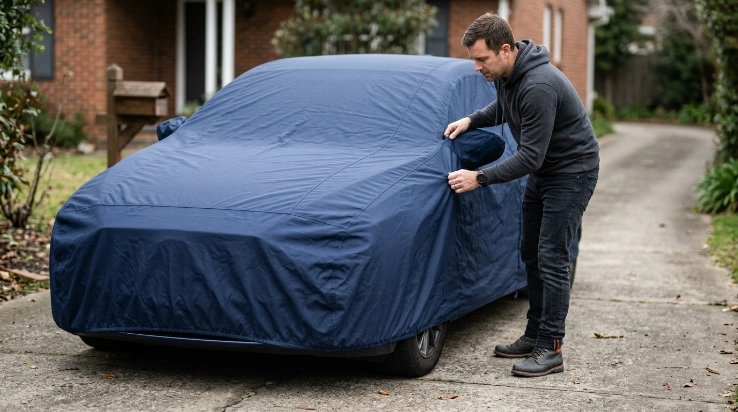
A properly sized cover should follow the general shape of the vehicle without excessive loose fabric or severe tension. Both extremes can create problems.
Buying a cover that’s too large
Oversized covers leave additional material around bumpers, doors, mirrors, and rocker panels. Outdoors, that extra fabric gives moving air more material to catch.
- Loose panels: Fabric may repeatedly move against the vehicle.
- Poor hem grip: The cover may not stay seated below the front and rear bumpers.
- More contamination: Gaps can make it easier for airborne dust and debris to reach underneath.
- Awkward installation: Excess material makes orientation and removal harder.
Buying a cover that’s too small
An undersized cover creates a different problem. Material can become overly stretched across corners and accessories.
- Stressed seams: Constant tension can load stitched areas and elastic hems.
- Exposed panels: Bumpers or lower body sections may remain uncovered.
- Mirror pressure: Tight material may pull hard against mirrors or mirror pockets.
- Poor seating: The front or rear hem may repeatedly work loose.
Universal vs. semi-custom vs. custom-fit covers
A universal cover is designed around a general vehicle category and size range. That flexibility can be convenient, but it usually leaves more room for fit variation.
Semi-custom designs narrow the intended shape or vehicle group. Custom-fit designs are patterned for a particular vehicle configuration.
| Cover type | Fit precision | Best consideration |
|---|---|---|
| Universal | Broad | Confirm actual measurements carefully |
| Semi-custom | Moderate | Check body style and exterior equipment |
| Custom-fit | Vehicle-specific | Confirm exact year, model, trim-related body differences, and accessories |
Measure instead of guessing
Don’t rely on vehicle category alone when a manufacturer requests dimensions. Follow the cover maker’s measuring instructions because its sizing system may differ from another brand’s.
- Confirm overall vehicle length.
- Check the required width measurement.
- Check height when specified.
- Account for spoilers, racks, antennas, mirror shapes, and aftermarket equipment.
- Verify sedan, coupe, hatchback, wagon, SUV, or pickup body style.
For example, don’t assume two sedans from the same model family share identical external dimensions. Different generations or body configurations may require different covers.
Section Takeaway: Fit comes before fabric thickness. Verify the vehicle and the manufacturer’s sizing method before comparing secondary features.
Should a Car Cover Be Waterproof or Breathable?
For many outdoor situations, water protection and breathability both matter. Treating them as opposite choices can lead buyers toward the wrong product.
Water can reach a covered vehicle through precipitation, splash, a wet cover, or moisture already present on the car. Humid air can also contribute to condensation when temperatures change.
Mistake: assuming “waterproof” solves every moisture problem
A cover can block rain from above yet still encounter moisture underneath. Covering a damp car is one obvious example.
Parking over wet ground or inside a humid garage can also create a damp environment. Moisture management therefore involves more than the outer surface.
- Start dry: Let the vehicle dry before covering it.
- Store dry: Don’t fold and store a wet cover unless its instructions specifically address wet storage.
- Allow vapor escape: Choose materials appropriate for the humidity and exposure expected.
- Inspect periodically: Long-term storage shouldn’t mean forgetting the vehicle exists.
Mistake: buying an indoor cover for outdoor exposure
Indoor covers commonly focus on dust, light contact, and a softer vehicle-facing surface. Outdoor covers face a different list of demands.
- Sun exposure
- Rain and changing humidity
- Wind
- Pollen and airborne debris
- Repeated wet-and-dry cycles
The reverse mistake happens too. A bulky outdoor cover may provide features that a clean garage simply doesn’t require.
I decide the environment first and material second. That keeps impressive marketing terms from distracting me from the cover’s actual job.
Section Takeaway: Don’t shop for “waterproof” in isolation. Match moisture protection, breathability, and construction to where the vehicle will actually be stored.
Can the Wrong Car Cover Scratch Your Paint?
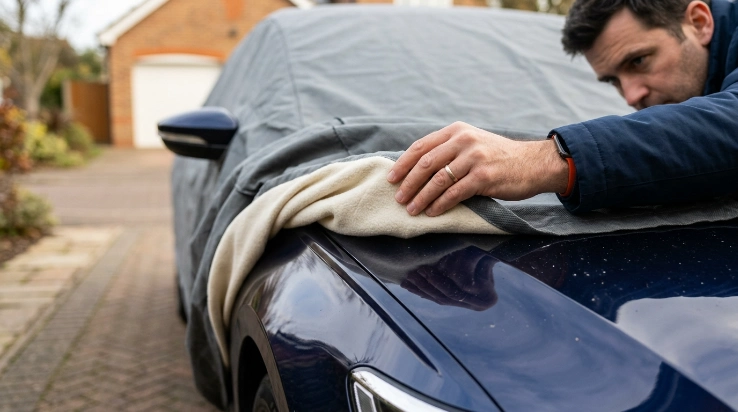
A car cover can contribute to paint marking when dirt becomes trapped between the cover and vehicle and the material moves. The risk depends heavily on cleanliness, fit, fabric, and conditions.
This is one of the most misunderstood car cover buyer mistakes. Shoppers often focus on whether the material feels soft while ignoring what may become trapped underneath it.
Mistake: covering a dusty or dirty vehicle
Imagine placing fine dust between two surfaces and rubbing them together. That’s the situation you’re trying to avoid.
Before covering a vehicle, remove the contamination according to appropriate vehicle-cleaning practices. Kelley Blue Book also provides broader vehicle care and maintenance resources for owners building a regular upkeep routine.
Mistake: dragging the cover across the paint
Installation technique matters too. Pulling a bundled cover sideways across several dirty panels creates unnecessary contact.
I prefer to identify the front and rear first. Then I unfold the material systematically instead of dragging loose fabric around the vehicle.
Mistake: letting a loose cover flap outside
Wind movement creates repeated contact. A cover that’s quiet on a calm afternoon may behave differently when weather changes overnight.
- Check elastic hems: They should still hold the intended edges securely.
- Use supplied straps: Follow the manufacturer’s instructions for outdoor securing systems.
- Avoid makeshift hardware: Hard objects or unsuitable cords can introduce their own risks.
- Recheck after installation: Look for large loose panels before leaving the car.
Mistake: ignoring the inside of the cover
The inner surface deserves as much attention as the outer shell. Check for rough seams, embedded debris, dried mud, leaves, sand, or damaged material before installation.
Never throw the clean inner surface onto a dirty garage floor during removal. Fold it in a way that helps keep the vehicle-facing side clean.
Section Takeaway: A soft cover isn’t automatically paint-safe. Clean paint, a clean liner, proper fit, and controlled movement are what reduce unnecessary rubbing.
Which Car Cover Features Actually Matter?
The useful features depend on where and how you’ll use the cover. A long specification sheet has little value if its main features solve problems you don’t have.
Secure fit and tie-down points
Outdoor users should pay close attention to how the cover stays positioned. Elastic hems, fitted contours, belly straps, buckles, and reinforced attachment points are common approaches.
Check how the manufacturer intends each feature to be used. A security cable and a wind strap also serve different purposes.
Exterior material suited to your environment
Read what the manufacturer says the material is designed to handle. Avoid assuming that “heavy-duty,” “premium,” or a large layer count has one universal technical meaning.
Instead, look for clearly described intended use. Outdoor exposure, indoor storage, UV exposure, and precipitation place different demands on fabric.
Vehicle-facing surface
The inside should be appropriate for contact with your vehicle’s finish. It should also remain clean during storage.
A damaged or contaminated liner changes the equation. Inspect it periodically rather than trusting it forever because it felt soft when new.
Mirror pockets and accessory compatibility
Mirror pockets can improve orientation and fit when they’re positioned correctly. They can become a source of tension when the cover doesn’t match the vehicle.
Exterior modifications require extra attention. Think through anything that changes the stock silhouette.
- Rear spoilers
- Roof racks
- Roof boxes
- External antennas
- Brush guards
- Aftermarket body kits
Security features
Some covers include reinforced grommets or provisions for a cable and lock. These can discourage casual removal of the cover, but they don’t replace normal vehicle security.
NHTSA advises drivers to remove their keys, lock doors and windows, park in well-lit locations when possible, and avoid leaving valuables visible. Its vehicle theft prevention guidance is worth following even when a vehicle is covered.
Storage bag and manageable installation
A cover protects nothing when it’s too frustrating to install. Weight, bulk, folding method, and storage space matter for daily users.
If you’ll remove the cover every morning, convenience deserves more weight in your decision. Long-term storage users may prioritize different features.
Section Takeaway: Buy features that solve your real storage problems. Secure fit, appropriate materials, clean interior construction, compatibility, and manageable installation usually matter more than marketing numbers.
What Should You Check Before Buying a Car Cover?
Before checkout, run through a short compatibility checklist. Five minutes of checking can prevent a disappointing fit.
1. Identify where the car will be parked
- Garage: Dust and light indoor contact may be the main concerns.
- Carport: Wind-driven moisture, dust, and indirect weather can still matter.
- Driveway: Sun, rain, wind, pollen, and environmental debris become more important.
- Long-term storage: Breathability, cleanliness, inspection access, and storage preparation deserve extra attention.
2. Confirm the vehicle information
Write down your year, make, model, and body style before comparing covers. Don’t rely entirely on appearance.
If the seller offers a fitment selector, enter the vehicle carefully. Check whether different trims or body configurations affect the exterior shape.
3. Record exterior modifications
A seller’s fitment data may assume a stock vehicle. Added accessories can change the dimensions or pressure points.
4. Compare specifications, not slogans
Terms such as “ultimate,” “professional,” or “all-season” don’t tell you enough. Look for usable specifications and manufacturer instructions.
- Intended indoor or outdoor use
- Vehicle sizing method
- Outer and inner material descriptions
- Securing method
- Cleaning instructions
- Storage instructions
- Warranty terms
- Return and fitment policy
5. Think about how often you’ll use it
A cover removed twice a day faces different handling demands from one installed for extended storage. Frequent use puts convenience near the top of my checklist.
If installation becomes a chore, owners naturally become less consistent. Easy orientation and sensible storage can therefore be valuable features.
6. Don’t assume price proves quality
Price alone doesn’t tell you whether a cover fits your specific needs. An expensive indoor cover can still be the wrong tool for outdoor storage.
Likewise, a less complicated cover can be appropriate when its intended use matches your environment. Compare suitability before comparing prestige.
My pre-purchase car cover checklist
- Does it match my exact vehicle or required measurements?
- Is it intended for my parking environment?
- How does it handle moisture and drying?
- How is it secured against movement?
- What touches the paint?
- Will exterior accessories affect fit?
- Can I realistically install and remove it as often as needed?
- How should it be cleaned and stored?
- What do the warranty and return terms cover?
That’s the checklist I would use before becoming distracted by colors, layer counts, or promotional claims. It keeps the decision centered on protecting the actual vehicle.
Section Takeaway: Define your vehicle, environment, and routine before shopping. Once those are clear, comparing car covers becomes much easier.
Frequently Asked Questions About Car Cover Buyer Mistakes
Is it bad to buy a car cover that’s too big?
Yes, an excessively large cover can leave loose material that moves in wind and fits poorly around the vehicle. Choose the manufacturer’s recommended size and verify measurements when required rather than deliberately oversizing for easier installation.
Should I put a car cover on a dirty car?
It’s better to cover a clean, dry vehicle. Dirt, sand, and other particles trapped between the paint and cover can become abrasive when the fabric moves during installation, removal, or windy conditions.
Are more layers always better in a car cover?
No. Layer count alone doesn’t prove that a cover is better for your situation because material type, construction, fit, breathability, lining, and intended environment also matter. Compare what the cover is designed to do rather than shopping by layer count alone.
Is a universal car cover worth buying?
A universal cover can work when its dimensions and intended environment suit your vehicle. The tradeoff is usually less precise fitment, so measure carefully and pay extra attention to loose panels, hems, mirrors, and securing methods.
Do I need a waterproof car cover?
If your vehicle is exposed to rain, water resistance is important, but moisture management shouldn’t stop there. Consider breathability, installation on a dry vehicle, local humidity, drying instructions, and how the cover behaves after becoming wet.
Can I use the same cover indoors and outdoors?
Only if the manufacturer specifically designs and recommends it for both environments. Indoor and outdoor storage create different demands, especially around weather exposure, UV, moisture, wind movement, fabric strength, and securing systems.
Should a car cover be tight?
A cover should fit securely without excessive loose fabric or severe stretching. It should follow the vehicle’s shape while seating correctly around the intended hems, mirrors, and securing points according to the manufacturer’s instructions.
Final Takeaway: Most car cover buyer mistakes happen before the package is opened. Buyers focus on a single feature instead of matching the entire cover to the car and its environment.
Start with fit, parking conditions, moisture management, paint-safe use, and wind security. Then compare convenience, warranty, construction, and price.
That approach won’t make every car cover identical, and that’s the point. The goal is to choose the cover that makes sense for how your vehicle actually lives.