
Tesla Car Cover Issues: Common Problems, Risks, and Fixes

Quick Answer
The most common Tesla car cover issues are paint rubbing, trapped moisture, loose fabric in wind, charging-port interference, poor ventilation while charging, and bad fit around mirrors or body panels. Tesla specifically advises using a Tesla-approved cover when the vehicle is plugged in because an unsuitable cover can interfere with battery cooling; you can review the guidance in the Tesla Model 3 owner’s manual.
Tesla cover problems to check first
- Paint rubbing: Dirt between the cover and paint can cause fine marks when fabric moves.
- Charging airflow: A poorly designed cover may restrict ventilation around a plugged-in Tesla.
- Trapped moisture: Covering a wet car or using poor ventilation can keep panels damp.
- Loose fit: Excess fabric can flap across the hood, doors, roof, and bumpers.
- Charge-port access: Some universal covers make connecting or disconnecting the charging cable awkward.
- Wrong cover type: Lightweight indoor covers usually aren’t suitable for outdoor wind and rain.
Best first step
- Remove the cover, clean and dry both surfaces, inspect the fit, and confirm that charging ventilation isn’t obstructed before reinstalling it.
I like the idea of covering a Tesla because its large painted panels collect dust, pollen, bird mess, and tree debris quickly. The trouble is that a cover can create its own problems when the fit, material, or installation isn’t right.
That matters on the Model 3, Model Y, Model S, and Model X because charging adds another consideration. In this guide, I’ll walk through the Tesla car cover issues I would check before leaving the vehicle covered for hours or days.
In This Guide
What Tesla Car Cover Issues Are Most Common?
The most common problems involve movement, contamination, moisture, fit, and charging access. A cover isn’t automatically harmful, but those factors determine whether it protects the car or becomes another source of trouble.
A car cover is a removable fabric barrier designed to reduce exposure to dust, sunlight, moisture, bird droppings, leaves, and other contaminants while a vehicle is parked.
Loose fabric moving in the wind
A loose cover is one of the first things I check outdoors. If large sections balloon or flap, the fabric can repeatedly slide across the same areas of paint.
- Hood: Large flat areas can collect loose fabric.
- Doors: Wind can pull material sideways across dusty panels.
- Roof: Air entering underneath may lift the center section.
- Bumpers: Poor elastic tension can let wind enter from below.
- Mirrors: Incorrectly positioned pockets can pull the cover off-center.
Charging-port access problems
A universal cover may not place its opening where Tesla’s charge port sits. Owners sometimes end up pulling material away from the rear corner or leaving part of the cover unsecured.
That defeats some of the benefit of a fitted cover. It can also create a new opening for wind.
Dirty lining
The inside of the cover matters as much as the outside. Once grit, sand, or garage-floor dirt gets into the lining, that contamination can contact the paint every time you reinstall it.
- Don’t drag the cover across pavement.
- Don’t place the clean inner surface on the ground.
- Inspect the lining after windy weather.
- Clean the cover according to its manufacturer’s instructions.
- Store it completely dry.
Poor fit around accessories
Aftermarket spoilers, roof racks, antennas, and other exterior accessories can change how a cover fits. A cover designed for a stock vehicle may become too tight in one area and loose elsewhere.
Section Takeaway: Most Tesla car cover issues begin when the cover moves excessively, carries contamination, traps moisture, or doesn’t match the vehicle’s shape and charging setup.
Can a Car Cover Scratch Tesla Paint?
Yes, cover use can contribute to fine paint marks when dirt is trapped underneath and the fabric moves. The important combination is contamination plus pressure plus movement.
The cover doesn’t need to feel rough in your hand. Fine dust can become the abrasive material.
How scratching can happen
- Dust, pollen, sand, or road film remains on the paint.
- The cover presses those particles against the surface.
- Wind or installation moves the cover.
- The particles move across the clear coat.
- Fine marks may become visible under direct lighting.
This is why I don’t like covering a Tesla immediately after a dusty drive. A visibly dirty car needs cleaning first.
Be careful when installing and removing the cover
Dragging a heavy cover from one bumper to the other increases contact with the paint. I prefer lifting and unfolding it across the vehicle in controlled sections.
- Start with clean hands.
- Keep the lining away from the ground.
- Avoid pulling buckles across paint.
- Lift dirty sections instead of dragging them.
- Check the cover after storms or strong wind.
Tesla recommends regularly inspecting exterior paint and addressing chips or scratches appropriately. Its body repair support is the safer starting point when damage goes beyond basic cleaning or detailing.
Mechanic Alert: If you find deep scratches, exposed metal, damaged trim, or loose exterior parts, have the vehicle inspected by a qualified body repair professional.
Symptoms and likely causes
| What You Notice | Likely Cover Issue | First Check |
|---|---|---|
| Fine marks on hood or doors | Dirt plus fabric movement | Inspect paint and inner lining |
| Marks near mirrors | Poor mirror-pocket fit | Check cover alignment |
| Repeated marks after windy days | Loose cover | Check hem, straps, and sizing |
| Grit inside cover | Contaminated lining | Stop use until cleaned |
Section Takeaway: A clean, well-fitted cover on clean paint is much safer than a loose cover rubbing over dust or grit.
Can You Charge a Tesla With a Car Cover On?
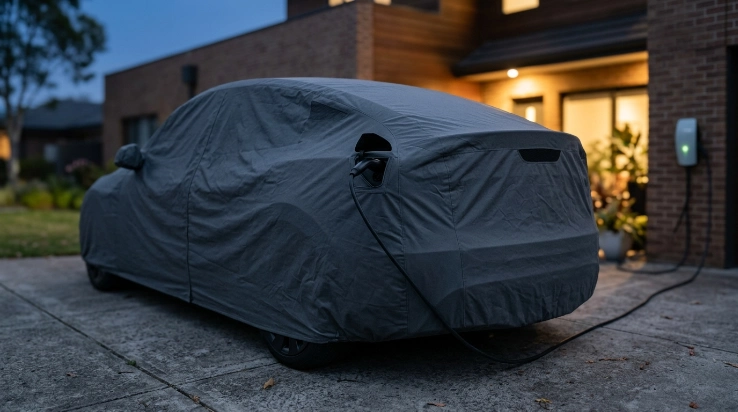
You can charge with an appropriate Tesla-approved cover, but you shouldn’t assume every aftermarket cover is suitable. Tesla warns that a non-approved cover can interfere with battery cooling while the vehicle is plugged in.
This is the biggest Tesla-specific difference compared with covering a conventional parked vehicle.
Why ventilation matters during charging
Electric vehicles actively manage battery temperature. Cover design should not obstruct areas needed for airflow or normal thermal management.
Tesla’s official outdoor covers provide both a charge-port opening and ventilated mesh. That’s a useful clue about what matters in a charging-compatible design.
- Charge-port opening: The cable shouldn’t force the cover into an awkward position.
- Ventilation: The cover shouldn’t seal the vehicle inside an unventilated shell.
- Correct fit: Fabric shouldn’t bunch around charging areas.
- Secure installation: The cover shouldn’t shift onto the connector.
For current vehicle-specific warnings, check the applicable Tesla owner’s manual rather than relying only on a car-cover manufacturer’s marketing.
Don’t modify an unsuitable cover casually
Cutting a hole into a universal cover can weaken the material and leave rough edges. It also doesn’t solve ventilation or fit problems elsewhere.
If a cover wasn’t designed for charging access, I would remove it before charging rather than improvising around the connector.
Mechanic Alert: If a charging connector, port, cable, or vehicle charging component appears damaged or overheated, stop using it and seek qualified service rather than attempting electrical repairs yourself.
Section Takeaway: When your Tesla is plugged in, cover compatibility becomes a thermal-management and charging-access issue, not just a paint-protection decision.
Why Does Moisture Build Up Under a Tesla Cover?
Moisture appears when water or humid air gets underneath faster than it can escape. Rain penetration is only one possible cause.
I also look for a wet vehicle, condensation, humid parking conditions, or a damp cover being reinstalled.
Common moisture sources
- Wet paint: Water remains after washing or rain.
- Condensation: Temperature changes turn humid air into droplets.
- Damp lining: A cover stored wet puts moisture back against the vehicle.
- Poor airflow: Low-breathability materials slow evaporation.
- Wet ground: Grass, soil, or a damp garage can increase local humidity.
Water-resistant isn’t the same as airtight
A good outdoor cover needs to balance weather resistance with moisture management. Tesla describes its outdoor Model 3 cover as using woven polyester layers with a thermoplastic polyurethane middle layer while retaining breathability.
That design approach makes sense. You want rain protection without intentionally sealing humid air inside.
What I do when I find condensation
- Remove the cover.
- Let the vehicle dry completely.
- Dry the cover separately.
- Inspect the inner surface for dirt or mildew odors.
- Check whether moisture returns under dry starting conditions.
One damp morning doesn’t prove the cover has failed. Persistent moisture that remains after surrounding surfaces dry deserves more attention.
Section Takeaway: Moisture problems usually improve when both the Tesla and cover start completely dry and the material provides enough ventilation for humidity to escape.
Tesla Cover vs Universal Cover: What’s Different?
A fitted Tesla-specific cover is designed around the vehicle’s body shape and charging location. A universal cover is designed to accommodate several vehicles, so compromises in fit are more likely.
That doesn’t mean every universal cover is bad. It means you need to inspect it more carefully.
| Feature | Tesla-Specific Cover | Universal Cover |
|---|---|---|
| Body fit | Designed around a specific Tesla model | May leave excess material |
| Charge-port access | Can be built into the cover | May not align with Tesla charge port |
| Charging ventilation | Tesla-approved designs account for charging use | Compatibility must be verified |
| Mirror fit | Usually shaped for model mirrors | May be loose or tight |
| Wind movement | Generally easier to control with correct installation | Depends heavily on sizing and fastening |
Indoor and outdoor covers solve different problems
An indoor Tesla cover mainly deals with dust and minor contact in a sheltered space. Outdoor use adds wind, rain, sunlight, debris, and stronger fastening requirements.
- Garage: Prioritize soft lining and breathability.
- Carport: Add secure fit and water resistance.
- Driveway: Prioritize weather resistance, ventilation, and wind control.
- Long-term outdoor storage: Inspect underneath periodically instead of assuming the cover can be ignored.
As of 2026, Tesla’s official Model 3 and Model Y outdoor cover descriptions emphasize weather resistance, soft inner material, charge-port access, and ventilation. Those are sensible features to compare when evaluating any alternative.
How Do You Prevent Tesla Car Cover Problems?
Most problems are easier to prevent than repair. Cleanliness and fit do more work than flashy marketing claims.
Use this routine before covering your Tesla
- Check the paint. Avoid covering a visibly dusty or gritty vehicle.
- Dry the car. Pay attention to mirrors, trim gaps, glass, and weather seals.
- Inspect the lining. Remove grit, leaves, or other debris.
- Center the cover. Align mirror areas and body contours before securing it.
- Control loose fabric. Use the intended hems, straps, or fastening system.
- Check charging compatibility. Follow Tesla guidance whenever the vehicle is plugged in.
- Inspect after bad weather. Wind and heavy rain can change how a cover sits.
Remove the cover if warning signs appear
Don’t keep using a cover just because it still looks intact from a distance. A problem underneath can be more important than visible fabric wear.
- Persistent condensation
- New fine paint marks
- Strong flapping in moderate wind
- Broken straps or elastic
- Torn seams
- Rough or contaminated lining
- Poor access around the charging connector
For broader ownership and maintenance information, the Consumer Reports automotive section is a useful general reference for vehicle care and ownership decisions.
I’ve found that a two-minute inspection before installation saves much more time than trying to identify mysterious paint marks later. I pay particular attention to the hood, roof edges, mirrors, and rear charging area.
Section Takeaway: Keep the car clean and dry, keep the cover clean, control wind movement, and follow Tesla’s charging-cover guidance whenever the vehicle is plugged in.
Frequently Asked Questions
Is it safe to put a car cover on a Tesla?
Yes, a suitable car cover can protect a parked Tesla from dust and environmental exposure. Problems become more likely when the cover is dirty, poorly fitted, installed over wet paint, or allowed to flap repeatedly in wind.
Can I cover my Tesla while it is charging?
Tesla advises using only a Tesla-approved car cover when the vehicle is plugged in. The concern is that an unsuitable cover can interfere with battery cooling, so don’t assume a generic cover is charging-compatible.
Will a Tesla car cover scratch the paint?
The fabric touching clean paint doesn’t automatically cause scratches. The bigger risk comes from dust or grit trapped underneath while the cover moves across the surface, especially in windy outdoor conditions.
Why is my Tesla wet underneath the car cover?
Condensation, a wet vehicle, a damp cover, poor ventilation, rain penetration, or high humidity can all leave moisture underneath. Remove the cover and let both surfaces dry before investigating which source is responsible.
Should I use an indoor or outdoor cover for a Tesla?
Use an indoor cover for a clean, enclosed garage where dust is the main concern. Outdoor parking calls for stronger weather resistance, secure fastening, good fit, and enough breathability to manage moisture.
Can I use a universal car cover on a Tesla?
A universal cover may work while the car is parked and unplugged if the size, lining, ventilation, and fastening are suitable. When charging, follow Tesla’s warning about using a Tesla-approved cover rather than assuming a universal design is safe.
How often should I remove a Tesla car cover?
There’s no single interval that fits every environment. I would check more often after rain, strong wind, temperature changes, dusty weather, or long outdoor storage so moisture and contamination aren’t left unnoticed.
If you’re dealing with Tesla car cover issues, start with the simple checks first. Remove the cover, clean and dry both surfaces, inspect the fit, and look closely at what happens around the charging area.
A cover should reduce exposure without creating new risks. When it starts trapping moisture, rubbing dirty paint, flapping excessively, or interfering with charging, fix the underlying issue before putting it back on.
