
Tropical Climate Car Cover Issues: Problems, Causes, and Fixes

Quick Answer
Tropical climate car cover issues usually come from high humidity, frequent rain, trapped condensation, strong sunlight, wind, and slow fabric drying. The safest setup is a clean, dry vehicle with a breathable, weather-resistant, snug-fitting cover that can dry between storms. Proper cleaning and drying also matter because grit trapped beneath a moving cover can mark the finish.
Most common tropical-climate problems
- Trapped humidity: Moist air can remain between the fabric and vehicle when evaporation is slow.
- Condensation: Temperature changes can produce water droplets even when the cover itself does not leak.
- Slow drying: Repeated tropical rain can keep the cover damp for long periods.
- Wind rubbing: Loose wet fabric can move against dusty paint during storms.
- Sun damage: Strong ultraviolet exposure can weaken an outdoor cover and heat the vehicle beneath it.
- Mildew and odors: Folding or reinstalling a damp cover can encourage musty smells and contamination.
Best first move
- Remove a damp cover, dry the vehicle and fabric completely, inspect for dirt, then correct the moisture or fit problem before reinstalling it.
I’ve found tropical weather exposes weaknesses in a car-cover setup faster than almost any other climate. Heat, heavy rain, humidity, wind, and intense sunlight can all hit the same parked vehicle within a single day.
That doesn’t mean you should avoid car covers in humid regions. It means the cover needs to manage moisture, dirt, sun, and movement instead of simply blocking rain.
In This Guide
- What Car Cover Problems Are Common in Tropical Climates?
- Why Does Humidity Build Up Under a Car Cover?
- How Do Tropical Rain, Sun, and Wind Affect a Car Cover?
- What Type of Car Cover Works Best in a Tropical Climate?
- How Do You Prevent Tropical Climate Car Cover Problems?
- When Should You Replace a Tropical-Climate Car Cover?
- Frequently Asked Questions
What Car Cover Problems Are Common in Tropical Climates?
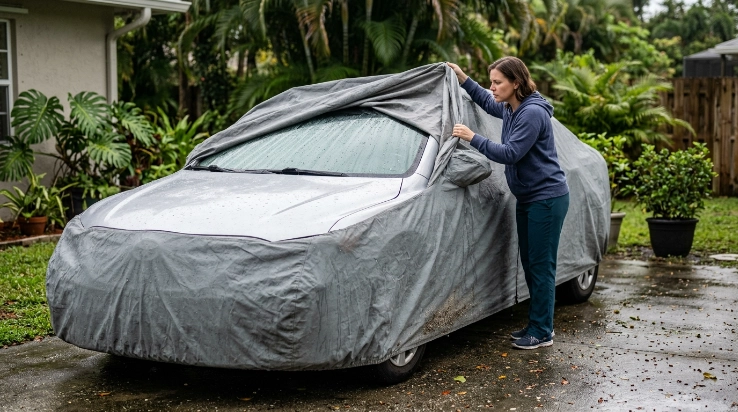
Tropical climate car cover issues mainly involve moisture, heat, ultraviolet exposure, dirt, and fabric movement. These conditions often happen together, which makes choosing and using a cover more complicated.
A tropical-climate car cover is an outdoor vehicle cover used where warm temperatures, high humidity, strong sunlight, and frequent rainfall are normal. Its job is to shield the vehicle while allowing trapped moisture to escape.
Condensation under the cover
Water underneath a cover doesn’t always mean rain leaked through it. Humid air can condense when the vehicle surface and surrounding air change temperature.
This often becomes noticeable overnight or early in the morning. The roof, windows, hood, and trunk may feel damp despite the exterior of the cover appearing dry.
A cover that never seems to dry
Frequent rain creates another problem. The outside fabric may get wet again before it has completely dried from the previous storm.
Once the lining stays damp, putting it back against the vehicle simply brings moisture back into the protected space.
- Damp lining: Transfers moisture directly toward the vehicle.
- Wet seams: May take longer to dry than exposed panels.
- Folded moisture: Can create a musty smell while the cover is stored.
- Repeated storms: Give the material little time to dry.
Paint rubbing during windy weather
Wind itself isn’t necessarily the paint problem. The bigger concern is a dirty cover repeatedly moving across dirty paint.
Fine sand, dust, pollen, and road grime can become abrasive when trapped between two moving surfaces. Consumer Reports likewise warns that loose debris can scratch automotive finishes during physical contact.
Mildew and musty smells
Warmth plus moisture makes damp fabric difficult to manage. A cover stored wet can develop musty odors or visible contamination.
If I smell a strong damp odor after unfolding one, I don’t immediately put it back on the car. I clean it according to its care instructions and let it dry first.
| What You Notice | Likely Tropical-Climate Cause | First Check |
|---|---|---|
| Fine droplets underneath | Condensation or trapped humidity | Dry car, cover, and parking surface |
| Wet patch after rain | Water penetration or saturated seam | Inspect material and stitching |
| Fine paint marks | Dirt combined with cover movement | Check lining, paint, and fit |
| Musty odor | Fabric remained damp | Clean and air-dry the cover |
| Cover flapping heavily | Poor sizing or weak fastening | Check hem, straps, and vehicle fit |
Section Takeaway: Tropical car-cover trouble usually comes from moisture, contamination, heat, or movement. Diagnose those conditions before assuming the cover itself has completely failed.
Why Does Humidity Build Up Under a Car Cover?
Humidity builds up when moisture enters or forms beneath the cover faster than it can escape. A wet vehicle, damp ground, humid air, rain, and limited airflow can all contribute.
This distinction matters because making a cover more waterproof doesn’t automatically solve condensation. Moisture management requires an escape path as well as rain protection.
Breathability and waterproofing are different
Water resistance describes how well a material limits liquid water entering from outside. Breathability describes how readily water vapor can move out through the material.
Those qualities need to work together. An outdoor cover that blocks rain but keeps existing moisture trapped can create a different problem underneath.
Never cover a wet car
A car can look dry while still holding water. I check mirror housings, badges, handles, weather stripping, wheel openings, and panel gaps after washing.
Those hidden areas can release water after the cover is installed. In humid weather, that moisture may evaporate slowly.
- Dry the paint and glass completely.
- Check mirrors and exterior trim for hidden water.
- Let panel gaps drain after washing.
- Inspect the cover lining before installation.
- Avoid covering a vehicle sitting over standing water.
Watch the parking surface
A soaked driveway, grass parking area, or damp garage floor keeps moisture near the vehicle. That can raise humidity around the lower body and beneath the cover.
When possible, I prefer a paved, well-drained surface. Indoor storage is even better when the space itself stays dry.
Kelley Blue Book’s vehicle-storage guidance also recommends sheltered storage when available and emphasizes preparing the vehicle before longer storage periods.
How to diagnose condensation
Start with both the vehicle and cover completely dry. Then inspect underneath after the conditions that usually trigger the problem.
- Check the roof and glass for widespread fine droplets.
- Inspect the hood and trunk.
- Feel the cover lining for moisture.
- Look for concentrated wetness near seams.
- Check the ground beneath the vehicle.
- Compare conditions before and after rainfall.
A broad layer of fine droplets after a temperature change points more toward condensation. A localized wet section directly below a seam after rain suggests water penetration deserves attention.
Section Takeaway: High tropical humidity makes drying harder. Keep the vehicle, cover, and parking area as dry as practical instead of relying on waterproof material alone.
How Do Tropical Rain, Sun, and Wind Affect a Car Cover?
Tropical weather attacks a cover from several directions. Rain tests water resistance, sun ages exposed material, and wind stresses the fit and fastening system.
The result is often faster wear than you’d expect from a cover used in a sheltered environment.
Heavy rain can overwhelm weak material
An outdoor cover needs to shed normal rainfall without becoming a saturated blanket. Aging coatings, damaged seams, and worn fabric can reduce that ability.
Check what happens after a storm instead of trusting the label forever. Water penetration is a performance problem even if the cover worked well when new.
Strong sun can age the cover
Sun exposure heats both the cover and the vehicle beneath it. Repeated ultraviolet exposure can also fade or weaken materials over time.
Kelley Blue Book notes that indoor or covered storage reduces exposure to direct sunlight and other weather. That advantage becomes especially useful when a car sits unused for extended periods.
As of 2026, I would judge an outdoor cover by its current condition rather than its original marketing claims. An old UV-resistant cover can still become brittle after prolonged exposure.
Wind turns poor fit into movement
A loose cover catches moving air more easily. Extra material can balloon, slap against panels, or pull on fastening points during storms.
Fit should be snug without forcing the material over mirrors, antennas, spoilers, or accessories.
- Too loose: More fabric can move against the paint.
- Too tight: Seams and exterior accessories may carry excessive tension.
- Weak elastic: Edges may lift more easily during wind.
- Poor straps: The cover may shift despite appearing secure when installed.
Storm conditions are different
A normal outdoor cover isn’t a substitute for secure shelter during a severe tropical storm or hurricane. Flying objects, flooding, falling branches, and extreme wind create hazards beyond everyday weather protection.
If dangerous weather is expected, use secure indoor parking when available and follow official emergency guidance. NHTSA is a reliable starting point for federal vehicle-safety information.
Section Takeaway: Tropical rain, sunlight, and wind don’t act independently. Choose a cover and parking method that can handle all three without trapping moisture or moving excessively.
What Type of Car Cover Works Best in a Tropical Climate?
The best tropical-climate car cover is breathable, weather-resistant, UV-resistant, clean inside, and correctly sized. No single material characteristic should be considered in isolation.
I would prioritize moisture management first. A cover that’s impressive during rain but stays wet against the car afterward isn’t a good long-term solution.
Breathable vs. non-breathable cover
| Feature | Breathable Outdoor Cover | Poorly Ventilated Barrier |
|---|---|---|
| Moisture vapor escape | Designed to allow evaporation | May dry more slowly underneath |
| Tropical suitability | Usually the better starting point | Requires careful moisture management |
| Rain protection | Depends on fabric construction | May block liquid well but still trap vapor |
| Best use | Regular outdoor use in humid weather | Situations where ventilation is otherwise controlled |
Choose the cover for the parking location
An indoor garage and an exposed driveway demand different materials. Don’t buy the heaviest outdoor cover simply because heavier sounds safer.
- Enclosed garage: Prioritize softness, dust control, breathability, and fit.
- Carport: Add protection against wind-driven rain and greater humidity.
- Outdoor driveway: Prioritize rain resistance, UV durability, breathability, and secure fastening.
- Coastal location: Keep the car and cover clean because airborne salt and grit can accumulate.
Fit matters as much as fabric
A fitted cover generally controls excess material better than an oversized universal cover. That helps reduce movement when tropical winds pick up.
Still, the cover shouldn’t need aggressive stretching. Check the manufacturer’s sizing information for your vehicle and any added exterior accessories.
A soft lining cannot compensate for dirt
Owners sometimes focus heavily on finding the softest possible inner layer. I care just as much about whether that lining stays clean.
Dirt between soft fabric and paint is still dirt. Consumer Reports’ vehicle-cleaning guidance stresses using gentle materials and keeping abrasive contamination away from automotive finishes.
Section Takeaway: In a tropical climate, look for a balanced cover rather than one extreme feature. Breathability, rain resistance, UV durability, cleanliness, and secure fit all matter.
How Do You Prevent Tropical Climate Car Cover Problems?
The best prevention routine is simple: keep everything clean, keep everything dry, control movement, and inspect the cover regularly. Tropical weather makes skipping those steps more costly.
Use this routine before covering the car
- Clean loose contamination: Remove dust, sand, bird droppings, leaves, and road grime.
- Dry the vehicle: Pay attention to mirrors, badges, trim, seals, and panel gaps.
- Inspect the lining: Shake out or clean any visible grit.
- Check the cover: Confirm that it isn’t already wet from storage.
- Install without dragging: Keep the lining away from dirty pavement.
- Secure the fit: Check hems and manufacturer-provided fastening points.
I avoid dragging a cover across concrete whenever possible. One careless removal can load the inner fabric with the exact grit I don’t want against the paint.
Remove the cover periodically
Outdoor covers shouldn’t become something you install and forget for months in a humid tropical environment. Periodic removal gives you a chance to find moisture, dirt, insects, staining, or cover deterioration early.
There’s no universal inspection interval for every climate and cover. Check more frequently during rainy periods or after severe weather.
Let a soaked cover dry completely
If the cover becomes saturated, remove it when conditions allow. Hang or spread it according to the manufacturer’s care instructions until both sides dry.
Never fold a wet cover into its storage bag for convenience. That traps moisture in layers of fabric.
Keep the paint reasonably clean
Routine washing matters because a cover physically touches or rests close to the vehicle. Sand, dust, tree residue, bird contamination, and road dirt shouldn’t stay trapped underneath.
A dedicated automotive cleaner and nonabrasive wash tools are safer choices than harsh household detergents. Keeping paint clean also lets you spot existing finish damage before blaming the cover.
Use shelter whenever you can
A carport or garage reduces direct rain, ultraviolet exposure, debris, and wind load. The cover can then work as a secondary layer instead of taking every environmental hit itself.
Even a garage still needs moisture control. Look for leaks, standing water, and a damp floor before assuming an enclosed space is automatically dry.
Section Takeaway: Tropical car-cover care is mostly routine management. A clean, dry car and a clean, dry, secure cover prevent more problems than complicated accessories do.
When Should You Replace a Tropical-Climate Car Cover?
Replace the cover when its material, seams, lining, or fit can no longer protect the vehicle reliably. Age alone isn’t the best test.
Tropical sunlight and rain may accelerate wear, but usage conditions vary too much to assign every cover the same lifespan.
Warning signs I would not ignore
- Water penetration: Rain repeatedly passes through areas that previously stayed dry.
- Brittle fabric: The material feels stiff, powdery, cracked, or unusually weak.
- Failed seams: Stitching has separated or stretched open.
- Damaged lining: The inner surface feels rough, contaminated, or deteriorated.
- Loose elastic: The cover no longer stays positioned around the vehicle.
- Persistent flapping: Proper installation no longer controls movement.
- Permanent musty condition: Odor or contamination returns despite correct cleaning and drying.
Test performance instead of guessing
Inspect the cover during normal use. Look underneath after rainfall and check the fit after windy conditions.
Small cosmetic fading doesn’t automatically mean failure. Structural deterioration or repeated moisture problems matter far more.
If the cover continually creates the same problem despite a clean, dry vehicle and correct installation, replacement becomes more reasonable. Match the new cover to the environment that defeated the previous one.
Section Takeaway: Replace a tropical-climate cover based on lost function, not just age. Water penetration, weak fabric, damaged lining, failing seams, and uncontrolled movement are stronger warning signs.
Frequently Asked Questions
Are car covers good in tropical climates?
Yes, a car cover can be useful in a tropical climate when it matches the parking conditions. Choose breathable, weather-resistant material with UV protection and a secure fit, then keep both the vehicle and cover clean and dry.
Can a car cover cause rust in humid weather?
A cover doesn’t automatically cause rust, but persistent trapped moisture can keep exposed metal damp longer. Remove the cover when you find repeated condensation, dry everything, and correct the moisture source rather than leaving the vehicle covered.
Should a tropical car cover be completely waterproof?
Don’t judge a tropical cover by waterproofing alone. You also need breathability because moisture already beneath the fabric needs a way to escape instead of remaining around the vehicle.
Why is my car wet under the cover when it didn’t rain?
Condensation is a likely explanation. Humid air beneath the cover can turn into droplets when temperature conditions change, especially overnight or during rapid weather changes.
Can a car cover scratch paint in windy tropical weather?
It can if dirt becomes trapped between the cover and paint while loose fabric moves repeatedly. Reduce the risk by keeping both surfaces clean and using a correctly fitted, securely installed cover.
Should I cover my car immediately after washing it?
No. Let the vehicle dry completely first, including water hidden around mirrors, badges, weather stripping, door handles, trim, wheel openings, and panel gaps.
Is indoor parking better than using a car cover outside?
Secure indoor parking generally provides better protection from direct rain, sunlight, wind, and debris. A breathable indoor cover can then add dust and contact protection, provided the garage and vehicle are dry.
The Bottom Line
Tropical climate car cover issues aren’t solved by buying the thickest or most waterproof cover available. Moisture management, correct fit, cleanliness, UV durability, and drying time matter together.
My simple rule is to never trap a wet vehicle beneath wet fabric. Keep the car clean, let the cover dry between storms, inspect it after harsh weather, and replace it once it stops doing its job safely.
If your current cover keeps leaving the vehicle damp or keeps moving against the paint, don’t ignore the pattern. Diagnose the moisture source and fit before the next long period of outdoor storage.
