
Antenna Tearing Car Cover? Causes, Fixes, and Prevention

Quick Answer
If your antenna is tearing your car cover, the cover is usually too tight around the antenna, moving excessively in wind, or missing a reinforced antenna opening. Stop forcing the fabric over the antenna. Instead, use the cover’s supplied antenna patch, create a reinforced opening only if the manufacturer allows it, remove a detachable mast before covering, or switch to a correctly fitted cover. A properly sized cover matters, as shown in Car and Driver’s car cover testing.
What to check first
- Cover tension: Fabric shouldn’t be stretched tightly over a mast or shark-fin antenna.
- Antenna type: A removable mast needs a different solution from a fixed shark-fin antenna.
- Existing hole: An unreinforced cut can spread quickly under tension.
- Wind movement: Flapping fabric repeatedly loads the same contact point.
- Cover size: A cover that’s too small can pull hard against roof accessories.
Safest immediate move
- Remove the cover and inspect the antenna, roof, fabric, seams, and surrounding paint before using it again.
If your antenna keeps tearing your car cover, don’t treat the rip as the whole problem. The tear is usually telling you that the cover, antenna, or installation method isn’t working together correctly.
I look at the tension first. A car cover should protect the vehicle without pulling hard against antennas, mirrors, spoilers, roof racks, or other raised parts.
This guide explains why antenna tears happen, how to repair minor cover damage, and when changing the cover is the better answer.
In This Guide
- Why Is My Antenna Tearing My Car Cover?
- Does the Type of Car Antenna Change the Fix?
- How Do You Stop an Antenna From Tearing a Car Cover?
- Can You Repair a Car Cover Torn by an Antenna?
- Can a Tight Car Cover Damage the Antenna or Paint?
- What Car Cover Should You Use Around an Antenna?
- Frequently Asked Questions
Why Is My Antenna Tearing My Car Cover?
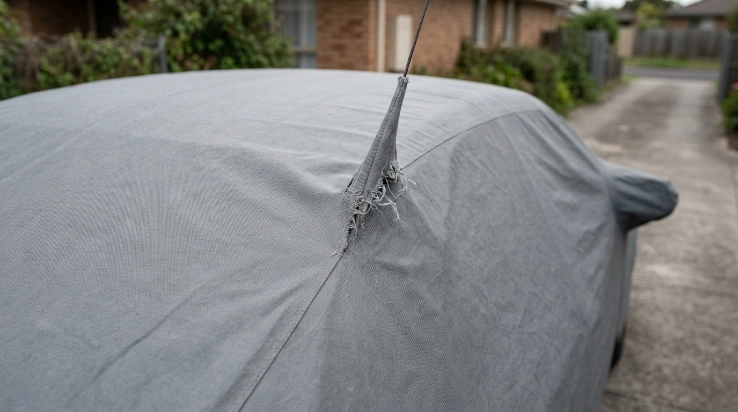
An antenna usually tears a car cover because concentrated tension is being placed on a small area of fabric. Wind and repeated installation can make that stress worse.
A car cover should follow the vehicle’s shape without being stretched like a fitted sheet that’s one size too small.
An antenna tear point is the small area where the cover contacts a raised antenna and repeatedly experiences pulling, rubbing, or puncture stress.
The cover may be too small
An undersized cover often feels tight before you even reach the roof. Once fitted, the antenna can become one of the highest-pressure points.
- Hard stretching: You have to pull strongly to reach the bumpers.
- Distorted seams: Stitching looks stretched once the cover is installed.
- Tight roof fabric: Little or no slack remains around the antenna.
- Difficult removal: The cover catches instead of lifting away easily.
The antenna can act like a pressure point
A thin mast concentrates force into a much smaller area than the roof itself. A sharp antenna tip can make the problem worse.
The first sign may be a stretched patch rather than an obvious hole. Small fibers can weaken before the material finally splits.
Wind can enlarge a small tear
Outdoor wind changes a static pressure point into a moving one. Fabric can pull away and snap back against the antenna repeatedly.
That movement also loads seams, elastic hems, straps, and other raised body areas.
| What You See | Likely Cause | First Check |
|---|---|---|
| Small hole directly over mast | No reinforced antenna opening | Check cover instructions for an antenna patch |
| Long rip spreading from antenna | High cover tension | Verify cover size and fit |
| Frayed material around hole | Repeated rubbing or wind movement | Check cover stability outdoors |
| Tear plus strained seams | Cover likely too small | Compare vehicle dimensions with cover specifications |
| Hole keeps reopening after repair | Underlying fit problem remains | Fix tension before repairing again |
Section Takeaway: An antenna usually doesn’t tear a sound, correctly fitted cover without another contributing factor. Check sizing, reinforcement, and wind movement before blaming the fabric alone.
Does the Type of Car Antenna Change the Fix?
Yes. A removable whip antenna, fixed mast, power antenna, and shark-fin antenna shouldn’t automatically be handled the same way.
Identify what your vehicle has before cutting or modifying anything.
Removable mast antenna
Some screw-in antenna masts can be removed by hand or with the method specified by the vehicle manufacturer. Removing the mast can eliminate the pressure point completely.
Don’t assume every mast is designed for frequent removal. Check the owner’s manual if you’re uncertain.
Fixed mast antenna
A fixed mast usually needs a properly positioned reinforced opening in a compatible cover. Forcing intact fabric over it creates unnecessary tension.
Some car covers include an adhesive reinforcement patch specifically for this purpose. Follow the cover manufacturer’s instructions rather than making a bare slit.
Power antenna
Older vehicles may use a power antenna that retracts when the radio or vehicle is switched off. Make sure it has fully retracted before installing the cover.
If the power antenna stays extended because of a fault, don’t push it down by force.
Mechanic Alert: A power antenna that won’t retract may have a motor, mast, wiring, or mechanism problem. Have it diagnosed if normal operation doesn’t restore movement.
Shark-fin roof antenna
A shark-fin antenna is lower than a traditional mast, but a tight cover can still load it heavily. Don’t treat the housing as a handle or tie-down point.
Roof antenna assemblies may contain mounting hardware and electrical connections beneath the roof. NHTSA’s published manufacturer service bulletins show that roof antenna assemblies can involve specific mounting and cable concerns, reinforcing why the antenna itself shouldn’t be casually modified.
If the cover is tight enough to pull sideways on a shark fin, solve the cover-fit problem rather than cutting around the antenna housing.
How Do You Stop an Antenna From Tearing a Car Cover?
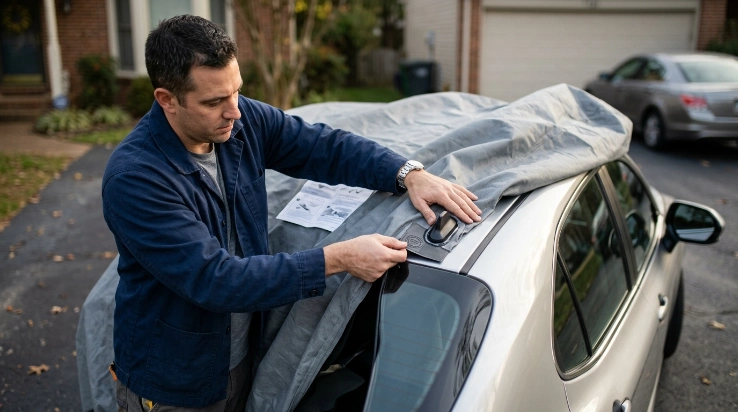
The best solution removes concentrated pressure without creating a loose, flapping cover. Start with the least invasive option.
- Remove the cover. Don’t keep using it while the tear is spreading.
- Inspect the antenna. Check whether it is loose, bent, cracked, or already damaged.
- Inspect the roof. Look for rubbing marks, scratches, or disturbed trim around the antenna.
- Confirm cover size. Compare the cover’s application and dimensions with your vehicle.
- Check the instructions. Look for an included antenna patch or approved modification method.
- Remove a detachable mast if appropriate. Follow the vehicle manufacturer’s procedure.
- Reinforce an approved opening. Never leave a raw cut that can continue spreading.
- Secure the cover correctly. Use only the straps, hems, or fastening points designed for it.
Use an antenna reinforcement patch when supplied
A reinforcement patch spreads stress over a larger area. That’s safer for the fabric than letting a mast rub directly against an unfinished hole.
Positioning matters. Install the cover first to identify the antenna location before permanently applying or cutting anything.
Don’t make the hole oversized
A huge opening may solve pressure around the antenna, but it can create another weak area. It can also allow more dust, water, or debris through the cover.
Follow the cover maker’s recommended hole size and reinforcement method when available.
Control wind movement
A reinforced opening won’t solve a cover that’s ballooning in every gust. Outdoor covers need enough security to remain controlled without excessive tension.
- Check hems: Worn elastic can let the cover lift.
- Use intended straps: Don’t improvise attachments around fragile components.
- Remove excess slack: Large loose panels can flap against the vehicle.
- Inspect after storms: Wind can shift a previously good installation.
Section Takeaway: Solve both sides of the problem. Protect the antenna contact point and make sure the entire cover fits securely without excessive stretching.
Can You Repair a Car Cover Torn by an Antenna?
A small, localized tear can often be repaired if the surrounding material is still strong. A large rip in brittle or deteriorated fabric usually points toward replacement.
Most important, fix the cause first. Otherwise, the antenna may tear straight through the repair.
When a repair makes sense
- Small damage: The hole or tear is limited to one area.
- Healthy fabric: Material around the damage still feels flexible and strong.
- Good overall fit: The cover isn’t being stretched excessively.
- Sound seams: Stitching elsewhere remains intact.
- Known cause: You can correct the antenna contact problem before reuse.
How to patch the area
Use a repair material specifically compatible with the cover fabric. Generic household tape may not tolerate outdoor moisture, ultraviolet exposure, or repeated flexing.
- Remove the cover from the vehicle.
- Clean and dry the damaged area as directed by the repair product.
- Bring the torn edges back into their natural position without stretching them.
- Apply the approved patch with enough overlap around the damaged material.
- Allow adhesive or repair material to cure as instructed.
- Correct the antenna clearance before reinstalling the cover.
When I would replace the cover
I wouldn’t keep layering patches onto a cover that’s failing in several places. Once the material tears easily by hand pressure or normal installation, its useful protective life is questionable.
- Multiple tears are appearing.
- Fabric feels brittle or unusually thin.
- Seams are separating.
- Elastic no longer holds the cover securely.
- Water resistance has deteriorated badly.
- The cover no longer fits after vehicle modifications.
A damaged cover may also expose rough repair edges to the paint. Keep the vehicle finish in mind when deciding whether another repair is worthwhile.
Can a Tight Car Cover Damage the Antenna or Paint?
It can. Excessive tension can pull against exterior components, while dirt trapped under moving fabric can increase the risk of marking the finish.
That doesn’t mean car covers are inherently harmful. Installation, cleanliness, fit, and storage conditions matter.
Inspect the antenna before covering again
A roof antenna that feels loose deserves attention before another cover goes over it. Don’t tighten hidden antenna mounting hardware by guessing at a torque value or dismantling the headliner without service information.
NHTSA hosts manufacturer service information and safety material at NHTSA.gov, which can be useful when checking vehicle-specific concerns.
Mechanic Alert: If the antenna housing moves at its base, wiring is exposed, water is entering the cabin, or accessing the mounting point requires removing interior trim, use a qualified technician.
Keep grit away from the paint
Cleanliness is particularly important when a cover moves outdoors. Dust, sand, and road grit between two surfaces can become abrasive when rubbed repeatedly.
Consumer Reports’ car-washing guidance recommends paint-safe washing products and soft washing materials rather than harsh household cleaners.
Inspect the antenna contact area
- Look for dull rubbing marks around the roof.
- Check painted antenna housings for scuffs.
- Inspect nearby trim for movement.
- Check the underside of the cover for trapped grit.
- Make sure a repair patch has no abrasive exposed edges.
If you find a mark, wash and inspect it before reaching for polish. You need to know whether you’re seeing dirt transfer, a superficial mark, or actual finish damage.
What Car Cover Should You Use Around an Antenna?
Choose a cover that fits the complete shape of your vehicle, including permanent exterior equipment. Antenna clearance should be considered before purchase, not after the fabric starts tearing.
As of 2026, you’ll still find both vehicle-specific and broader universal-fit covers. Neither label alone guarantees correct fit.
Custom-fit versus universal-fit covers
| Feature | Vehicle-Specific / Custom Fit | Universal Fit |
|---|---|---|
| Body contour | Designed around a narrower vehicle application | Designed to accommodate a broader size range |
| Excess fabric | Usually less when application is correct | May have more depending on vehicle shape |
| Antenna accommodation | Varies by manufacturer and application | Often requires checking patch or opening instructions |
| Best buying approach | Verify exact vehicle and accessory compatibility | Verify dimensions and roof accessory clearance carefully |
Look beyond the length measurement
Vehicle length alone doesn’t tell you how fabric will sit over the roof. Body height, mirrors, spoilers, roof racks, and antennas can change the effective fit.
I also check how the cover is secured. A theoretically correct size isn’t much help if large sections flap badly outside.
Match the cover to where you park
- Garage: Prioritize a clean, paint-friendly inner surface and sensible fit.
- Carport: Consider airflow, wind-driven rain, and secure fastening.
- Driveway: Weather resistance and wind stability become more important.
- Long-term storage: Cleanliness, dryness, fit, and periodic inspection all matter.
Kelley Blue Book’s exterior-care resources provide broader guidance for protecting and maintaining vehicle exterior surfaces.
Before buying, read the manufacturer’s application guide and antenna instructions. Don’t assume you’ll be able to safely cut any cover after purchase.
Section Takeaway: The best car cover for an antenna-equipped vehicle is one that fits without concentrating tension around the antenna and includes a manufacturer-approved way to accommodate exterior protrusions.
Frequently Asked Questions
Should I cut a hole in my car cover for the antenna?
Only if the cover manufacturer allows it and provides suitable instructions. A raw hole can spread under tension. When an antenna opening is required, a reinforced patch or finished opening is safer than simply cutting a slit into unsupported fabric.
Should I remove my car antenna before putting on a cover?
If your vehicle has a removable screw-in mast and the manufacturer permits normal removal, taking it off can prevent cover pressure. Don’t force a fixed antenna, powered mast, or shark-fin assembly off the vehicle just to install a cover.
Can a shark-fin antenna tear a car cover?
Yes. Although a shark fin is lower and broader than a mast antenna, an undersized or excessively tight cover can still pull against its edges. A cover that strains around the shark fin should be resized or repositioned rather than forced into place.
Why does my repaired antenna hole keep tearing?
The original cause probably remains. Common reasons include an undersized cover, an opening without enough reinforcement, brittle fabric, wind movement, or poor hole positioning. Correct the fit and stress around the antenna before applying another repair.
Can I put tape around the antenna to stop tearing?
Wrapping the vehicle’s antenna with random tape isn’t my preferred solution. Adhesive can leave residue, and padding the antenna doesn’t correct excessive cover tension. Use a cover-manufacturer-approved reinforcement or repair method instead.
How tight should a car cover be?
A cover should be secure enough to limit uncontrolled movement but shouldn’t require aggressive stretching over antennas, mirrors, spoilers, or trim. If seams are strained or installation requires strong pulling, verify that the cover is the correct size.
Do I need a new car cover after an antenna tear?
Not necessarily. A small tear in otherwise healthy material may be repairable with the correct patch. Replace the cover if the fabric is brittle, several areas are failing, seams are separating, or the underlying fit is wrong for your vehicle.
Bottom line: If an antenna is tearing your car cover, don’t keep pulling the same damaged fabric over it. Identify whether the real problem is sizing, antenna clearance, missing reinforcement, worn material, or excessive wind movement.
Fixing that cause protects more than the cover. It also reduces unnecessary pressure and rubbing around the antenna, roof, paint, and nearby trim.