
Can Pollen Get Through a Car Cover? How to Keep It Out

Quick Answer
Yes, pollen can get through or underneath a car cover. Breathable fabric, seams, mirror pockets, loose edges, and wind can all let fine airborne contamination reach the vehicle. A clean, correctly fitted cover can reduce pollen significantly, but most conventional covers are not completely particle-tight, as shown by current car-cover testing.
Where pollen gets in
- Breathable fabric: Airflow that helps moisture escape may also allow some fine contamination to pass.
- Loose lower edges: Wind can push pollen underneath the hem and onto lower body panels.
- Seams and openings: Mirror pockets, antenna openings, and stitching are not normally airtight.
- Cover movement: A loose cover can pump dusty outside air underneath as it moves.
- Dirty handling: Pollen on the cover’s exterior can transfer to the vehicle during removal or installation.
Best prevention
- Use a snug cover suited to your storage environment, secure it properly, and keep both the vehicle and inner cover surface clean.
Pollen through a car cover is possible even when the fabric looks thick and protective. The key question is whether pollen passed through the material itself or entered around the edges.
I treat those as two different problems. Once you know where the contamination is coming from, keeping the car cleaner becomes much easier.
In This Guide
Can Pollen Go Through a Car Cover?
Yes. Some pollen can pass through certain cover materials, while more often it enters through gaps around the cover.
A standard car cover is designed as a protective barrier. It normally isn’t engineered as a sealed air-filtration system.
Definition: Pollen protection from a car cover means reducing the amount of airborne pollen that settles directly on the vehicle. It does not necessarily mean creating an airtight or particle-proof enclosure.
Breathable does not mean sealed
Many good covers are intentionally breathable. Breathability helps moisture and humid air escape from around the vehicle.
That benefit creates a tradeoff. A material that exchanges air should not automatically be treated like a sealed plastic barrier.
Airborne contamination may also enter without moving directly through the main fabric.
- Elastic hems leave openings underneath the vehicle.
- Mirror pockets add seams and shaped areas.
- Antenna holes can create another entry point.
- Strap openings are rarely sealed against air.
- Wind can push contaminated air underneath the cover.
That’s why you may remove a seemingly clean cover and still find a yellow or greenish film on the paint.
Does pollen always penetrate the fabric?
No. Finding pollen underneath doesn’t prove that it traveled straight through the fabric.
In my experience, I check the lower edges first. Pollen concentrated near rocker panels, bumpers, and wheel arches often points toward air entering underneath.
Pollen spread evenly across the roof and hood may suggest either fabric permeability or contamination transferred during handling.
As of 2026, most consumer car-cover specifications still focus on weather resistance, UV exposure, fit, softness, and water management. Particle-filtration efficiency is rarely a standard advertised specification.
That means I wouldn’t trust an ordinary cover to guarantee a pollen-free vehicle.
Why Does Pollen Get Under a Car Cover?
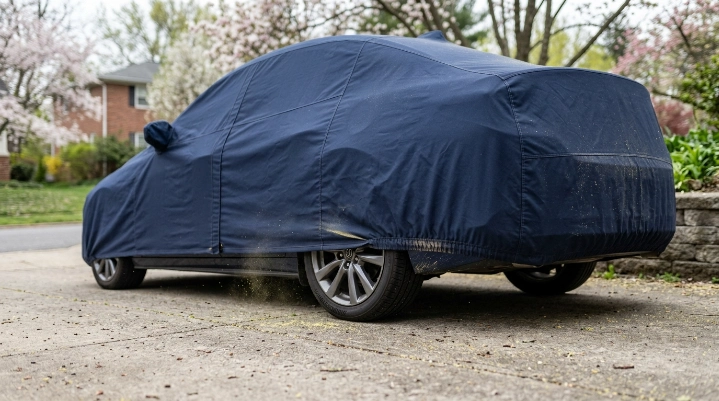
Pollen usually gets underneath because moving air finds a path through or around the cover. Poor fit makes that problem worse.
Wind pushes pollen beneath loose edges
A cover doesn’t need to blow off for wind to cause trouble. Small movements at the hem can repeatedly pull outside air underneath.
- Wind lifts one side of the hem.
- Outside air carrying pollen enters.
- The cover settles back against the body.
- The process repeats with each gust.
- Pollen gradually settles on the paint.
This pumping effect is one reason I prefer secure fitment over simply buying the thickest material available.
The cover may already be contaminated
The outside surface naturally collects pollen while protecting the vehicle. Trouble starts when that dirty surface contacts the clean side.
Removing a cover carelessly can fold pollen inward. The contamination then reaches the lining that will touch your paint next time.
Garage tip: I fold the lower sides upward and toward the roof before lifting the cover away. This keeps the dirty exterior from being dragged across painted panels.
Your parking location matters
A vehicle beneath flowering trees faces a much heavier pollen load than one inside an enclosed garage. A carport usually sits somewhere between those extremes.
- Enclosed garage: Lowest direct exposure, though pollen can enter when doors open.
- Carport: Roof protection helps, but wind still carries pollen through open sides.
- Driveway: Constant exposure to wind, trees, road dust, and changing weather.
- Under trees: Heavy pollen plus sap, leaves, insects, and bird droppings.
A cover that works well inside a garage may perform poorly during an outdoor pollen season.
What Type of Car Cover Blocks Pollen Best?
A snug, clean cover with good overall coverage generally gives better pollen protection than a loose universal cover. Your ideal material depends on whether the car lives indoors or outside.
| Cover Type | Pollen Protection | Best Environment | Main Limitation |
|---|---|---|---|
| Fitted indoor dust cover | Good | Enclosed garage | Not designed for outdoor weather |
| Fitted multilayer outdoor cover | Good | Driveway or carport | Air and pollen can still enter underneath |
| Loose universal cover | Fair | Temporary protection | More wind movement and edge gaps |
| Disposable plastic cover | Potentially good short-term barrier | Temporary indoor dust or pollen events | Poor durability and moisture management |
| Fully encapsulating storage system | Highest potential protection | Long-term indoor storage | Cost, space, and setup |
Fit matters as much as layers
Don’t judge a pollen cover only by layer count. A thick cover with large gaps can still allow contaminated air underneath.
A secure fit reduces excess fabric movement. It also limits the size of openings exposed to wind.
Kelley Blue Book’s vehicle-storage guidance likewise recommends matching a cover to the storage location and securing it properly.
What about waterproof covers?
Waterproofing doesn’t automatically mean pollen-proof. Water resistance and particle filtration describe different properties.
I also avoid sacrificing moisture control just to create a less breathable setup outdoors. Trapping damp air against a vehicle creates another problem entirely.
How Do You Stop Pollen Getting Under a Car Cover?
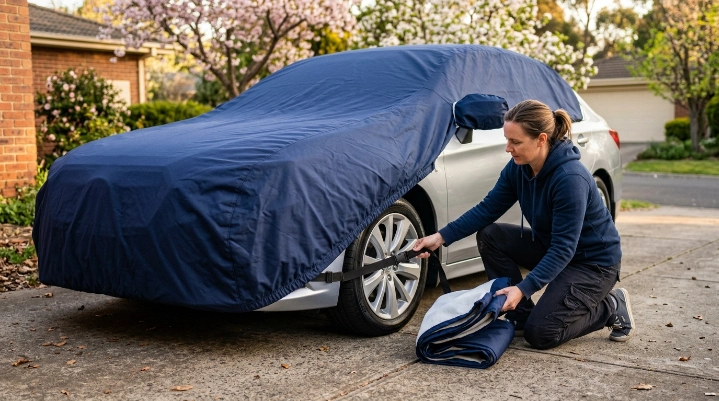
You probably can’t eliminate every grain of pollen with a traditional outdoor cover. You can reduce it substantially with better fit, cleaner handling, and smarter parking.
- Start with a clean vehicle. Remove existing pollen, road dust, and grit before installing the cover.
- Let the car dry completely. Don’t trap wash water or moisture underneath.
- Inspect the cover lining. Shake out or clean contamination before the liner touches the paint.
- Position the cover correctly. Align mirror pockets and shaped sections before pulling down the hem.
- Secure every intended strap. Reducing movement helps prevent air from repeatedly pumping underneath.
- Keep the cover off the ground. Concrete and driveways hold grit that can transfer to the liner.
- Clean the cover during heavy pollen season. Follow its manufacturer’s washing instructions.
Park away from direct pollen sources when possible
Moving the car a short distance can make a noticeable difference. I avoid parking directly beneath heavily flowering trees when another space is available.
A garage remains better than relying on fabric alone. Even a carport can reduce the amount falling directly from above.
Don’t seal a wet car in plastic
A plastic barrier may appear attractive because pollen cannot easily pass through solid material. Outdoor vehicle storage also has to deal with condensation, heat, wind, and rain.
Use only covers designed for the environment where you’re parking. Temporary plastic protection should not automatically replace a proper outdoor cover.
For longer storage, Edmunds’ long-term storage guidance also recommends cleaning the car and using suitable protection when a garage isn’t available.
Can Pollen Under a Car Cover Scratch Paint?
Pollen underneath a cover can contribute to paint marks when contamination is combined with rubbing. The bigger concern is often pollen mixed with harder dust and grit.
A stationary particle on clean paint creates less concern than contamination being dragged repeatedly across the clear coat.
Movement changes the risk
Imagine a loose cover moving across the same hood edge during every gust. Anything trapped between the fabric and paint moves with it.
- Wind flapping creates repeated contact.
- Dragging the cover moves contamination across large panels.
- Dirty lining keeps abrasive debris against the finish.
- Improper washing can grind loose particles into the clear coat.
I pay extra attention to mirror caps, fender peaks, hood corners, spoilers, and roof edges. Those areas often experience the strongest fabric contact.
Remove loose contamination before touching the paint
Don’t wipe a dry, pollen-covered vehicle aggressively with a towel. That can move whatever dust is mixed into the pollen across the finish.
Consumer Reports’ car-washing guidance recommends rinsing away loose dirt and debris before washing because particles can contribute to scratching.
Simple rule: If you can clearly see pollen or dust on the paint, remove it safely before reinstalling a cover. Don’t use the cover itself as a cleaning cloth.
What Should You Do When Pollen Is Already Under the Cover?
Remove the cover carefully and clean the vehicle before covering it again. You should also find out why the pollen entered.
- Release any straps or securing points.
- Fold the lower edges upward toward the roof.
- Lift the cover instead of dragging it across the body.
- Inspect the paint under good lighting.
- Rinse or wash away pollen and loose contamination safely.
- Allow the vehicle to dry completely.
- Inspect the inside of the cover.
- Clean the cover according to its care instructions when needed.
Look at the pollen pattern
The location of the pollen gives you clues. Heavy contamination near the bottom often suggests air entering beneath the hem.
Dust concentrated around one corner may mean that section is lifting in wind. Uniform contamination may point toward a more permeable material or contaminated lining.
Check the cover before reinstalling it
- Look for stretched elastic.
- Check loose or damaged straps.
- Inspect seams for openings.
- Look for tears and worn fabric.
- Feel the liner for grit.
- Check whether the sizing is correct.
An old cover can lose its shape and become harder to secure. Replacing a badly worn cover may work better than continually tightening a poor fit.
Frequently Asked Questions
Does a car cover completely stop pollen?
No. A normal car cover can greatly reduce direct pollen accumulation, but it usually isn’t an airtight enclosure. Pollen may enter through breathable material, seams, openings, or loose edges, especially when wind pushes contaminated air underneath.
Why is there pollen on my car even though it was covered?
The cover may be allowing airflow through its fabric or around its lower edge. Wind can also lift loose sections and carry pollen underneath. A dirty cover can transfer pollen to the vehicle during installation or removal.
Is a breathable car cover bad for pollen?
Not necessarily. Breathability helps trapped moisture escape, which can be important for vehicle storage. The tradeoff is that a breathable cover should not be assumed to block every airborne particle.
Is an indoor car cover better for pollen?
A fitted indoor cover can work well against garage dust and pollen because it isn’t exposed to strong outdoor wind. However, indoor covers generally aren’t designed to protect a vehicle from rain, heavy UV exposure, or outdoor weather.
Should I wash pollen off before putting on a car cover?
Yes, when the vehicle has visible pollen mixed with dust or grit, clean it before installing the cover. Putting fabric over a contaminated surface can trap particles against the paint and increase rubbing when the cover moves.
Can I use a plastic sheet to keep pollen off my car?
A plastic sheet may block pollen temporarily, but it isn’t automatically safe for long-term outdoor use. Poor fit, wind movement, heat, and trapped moisture can create new problems. Use a purpose-designed vehicle cover for routine storage.
How often should I clean a car cover during pollen season?
There is no universal interval because pollen exposure varies by location and cover material. Inspect the cover regularly and clean it when the exterior is heavily contaminated or the inner surface is no longer clean, following the manufacturer’s care instructions.
Bottom line: A car cover can dramatically reduce pollen on your vehicle, but most traditional covers cannot guarantee a particle-free surface.
For the best result, use the right cover for your parking environment, keep the fit secure, and clean both surfaces regularly. Those simple habits also reduce the chance that pollen, dust, and grit will get rubbed into your paint.
“`
