
Insects Under Car Cover: Why They Gather and How to Stop Them

Quick Answer
Insects under a car cover usually appear because the covered space is dark, quiet, protected, and sometimes damp. The best fix is to remove the bugs, dry and clean the car and cover, then remove nearby food, moisture, vegetation, and hiding places using the same prevention-first approach recommended by EPA Integrated Pest Management guidance.
What to check first
- Trapped moisture: Damp conditions can make the area more attractive to moisture-loving bugs.
- Leaf litter: Leaves, grass, mulch, and organic debris provide food and shelter around the vehicle.
- Loose cover edges: Large gaps let crawling insects reach the protected space underneath.
- Nearby food: Pet food, garbage, spilled drinks, and crumbs can attract ants, cockroaches, and other pests.
- Long undisturbed storage: A vehicle that sits untouched gives insects time to build webs, egg sacs, or small nests.
Best first move
- Remove the cover carefully, clean both surfaces, dry everything completely, and inspect the parking area before covering the car again.
Finding insects under a car cover is unsettling, but it does not automatically mean your vehicle is infested. In most cases, the cover has simply created a convenient hiding place.
I treat recurring bugs as an environmental problem first. Killing the insects you can see rarely works for long if moisture, leaves, food, or easy access remain around the vehicle.
In This Guide
- Why Are Insects Getting Under My Car Cover?
- What Bugs Are Commonly Found Under Car Covers?
- Can Insects Damage a Car Under a Cover?
- How Do You Safely Remove Insects From Under a Car Cover?
- How Do You Stop Insects From Coming Back?
- Does the Type of Car Cover Make a Difference?
- Frequently Asked Questions
Why Are Insects Getting Under My Car Cover?
Insects usually get underneath because a conventional car cover is a protective fabric layer, not a sealed enclosure. Crawling bugs can enter around the tires, bumpers, rocker panels, straps, and loose lower edges.
Definition: “Insects under a car cover” describes insects or other small arthropods using the protected space between a parked vehicle, its cover, and the surrounding parking surface as temporary shelter or habitat.
Darkness and shelter are major attractions
A fitted cover blocks sunlight and reduces disturbance around much of the vehicle. That creates the type of quiet hiding place many small creatures naturally seek.
Spiders are especially likely to use undisturbed protected spaces because those locations can also contain insect prey. Garages, storage areas, and other quiet locations commonly provide suitable hiding spots.
Moisture makes the problem worse
A wet parking surface, damp cover, condensation, or nearby vegetation can increase moisture around the vehicle. Moisture-loving organisms such as springtails become more common where humidity and organic debris stay high.
The University of Minnesota’s household insect guidance repeatedly emphasizes moisture reduction, sanitation, and removal of hiding places for many nuisance pests.
The parking location matters as much as the cover
- Grass: Offers insects direct access from soil, plants, and ground debris.
- Mulch: Holds moisture and contains decaying organic material.
- Under trees: Adds falling leaves, insects, sap, and organic debris.
- Damp garages: Provide shelter while allowing bugs to remain undisturbed.
- Concrete: Usually provides fewer natural hiding places when kept clean and dry.
That is why changing covers alone may not solve the problem. If the ground and surrounding area remain attractive, insects can simply crawl beneath the replacement.
Section Takeaway: Most insects are not attracted to the cover itself. They are attracted to the shelter, moisture, food, prey, or debris associated with the covered parking space.
What Bugs Are Commonly Found Under Car Covers?
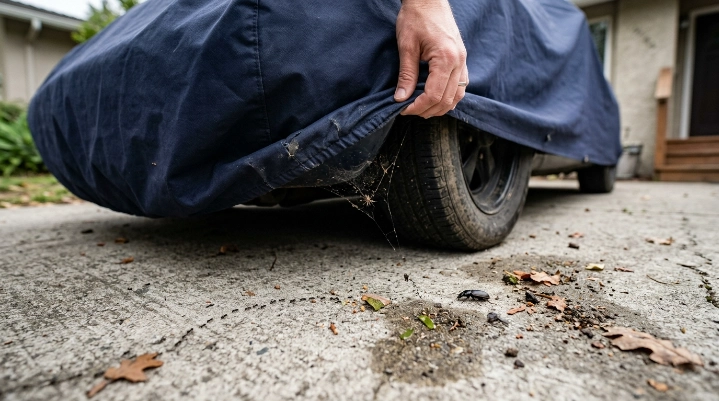
The exact species depends on your climate, parking location, season, and moisture level. Some creatures commonly described as “bugs” are not technically insects.
| What You Find | Likely Reason | First Action |
|---|---|---|
| Ants | Food, sweet residue, nearby colonies, or protected travel routes | Remove food sources and trace where they enter |
| Spiders | Quiet shelter plus other insects to eat | Vacuum webs and reduce insect prey nearby |
| Springtails | High moisture and organic debris | Dry the area and remove damp material |
| Cockroaches | Shelter combined with food, water, or clutter | Clean the area and remove food and water |
| Beetles or weevils | Temporary shelter or nearby plant material | Remove debris and monitor for repeat activity |
| Wasps | Protected cavities around mirrors, panels, or nearby structures | Avoid disturbing an active nest and seek professional help when needed |
A handful of harmless outdoor bugs after parking near vegetation is different from repeatedly finding dozens of the same species. Repeated activity points to a nearby source that deserves attention.
Also watch for spiders, millipedes, centipedes, or sowbugs. They are not all insects, but owners commonly group them together when describing bugs under a cover.
Can Insects Damage a Car Under a Cover?
Most small insects found beneath a cover are more nuisance than mechanical threat. The greater concern is what they leave behind or where they establish themselves.
Possible problems include contamination and nesting
- Webs and egg sacs: These can collect around mirrors, wheels, vents, and sheltered body gaps.
- Droppings or debris: Insect residue can dirty paint, trim, and the inside surface of the cover.
- Cabin entry: Ants or cockroaches may become a larger problem if food is left inside the vehicle.
- Nests in cavities: Wasps or similar insects may use mirror housings or protected openings.
- Moisture-related problems: Conditions attractive to bugs may also encourage mildew or corrosion elsewhere.
The insects themselves are not always the main warning sign. Persistent bugs can tell you that the storage space stays too wet, dirty, cluttered, or undisturbed.
If you discover chewed insulation or wiring, do not assume insects caused it. Rodents are a much more likely source of obvious chewing damage.
For long-term storage, Consumer Reports’ vehicle-storage guidance also stresses preparing the vehicle and checking for pest-related concerns rather than simply parking it and forgetting it.
Section Takeaway: A few insects rarely ruin a vehicle, but repeated pest activity can reveal storage conditions that deserve attention before they create bigger problems.
How Do You Safely Remove Insects From Under a Car Cover?
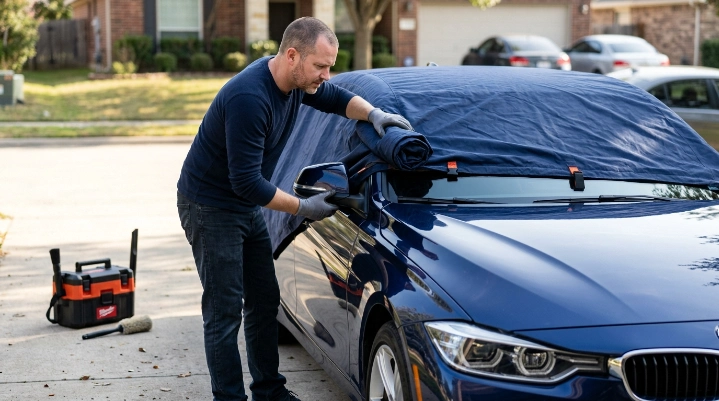
Remove the cover slowly rather than grabbing it and pulling it toward yourself. You want to see what is underneath before your hands reach hidden folds or pockets.
- Move into good light. If practical, uncover the vehicle in an open, well-lit area.
- Inspect the outside first. Look around hems, straps, mirror pockets, and folds before touching them.
- Lift from one end. Roll or fold the cover gradually instead of dragging it across the paint.
- Remove loose bugs. Use a vacuum, soft brush, or controlled shaking away from the vehicle.
- Clean the car. Remove webs, insect residue, leaves, and dust without grinding debris into the finish.
- Clean the cover. Follow its care label and pay special attention to the inner surface.
- Dry everything. Do not reinstall the cover while the car or fabric is damp.
Wear gloves if you are reaching into dark folds or sheltered areas. Stop if you find an active wasp nest or a spider you cannot safely identify.
Avoid spraying random insecticide directly over paint, weather seals, interior surfaces, or cover fabric. If chemical treatment becomes necessary, use only a product whose label allows that exact application.
My rule is to clean first and spray last. Removing the conditions that support pests usually gives a more durable result than repeatedly treating the visible bugs.
How Do You Stop Insects From Coming Back?
The most reliable strategy is to make the parking area less useful to insects. That means reducing access to water, food, shelter, and undisturbed hiding places.
Start with the ground around the vehicle
- Park on clean concrete, asphalt, or another well-drained hard surface when possible.
- Remove wet leaves, grass clippings, mulch, cardboard, and accumulated debris.
- Keep trash cans and pet food away from the storage area.
- Fix leaks or drainage problems that leave standing water nearby.
- Trim vegetation so branches and plants do not touch the cover.
Never cover a damp vehicle
Rainwater, wash water, or condensation trapped under fabric can keep the covered space humid. Let the car and the cover dry completely before reinstalling it.
This also protects the finish. Moisture management matters even when insects are not present.
Clean the cover before storage
Dirt and organic debris trapped in folded fabric can become part of the problem. Store the clean cover in a dry bag, cabinet, or shelf rather than dropping it onto a garage floor.
Inspect the vehicle on a schedule
For a daily driver, bugs usually become obvious because the cover is removed regularly. Seasonal storage requires deliberate checks.
- Warm or wet conditions: Check beneath the cover about once a week until you know the area stays pest-free.
- Dry indoor storage: A periodic inspection every few weeks can catch webs, moisture, or debris early.
- After storms: Recheck the lower cover edges and ground for wet leaves or standing water.
These are practical inspection intervals, not manufacturer service requirements. Adjust them to your climate and the level of pest activity you see.
Do not leave food inside the car
Snack wrappers, crumbs, sugary drink residue, and pet treats can turn a minor outside insect issue into a cabin problem. Vacuum seats, mats, cup holders, and cargo areas before long-term storage.
This prevention-first strategy follows the basic logic of integrated pest management. Remove what pests need before reaching for stronger controls.
Section Takeaway: The best insect prevention happens around the car, not just on the car. Dry ground, less debris, no food, regular inspections, and a clean cover remove most of the conditions pests use.
Does the Type of Car Cover Make a Difference?
Yes, but no ordinary drape-style cover can guarantee that insects will stay out. The underside remains accessible unless the storage system fully encloses the vehicle.
A snug fit reduces large entry gaps
A correctly sized cover is less likely to leave excessive loose fabric around the perimeter. Secure hems and straps also help keep the cover positioned where it belongs.
Fit matters for paint protection too. Car and Driver’s 2026 car-cover testing found meaningful differences in fit, fastening, moisture protection, and pest-oriented designs.
Breathability matters when moisture is the trigger
A waterproof barrier is not automatically the best answer if it traps moisture underneath. Choose a cover designed for the environment where you actually park.
- Dry indoor garage: A soft, breathable indoor cover may be sufficient.
- Outdoor parking: Use an outdoor-rated cover with secure fastening and suitable weather protection.
- High pest pressure indoors: A fully enclosing vehicle-storage system provides a stronger physical barrier.
- Wet ground: Fix the parking condition first rather than expecting fabric alone to solve it.
Do not substitute a loose plastic tarp for a purpose-built cover. A tarp can move against paint, trap moisture, and still leave large openings near the ground.
As of 2026, fully encapsulating indoor systems are available for owners who need more isolation than a normal cover provides. They are usually unnecessary for a daily driver with an otherwise clean storage area.
Frequently Asked Questions
Why are there suddenly bugs all over my car cover?
A sudden increase often follows warm weather, rain, nearby vegetation growth, or seasonal insect activity. Check beneath and around the vehicle for damp leaves, standing water, food sources, webs, and clusters of one particular pest before assuming the cover itself caused the problem.
Do car covers attract spiders?
The fabric does not necessarily attract spiders by itself. A covered vehicle creates a quiet, shaded area, while insects living around the parking space can provide prey, so spiders may use the cover, wheel wells, mirrors, and surrounding structures as convenient shelter.
Can ants live under a car cover?
Ants can travel beneath a cover and may remain there if nearby food, moisture, or a colony makes the location useful. Remove food from the vehicle, clean sugary residue, inspect the parking surface, and follow the ant trail to find the source.
Should I spray insect killer under my car cover?
Usually not as the first step. Clean and dry the area, identify the pest, and remove its food, water, and shelter first. If pesticide use becomes necessary, follow the product label and avoid applying chemicals to vehicle surfaces unless that use is specifically allowed.
Will a tighter car cover keep insects out?
A better fit can reduce some openings and prevent excess fabric from creating additional hiding places. However, a conventional cover still does not seal the vehicle at ground level, so small crawling insects can usually enter from underneath.
Are bugs under a car cover a sign of an infestation?
Not always. One or two outdoor insects may simply be seeking temporary shelter, while repeated sightings of many identical pests suggest a nearby source. Look for egg sacs, nests, trails, food, moisture, and recurring activity before deciding how serious the problem is.
What should I do if insects keep coming back?
Stop treating only the car and inspect the entire storage area. Remove debris, reduce moisture, move food and trash, trim vegetation, clean the cover, and monitor the location. A persistent or hazardous infestation is a good reason to contact a qualified pest-control professional.
Final takeaway: Insects under a car cover usually mean the covered space is giving them convenient shelter, moisture, food, or access from the surrounding environment.
Clean and dry the vehicle, improve the parking area, use a properly fitted cover, and inspect it regularly. Once you remove what attracts the bugs, the cover can go back to doing its real job: protecting your car.
“`
