
Stolen Car Cover: What to Do and How to Prevent It

Quick Answer
If your car cover was stolen, first make sure it did not blow away or get removed by property management. Check nearby areas and cameras, document the loss, and report suspicious theft when appropriate. For broader protection around your parked vehicle, follow NHTSA vehicle theft prevention guidance and add a physical cover lock if your cover supports one.
What I would do first
- Search nearby: Wind can carry a loose cover farther than most owners expect.
- Check cameras: Review home, parking-lot, doorbell, or nearby business footage.
- Ask management: Apartment or parking staff may have removed an unsecured cover.
- Document everything: Save receipts, photos, camera footage, and the approximate time it disappeared.
- Secure the replacement: Use compatible grommets with a coated cable and lock when possible.
One important distinction
- A cover lock is mainly a deterrent. A determined thief with tools may still defeat it, so parking location and vehicle security also matter.
Walking out to an uncovered car when you know you installed the cover the night before is frustrating. My first reaction would be theft too, but I would rule out wind, towing activity, and property-management removal before assuming someone took it.
A stolen car cover is usually a simpler problem than a stolen vehicle, but it still deserves attention. This guide covers recovery steps, prevention, cable locks, parking security, and mistakes that can damage your paint.
In This Guide
What Should You Do if Your Car Cover Was Stolen?
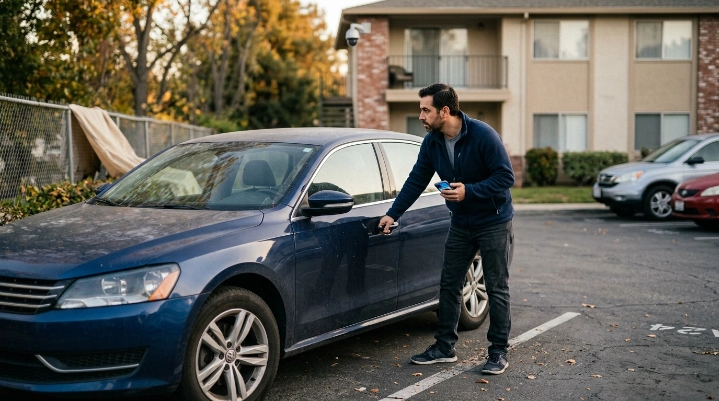
If your car cover disappears, verify that it was actually stolen before replacing it. Strong wind, maintenance crews, parking rules, and another driver’s mistake can produce the same result.
I would work through the situation in this order:
- Inspect the surrounding area. Look behind fences, bushes, dumpsters, nearby vehicles, and other places where wind could carry a lightweight cover.
- Check your vehicle. Look for damaged mirrors, antenna parts, trim, scratches, footprints, or signs someone tampered with the doors.
- Ask neighbors or parking staff. Someone may have seen the cover being removed or blowing away.
- Review available video. Check your own cameras and ask nearby businesses or property managers about footage.
- Save proof of ownership. Keep the receipt, order confirmation, product photos, and any identifying information.
- Report theft when appropriate. Local police procedures vary, but documentation can help if several thefts are occurring in the same parking area.
Do not confront someone you suspect of taking the cover. A replaceable accessory is not worth turning a property dispute into a dangerous encounter.
If you notice evidence that someone also tried to enter or steal the vehicle, treat that as the more serious issue. The FBI’s motor vehicle theft guidance recommends contacting law enforcement promptly when a vehicle is stolen.
Definition: A car cover theft is the unauthorized removal of the protective cover itself. It does not automatically mean the thief intended to steal the vehicle underneath it.
Why Do Car Covers Get Stolen?
Car covers can be attractive to opportunistic thieves because an unsecured one may take seconds to remove. Some premium fitted covers also have enough resale or reuse value to make them worth taking.
The risk usually increases when several conditions appear together:
- No physical lock: The cover can be lifted away without unlocking anything.
- Predictable parking: The vehicle sits unattended in the same exposed location for long periods.
- Poor lighting: A dark parking area gives someone more privacy.
- Loose installation: A partly detached cover looks easier to remove.
- Premium appearance: Thick, fitted, branded covers can look more valuable than disposable covers.
- No surveillance: A thief may expect less chance of identification.
There is another possibility I always keep in mind: wind. A missing cover is not proof of theft when the cover was secured only by elastic hems.
Wind can get beneath loose fabric and progressively peel the cover from the vehicle. That is why securing the lower portion helps with both theft deterrence and weather resistance.
How Can You Stop a Car Cover From Being Stolen?
You cannot make a fabric cover impossible to steal. You can make removal slower, more visible, and less convenient.
I prefer several small security layers instead of trusting one accessory.
Use the cover’s security grommets
Many outdoor covers have reinforced holes near their lower edges. These grommets allow a cable to pass underneath the vehicle and connect both sides.
Current commercial locking kits commonly use vinyl-coated steel cable. For example, WeatherTech specifies an 8-foot coated cable, while Coverstore lists a 7-foot cable in its vehicle-cover locking kit.
Add a cable and padlock
A locked cable creates an extra step for anyone trying to remove the cover. It also provides a visible sign that the cover is secured.
That does not make the fabric cut-proof. Think of the cable as an opportunistic-theft deterrent rather than a vault.
Improve where you park
Parking strategy costs nothing and can protect more than the cover. NHTSA recommends well-lit parking, locked doors, closed windows, secured keys, and removing visible valuables.
When possible, I would prioritize these locations:
- A locked private garage
- A driveway with lighting and cameras
- A monitored apartment parking area
- A busy, visible parking space
- A position within clear camera coverage
Make the cover identifiable
A discreet identifier can help distinguish your cover from another identical model. Place it where it does not contact painted body panels.
You could record the cover’s brand, model, color, purchase date, and unique markings. Photograph those details before the cover goes into daily use.
Section Takeaway: The strongest practical setup combines a secure parking location, a correctly fitted cover, reinforced grommets, and a coated locking cable.
How Do You Lock a Car Cover Safely?
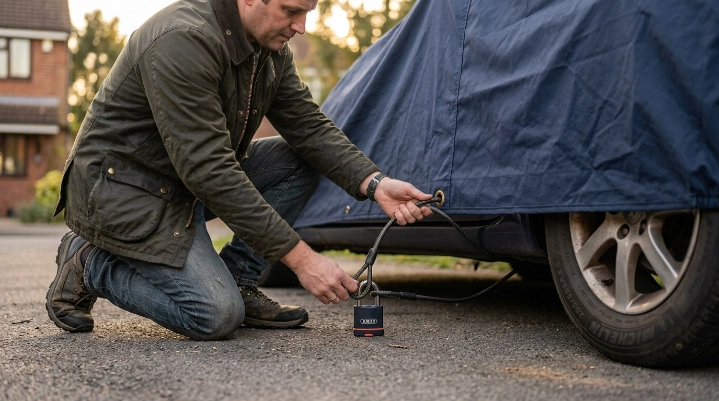
A typical car-cover cable passes through lower grommets and underneath the vehicle before being locked. The important part is keeping metal hardware away from the paint and moving components.
Here is the approach I use for a basic grommet-style system:
- Fit the cover completely. Center it over the vehicle and confirm the mirror pockets, hems, and corners sit correctly.
- Find the reinforced grommets. Never cut random holes in thin fabric unless the manufacturer provides a proper grommet kit.
- Feed the coated cable through one side. Follow the locking kit’s instructions for its loop or connector design.
- Pass the cable beneath the vehicle. Push it from one side rather than crawling beneath the car.
- Connect the opposite grommet. Remove unnecessary slack without pulling the cover excessively tight.
- Lock the cable. Position the lock where it cannot swing against the rocker panel, wheel, or painted surface.
- Test the installation. Gently lift both lower edges and make sure the hardware stays clear of the vehicle.
WeatherTech and other current cover-lock manufacturers use coated cables specifically to reduce contact damage. The coating should still be inspected because exposed steel can become a scratch risk.
Mechanic Alert: Never jack up the vehicle or crawl underneath it just to route a car-cover cable. If the cable cannot be passed safely from the side, use another fastening method or ask a qualified professional for help.
Avoid wrapping the cable around brake lines, exhaust parts, suspension components, steering parts, or wiring. The cable only needs to connect the cover’s intended securing points.
Which Car Cover Security Method Works Best?
A cable lock usually provides the strongest simple theft deterrent for a compatible cover. Straps and elastic hems are more useful for fit and wind control.
| Security Method | Primary Benefit | Theft Deterrence | Main Limitation |
|---|---|---|---|
| Coated cable + padlock | Physically connects opposite cover edges | Good for opportunistic theft | Fabric or cable can still be cut |
| Underbody buckle strap | Controls wind and movement | Low to moderate | Many buckles release quickly |
| Elastic hem | Keeps cover fitted around bumpers | Low | Usually removable without tools |
| Lighting + camera coverage | Raises visibility around parked vehicle | Useful supporting deterrent | Does not physically secure the cover |
| Locked garage | Limits public access to vehicle and cover | Strongest option here | Not available to every driver |
If your cover already has reinforced locking grommets, a purpose-made kit is usually cleaner than improvising with rope or bare cable. WeatherTech’s car cover locking system is one verified example of the basic coated-cable design.
Another current example is the Coverking lock and cable kit, which passes through security grommets on compatible outdoor covers.
Does a Car Cover Protect the Vehicle From Theft?
A car cover can hide identifying details and make casual observation harder, but it should not be treated as a vehicle anti-theft system. A thief can remove or cut fabric.
Your actual vehicle security should remain independent of the cover.
NHTSA describes several broad anti-theft categories:
- Visible deterrents: Steering-wheel locks and other obvious security devices can discourage an attempt.
- Audible devices: Alarms draw attention when unauthorized entry is detected.
- Immobilizing devices: These make it harder to start or operate the vehicle without authorization.
- Recovery systems: Electronic tracking technology can help locate a stolen vehicle.
As of 2026, NHTSA reports more than 650,000 U.S. vehicle thefts during 2025. That is a reminder not to confuse protecting a cover with protecting the entire car.
I would rather see an inexpensive cover over a well-secured vehicle than an expensive locked cover over a car with keys left inside. The priorities matter.
Before walking away, use a simple parking checklist:
- Take the keys with you.
- Close every window.
- Lock every door.
- Remove visible valuables.
- Activate the factory security system.
- Use your additional anti-theft device if equipped.
- Secure the cover last.
Frequently Asked Questions
Can someone steal a locked car cover?
Yes. A cable lock makes theft less convenient, but fabric can be cut and some locks can be defeated. The goal is deterrence, not absolute protection. Combine the lock with good lighting, surveillance, and secure parking whenever possible.
Should I report a stolen car cover to the police?
You can report suspected theft according to your local police department’s procedures, especially when you have video evidence or other property was damaged. For a low-value cover, the department may use a non-emergency reporting process rather than sending an officer.
Does car insurance cover a stolen car cover?
Coverage depends on your insurer, policy language, how the cover is classified, and your deductible. Do not assume it is covered. Save your receipt and contact your insurer if the cover’s value makes a claim worth investigating.
Can I use a bicycle cable lock on a car cover?
Only if it fits the cover’s reinforced attachment points and can be installed without contacting the paint or vehicle components. A purpose-made coated car-cover cable is usually easier because it is designed to pass underneath the vehicle.
Can I add locking holes to a car cover?
Some covers can accept reinforced replacement grommets, but cutting an unsupported hole can cause tearing. Check the cover manufacturer’s instructions first and use a proper reinforcement kit when one is approved.
Will a car-cover lock stop the cover from blowing away?
It can help because the cable connects the lower sides beneath the vehicle. However, correct fit and wind straps still matter. A loose cover can continue flapping even when the entire cover cannot leave the vehicle.
Should I stop using a car cover after one gets stolen?
Not necessarily. If you still need protection from sun, dust, bird droppings, or weather, replace it with a properly fitted cover that supports physical securing. The better solution is usually improving how and where the cover is secured.
Final takeaway: A stolen car cover is annoying, but the next one does not need to be an easy target. Verify what happened, document the loss, then combine a fitted cover, reinforced grommets, coated locking cable, good lighting, and sensible vehicle security.
Most importantly, protect the car before protecting the fabric covering it. A locked cover is useful, but your keys, doors, immobilizer, parking location, and overall anti-theft habits matter much more.
