
Car Cover Tearing: Why It Happens and How to Stop It

Quick Answer
Car cover tearing usually comes from wind-driven flapping, incorrect sizing, stressed seams, sharp contact points, weakened fabric, or tie-downs pulling too hard on one area. A snug fit and correct securing matter most, especially in windy conditions, as explained in Covercraft’s windy-condition guidance.
What to check first
- Cover fit: Loose material can balloon and flap, while an undersized cover can overload seams.
- Tear location: Damage near a strap, seam, mirror pocket, or grommet often points to concentrated tension.
- Sharp contact: Check antennas, brackets, spoilers, corners, and aftermarket accessories beneath the cover.
- Fabric condition: Brittle, faded, thinning material may have reached the end of its useful life.
- Wind movement: Repeated flapping can enlarge a tiny puncture into a long rip.
Best next move
- Patch small, isolated damage only when the surrounding fabric remains strong and the cover manufacturer allows that repair method.
A torn car cover can go from a pinhole to a useless sheet faster than many owners expect. I usually start by looking at where the tear formed because the damage pattern often tells you what caused it.
This guide covers the common causes of car cover tearing, repair options, replacement signs, wind problems, and practical prevention methods for everyday drivers.
In This Guide
Why Does a Car Cover Keep Tearing?
A car cover normally tears because force keeps concentrating on one part of the material. Wind is a major cause, but fit, age, installation, and vehicle accessories can contribute too.
Definition: Car cover tearing is a split, puncture, seam failure, or fabric rupture that forms when the cover’s material can no longer withstand tension, abrasion, weathering, or contact with an object beneath it.
A loose cover can flap repeatedly
Extra material gives wind room to get underneath the cover. Once the fabric starts billowing, each gust pulls and releases the same seams and attachment points.
The movement also matters to your paint. Dirt trapped between a moving cover and the vehicle can create unwanted abrasion.
An undersized cover can be just as troublesome
A cover that’s too small stays under constant tension. Mirror pockets, elastic hems, seams, and corners may be stretched harder than their design allows.
As of 2026, Car and Driver’s car-cover testing and buying guidance also emphasizes proper sizing. Its guidance notes that excessively tight and excessively loose covers can both create problems.
Sharp or raised parts create pressure points
Antenna masts, license-plate brackets, spoilers, roof accessories, mirror corners, and aftermarket parts can press against the material. Wind or installation movement then rubs the fabric over that same point.
A tiny puncture can become a longer rip after repeated loading. This is why I inspect underneath a tear before reaching for repair tape.
Old material loses strength
Outdoor covers face sunlight, moisture, temperature swings, dirt, and repeated folding. Over time, some fabrics become thin, stiff, faded, or brittle.
- Fading: Heavy color change may accompany long-term weather exposure.
- Thinning: Worn areas may feel noticeably weaker than surrounding material.
- Brittleness: Fabric that cracks or splits with gentle flexing is a poor repair candidate.
- Seam deterioration: Thread and stitched areas can weaken before the main panel fails.
Incorrect tie-down tension can damage the cover
Straps should control movement without turning a grommet or seam into a single high-load anchor. Pulling one strap extremely tight can simply move the wind load to the weakest point.
The same problem happens when improvised cords pull sideways against fabric that wasn’t designed for that loading direction.
Section Takeaway: Most recurring tears are symptoms of another problem. Find the source of tension, rubbing, or wind movement before repairing the fabric.
How Does Wind Tear a Car Cover?
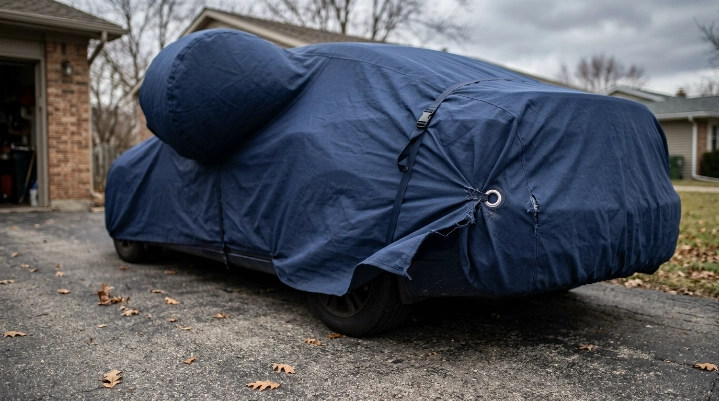
Wind damages covers by getting underneath loose areas and creating lift. The cover then balloons, snaps, and pulls repeatedly against seams, straps, elastic hems, and protruding vehicle parts.
Think of a loose cover more like a sail than a fitted protective layer. More movement means more repeated stress.
Look for these wind-related damage patterns
| Damage pattern | Likely cause | What to check |
|---|---|---|
| Rip beside a grommet | Concentrated tie-down load | Strap tension and grommet reinforcement |
| Long tear near a seam | Flapping or excessive stretch | Overall size and seam condition |
| Small repeating puncture | Hard or sharp object underneath | Antenna, bracket, accessory, or body edge |
| Frayed lower edge | Ground contact or uncontrolled movement | Hem position and cover length |
| Several unrelated splits | Aged or weakened material | Fabric strength across the entire cover |
More straps aren’t always the answer
Adding securement can help a properly fitted cover, but excessive tension can create new failure points. Use the attachment system and securing method recommended for that specific cover.
Don’t tie cords around exhaust components, steering parts, brake components, suspension pieces, or other unsuitable areas beneath the vehicle.
Severe wind changes the calculation
There’s a point where leaving a cover installed becomes less sensible than removing it. Covercraft specifically recommends temporary removal during severe or sustained high winds because those conditions can overload even a properly secured cover.
When a major wind event is expected, follow the cover manufacturer’s weather guidance. Indoor or covered parking is preferable when it’s available.
Section Takeaway: Wind damage is mainly a movement problem. Reduce billowing and uneven loading instead of simply pulling every strap tighter.
Can You Repair a Torn Car Cover?
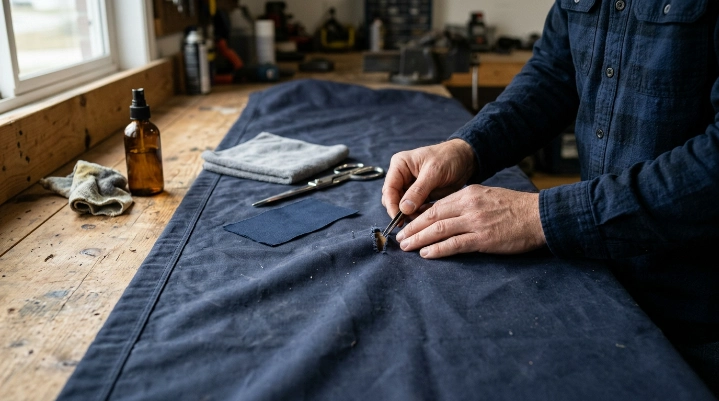
Yes, some small car cover tears can be repaired. A repair makes the most sense when the damage is isolated and the surrounding fabric remains flexible and strong.
A large seam failure, ripped attachment point, or brittle cover usually needs more than a simple patch.
How to patch a small car cover tear
- Remove the cover. Never perform an adhesive repair while the cover is sitting against the vehicle’s paint.
- Read the care label. Identify the material and check whether the manufacturer recommends a particular patch or repair product.
- Clean the damaged area. Remove dust and contamination using a method that’s safe for the cover material.
- Let it dry completely. Many repair adhesives won’t bond correctly to damp or contaminated material.
- Lay the fabric flat. Bring the torn edges into their natural position without stretching the panel.
- Apply the approved patch. Follow the repair product’s overlap, pressure, curing, and temperature instructions.
- Inspect the opposite side. Some repair systems allow reinforcement on both sides, while others don’t.
- Fix the original cause. Correct the fit, wind movement, sharp contact point, or strap problem before reinstalling the cover.
Should you sew a car cover?
Sewing can work on certain fabrics, but it isn’t automatically the best repair. Needle holes can change the water resistance of coated materials, and an ordinary thread may fail quickly outdoors.
Check the manufacturer’s instructions before sewing. A seam or upholstery repair specialist may be a better option for an expensive custom-fit cover.
Don’t let repair materials touch the paint
Exposed adhesive, stiff patch corners, clips, and rough repair surfaces can rub against the vehicle. Inspect the inside of the finished repair before putting the cover back on.
I also run my hand across the repaired area from the side that faces the car. If anything feels hard, sharp, or sticky, I don’t place it against painted bodywork.
Should You Repair or Replace a Torn Car Cover?
Repair is usually reasonable for one small tear in otherwise healthy material. Replacement is the safer choice when deterioration affects several areas or an important structural attachment has failed.
| Condition | Repair or replace? | Reason |
|---|---|---|
| One small clean tear in a panel | Often repairable | Low-stress damage may accept a compatible patch |
| Tiny puncture over an antenna or bracket | Repair after correcting contact | The puncture will return if the pressure point remains |
| Torn grommet or strap attachment | Professional repair or replacement | This area carries significant securing load |
| Long seam separation | Usually needs stronger repair | A simple surface patch may not restore seam strength |
| Multiple tears in different areas | Replace | Widespread damage suggests general material deterioration |
| Brittle or cracking fabric | Replace | A patch cannot restore strength to the rest of the cover |
Think beyond the visible tear
A patch can look successful while the surrounding fabric is already failing. Gently inspect nearby material instead of judging the cover from the damaged spot alone.
If new holes appear shortly after each repair, replacement usually makes more sense. Continuing to patch weak material can become an endless cycle.
Check whether the cover still protects the vehicle correctly
A cover’s job isn’t simply to remain in one piece. It should fit correctly, stay reasonably stable, protect the finish, and suit the environment where you park.
For broader exterior-care considerations, the Kelley Blue Book exterior-care resource covers vehicle-finish maintenance topics that are useful alongside proper cover use.
How Do You Prevent Car Cover Tearing?
Preventing tears starts with proper sizing and controlled movement. Once the cover fits correctly, protect it from sharp contact, dirt, poor storage, and unnecessary wind exposure.
Choose the correct size and type
Match the cover to the vehicle’s dimensions and intended parking environment. A light indoor dust cover isn’t the right tool for regular exposure to outdoor wind and weather.
- Custom-fit covers: Follow the vehicle’s body shape closely and usually leave less loose material.
- Semi-custom covers: Can work well when the sizing range closely matches the vehicle.
- Universal covers: Require extra attention to dimensions because excess fabric can increase movement.
- Outdoor covers: Choose a product specifically intended for the conditions where the vehicle is stored.
Install the cover in the correct orientation
Center the cover before pulling it tightly over the ends. If it has mirror pockets or a marked front and rear, align those features before securing anything.
Don’t force a slightly wrong position into place using the straps. Reposition the cover first.
Use tie-downs without creating stress points
Fasten the manufacturer’s straps or securing system so they limit lifting and flapping. The goal is stable coverage, not maximum possible tension.
- Keep tension balanced from side to side.
- Check that straps aren’t twisted.
- Inspect grommets for early fraying.
- Don’t run securing cords across sharp edges.
- Recheck the setup after strong weather.
Protect known pressure points
Remove a detachable antenna if the vehicle and cover instructions allow it. Otherwise, use the cover manufacturer’s recommended solution for antenna openings or other protrusions.
Pay special attention after adding roof equipment, spoilers, racks, brackets, or other accessories. A cover that once fit correctly may no longer match the vehicle’s shape.
Keep the vehicle and cover clean
Dirt on either surface increases abrasion when the cover moves. Follow the manufacturer’s cleaning directions because washing methods vary by cover material.
Store the removed cover somewhere clean and dry rather than dropping it on pavement. Small grit particles picked up during storage can end up between the cover and paint.
Inspect before the tear becomes large
Early damage is easier to manage. A quick inspection can reveal fraying seams, stretched attachment holes, weakened elastic, punctures, and worn contact points.
- Check after unusually windy weather.
- Inspect before long-term vehicle storage.
- Look at seams and tie-down locations closely.
- Check the inside for rough patches or trapped debris.
- Replace questionable securing hardware before it damages the fabric.
Remove the cover when weather exceeds its limits
No cover should be treated as indestructible. Follow the manufacturer’s instructions for storms, sustained high winds, snow loading, and other severe conditions.
If safer covered storage is available during extreme weather, use it. Avoiding uncontrolled flapping can protect both the cover and the vehicle underneath.
Section Takeaway: The best way to stop car cover ripping is to combine correct fit, balanced securement, clean surfaces, pressure-point inspection, and sensible severe-weather decisions.
Frequently Asked Questions
Why is my new car cover already tearing?
A new cover may tear because it’s the wrong size, installed incorrectly, rubbing against a sharp feature, or moving heavily in wind. Inspect the exact tear location first because damage around mirrors, straps, grommets, antennas, or seams often reveals the cause.
Can wind rip a car cover?
Yes. Wind can get beneath loose material and make the cover billow or flap repeatedly. That movement increases stress on seams, attachment points, elastic hems, and areas touching protruding parts of the vehicle.
Can I use duct tape to repair a car cover?
A manufacturer-approved fabric repair product is generally a better choice than improvised tape. Some adhesives may not bond correctly to cover materials, may leave residue, or may create a stiff surface that could contact the vehicle.
Why does my car cover tear near the grommets?
Grommet tears often indicate concentrated pulling force. Check whether a tie-down is excessively tight, pulling at an angle, or repeatedly being loaded by a cover that balloons in the wind.
Is a tight car cover better in windy weather?
A correctly fitted cover is better than either an oversized or excessively tight cover. It should limit loose fabric without stretching seams and panels beyond their intended shape.
Should I leave a car cover on during a windstorm?
Follow the manufacturer’s weather guidance for your specific cover. Some manufacturers advise removing covers during severe or sustained high winds because extreme movement can damage the fabric, securing points, or potentially the vehicle’s finish.
How do I know when a car cover is worn out?
Replacement becomes sensible when the fabric is brittle, thinning, cracking, developing several tears, or repeatedly failing after repairs. A damaged strap system, badly stretched hem, or widespread seam deterioration can also indicate that the cover has reached the end of its useful service.
Final Takeaway
Car cover tearing isn’t something you should keep patching without finding the cause. Start with fit, wind movement, attachment tension, fabric age, and anything underneath the cover that could create a pressure point.
A small isolated tear may be repairable with a compatible product. When the fabric itself is failing, replacing the cover is usually the more dependable way to protect your vehicle.
After installing or repairing any cover, check it again after the next windy day. Catching the first signs of movement or fraying can prevent another rip from developing.