
Car Cover Too Tight? Signs, Risks, and How to Fix the Fit

Quick Answer
A car cover should feel snug, but it should not require excessive force to pull over the mirrors or bumpers. If the seams are stretched hard, mirror pockets will not line up, or one bumper cannot stay covered, stop forcing it and check the size, orientation, and vehicle options against the manufacturer’s car cover fit guidance.
Signs Your Car Cover Is Too Tight
- Mirror pockets pull: The pockets need strong sideways tension before they reach the mirrors.
- Bumper stays exposed: The hem will not sit around both bumpers at the same time.
- Seams look strained: Stitching is stretched instead of resting naturally along the body.
- Accessories create peaks: Spoilers, antennas, racks, or mirrors push hard against the fabric.
- Removal feels risky: You have to drag or yank the cover across painted panels.
First Thing to Try
- Remove the cover, confirm the front and rear orientation, center it again, seat any mirror pockets, and then test both bumper hems without forcing them.
A snug car cover is normally a good thing. The problem starts when “snug” turns into enough tension that you’re fighting the fabric every time you install it.
I’ve seen covers look one size too small simply because they were installed backward or caught on a mirror. I’ve also seen genuinely undersized covers that could never fit correctly, no matter how much someone stretched them.
As of 2026, the basic diagnosis is still straightforward. Check alignment, vehicle features, cover size, and installation technique before assuming the material itself is defective.
In This Guide
How Tight Should a Car Cover Actually Be?
A properly fitted car cover should follow the vehicle’s shape without hanging loose or putting obvious strain on mirrors, seams, spoilers, and bumper corners. You should feel some elastic tension at the hem, but installation should remain controlled.
A too-tight car cover is a cover that cannot sit in its intended position without excessive stretching, distorted seams, or concentrated pressure on vehicle parts.
Snug does not mean stretched to the limit
Elastic front and rear hems are supposed to grip the vehicle. That tension helps stop the cover from sliding or lifting during normal use.
The fabric itself should still lie naturally over the roof, hood, trunk, and side panels. Mirror pockets should reach the mirrors without pulling the rest of the cover sideways.
- Normal fit: The cover follows the body and both bumper hems stay seated.
- Too tight: Covering one end causes the opposite end to pull off.
- Too loose: Large sections sag, balloon, or move easily in the wind.
- Misaligned: The cover seems tight on one side but loose on another.
Fit matters for paint protection too. Covercraft’s guidance on car covers and paint protection emphasizes keeping the vehicle and cover clean while preventing unnecessary movement.
That is why I don’t judge fit by appearance alone. I check whether the cover can reach every designed attachment point without forcing the fabric across paint.
How Can You Tell If Your Car Cover Is Too Tight?
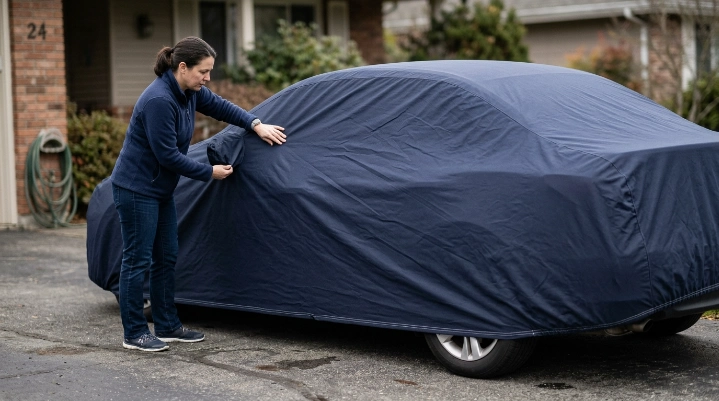
The clearest sign is concentrated tension. If one part of the vehicle is carrying most of the load, something is wrong with the fit or installation.
Walk around the car after installation. Look at the mirrors, roof seams, bumper corners, antenna area, rocker panels, and any aftermarket equipment.
| What You See | What It Usually Suggests | What to Check First |
|---|---|---|
| Mirror pocket will not reach | Cover is misaligned or incorrect for the vehicle | Front/rear orientation and model fitment |
| Rear hem comes off when front is fitted | Insufficient overall length | Cover size and vehicle length |
| Fabric tents over spoiler or rack | Cover was not designed for that accessory | Accessory compatibility |
| Seams pull diagonally across roof | Cover is off-center or wrong shape | Centering and mirror alignment |
| Installation requires hard yanking | Possible undersizing or obstruction | Size, accessories, and trapped fabric |
Pay special attention to the mirrors. They are often the first place an undersized or incorrectly positioned cover shows excessive tension.
The bumper test is just as useful. Both ends should remain covered after installation without one end constantly pulling the other loose.
Can a Too-Tight Car Cover Damage Your Car?
Yes, an excessively tight cover can create problems, although the exact risk depends on where the tension is concentrated. The biggest concern is usually pressure on protruding parts and abrasion during forced installation or removal.
Mirrors and accessories take concentrated pressure
A side mirror sticks out farther than most body panels. If the cover’s pocket cannot reach naturally, repeated pulling can put unnecessary load on the mirror area.
The same principle applies to spoilers, roof racks, antennas, hood ornaments, and aftermarket body parts. A fitted cover needs enough room for every feature underneath it.
- Mirror housings: Watch for fabric pulling the mirror inward or downward.
- Spoilers: Avoid sharp tension across spoiler edges or mounting points.
- Antennas: Retract or remove them when the cover design requires it.
- Trim pieces: Do not let a tight seam hook under loose exterior trim.
- Paint: Avoid dragging a highly tensioned cover across dusty surfaces.
The cover can damage itself too
Overstretched seams remain loaded whenever the vehicle is covered. Corners around mirrors, bumpers, and accessories can become high-stress areas.
I would inspect those areas before every reinstall if the cover has already been forced several times. Look for opened stitching, stretched elastic, small tears, or thinning fabric.
General vehicle upkeep still matters while a car is stored. Kelley Blue Book’s car maintenance resource center is a useful reference for keeping routine ownership checks from being forgotten during storage.
Why Is My Car Cover Suddenly Too Tight?
If a cover used to fit and now feels too tight, don’t immediately assume it shrank. Start with the simple causes because positioning problems are easier to create than most owners realize.
The cover may be backward or off-center
Many fitted covers have a defined front and rear. Turning one around can move mirror pockets, seams, and bumper contours far enough to make the cover feel undersized.
Even the correct orientation can feel wrong when the roof section is shifted several inches to one side. Recenter the cover before applying more tension.
Your vehicle may have equipment the pattern did not include
A spoiler, roof rack, wide mirror, brush guard, body kit, or other accessory changes the space a cover must enclose. That can turn a previously acceptable generic size into a poor fit.
Some manufacturers offer special patterns for modified vehicles. Covercraft, for example, specifically addresses covers for roof racks, spoilers, mirrors, and aftermarket equipment.
Washing or drying may have changed the material
If the problem appeared immediately after cleaning, check the care label before doing anything else. Car cover fabrics use different washing and drying instructions.
Don’t automatically use hot water or a high-heat dryer. Follow the manufacturer’s instructions for your exact fabric rather than treating every cover like ordinary laundry.
The elastic may be creating the impression of a smaller cover
Elastic hems can bunch fabric together when the cover is off the vehicle. Spread the cover fully and find its center before deciding the overall dimensions have changed.
How Do You Fix a Car Cover That Is Too Tight?
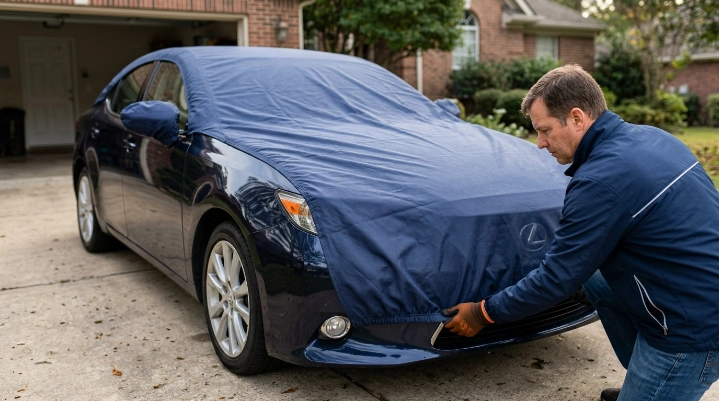
Start by removing all unnecessary tension and reinstalling the cover from scratch. Don’t try to solve a questionable fit by pulling harder.
- Remove the cover completely. Release both ends rather than dragging a tight cover over the body.
- Find the front. Look for the manufacturer’s front label, logo, or identifying mark.
- Center the roof section. Keep similar amounts of fabric on both sides.
- Deal with the antenna. Retract or remove it when the cover instructions require that step.
- Seat the mirror pockets. They should align before you force either bumper hem into place.
- Fit the front and rear hems. Use steady hand tension instead of jerking the fabric.
- Walk around the vehicle. Check for diagonal seams, exposed bumper corners, stretched pockets, or sharp pressure points.
If the cover now fits normally, the original problem was probably positioning. Marking the inside front edge can make the next installation much quicker.
If it still will not reach both ends, verify the product’s listed vehicle application or dimensions. Don’t rely only on labels such as compact, midsize, large, SUV, or sedan.
Do not try to permanently stretch an undersized cover
Some fabrics have useful flexibility, but stretching cannot correct the wrong basic dimensions or pattern. A cover that does not accommodate the vehicle should be exchanged for the correct fit.
I also avoid homemade cuts around mirrors or spoilers unless the manufacturer specifically provides a procedure. Cutting the wrong area can weaken the fabric and may affect water resistance or warranty coverage.
Should You Stretch, Size Up, or Replace the Cover?
Keep the cover if the problem disappears after proper alignment and it rests naturally once installed. Replace or exchange it when correct installation still leaves major parts under constant tension.
| Situation | Best Choice |
|---|---|
| Fits after recentering | Keep it and improve installation technique |
| Between two universal sizes | Check the manufacturer’s sizing chart and choose the size that fully accommodates the vehicle |
| Mirror pockets never align | Verify vehicle application or replace the cover |
| Aftermarket accessories create hard pressure points | Use a compatible or custom-pattern cover |
| Seams or fabric are already damaged | Stop forcing it and contact the manufacturer |
Custom-fit vs. universal covers
A universal cover has to accommodate several vehicle shapes. That makes exact alignment around mirrors, bumpers, spoilers, and rooflines less predictable.
A vehicle-specific pattern usually gives you a clearer answer about intended fit because the cover was designed around a particular application. Accurate year, make, model, trim, and accessory information still matters.
Outdoor use adds another consideration: wind. A tight cover is not automatically windproof, and a loose cover should not be “fixed” by over-tightening one strap or one section.
Covercraft’s windy-condition car cover guidance recommends proper securing and regular fit checks rather than allowing the cover to shift excessively.
For a vehicle sitting for weeks or months, keep normal service needs in mind too. Edmunds maintains a broad car maintenance guide covering routine upkeep for cars, trucks, and SUVs.
Frequently Asked Questions
Is a tight car cover supposed to be difficult to put on?
A fitted cover can require light stretching around elastic bumper hems, but it should not require aggressive pulling. If you need to yank the fabric or force it over mirrors, verify its orientation, positioning, and size before continuing.
Can a tight car cover break a side mirror?
Excessive tension around a mirror can put unnecessary pressure on the housing or mounting area. Stop if the mirror is visibly being pulled or if the pocket cannot reach it naturally.
Should I buy a larger car cover if mine is too tight?
First confirm that the existing cover is installed correctly and matches your vehicle. If it still cannot cover both bumpers or accommodate mirrors and accessories, follow the manufacturer’s sizing chart and exchange it for the proper application.
Can I stretch a car cover overnight to make it fit?
I would not use permanent stretching as a solution for an undersized cover. Stretching may stress seams and elastic without correcting the underlying length, width, mirror-pocket, or accessory mismatch.
Why does my car cover fit one side but not the other?
The cover is often off-center, twisted, backward, or caught on a mirror or accessory. Remove tension, reposition the roof section, align the mirror pockets, and check both bumper hems again.
Can washing make a car cover too small?
Fit changes after washing can happen if the material was cleaned or dried outside its specified care instructions. Check the manufacturer’s label for the correct machine type, detergent, water temperature, and drying method for your exact fabric.
Is a loose cover better than a cover that is slightly tight?
Neither extreme is ideal. The goal is a secure, properly aligned fit that minimizes movement without placing excessive stress on mirrors, accessories, seams, or bumper corners.
The bottom line: a car cover should hug the vehicle, not fight it. If correct alignment still requires heavy force, treat that as a fitment problem instead of stretching the cover harder.
Check the product application, confirm your vehicle’s accessories, and exchange the cover when necessary. The right cover should protect your car while remaining straightforward to install and remove.
“`