
75 Percent Window Tint Explained

75% window tint allows 75% of visible light to pass through your car’s glass, making it one of the lightest and most legal tint options available. For BMW owners, it offers a subtle, factory-like appearance while providing modest UV protection and glare reduction without significantly darkening the cabin. It’s crucial to verify your state’s specific VLT laws, as even this light tint can be illegal on certain windows in some regions.
Key Takeaways
- 75% VLT is very light: It offers minimal darkening, often looking nearly factory stock, and is primarily used for UV protection and slight glare reduction.
- Legal in most places for front sides: Many states allow 75% tint on front side windows, but you must always check your specific state’s regulations first.
- Not for privacy: Do not choose 75% tint if your primary goal is to prevent people from seeing inside your vehicle.
- BMW-friendly aesthetic: It complements the clean, sophisticated lines of a BMW without altering the intended design or cabin brightness.
- Installation quality is key: Even a simple tint like 75% can look terrible if installed poorly with bubbles or debris, so professional installation is highly recommended.
- Focus on UV blocking: Prioritize high-quality films that block 99%+ of UV rays, as this is the most valuable protective feature at this VLT level.
📑 Table of Contents
- What Exactly Does “75 Percent Window Tint” Mean?
- The BMW Owner’s Perspective: Why Choose 75% Tint?
- Legal Landscape: Is 75% Tint Legal in Your State?
- The Installation Process: What to Expect with 75% Tint
- Maintenance and Care for Your 75% Tint
- How 75% Tint Compares to Other Popular Percentages
- Cost Considerations for Tinting Your BMW
What Exactly Does “75 Percent Window Tint” Mean?
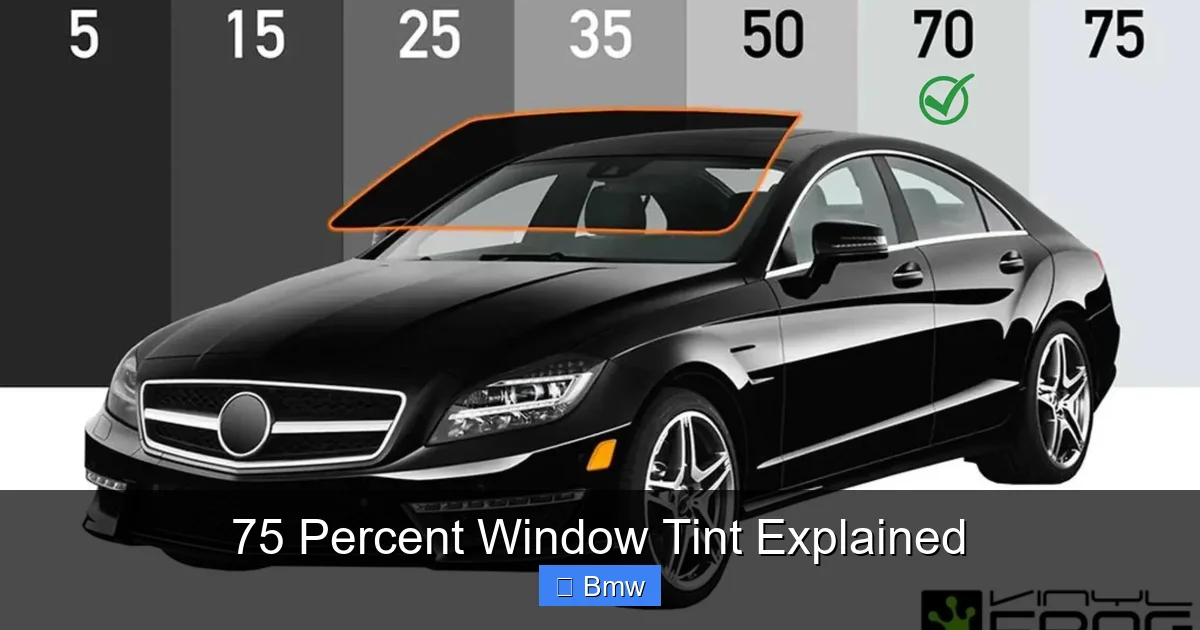
Let’s clear up the biggest point of confusion right away. When you see “75% window tint,” that number refers to the Visible Light Transmission, or VLT. Simply put, VLT is the percentage of visible light that the tint film allows to pass through your car’s window glass. A 75% VLT tint means 75% of the outside light makes it through, while 25% is blocked or reflected. This makes it an extremely light tint. In fact, it’s so light that from the outside, your windows will look almost completely clear, like they just have a very high-quality factory tint or a good glass treatment. The inside will feel slightly different—a touch less harsh on sunny days—but the cabin will remain very bright and open. It is the polar opposite of the dark “limo tint” you might see on SUVs.
For a BMW owner, this is a critical distinction. BMWs are designed with a specific aesthetic in mind: clean, open, and driver-focused. A heavy, dark tint can sometimes clash with that European design language, making a sporty sedan look like it’s trying too hard or hiding something. A 75% tint respects the original design while adding a layer of practical, invisible protection. It’s the “stealth mod” of the tinting world—most people won’t even notice it’s there, but you’ll feel the subtle benefits every time you drive.
The Science of Light: How 75% Tint Works
Window tint film is a multi-layered polyester product. At a 75% VLT, the film itself is very clear and thin. Its magic isn’t in making things dark; it’s in its ability to filter specific wavelengths of light. High-quality 75% films are engineered to:
- Block Ultraviolet (UV) Rays: This is the most important function. Quality films block over 99% of UV-A and UV-B radiation. This protects your skin from sun damage and, more importantly for a BMW, prevents the sun from bleaching and cracking your dashboard, door panels, and leather seats. The sun’s UV rays are the number one cause of interior fade and deterioration.
- Reduce Infrared (IR) Heat: While less effective at blocking heat than a dark tint, a premium 75% film will still reject a significant portion of infrared radiation—the part of sunlight we feel as heat. This means your cabin won’t heat up as quickly, reducing the workload on your A/C system and improving comfort and efficiency.
- Cut Glare: By filtering some of the intense visible light, it reduces the blinding glare from the sun or headlights at night. This reduces eye strain and can improve driving safety without the dramatic visual change of a darker film.
The BMW Owner’s Perspective: Why Choose 75% Tint?
So, why would someone with a pristine BMW choose the lightest tint on the market? The answer lies in a combination of practicality, legality, and preserving the driving experience.
Visual guide about 75 Percent Window Tint Explained
Image source: vinylfrog.com
Preserving the Factory Aesthetic and Visibility
BMW interiors are celebrated for their driver-centric cockpits and excellent outward visibility. A dark tint, especially on the front windows, can create a tunnel vision effect and make the cabin feel claustrophobic, particularly in smaller models like a 2 Series Gran Coupe or a 3 Series sedan. A 75% tint maintains that open, airy feel. It allows for perfect nighttime visibility—there’s no need to roll down windows to see clearly at dusk or in parking garages. You get the protective benefits without compromising the core BMW philosophy of clear sightlines and a connected-to-the-road driving position.
A Stealth Upgrade for Resale and Warranty
For many BMW enthusiasts, maintaining a “stock” appearance is paramount for future resale. A non-invasive, nearly invisible modification is far easier to explain to a potential buyer than a dark, aftermarket tint. Furthermore, some new car warranties (especially lease agreements) have strict clauses against certain modifications. While tinting is often allowed, a 75% tint is far less likely to raise any red flags during a lease-end inspection than a 20% limo tint. It’s a low-risk, high-reward modification.
Superior UV Protection Without the Drawbacks
Think of your BMW’s interior as a piece of art. The Nappa leather, the wood trim, the aluminum accents—they’re all susceptible to sun damage. A 75% ceramic or metallic film acts like an invisible sunscreen for your entire interior. It protects your investment from fading, drying, and cracking. Unlike darker tints, it won’t interfere with your BMW’s advanced driver-assistance systems (ADAS) like cameras or sensors, which are often located behind the windshield and near the rearview mirror. While most modern films are engineered to be GPS and radar-signal friendly, the lighter the film, the less potential for any signal interference, giving you peace of mind.
Legal Landscape: Is 75% Tint Legal in Your State?
This is the non-negotiable section. Window tint laws in the United States are a complex patchwork of state and even local regulations. They specify different VLT percentages for different windows: front windshield, front side windows, rear side windows, and rear windshield. The key term is often “non-reflective” or “metallic” for the front windshield strip, and a specific VLT for the front sides.
Visual guide about 75 Percent Window Tint Explained
Image source: cdn.shopify.com
The good news: 75% tint is one of the most widely legal options for front side windows in the country. Many states set their front side window minimum VLT at 70% or even 65%, meaning 75% is perfectly compliant. However, you must never assume.
How to Check Your Local Laws
1. Identify Your State: Start with your state’s DMV or highway patrol website. They will have the official, current statutes.
2. Note the Specifics: Look for the exact VLT percentage allowed for “front side windows” (driver and passenger). Also check rules for the rear windows—some states allow any darkness on the rear if the front sides are above a certain percentage.
3. Understand the “Any” Rule: A few states (like California) require front and rear side windows to allow over 70% light, but also have a rule that the tint must be “non-reflective.” This means no mirror-like or metallic films on the front.
4. Medical Exemptions: Some states offer exemptions for medical conditions (like lupus or xeroderma pigmentosum) that require extreme sun protection. These are official permits, not something you get from a tint shop.
Critical Reminder: Even if 75% is legal on your front sides, your state may have different rules for the windshield (often only a 5-6 inch strip at the top allowed) and rear windows. Always verify for all windows. For a comprehensive, updated overview, you can reference resources like our Window Tint Laws By State Updated 2026 guide, which breaks down the rules for every state.
Common Legal Pitfalls for BMW Owners
BMW models with large panoramic sunroofs or full rear glass (like the 4 Series Gran Coupe or X5) can be tricky. Some states count the rear glass as a single “rear window” with one VLT requirement, while others treat it as two side windows and a rear window. A tint shop should know this, but it’s your responsibility as the vehicle owner to ensure compliance. Getting pulled over for an illegal tint can result in a “fix-it” ticket, a fine, and a mandatory removal of the tint—a costly and frustrating outcome for a simple mod.
The Installation Process: What to Expect with 75% Tint
Because 75% tint is so light, the installation process is actually more forgiving than with dark tints. There’s less risk of visible streaks or “orange peel” texture because the film itself is nearly clear. However, the quality of the install still makes a massive difference between a professional job and a DIY disaster.
Visual guide about 75 Percent Window Tint Explained
Image source: cdn.shopify.com
Professional vs. DIY: The Clear Choice
While a DIY kit for 75% might seem tempting due to its simplicity, the value of a professional install cannot be overstated. A pro will:
- Perform a meticulous glass prep: They will remove all dirt, grease, and old adhesive from the glass. Any speck of dust trapped under the film will be permanently visible, even in a clear tint.
- Use proper tools: Specialized squeegees, heat guns, and spray solutions are used to apply the film smoothly without bubbles or wrinkles.
- Handle complex curves: BMWs have steeply raked windshields and sometimes complex door window frames. Pros know how to heat and stretch the film to fit these contours perfectly, something extremely difficult for a novice.
- Provide a warranty: Reputable shops offer warranties against bubbling, peeling, and discoloration (often 5-10 years for ceramic films).
If you do attempt a DIY job on a BMW, be prepared for a steep learning curve. The door windows are the easiest place to start. Practice on a scrap piece first. The windshield is a two-person, advanced-level job due to its size and the need to work around the rearview mirror and sensor housing.
Choosing the Right Film Type for 75%
At this VLT, the type of film matters more for its functional properties than its darkness. You have three main choices:
- Dyed Film: The most economical. It uses dye to absorb heat and provide the tint. At 75%, it will look very clear. The downside is the dye can fade over time (purpling or browning), and its heat rejection is mediocre. Not recommended for a premium BMW where longevity is key.
- Metalized Film: Uses tiny metallic particles to reflect heat and UV. Offers better heat rejection than dyed film and is very durable. However, it can interfere with radio, GPS, and keyless entry signals. It also has a slightly reflective/shiny look, which may not suit the subtle aesthetic you want for a BMW.
- Ceramic Film: The top-tier choice. Uses non-conductive ceramic nanoparticles to block UV and IR heat with virtually zero signal interference. It’s the most optically clear, most durable, and offers the best heat rejection of any film type. For a BMW, ceramic is the clear winner if your budget allows, as it protects the interior best and maintains all electronic functions perfectly.
Maintenance and Care for Your 75% Tint
The beauty of a light tint is that it requires almost no special care beyond what you’d do for a clean window. However, there are important rules to follow, especially in the first week after installation.
The Curing Period: Patience is a Virtue
After installation, the film’s adhesive needs time to fully bond to the glass. This is called the “curing” or “drying” period. It typically lasts 3-7 days, depending on climate (longer in cold, humid weather). During this time:
- Do not roll down windows: This is the most important rule. Rolling the window will catch the film’s edge and likely cause it to peel or tear.
- Avoid aggressive cleaning: Don’t spray cleaners directly onto the film. Use a soft microfiber cloth and a mild, ammonia-free glass cleaner (or a 50/50 water/vinegar solution). Spray the cleaner onto the cloth, not the window.
- Don’t touch or rub the edges: The edges are the most vulnerable while the adhesive sets.
Once fully cured (you’ll know because you can roll the windows without issue and no moisture remains between the film and glass), care is simple. Clean regularly to prevent dirt and mineral buildup from etching the film over time. Always use soft cloths and non-abrasive cleaners.
How 75% Tint Compares to Other Popular Percentages
Understanding where 75% sits on the spectrum helps you make the right choice. Let’s compare it to two other common options.
75% vs. 70% Tint
The difference between 75% and 70% is minimal—only 5% more light transmission. Visually, you would be hard-pressed to tell them apart in most lighting conditions. Both are very light, factory-looking tints. The choice between them is almost always a legal one. If your state’s minimum for front sides is 70%, then 75% gives you a tiny bit more light (and arguably even less potential for a ticket) while still providing nearly identical UV/IR protection from a high-quality film. For a BMW owner in a 70% state, 75% is a safe, compliant choice. You can see a real-life comparison of what a 70 percent window tint looks like with real-life examples.
75% vs. 35% or 20% Tint
Here’s where the worlds diverge. A 35% tint is a medium-dark shade, offering a significant cosmetic change and good privacy. A 20% tint is very dark, providing substantial privacy and heat rejection but with the downsides of poor nighttime visibility and a high likelihood of being illegal on front windows. Choosing 75% over these darker options is a deliberate statement: you prioritize legality, visibility, and a stock appearance over privacy and maximum heat rejection. For a daily-driven BMW that you enjoy on canyon roads at night, 75% is the smarter, more practical choice. The dramatic difference in appearance between a light 75% and a dark 35% is stark; you can explore visual examples of a 35 percent window tint meaning with real-life examples or a 20 percent window tint meaning with real-life examples to see the contrast.
Cost Considerations for Tinting Your BMW
How much should you expect to pay for a professional 75% ceramic tint on your BMW? The cost is less about the VLT percentage and more about the film brand/quality, the number of windows, and your geographic location.
- Film Quality: A basic dyed film might cost $100-$200 for a full car. A premium ceramic film from brands like 3M, Llumar, or SunTek will range from $250 to $500+ for a full car. For a BMW, investing in ceramic is highly advisable for its superior performance and longevity.
- Vehicle Type: A BMW 2 Series has fewer, smaller windows than an X7 SUV, so labor and material costs differ. Complex curves and large glass panels (like a panoramic roof) increase the price.
- Shop Reputation: A well-established, reputable shop with a strong warranty will charge more than a mobile tinter working out of their truck. For a luxury car, the premium shop is usually worth the cost.
For a specific estimate on your BMW model, you’ll need to get local quotes. However, a national average for a good quality ceramic film on a standard sedan like a 3 Series or 5 Series typically falls between $300 and $600. Always get a detailed, written quote that specifies the film brand, type (ceramic), VLT percentage (75%), and which windows are included. Be wary of quotes that seem too good to be true—they often use low-grade film or cut corners on preparation. To understand the broader market, our article on how much does auto window tint cost provides a helpful breakdown of pricing factors.
Frequently Asked Questions
Is 75% window tint worth it for a BMW?
Yes, if your goals are UV protection, slight heat reduction, and glare cutting without altering the car’s stock appearance or compromising visibility. It’s an excellent “invisible” mod that protects your interior investment.
Will 75% tint keep my BMW cooler?
It will help, but not dramatically. A high-quality ceramic 75% film will reject a good portion of infrared heat, so your cabin will warm up slower and your A/C won’t have to work as hard. For maximum cooling, you’d need a darker tint, but you sacrifice visibility and risk legal issues.
Can I tint just my windshield with 75% film?
Almost never. Most states only allow a non-reflective tint strip at the top of the windshield (usually 5-6 inches). Tinting the entire windshield, even with 75%, is illegal in virtually all jurisdictions and severely impairs night vision.
Does 75% tint provide any privacy?
Virtually none. At 75% VLT, your windows will look clear from the outside during the day and night. People will be able to see directly into your car. If privacy is a goal, you need a much darker tint (like 20% or 35%), understanding the legal and visibility trade-offs.
How long will a 75% tint last on my BMW?
A professionally installed, high-quality ceramic film can last 10-15 years or the lifetime of the car, with no fading, bubbling, or discoloration. Cheaper dyed films may start to show purple or brown within 3-5 years. The lifespan depends almost entirely on film quality and installation skill.
Will 75% tint affect my BMW’s parking sensors or cameras?
No. 75% is a very light, clear film. It will not interfere with any electromagnetic signals. This is a non-issue at this VLT. Darker metallic films can sometimes cause minor interference, but ceramic films are specifically designed to be signal-friendly.