
33 Percent Window Tint: Is It Legal in Your State?

Wondering if that sleek 33 percent window tint is legal where you live? The short answer is: it depends entirely on your state’s specific Visible Light Transmission (VLT) laws, which vary wildly. While 33% tint is a popular choice for its balance of privacy and visibility, it’s often illegal for front driver and passenger windows in many states, though frequently permitted on rear windows. For BMW owners, this is especially crucial as factory tint options and aftermarket installations must both comply. Always verify your state’s exact percentage limits before tinting to avoid costly tickets and mandatory removal.
So, you’re eyeing that perfect shade for your BMW. You want the look—that sophisticated, sleek privacy that makes your car stand out while keeping the cabin cooler and protecting your skin from harmful UV rays. You’ve heard about 33 percent window tint. It sounds like a great middle ground: darker than the typical factory glass, but not so dark that you feel like you’re driving at night during the day. But before you hand over your keys to the tint shop, there’s one monumental question you must answer: Is 33 percent window tint legal in your state?
The world of window tint law is a confusing patchwork of regulations that change from one state line to the next. What’s perfectly acceptable in Texas can get you pulled over in California. For a BMW owner, this is more than just a legal curiosity; it’s about protecting your investment, ensuring your car passes inspections, and avoiding that dreaded “fix-it” ticket. This guide will cut through the noise. We’ll break down exactly what 33% VLT means, walk through the legal landscape state by state, and give you the practical steps to enjoy your tinted windows with total confidence. Let’s get into it.
Key Takeaways
- 33% VLT means 33% of visible light passes through the glass; it’s a measure of darkness, not reflectivity.
- Legality is determined by state law, not personal preference, and rules differ for front side, rear side, and rear windows.
- Many states prohibit 33% tint on front windows, often requiring a minimum of 70% (or even 88%) VLT for driver/passenger windows.
- Rear window rules are typically more lenient, making 33% a common and legal choice for back sides and rear glass in numerous states.
- BMW factory “Privacy Glass” is usually around 20% VLT, so adding aftermarket 33% tint over it can create an illegal, darker combined effect.
- Medical exemptions for darker tint exist in some states, but require official documentation and are not automatically granted.
- Penalties for non-compliance include fix-it tickets, fines, and in some cases, a failed vehicle inspection that prevents registration renewal.
📑 Table of Contents
- Understanding Window Tint Percentages: What Does “33%” Actually Mean?
- Why 33% Tint is a Popular Choice for BMW Owners
- The Great American Patchwork: State-by-State Legality of 33% Tint
- How to Accurately Find and Verify Your State’s Window Tint Laws
- The Real-World Consequences of Ignoring Tint Laws
- Professional Installation vs. DIY: Ensuring Compliance for Your BMW
- Conclusion: Style and Compliance Can Coexist in Your BMW
Understanding Window Tint Percentages: What Does “33%” Actually Mean?
Before we dive into state laws, we need to be crystal clear on the terminology. The number you see—33%, 35%, 20%—refers to the window’s Visible Light Transmission (VLT). This is the percentage of visible light that the tint film allows to pass through the glass.
The VLT Scale: Lower is Darker
Think of it in reverse: a lower percentage means a darker tint. A 5% “limo tint” lets in only 5% of light, making it very dark. A 70% tint is much lighter, allowing 70% of light through. Therefore, 33% window tint is a medium-dark film. It blocks 67% of visible light, offering significant glare reduction and privacy while still allowing for decent visibility at night and in poor weather. This makes it a popular choice for people who want noticeable benefits without the extreme darkness of 20% or lower.
It’s also critical to understand that VLT is measured on the glass and film combined. If your BMW already has factory-tinted glass (often called “Privacy Glass” or “Solar Glass”), adding aftermarket film on top creates a cumulative VLT. For example, if your factory glass is 20% VLT and you add a 33% film, the combined VLT will be darker than 33%—likely around 15% or less. This almost always violates state laws that limit tint to a specific VLT on new installations. Always check your factory glass’s VLT (usually found in your owner’s manual or a sticker in the door jamb) before adding any aftermarket product.
Why 33% Tint is a Popular Choice for BMW Owners
So why is this specific shade such a common target? It comes down to a perfect blend of aesthetics and function that resonates with BMW drivers.
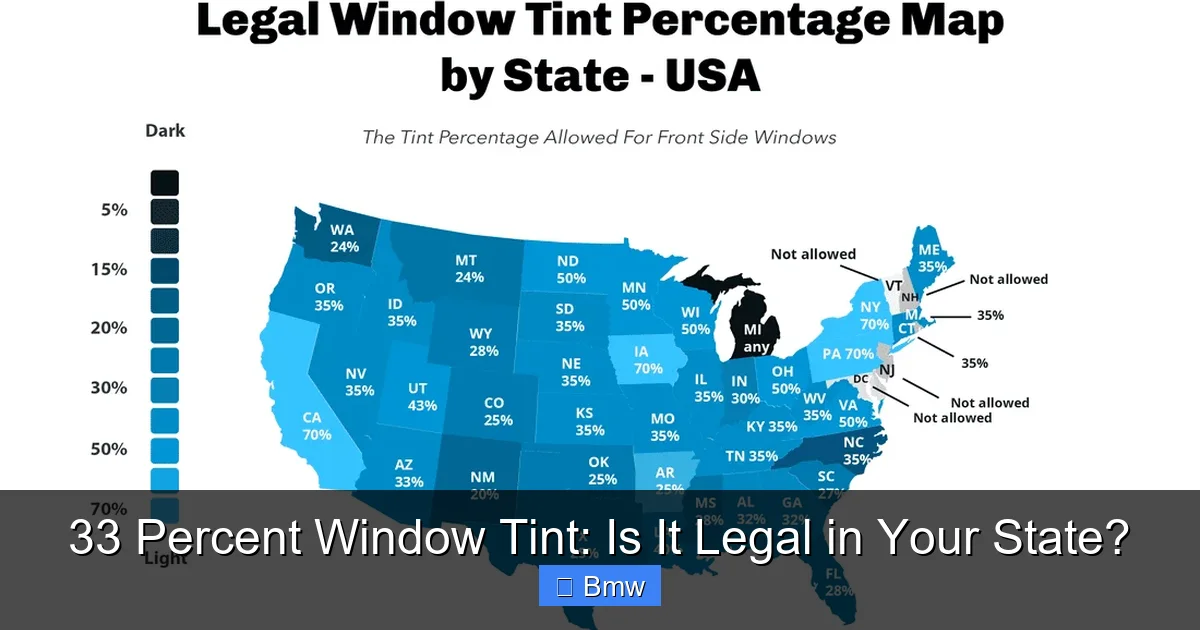
Visual guide about 33 Percent Window Tint: Is It Legal in Your State?
Image source: windowtintinginlv.com
The Aesthetic and Practical Balance
A 33% tint gives your BMW a sharp, coordinated, and premium look. It deepens the color of the paint, makes the window outlines less prominent, and gives the car a more cohesive, “expensive” appearance from the outside. From the inside, it provides a substantial reduction in sun glare—a huge plus for long drives or commuting—and significantly cuts interior heat buildup, protecting your dashboard and seats from sun damage. It also offers a genuine sense of privacy for passengers and belongings.
For BMW models with large glass areas like the BMW X5 or X3, this level of tint can make a dramatic difference in cabin comfort without making the driver feel isolated from the road environment. It’s dark enough to be effective but light enough to maintain good outward visibility, which is a safety consideration many drivers prioritize.
BMW Factory Tint vs. Aftermarket 33%
Many new BMWs come with a degree of factory tint, typically around 20% VLT on the rear windows. If you want a uniform look all around, applying 33% film to the front windows of a car with 20% rear glass creates a slight but noticeable gradient. However, as mentioned, you must calculate the combined VLT on the rear if you film over the factory glass. Some BMW owners choose to apply a lighter film (like 50% or 70%) to the front to match the factory rear tint’s light transmission and stay within legal limits. This is where knowing your state’s front window VLT minimum becomes non-negotiable.
The Great American Patchwork: State-by-State Legality of 33% Tint
Here’s where we get to the heart of the matter. There is no federal standard for window tint. Each state sets its own rules, usually specifying a minimum VLT percentage for the front side windows (driver and passenger), rear side windows, and the rear windshield. Some states also have rules about reflectivity (how much light the tint reflects outward) and require certification stickers on the windows.
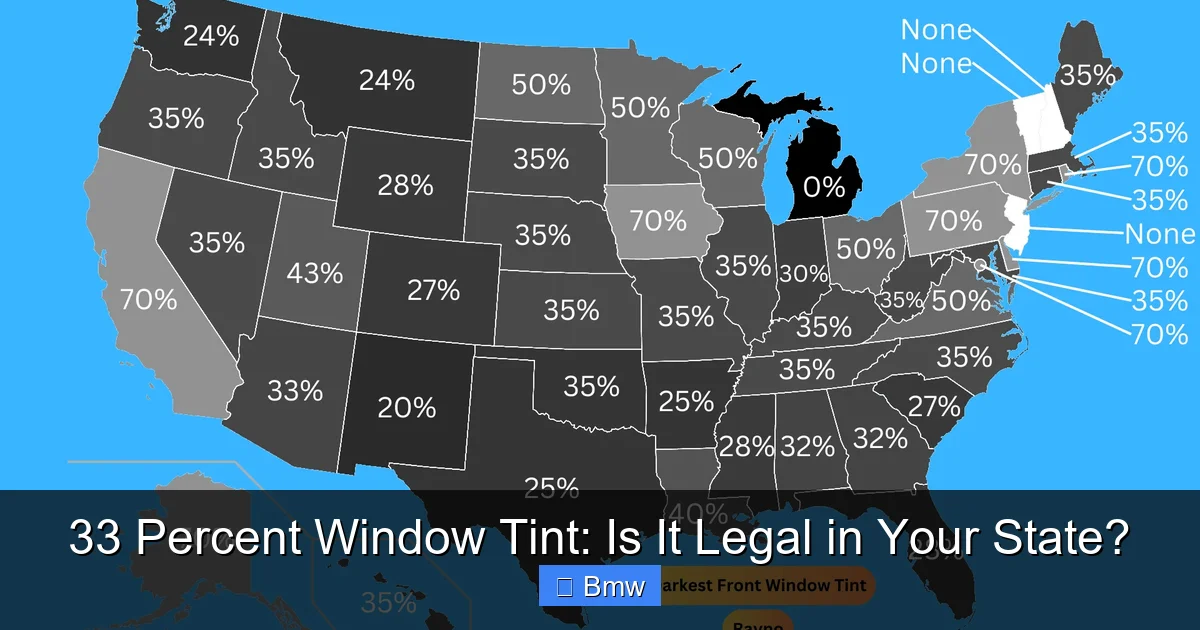
Visual guide about 33 Percent Window Tint: Is It Legal in Your State?
Image source: brilliantmaps.com
For 33% tint, the legality hinges almost entirely on the front side window rules. Let’s break down the general categories:
States Where 33% Tint is ILLEGAL on Front Windows
This is the most common scenario. Many states, particularly on the West Coast, Northeast, and parts of the Midwest, have strict front window VLT requirements. They mandate that front side windows must allow a very high percentage of light through.
- California, Delaware, Hawaii, Illinois, Michigan, New York, Rhode Island, Vermont, Virginia, Washington D.C.: These states typically require front side windows to have a VLT of 70% or higher. This means 33% tint is definitely illegal on the front driver and passenger windows of your BMW.
- Alaska, New Mexico, Texas: These states often set the front minimum at 50% VLT. Again, 33% is too dark and would not pass legal muster.
In these states, you could legally install 33% tint on the rear sides and rear window (unless otherwise specified), but the front windows must remain at or above the state minimum, which is almost always lighter than 33%.
States Where 33% Tint is LEGAL on Front Windows
A smaller group of states is more permissive, allowing darker tint on the front side windows. This is where 33% becomes a viable option for all windows.
- Arizona, Arkansas, Colorado, Florida, Georgia, Indiana, Iowa, Kansas, Kentucky, Louisiana, Maine, Maryland, Missouri, Montana, Nebraska, Nevada, New Hampshire, North Carolina, North Dakota, Ohio, Oklahoma, Oregon, Pennsylvania, South Carolina, South Dakota, Tennessee, Utah, West Virginia, Wisconsin, Wyoming: Many of these states set the front side window minimum at 35% or 32% VLT. This means a 33% film is just barely legal on the front sides in these jurisdictions. However, you must be precise—a film rated at 33% might actually measure at 32% or 34% depending on the batch and application. For absolute compliance in these states, you might consider a 35% film, which is clearly within the limit.
Important Note: Some states like Florida and New Hampshire have no specific VLT limit for rear windows, only for front sides. In these cases, 33% is legal everywhere as long as the front meets the minimum (which for FL is 28% on front sides, making 33% legal; for NH, it’s 70% on front sides, making 33% illegal on front). Always double-check the exact number.
The “Any Darkness” and Medical Exemption States
A few states are exceptionally lenient or have specific provisions:
- Alabama, Connecticut, Idaho, Mississippi, Minnesota: These states allow any darkness of tint on the rear windows but maintain a minimum for the front sides (often 32% or 70%). So for Alabama (front min 32%), 33% is legal on front. For Minnesota (front min 50%), 33% is illegal on front.
- Medical Exemptions: States like California, Florida, Texas, and many others allow darker tint for individuals with a medical condition requiring protection from sunlight (like lupus, porphyria, or severe photosensitivity). This requires a signed statement from a licensed physician and, in some cases, a special permit from the DMV. The tint allowed under exemption can be much darker (e.g., 5% or 15%). This is not a loophole for style; it’s a legitimate accommodation with strict documentation requirements.
This variation is why a one-size-fits-all answer is impossible. Your BMW’s legal tint is determined by the state where it is registered and driven. The safest approach is to consult the most current, official source for your specific state.
How to Accurately Find and Verify Your State’s Window Tint Laws
Relying on forum posts or tint shop advice can be risky. Laws change, and interpretations can be wrong. Here is your step-by-step guide to getting the correct information.
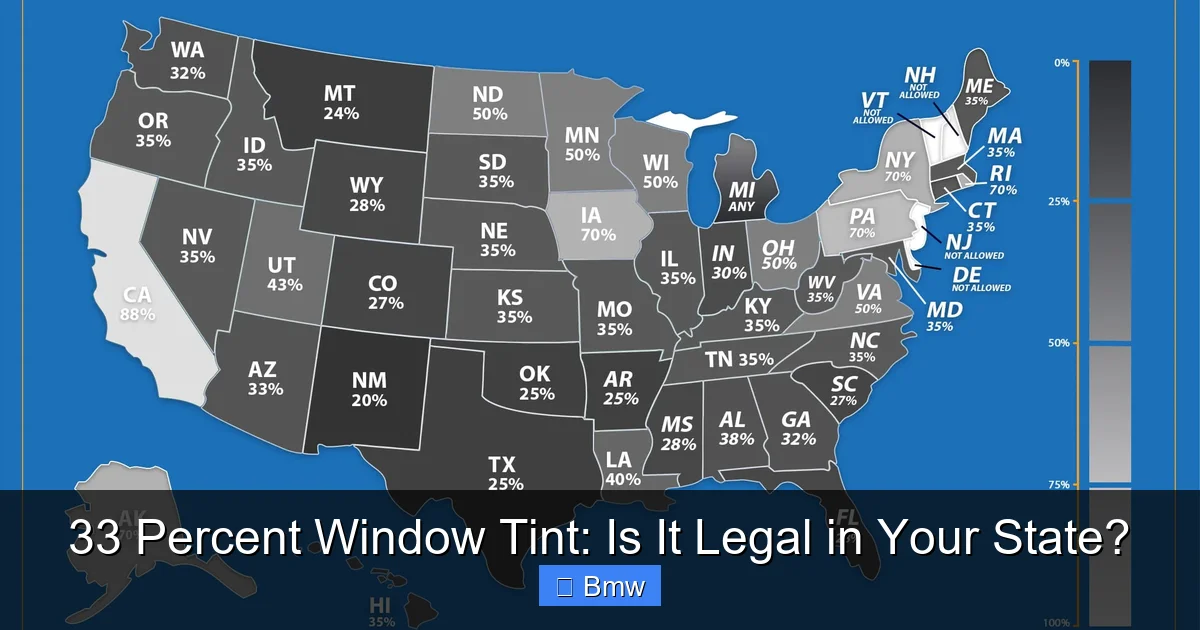
Visual guide about 33 Percent Window Tint: Is It Legal in Your State?
Image source: windowtintlaws.us
1. Start with Your Official State DMV or Highway Patrol Website
This is the gold standard. Search for “[Your State] Department of Motor Vehicles window tint” or “[Your State] vehicle code window tint.” Look for a PDF or webpage titled “Vehicle Equipment Regulations” or “Tint Law.” These documents will list the exact VLT percentages for each window location, any reflectivity limits, and other stipulations (like requiring side mirrors if rear window is tinted).
2. Understand the Specific Language
Pay close attention to how the law is written. Some states specify:
- “Must allow more than X% of light to pass through” – This means your VLT must be higher (lighter) than that number. For a “more than 70%” law, 71% is okay, 69% is not.
- “Light transmission must be not less than X%” – This means your VLT must be at least that number. For a “not less than 70%” law, 70% is okay, 69% is not.
The wording is nearly identical in meaning but can cause confusion. When in doubt, assume you need a VLT higher (lighter) than the number stated.
3. Use Reputable Third-Party Summaries as a Cross-Check
Websites like the Window Tint Laws By State Updated 2026 are excellent resources. They compile the information from official sources into an easy-to-read format, often with a map. Use this to get a quick overview, then always verify with your state’s official code. Laws are updated periodically (often yearly), so ensure the information is current for 2024/2025.
4. For BMWs: Check for Manufacturer-Specific Guidelines
BMW’s own warranty and guidelines may address aftermarket modifications. While they won’t override state law, they might have recommendations about not interfering with vehicle sensors (like rain or parking sensors) or causing damage to the defroster lines in the rear window. A professional installer familiar with BMWs will know how to avoid these pitfalls.
The Real-World Consequences of Ignoring Tint Laws
“Everyone does it” or “I’ve never been pulled over” are not valid legal defenses. Getting caught with illegal tint has tangible, often frustrating, consequences.
Fix-It Tickets and Fines
This is the most common outcome. An officer will issue a “fix-it” ticket (often called a “corrective” or “equipment” violation). You’ll be given a deadline (usually 30 days) to remove the illegal tint and get a signed certificate of compliance from a law enforcement officer or a licensed inspection station. You must then submit proof to the court. Failure to do so results in increased fines and potentially a hold on your registration. The initial fine itself can range from $50 to over $300 depending on the state and county.
Failed Vehicle Inspections
In states with mandatory annual or biennial safety/emissions inspections (like California, New York, Texas), illegal window tint will cause your vehicle to fail the inspection immediately. You cannot renew your registration until the tint is removed and the vehicle passes. This creates a costly and time-consuming loop: you pay for the inspection, fail, pay to have tint removed, and pay for another inspection.
Safety and Insurance Concerns
Beyond the law, excessively dark tint can create genuine safety hazards. It impairs your vision at night, in fog, or heavy rain. It can also make it difficult for other drivers to see your turn signals or hand gestures. While not typically a direct cause for an insurance denial, if an accident occurs and it’s determined that illegally dark tint significantly impaired your vision and contributed to the collision, it could be used as evidence of negligence.
For a premium brand like BMW, which emphasizes driving dynamics and safety, compromising visibility with non-compliant tint directly contradicts the vehicle’s engineering philosophy. It’s simply not worth the risk.
Professional Installation vs. DIY: Ensuring Compliance for Your BMW
Assuming you’ve confirmed 33% tint is legal for your state and window location, the next step is installation. This is not an area to cut corners.
The Critical Role of a Reputable, Legal-Aware Installer
A professional installer does more than just apply film. They:
- Know the Local Law: A good shop in your state will know the exact VLT limits and will recommend a film that is certified to meet or exceed those standards. They should be able to show you the film’s VLT certification from the manufacturer.
- Use Quality, Non-Dyed Film: Cheap dyed films not only fade and turn purple over time but can also have inconsistent VLT ratings. High-quality ceramic or metallized films from brands like 3M, Llumar, or SunTek offer stable, precise VLT and superior heat rejection.
- Understand BMW Specifics: They know how to work around the BMW antenna lines in the rear glass (common in models like the 3 Series and X5) to avoid interference. They also know to avoid the ADB (Advanced Driver Assistance Systems) camera and sensor areas in the windshield and rear glass, which are critical for features like lane departure warnings and adaptive cruise control. Tinting over these can render them useless.
The Importance of a VLT Meter Reading
Before you pay, ask the shop to measure the installed film with a professional VLT meter right there on your car. This handheld device gives an instant, accurate reading of the combined glass-and-film VLT. A reputable shop will do this gladly to prove compliance. If they refuse or make excuses, walk away. This simple step gives you documented proof that your tint is legal, which can be invaluable if you are ever questioned.
Why DIY is a Gamble
While DIY tint kits are cheaper, the risks are high. Applying film to a large, complex-curved window like a BMW’s front windshield or rear hatch is extremely difficult. Mistakes mean bubbles, wrinkles, and peeling. More importantly, you have no guarantee the film you buy meets the advertised VLT. A “33%” roll might actually be 28% or 36%. Without a meter, you’re flying blind. One botched job means you’ll likely need to pay a professional to remove it all and start over, negating any initial savings.
Conclusion: Style and Compliance Can Coexist in Your BMW
The question “Is 33 percent window tint legal in your state?” has a definitive, but geographically unique, answer. The journey to that answer requires you to become acquainted with your state’s specific VLT regulations. For the vast majority of states, 33% tint is illegal on the front side windows but may be perfectly legal on the rear sides and rear window. For a smaller number of states with a 32% or 35% front minimum, 33% sits in a legal gray area that demands precision.
As a BMW owner, you appreciate engineering, precision, and doing things correctly. Apply that same mindset to window tint. Research your state’s law using official sources. Have a frank conversation with a certified, experienced installer who understands BMWs and can provide a VLT meter reading. Invest in high-quality film that won’t degrade. By taking these steps, you can enjoy the undeniable aesthetic and comfort benefits of a 33% tint without the shadow of a fix-it ticket looming over your drive. Your sleek, private, and cool BMW cabin awaits—just make sure it’s all above board.
Frequently Asked Questions
Is 33% window tint legal on the front windows in California?
No. California law requires front side windows to allow at least 88% of light to pass through (effectively a very light tint). 33% tint is far too dark and is illegal for front driver and passenger windows in California. It may be used on rear windows.
How is window tint percentage measured and enforced?
Police and inspectors use a handheld device called a VLT meter. It’s placed on the inside of the window and gives an instant reading of the percentage of visible light transmitted through the glass and film combined. This is the only legally accepted method of measurement.
My BMW has factory Privacy Glass. Can I still add 33% tint?
You can, but you must calculate the combined VLT. Factory “Privacy Glass” is typically around 20% VLT. Adding 33% film over it will result in a combined VLT of approximately 15%, which is much darker than 33% and likely illegal in most states for front windows. You would need to check your state’s law for the combined value.
What’s the difference between VLT and VLR?
VLT (Visible Light Transmission) measures how much light passes through the window. A lower number is darker. VLR (Visible Light Reflectance) measures how much light is reflected off the window surface. Some states have limits on reflectance (e.g., no more than 20% reflection) to prevent mirrored or highly reflective films. Both metrics are important for full compliance.
Are there any states where 33% tint is legal on all windows?
Yes, but with a key caveat. States like Florida (front min 28%) and Georgia (front min 32%) allow 33% tint on front sides because it is darker than their minimum requirement. However, states like New York (front min 70%) and Virginia (front min 50%) do not, as 33% is darker than their allowed minimum. You must always check the specific front window rule for your state.
What happens if I get pulled over with illegal 33% tint in a strict state?
You will likely receive a “fix-it” ticket. You’ll be ordered to remove the tint within a set period (e.g., 30 days) and provide proof of correction to the court. You will also have to pay a fine. If your state has vehicle inspections, your car will fail until the tint is removed, preventing you from renewing your registration.