3 Percent Window Tint: Visibility

Contents
- 1 Key Takeaways
- 2 📑 Table of Contents
- 3 Introduction: The Allure and Risk of the Darkest Tint for Your BMW
- 4 What Does “3% VLT” Actually Mean? Demystifying the Numbers
- 5 The Nightmare Scenario: 3% Tint and Low-Light Visibility
- 6 Daytime Benefits: Why People Still Choose 3%
- 7 The Legal Labyrinth: Is 3% Tint Even Allowed on Your BMW?
- 8 BMW-Specific Considerations: Tech, Glass, and Design
- 9 Installation and Material: The Non-Negotiable Quality Factor
- 10 Conclusion: The Ultimate Trade-Off for Your BMW
- 11 Frequently Asked Questions


3% window tint is extremely dark, offering maximum privacy but significantly reducing visibility, especially at night. For BMW owners, this darkness can impact the function of advanced driver-assistance systems and may violate state tint laws. While it provides excellent heat and glare rejection, the trade-off in safety and legality is substantial. Professional installation and a clear understanding of local regulations are absolutely critical before choosing this shade.
Key Takeaways
- Extreme Darkness: 3% tint allows only 3% of visible light through, making it one of the darkest legal (and illegal) shades available, creating a “limo” effect.
- Night Visibility is Severely Impacted: Driving after dark or in low-light conditions like rain, fog, or tunnels becomes significantly more challenging and potentially unsafe with 3% tint.
- BMW Tech Interference Risk: This darkness can obstruct cameras, rain sensors, and lane-keeping assist systems located behind the windshield and front windows, causing malfunctions.
- Legal Status is Primarily Illegal: Most states prohibit front windshield and front side window tint this dark. It’s typically only legal for rear windows in specific states, and even then, often with restrictions.
- Heat & Glare Rejection is Exceptional: The primary benefit is outstanding rejection of solar heat and blinding glare, greatly improving cabin comfort in sunny climates.
- Professional Installation is Non-Negotiable: To avoid bubbles, peeling, and uneven application on complex BMW curves, high-quality film and expert installers are essential.
- Resale Impact is Mixed: While appealing to some buyers seeking privacy, it can deter others concerned about legality, safety, and the potential need for costly removal.
[FEATURED_IMAGE_PLACEHOLDER]
📑 Table of Contents
- Introduction: The Allure and Risk of the Darkest Tint for Your BMW
- What Does “3% VLT” Actually Mean? Demystifying the Numbers
- The Nightmare Scenario: 3% Tint and Low-Light Visibility
- Daytime Benefits: Why People Still Choose 3%
- The Legal Labyrinth: Is 3% Tint Even Allowed on Your BMW?
- BMW-Specific Considerations: Tech, Glass, and Design
- Installation and Material: The Non-Negotiable Quality Factor
- Conclusion: The Ultimate Trade-Off for Your BMW
Introduction: The Allure and Risk of the Darkest Tint for Your BMW
You slide into the driver’s seat of your BMW. The familiar cockpit greets you, but today feels different. The world outside is muted, softened into a sleek, mysterious shade. The glare from the setting sun is gone, replaced by a cool, private cabin. This is the promise of a 3% window tint—the ultimate in automotive privacy and solar control. It’s the shade often called “limo tint,” and for BMW owners who prize aesthetics and a sense of exclusivity, it’s a powerful draw.
But this darkness comes at a profound cost, a cost measured not in dollars, but in visibility. The question “3 percent window tint: visibility?” isn’t just a casual inquiry; it’s the central dilemma for anyone considering this extreme modification. For a brand like BMW, which is synonymous with the “Ultimate Driving Machine,” compromising the driver’s ability to see the road seems almost paradoxical. This article will pull back the curtain on the stark reality of 3% tint. We will dissect exactly what this level of darkness means for your sightlines, your safety, your car’s technology, and your legal standing. We’ll focus specifically on the BMW experience, from a 3 Series sedan to an X5 SUV, because the shape of your glass matters. By the end, you’ll know if the allure of near-total privacy outweighs the very real risks to your visibility and driving enjoyment.
What Does “3% VLT” Actually Mean? Demystifying the Numbers
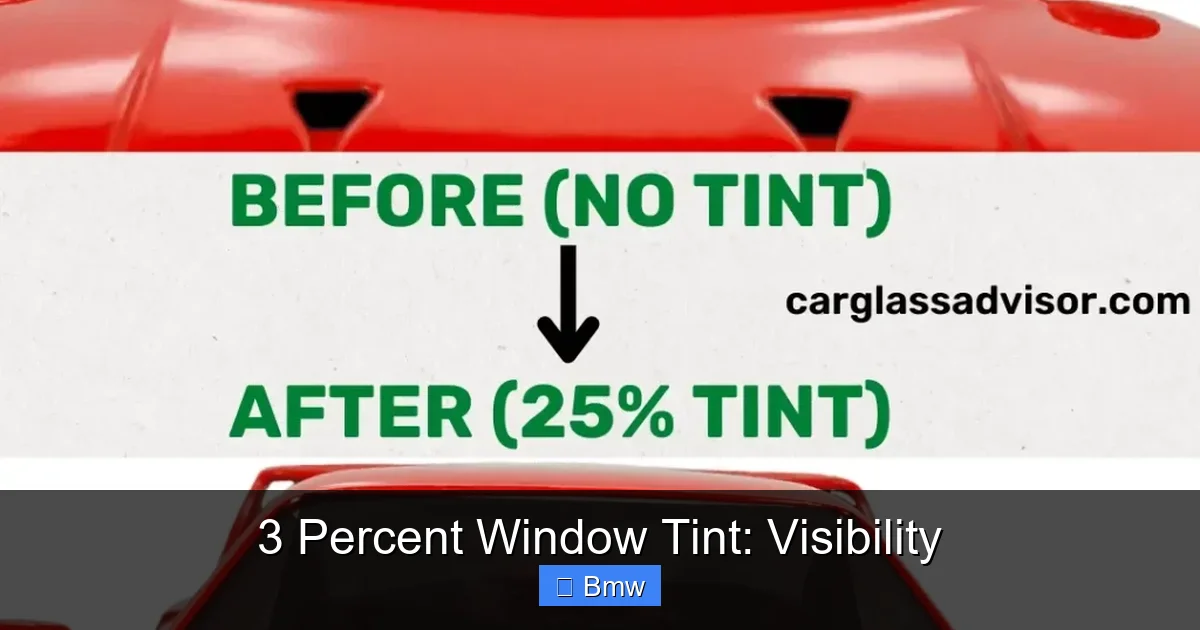
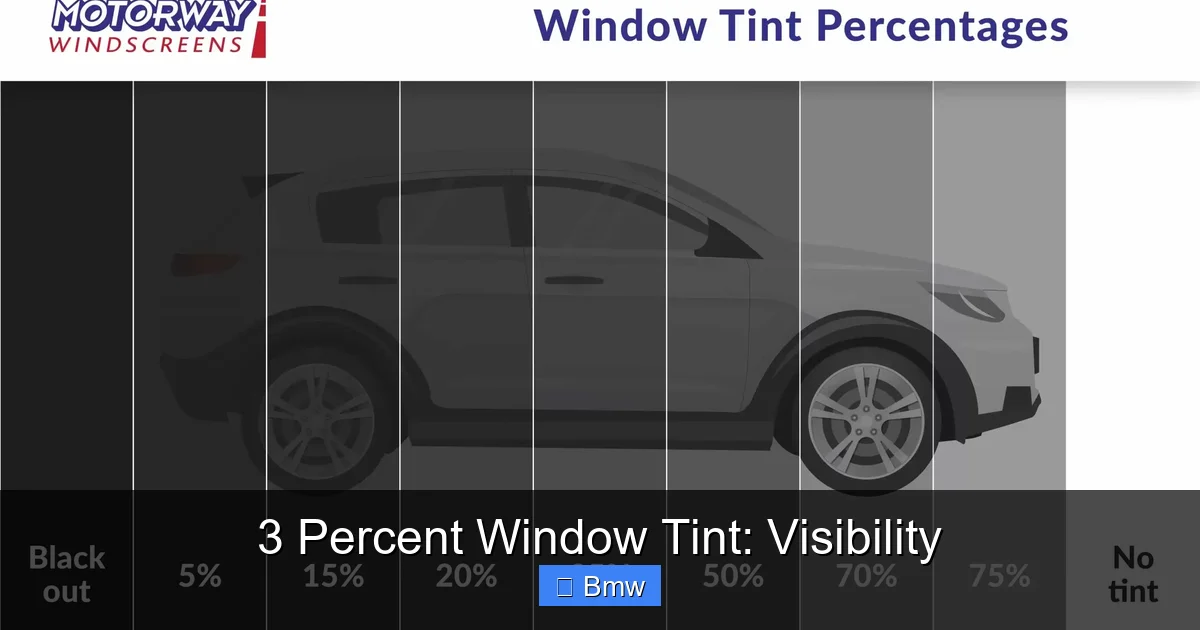
Before we talk about seeing through it, we must understand what 3% is. VLT, or Visible Light Transmission, is the standard measurement. A 3% VLT tint means that only 3% of the visible light from the outside world is allowed to pass through the glass and film into your car. Conversely, it blocks 97% of that light. To put that in perspective, factory-tinted glass on most modern cars, including many BMWs, typically ranges from 15% to 25% VLT for the rear windows. Standard clear automotive glass is around 70-80% VLT. So, 3% isn’t just dark; it’s an order of magnitude darker than what you likely drive with now.
Visual guide about 3 Percent Window Tint: Visibility
Image source: i2.wp.com
The “Limo Tint” Standard
The nickname “limo tint” originated because it was historically used in limousines to create a private, secluded compartment for passengers. From the outside, the windows appear nearly black, offering almost zero visibility into the cabin. From the inside, the view is dramatically dimmed. This is the experience you are signing up for. It transforms your BMW’s interior into a cocoon. While that sounds cool, it fundamentally alters your relationship with the outside environment. You are no longer a participant in the traffic scene; you are an observer in a shadow theater.
The Nightmare Scenario: 3% Tint and Low-Light Visibility
This is the most critical and dangerous aspect of 3% window tint. Daylight driving with 3% tint is manageable for many, albeit with a constant, slight strain. The real problem emerges the moment the sun dips below the horizon. Your ability to see is directly proportional to the amount of light reaching your eyes. Reduce that light by 97%, and you are effectively driving with a permanent, deep sunglasses filter on every window.

Visual guide about 3 Percent Window Tint: Visibility
Image source: lh4.googleusercontent.com
Specific Nighttime Dangers
Consider these common scenarios:
- Rain, Snow, and Fog: Precipitation scatters light. With 3% tint, the already minimal light bouncing off wet road surfaces or fog banks is reduced to a near-imperceptible gloom. Puddles, black ice, and road markings become incredibly difficult to discern. Your reaction time to hazards is severely compromised.
- Tunnels and Parking Garages: The abrupt transition from bright daylight to near-total darkness inside a tunnel or garage is disorienting. Your pupils cannot dilate quickly enough to compensate for the 97% light loss. You will be effectively blind for several terrifying seconds.
- Unlit Rural Roads: There are no streetlights. Your only illumination is your headlights. With 3% tint, your headlights’ effectiveness is gutted. The beam pattern is absorbed by the dark film, drastically shortening your sight distance. A pedestrian, an animal, or a stalled car can appear out of the darkness with no warning.
- Urban Night Driving: The contrast between bright neon signs, storefronts, and the dark tint inside creates a blinding, strobing effect. Your eyes are constantly forced to adjust, leading to rapid fatigue and headaches.
For a BMW, which is often driven for the pleasure of the journey, this turns a relaxing drive into a high-stress, fatiguing ordeal. The “Ultimate Driving Machine” becomes the “Ultimate Squinting Machine.”
Daytime Benefits: Why People Still Choose 3%
Despite the catastrophic night visibility, 3% tint has one overwhelming advantage that drives its popularity: solar control. In bright, sunny conditions—think Arizona, Florida, or a California summer—the benefits are tangible and significant.
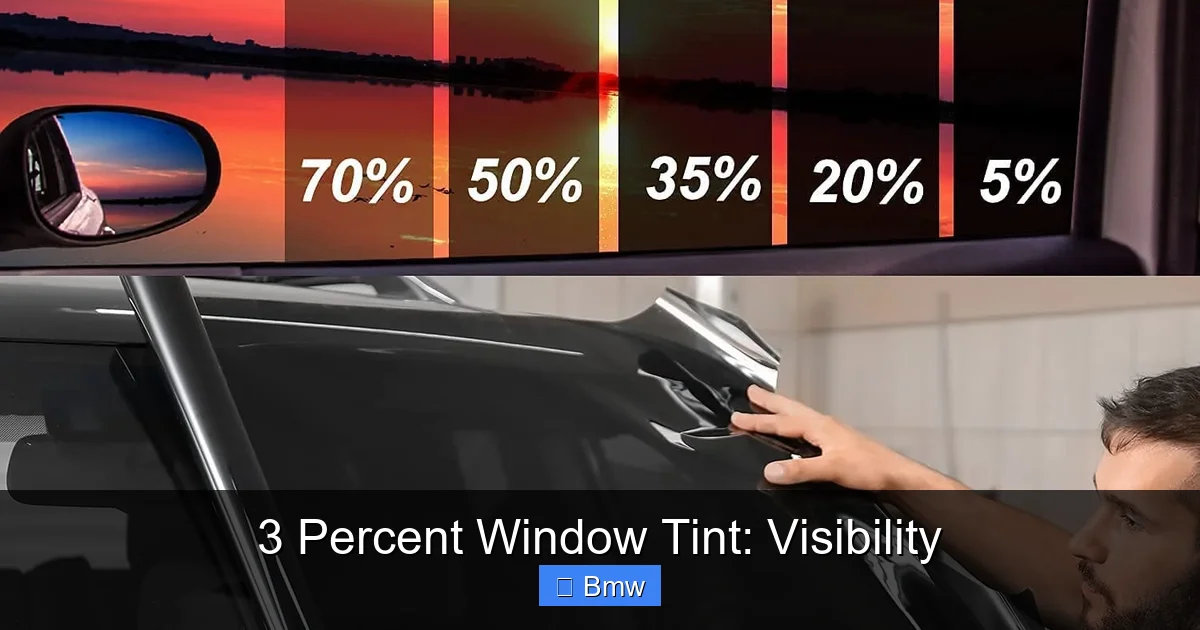
Visual guide about 3 Percent Window Tint: Visibility
Image source: images-na.ssl-images-amazon.com
Heat and Glare Annihilation
A high-quality ceramic 3% tint can reject upwards of 80% of the sun’s infrared heat energy. This means:
- Cabin Temperature: The interior stays dramatically cooler. You won’t need to crank the A/C as high, which can slightly improve fuel economy (or range in a BMW i-series). Seats and steering wheel won’t be scorching hot after parking.
- Glare Reduction: The blinding, white-hot glare reflecting off other cars, water, or concrete is almost entirely eliminated. This can actually make daytime driving more comfortable and reduce eye strain on long trips.
Privacy and Aesthetics
This is the other big draw. Your BMW’s interior, with its premium leather and tech, becomes your secret. Passersby cannot see in. Valuables left in the car are hidden. The car takes on a menacing, cohesive, “blacked-out” look that many find aesthetically superior to the factory glass. For those who prioritize this “stealth” appearance above all else, 3% is the final word. However, this benefit is purely cosmetic and applies only during daylight hours.
The Legal Labyrinth: Is 3% Tint Even Allowed on Your BMW?
This is a non-negotiable section. You must understand the law before you buy a single roll of film. In the United States, window tint laws are set by each state, not the federal government. The results are a patchwork of regulations, and for 3% tint, the news is almost universally bad.
General Statewide Prohibitions
With very few exceptions (like Wyoming for rear windows), 3% VLT is illegal for the front windshield and front side windows in all 50 states. Most states require a minimum of 70% VLT (or lighter) for the front windshield (often only allowed on the top 5-6 inches, the “AS-1” line) and a minimum of 35% to 70% VLT for the front driver/passenger windows. 3% is orders of magnitude darker than these limits.
The “Rear Window Only” Loophole
Some states, like California, Florida, and Texas, allow any darkness (including 3%) for the rear windshield and rear passenger windows, provided the front windows remain within the legal limit. This is the most common “legal” application for limo tint. However:
- You Must Have Side Mirrors: States with dark rear glass laws often require the car to have exterior side mirrors (which all BMWs do).
- Front Windows Must Be Legal: You cannot tint the front windows at 3%. A common illegal trick is to apply 3% all around, which will get you pulled over instantly.
- Check Specific State Laws: Laws change. You must verify your state’s current code. Our comprehensive guide on window tint laws by state is an essential resource for this step.
For BMWs, this means your dream of a fully blacked-out car is legally impossible in most of the country. You would be limited to a 3% rear package only, with a much lighter (and legally compliant) shade on the front doors.
BMW-Specific Considerations: Tech, Glass, and Design
A BMW is not a generic sedan. Its engineering presents unique challenges and considerations for extreme tint like 3%.
Advanced Driver-Assistance Systems (ADAS)
This is the silent killer of aftermarket tint. Modern BMWs are packed with cameras and sensors:
- Windshield Cameras: The forward-facing camera for lane departure warning, adaptive cruise control, and automatic emergency braking is typically mounted behind the rearview mirror, looking through the windshield. Metallic or even very dark dyed films can interfere with the camera’s view, causing errors, system deactivation, or erratic behavior. Ceramic films are less likely to cause interference but are not a guarantee at 3% VLT.
- Rain/Light Sensors: Located on the windshield, these control automatic wipers and headlights. Tint can block or scatter the light reaching these sensors, making them sluggish or unresponsive.
- Parking Sensors: While not optical, some systems’ performance can be subtly affected by the overall lighting change inside the car.
Critical Tip: Before tinting, check your BMW’s owner’s manual. It almost certainly contains warnings about aftermarket window tinting and its potential to interfere with vehicle systems. The cost to diagnose and fix a malfunctioning ADAS system can be thousands of dollars.
Glass Shape and Complex Curvature
BMW designs often feature steeply raked windshields, large glass roofs (like on the 4 Series Gran Coupe or i4), and complex door window curves. Applying a thick, dark film like 3% to these surfaces is an art. A poor application will result in visible air bubbles, creases, and peeling edges, especially on the deep curves. This demands a specialist who has experience with European cars. The cost to tint a BMW 3 Series or any model properly will be higher than for a standard American sedan due to this complexity and the need for high-end ceramic film.
Installation and Material: The Non-Negotiable Quality Factor
If you decide to proceed with a 3% rear tint (and only rear, if you want to stay legal), your choice of film and installer is everything. This is not a DIY project. Not even close.
Ceramic vs. Metallic vs. Dyed
- Dyed Film: The cheapest. It uses dye to absorb light. It provides good glare reduction but poor heat rejection. More importantly, the dye degrades and fades over time (often turning purple), and it is the most likely to interfere with ADAS due to its composition. Avoid for a BMW.
- Metallic (or Hybrid) Film: Uses metallic particles to reflect heat. Excellent heat rejection, but these particles can block radio, GPS, and keyless entry signals (a major problem for BMW’s Comfort Access system). It is also highly likely to interfere with ADAS cameras. Generally not recommended for modern BMWs.
- Ceramic Film: The gold standard. Uses non-conductive, non-metallic ceramic particles to absorb and dissipate heat. It offers the best heat rejection without signal interference. It is the least likely to cause ADAS issues (though not impossible at 3%). It is also the most color-stable and longest-lasting. For a 3% application on a BMW, high-quality ceramic from a reputable brand (like 3M, Llumar, XPEL, SunTek) is your only responsible choice.
The Installer is Half the Battle
A perfect film on a complex BMW glass is useless in the hands of a novice. The installer must:
- Precisely plot the pattern on the glass.
- Use a heat gun to shrink and form the film to every curve without creating tension points that lead to cracking later.
- Apply it in a clean, controlled environment to prevent dust and debris from getting trapped.
- Have the skill to work around the ADAS camera housing and other obstructions.
Ask for a portfolio of BMWs they’ve done. Check reviews specifically mentioning complex curves. Paying more for an expert is an investment in a job that won’t peel, bubble, or need redoing.
Conclusion: The Ultimate Trade-Off for Your BMW
The question of “3 percent window tint: visibility?” has a brutally honest answer. The visibility is profoundly, dangerously reduced, especially at night and in poor weather. The trade-off is exceptional daytime comfort and maximum privacy. For a BMW owner, the stakes are higher because of the potential for interfering with the very advanced technology that makes the car safe and enjoyable to drive.
Our advice is clear and cautious. For the vast majority of BMW drivers, 3% tint is a poor and potentially hazardous choice. Consider a much lighter shade for the front windows (like 35% or 50%) to maintain legal compliance and safe visibility, and if you desire extreme privacy, apply a 3% film only to the rear passenger and rear windshield, where it won’t affect your forward view or front sensors. Always, always check your state’s specific laws first. The thrill of a dark, private cabin is not worth the risk of a ticket, a voided warranty, a malfunctioning safety system, or, worst of all, an accident caused by not seeing the road.
If your primary goal is beating the heat, prioritize a high-quality ceramic film in a legal, visible-light-friendly percentage (like 30-50%). You’ll get 90% of the heat rejection benefit with 90% more visibility. Your BMW was engineered for clarity, control, and connection to the road. Don’t let a tint strip that away. Choose a shade that complements the driving experience, not one that sabotages it.
Frequently Asked Questions
Is 3% window tint legal on a BMW?
Almost never on the front windows or windshield in any U.S. state. Some states allow any darkness on rear windows only. You must tint the front doors to a legal VLT (usually 35% or lighter) to comply with the law. A full 3% car is illegal in all 50 states.
Will 3% tint affect my BMW’s backup camera or parking sensors?
It should not affect the backup camera itself, as it looks through the rear hatch glass. However, if applied to the rear side windows, it will severely limit your peripheral vision when backing up, making the camera even more critical. Parking sensors use ultrasonic waves, not light, so tint won’t affect them, but reduced visibility can make you rely on them more.
Can I see out of 3% tint at night?
Yes, but with extreme difficulty. Your vision is reduced to a level similar to wearing very dark sunglasses on a moonless night. It is significantly unsafe and requires intense concentration. Any precipitation or lack of street lighting makes it dangerously impractical.
Does the type of film (ceramic vs. metallic) make a difference in visibility?
The VLT percentage is the primary factor for visibility—3% is dark regardless of film type. However, high-quality ceramic films tend to have a more neutral, non-distorted view compared to cheaper dyed films, which can have a hazy or purple tint. The clarity difference is noticeable, but the fundamental light reduction is the same.
How much does it cost to put 3% tint on a BMW?
For a full car (illegally), it would cost $800-$1,500+ from a reputable shop using premium ceramic film. For a legal “rear-only” 3% package on a BMW 3 Series or X5, expect to pay $400-$800. The high cost is due to the complex glass curves, the need for premium film to avoid ADAS issues, and the skill of the installer. You can find more specific estimates for your model here.
Should I get 3% tint if I live in a very sunny state like Arizona?
Even in Arizona, 3% is overkill and dangerous. You can achieve 90% of the heat rejection with a 30-40% ceramic tint, which is legal for front windows in Arizona (minimum 33% VLT for front sides). This gives you superb comfort while maintaining safe nighttime visibility and legal compliance. A 3% tint in a sunny state is a choice of style over substance and safety.