
Will Jeep Rims Fit a Chevy 1500?

No, Jeep rims will not universally fit a Chevy 1500. Fitment depends on matching the exact wheel’s bolt pattern (lug pattern), center bore, and wheel dimensions. While some Jeep wheels may share a 6-lug pattern with certain Chevy 1500s, differences in the center bore size and offset often require modifications like hub-centric rings or wheel adapters, which can compromise safety and performance if not done correctly. Always verify your specific vehicle’s and wheel’s specifications before attempting installation.
Key Takeaways
- Lug Pattern is Primary: The bolt circle diameter (e.g., 5×5″ or 6×5.5″) must match exactly between the Jeep wheel and your Chevy 1500’s hub.
- Center Bore Must Align: The wheel’s center hole must match the Chevy’s hub size. A mismatch requires hub-centric rings, which are a temporary fix, not a permanent solution.
- Offset and Backspacing Matter: Incorrect offset can cause rubbing on brakes, suspension, or fenders and adversely affect handling.
- Not All Jeeps Are the Same: A Jeep Wrangler (JK/JL) and a Jeep Grand Cherokee (WK2) have different lug patterns and offsets, so you cannot generalize “Jeep rims.”
- Chevy 1500 Variations Exist: Model years and drivetrain (2WD vs. 4WD) can change the Chevy 1500’s lug pattern and brake components.
- Safety is Non-Negotiable: Using improper wheels or adapters can lead to catastrophic wheel failure. Professional consultation is mandatory.
- Check, Don’t Guess: Always measure your Chevy 1500’s hub and compare it directly to the Jeep wheel’s specs before any purchase or installation.
📑 Table of Contents
- Introduction: The Allure and the Risk of Cross-Brand Wheels
- Decoding Wheel Compatibility: The Three Pillars of Fitment
- Jeep vs. Chevy 1500: A Specification Showdown
- The Adapter & Spacer Conversation: A Slippery Slope
- What About Other Jeep Models? The Grand Cherokee & Gladiator Angle
- Step-by-Step: How to Actually Check for Fitment
- Practical, Safe Alternatives for Your Chevy 1500
- Conclusion: Prioritize Safety Over a “Cool Factor”
Introduction: The Allure and the Risk of Cross-Brand Wheels
So, you’re staring at a set of rugged, off-road-ready Jeep wheels, maybe a great deal on a used set, or perhaps a cool style you just love. Your trusty Chevy 1500 is your workhorse and adventure rig. The question pops into your head: “Will Jeep rims fit my Chevy 1500?” It’s a common thought for truck and SUV owners looking to customize or replace wheels without breaking the bank. The short, critical answer is: sometimes, but never by accident. Wheel compatibility is a precise science of measurements, and assuming fitment is a fast track to damaged components, unsafe driving conditions, and a very expensive repair bill.
This isn’t about brand loyalty; it’s about physics and engineering. Jeep and Chevy (specifically the Silverado/Sierra 1500 platform) are built for different purposes with different engineering teams. While both are icons of American capability, their wheel mounting specifications aren’t designed to be interchangeable. Let’s break down exactly what you need to know, measure, and consider before you even think about bolting a Jeep wheel onto your Chevy. We’ll talk lug patterns, center bores, offsets, and the real-world consequences of getting it wrong.
Decoding Wheel Compatibility: The Three Pillars of Fitment
For any wheel to safely and properly fit your Chevy 1500, three key measurements must align perfectly with your truck’s wheel hubs and suspension geometry. Think of these as the pillars of compatibility. If even one is off, you have a problem.
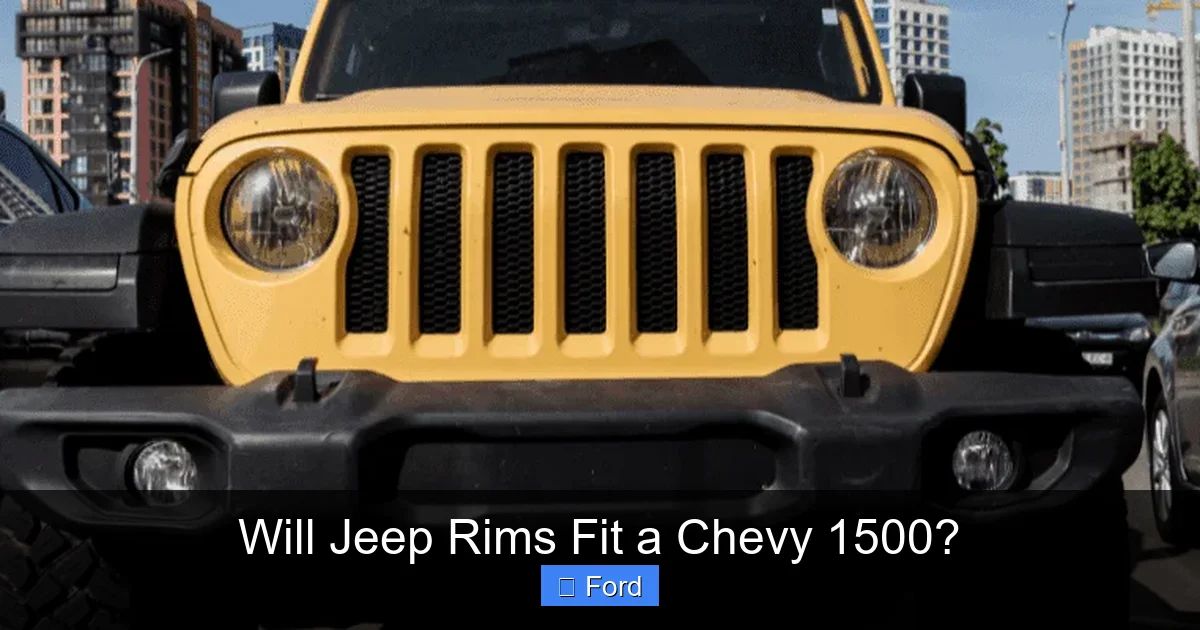
Visual guide about Will Jeep Rims Fit a Chevy 1500?
Image source: cdn.thedailyautomotive.com
1. The Bolt Pattern (Lug Pattern)
This is the first and most obvious checkpoint. The bolt pattern is expressed as two numbers: the number of lug nuts (studs) and the diameter of the imaginary circle they form (in inches or millimeters). For example, 6×5.5″ means six lugs on a 5.5-inch circle. Your Chevy 1500’s pattern depends heavily on the model year and drivetrain.
- Most Modern Chevy 1500s (2007+): Typically use a 6-lug pattern, specifically 6×5.5″ (also written as 6×139.7mm). This is the most common for 2WD and 4WD models in this era.
- Older Chevy 1500s (1996-2006): Many 2WD models used a 5-lug pattern (5×5″), while most 4WD models used the 6×5.5″ pattern. There are exceptions, so you must verify.
Jeep Patterns: This is where it gets tricky because “Jeep” covers multiple platforms. A Jeep Wrangler (TJ, JK, JL) uses a 5×5″ pattern. A Jeep Grand Cherokee (WK, WK2) and most Jeep Gladiator models use a 5×5″ pattern as well. However, some older Jeep Cherokee (XJ) and Comanche models used a 5×4.5″ pattern. Therefore, a Jeep wheel with a 5×5″ pattern will physically NOT bolt onto a Chevy 1500 with a 6×5.5″ pattern. The stud count alone is a deal-breaker. The only potential overlap is if you have an older Chevy 1500 2WD with a 5×5″ pattern, a Jeep Wrangler’s 5×5″ wheel would match the lug count and circle. But then we move to the next pillar…
2. The Center Bore (Hub Bore)
This is the hole in the center of the wheel that slides over the hub of your axle. Its diameter must match the hub’s diameter exactly for the wheel to be centered. This is a very common point of failure for cross-brand swaps.
- Chevy 1500 Hub Bore: For the vast majority of 6-lug Silverado/Sierra 1500s, the hub bore is 78.3mm. Some older models may be 78.1mm or 77.8mm. You must measure your specific hub.
- Jeep Hub Bore: A Jeep Wrangler (JK/JL) hub bore is 71.8mm. A Jeep Grand Cherokee (WK2) is 71.6mm.
The Problem: The Jeep wheel’s center hole (71.6-71.8mm) is significantly smaller than the Chevy 1500’s hub (78.3mm). The Jeep wheel will NOT slide onto the Chevy hub. It’s like trying to put a small bracelet on a large wrist—it simply won’t go on. To make it fit, you would need a set of wheel adapters or spacers that have a Chevy-side bolt pattern (6×5.5″) and a Jeep-side bolt pattern (5×5″), AND a built-in centering feature. This introduces major safety and engineering concerns we’ll discuss later.
3. Offset, Backspacing, and Wheel Dimensions
Even if you magically solved the lug pattern and center bore issues, the wheel’s positioning matters. Offset is the distance from the wheel’s mounting surface to its centerline. Backspacing is the distance from the mounting surface to the wheel’s inner lip. These determine how far the wheel/tire sits in or out from the fender and suspension components.
- Chevy 1500 Typical Offset: Often ranges from +15mm to +30mm (positive offset pushes the wheel in towards the suspension).
- Jeep Wrangler (JK/JL) Typical Offset: Usually around -6mm to +10mm (less positive or negative offset pushes the wheel outwards).
If you managed to mount a Jeep wheel (with its typically more negative/less positive offset) on a Chevy 1500, the wheel would sit significantly further out. This almost guarantees the tire will rub against the fender, bumper, or suspension control arms, especially during turning or under compression. You’d also drastically alter the vehicle’s scrub radius, killing handling precision and putting extra stress on wheel bearings and steering components.
Jeep vs. Chevy 1500: A Specification Showdown
Let’s get specific. We’ll compare the most common modern configurations because that’s where most people are looking at wheel swaps.
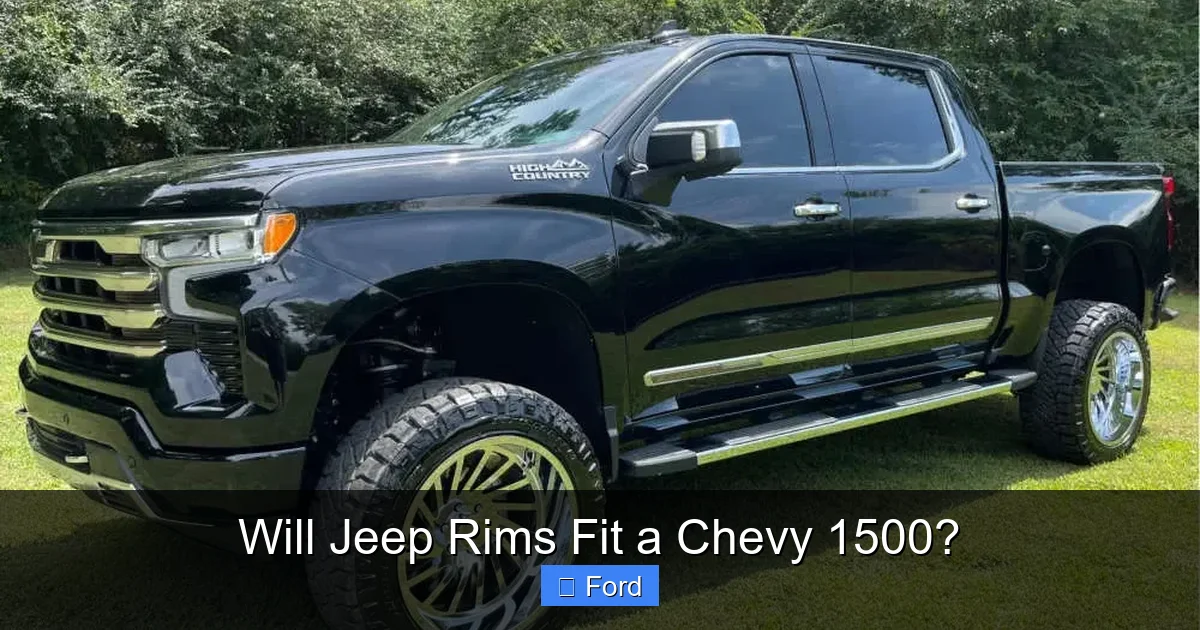
Visual guide about Will Jeep Rims Fit a Chevy 1500?
Image source: images.customwheeloffset.com
Chevy Silverado/Sierra 1500 (2007-Current, 6-Lug Models)
- Bolt Pattern: 6×5.5″ (6×139.7mm)
- Center Bore: 78.3mm (This is the standard, verify yours)
- Lug Nut Size: Typically 14×1.5mm or 14×1.75mm
- Typical Wheel Size Range: 17″ to 22″+
- Typical Offset Range: +15mm to +30mm
Jeep Wrangler (JK 2007-2018 / JL 2018-Current)
- Bolt Pattern: 5×5″ (5x127mm)
- Center Bore: 71.8mm (JK), 71.6mm (JL)
- Lug Nut Size: 14×1.5mm (but often uses a different conical seat)
- Typical Wheel Size Range: 17″ to 20″
- Typical Offset Range: -6mm to +10mm
Jeep Grand Cherokee (WK2 2014-Current)
- Bolt Pattern: 5×5″ (5x127mm)
- Center Bore: 71.6mm
- Lug Nut Size: 14×1.5mm
- Typical Wheel Size Range: 18″ to 22″
- Typical Offset Range: +20mm to +40mm (varies greatly by trim)
The Verdict from Specs: As you can see, the lug pattern is completely different (5 vs. 6 lugs). The center bore on the Jeep wheel is smaller than the Chevy hub. The offset ranges, while sometimes overlapping, are designed for a different vehicle’s suspension geometry. There is no direct, bolt-on fitment between a common Jeep wheel and a modern Chevy 1500. The only hypothetical scenario is an older Chevy 1500 2WD with a 5×5″ pattern, but you’d still have the center bore and offset issues to solve.
The Adapter & Spacer Conversation: A Slippery Slope
When faced with a mismatch, the internet will quickly suggest “wheel adapters” or “spacers.” These are metal plates that bolt to your vehicle’s hub with one bolt pattern and provide a new, different bolt pattern for the wheel. They also often have a larger built-in center bore to accommodate the smaller wheel bore. This is the only way to physically mount a 5-lug Jeep wheel onto a 6-lug Chevy 1500 hub.
Visual guide about Will Jeep Rims Fit a Chevy 1500?
Image source: thedailyautomotive.com
But this is a major modification with serious implications:
- Safety & Certification: Quality adapters must be engineered, CNC-machined from high-grade alloy (like 6061-T6 aluminum), and properly torqued. Cheap, cast “flip-out” adapters are dangerous and can fail under load. They must be installed with new, longer lug nuts and must be re-torqued frequently.
- Increased Stress: Adapters introduce an extra joint and leverage point. They put additional shear stress on the wheel studs and can accelerate bearing wear.
- Wheel Alignment: They effectively change the wheel’s offset by their thickness (e.g., a 1.5″ adapter adds 1.5″ to your effective offset). This will almost certainly cause rubbing and require a full alignment check.
- Legality & Insurance: In many regions, modifications using adapters to change bolt pattern may not be street-legal. More importantly, if an accident occurs and an investigator finds non-OEM, improperly modified wheels, your insurance claim could be denied.
Practical Example: To put a Jeep Wrangler’s 5×5″ wheel on a Chevy 1500, you’d need a 6×5.5″ to 5×5″ adapter. The Jeep wheel’s 71.8mm bore would then sit on the adapter’s larger bore (likely ~78mm), requiring a hub-centric ring (a plastic or aluminum shim) to center it. You now have a ring inside an adapter on your hub. This is a stack of components where failure at any point is catastrophic. For a daily driver or work truck, this is an unacceptable risk for most professionals.
What About Other Jeep Models? The Grand Cherokee & Gladiator Angle
What if you’re not looking at a Wrangler wheel? What about a Jeep Grand Cherokee or the newer Gladiator pickup? The Gladiator (JT) uses the same 5×5″ pattern as the Wrangler. The Grand Cherokee (WK2) also uses 5×5″. So the lug pattern issue remains the same: 5 lugs vs. 6 lugs. The center bore is still smaller (~71.6mm vs 78.3mm). The offset on a Grand Cherokee can be more similar to a Chevy (more positive), but the fundamental lug pattern and bore mismatch makes it a non-starter without adapters.
There is one potential exception that is often misunderstood: some Jeep Liberty (KK) models from 2008-2012 used a 5×4.5″ (5×114.3mm) pattern. Some older Chevy 1500 2WD models (pre-2007) also used a 5×4.5″ pattern. If you have a very specific older Chevy 2WD and a very specific older Jeep Liberty, the lug pattern *could* match. However: The center bore on the Jeep Liberty is 71.6mm, while the older Chevy 2WD hub is typically 66.6mm or 71.6mm depending on the exact year and model. You must measure. Even if the bore matched, the offset and wheel diameter/width must be checked for clearance. This is a rare and specific scenario, not a general rule.
Step-by-Step: How to Actually Check for Fitment
If you’re still wondering about a specific set of wheels you have your eyes on, here is the fail-safe method to determine fitment. Do not skip these steps.
Step 1: Identify Your Chevy 1500’s Exact Specifications
Do not rely on “it’s a 2015 Chevy 1500.” You need the precise data.
- Find your Vehicle Identification Number (VIN). Use a free online VIN decoder or take it to a tire shop. This will tell you the exact model year, drivetrain, and sometimes the factory wheel size and offset.
- Measure your hub bore. This is the most important step. Remove one wheel. Use a precision caliper to measure the diameter of the center hole on the hub itself (where the wheel slides on). Clean it first. Write this number down. It is likely 78.3mm, but verify.
- Confirm your bolt pattern. Count the number of studs. Measure the distance from the center of one lug to the center of the lug directly across from it (for 5-lug, measure skip-one). This gives you the diameter. For a 6-lug, measure center-to-center of two opposite lugs.
- Note your current wheel’s size and offset. This is on the inside rim: e.g., 18×9.0, ET+25. The “ET” is offset in mm.
Step 2: Get the Jeep Wheel’s Exact Specs
You need the manufacturer’s specs for the specific wheel model and size. Look for a stamp on the back of the wheel or the spec sheet. You need:
- Bolt Pattern (e.g., 5×5″)
- Center Bore (e.g., 71.8mm)
- Wheel Size (e.g., 17×8.0)
- Offset (e.g., ET+12)
- Wheel Width
- Stick to Chevy/Silverado/GMC Sierra OEM or Aftermarket Wheels: The safest, easiest route. Thousands of styles are available in your exact 6×5.5″ pattern and 78.3mm bore. You get perfect fitment.
- Explore Other 6-Lug Brands: Many trucks from Toyota (Tacoma/Tundra 6-lug), Nissan (Titan/Xterra 6-lug), and even some Ford 6-lug models use the same 6×5.5″ pattern. Their center bores vary (Toyota is often 106.1mm, Nissan 71.5mm), so you’d still need to check the bore. A Toyota wheel would need a massive hub-centric ring (~106mm to 78mm), which is not recommended. A Nissan Titan wheel (6×5.5″, 71.5mm bore) is a closer bore match but still requires a ring. This is where our internal linking is crucial: The compatibility questions between brands are very similar. For instance, the principles discussed in our article about whether Dodge 6 lug rims fit a Chevy apply directly to Nissan or Toyota 6-lug wheels—the bolt pattern may match, but the center bore often does not. Similarly, the issues with Jeep 5-lug wheels fitting a Dodge Ram 1500 are identical to your Chevy scenario: a 5-lug vs. 6-lug mismatch requiring risky adapters. Understanding these cross-brand dynamics is key.
- Use Wheel Spacers for Aesthetic Clearance ONLY: If you find a perfect Chevy-spec wheel (6×5.5″, 78.3mm bore) but it sits too far in and rubs the brake caliper, you can use a bolt-on, hub-centric spacer of the correct thickness (e.g., 5mm). This is a minor change, but still requires proper torque and lug nut length checks.
- Change Tires, Not Wheels: Often, the look you want can be achieved by changing to a more aggressive all-terrain tire on your stock wheels.
If the bolt pattern is different (5 vs. 6 lugs), stop. It will not fit without adapters. If the center bore is smaller than your Chevy’s hub, it will not slide on.
Step 3: The Clearance Check (If Specs Aligned)
This is theoretical if specs don’t match, but for educational purposes: if you found a wheel with a 6×5.5″ pattern and a 78.3mm bore (unlikely from a Jeep), you’d then need to compare the offset and width. A wheel with a much more negative offset than your stock wheel will stick out. You must check if the new tire size (width and diameter) will clear the fenders, brakes, and control arms at full lock and full compression. Online wheel/tire size calculators can help, but nothing beats a test fit with the wheel off the ground.
Practical, Safe Alternatives for Your Chevy 1500
You want a different look or capability. Here are the smart paths:
Conclusion: Prioritize Safety Over a “Cool Factor”
The dream of putting a set of iconic Jeep wheels on your Chevy 1500 is understandable. But the engineering reality creates a nearly insurmountable barrier for safe, direct fitment. The fundamental incompatibility in lug pattern (5 vs. 6) and the significant center bore mismatch (71.6mm vs. 78.3mm) mean that Jeep wheels will not fit a Chevy 1500 without the use of bolt-on wheel adapters.
While adapters exist, they are a compromise that introduces risk, complexity, and potential legal/insurance issues. For a vehicle like a Chevy 1500, which is often used for towing, hauling, and family transportation, compromising wheel security is simply not worth it. The potential for a wheel to separate from the vehicle at highway speeds is a risk no rational person should take.
Your best and only truly safe path is to select wheels designed for your Chevy 1500’s exact specifications. The aftermarket is vast—you can find styles just as rugged and attractive as Jeep wheels that are engineered for your truck’s hub. Take the time to measure your vehicle, understand the three pillars of fitment (bolt pattern, center bore, offset), and invest in proper wheels. Your safety, your truck’s longevity, and your peace of mind depend on it. When in doubt, consult a reputable wheel and tire professional who can verify fitment with you.
Frequently Asked Questions
Can I use hub-centric rings to make a Jeep wheel fit my Chevy 1500?
No. Hub-centric rings only solve the center bore size mismatch. They do nothing for the fundamental lug pattern difference (5-lug Jeep vs. 6-lug Chevy). You would still need wheel adapters to change the bolt pattern, and stacking adapters and rings is exceptionally dangerous and not recommended.
What is the biggest safety risk of using wheel adapters to fit Jeep rims?
The biggest risk is wheel failure. Adapters create an extra joint and leverage point. If not machined perfectly, torqued correctly, or if they are low-quality cast parts instead of forged, they can shear or loosen under load, causing the wheel to come off the vehicle.
Are there any Jeep models that share a 6-lug bolt pattern with a Chevy 1500?
No. All Jeep Wranglers, Grand Cherokees, and Gladiators use a 5-lug (5×5″) pattern. The only Jeeps with a 6-lug pattern are some very old models like the Jeepster Commando or some commercial vehicles, which are not relevant to modern wheel swaps. A 6-lug pattern on a Jeep is exceptionally rare.
If I have an older Chevy 1500 2WD with a 5×5″ pattern, will a Jeep Wrangler wheel fit?
Maybe, but you still have to check. The lug pattern would match (5×5″), but you must verify the center bore. A Jeep Wrangler’s bore is ~71.8mm. Your older Chevy’s 2WD hub bore is likely 66.6mm or sometimes 71.6mm. If it’s 66.6mm, the Jeep wheel’s bore is too large and would not center on the hub. If it’s 71.6mm, the bore matches, but then you must check offset and tire clearance meticulously.
Can a tire shop install Jeep wheels on my Chevy 1500 with adapters?
A reputable, safety-conscious tire shop will almost certainly refuse. They carry liability for the installation. Most professional shops have policies against installing wheels with bolt pattern adapters due to the inherent risks and potential for incorrect torque. You would likely need to find a specialty off-road shop that explicitly offers adapter installations and accepts the liability, but they will strongly advise against it for a daily driver.
What’s the best alternative to using Jeep wheels for a rugged look on my Chevy 1500?
Purchase aftermarket wheels specifically designed for your Chevy 1500’s 6×5.5″ bolt pattern and 78.3mm center bore. Brands like Method, Fuel, American Racing, and many others offer wheels in beadlock-style, deep-dish, or off-road aesthetic designs that will bolt on directly, safely, and legally. You get the look without the engineering nightmare.
