Will Car Battery Die If Door Is Left Open
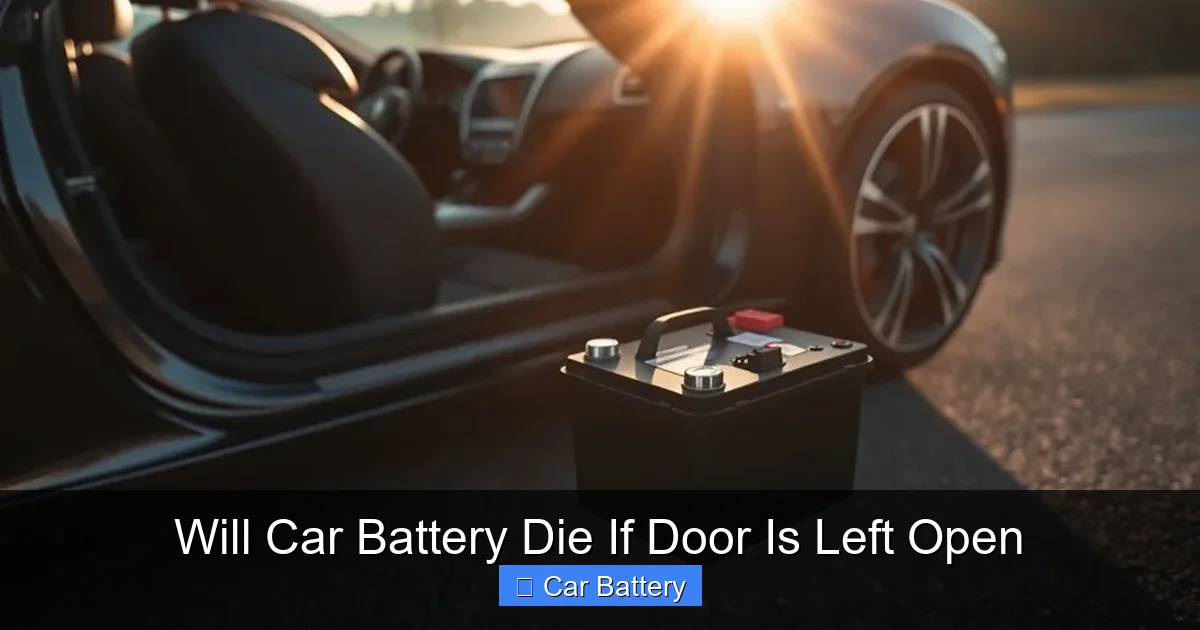
Leaving your car door open can drain the battery, especially if interior lights or electronics stay on. While modern vehicles have safeguards, prolonged exposure with accessories active may lead to a dead battery. Understanding what draws power and how long it takes helps prevent unexpected breakdowns.
This is a comprehensive guide about will car battery die if door is left open.
In This Article
- 1 Key Takeaways
- 2 Will Car Battery Die If Door Is Left Open?
- 3 How Car Doors Affect Battery Power
- 4 Modern vs. Older Vehicles: Battery Drain Differences
- 5 Factors That Influence Battery Drain
- 6 How Long Can You Leave a Door Open?
- 7 What to Do If Your Battery Dies
- 8 Conclusion
- 9 Frequently Asked Questions
- 9.1 Can leaving a car door open overnight kill the battery?
- 9.2 How long can I leave my car door open without draining the battery?
- 9.3 Why do my interior lights stay on even when the doors are closed?
- 9.4 Does cold weather make battery drain worse?
- 9.5 Can a dash cam cause a dead battery if the door is left open?
- 9.6 How can I prevent battery drain from an open door?
Key Takeaways
- Interior lights drain the battery: Dome lights, trunk lights, and courtesy lights draw power even when the engine is off, and leaving a door open keeps them on.
- Modern cars have battery-saving features: Many vehicles automatically turn off lights after a delay, but older models may not.
- Parasitic drain adds up: Even small electrical loads from alarms, clocks, and infotainment systems can deplete a battery over time when combined with door-open drain.
- Battery age matters: Older or weak batteries are more likely to die from minor drains than newer, fully charged ones.
- Time and conditions affect risk: A door left open overnight in cold weather increases the chance of a dead battery due to reduced battery efficiency.
- Prevention is simple: Always check that doors are fully closed, use a battery maintainer for long storage, and inspect lights if you suspect a drain.
- Jump-starting is a temporary fix: Repeated deep discharges can shorten battery life, so addressing the root cause is essential.
[FEATURED_IMAGE_PLACEHOLDER]
Will Car Battery Die If Door Is Left Open?
We’ve all been there—rushing out of the car after a long day, distracted by a phone call or a child tugging at your sleeve, and forgetting to close the door properly. Maybe it was just ajar, or perhaps you left it wide open while unloading groceries. The next morning, you go to start your car and… nothing. The dashboard lights flicker weakly, or worse, there’s only silence. Your first thought? “Did leaving the door open kill my battery?”
The short answer is: yes, it’s possible. But it’s not just about the door itself—it’s about what the open door triggers inside your vehicle. When a car door is left open, especially for an extended period, it can activate interior lights, courtesy lamps, and sometimes even the trunk or glove box lights. These small electrical components draw power from the battery, and over time, that drain can be enough to leave your car unable to start.
But not all cars are created equal. Modern vehicles come equipped with smart systems designed to prevent exactly this kind of scenario. Many automatically turn off interior lights after a set time, even if a door remains open. Others have sensors that detect prolonged door-open states and cut power to non-essential systems. However, older cars or those with aftermarket accessories may lack these safeguards, making them more vulnerable to battery drain.
Understanding how your car’s electrical system works—and what happens when a door is left open—can help you avoid the frustration of a dead battery. It’s not just about remembering to close the door; it’s about knowing how long it’s safe to leave it open, what components are drawing power, and how your battery’s health plays a role. In this guide, we’ll explore the science behind battery drain, the role of interior electronics, and practical tips to keep your car starting reliably—no matter how distracted you are.
How Car Doors Affect Battery Power
At first glance, a car door might seem like a simple mechanical component—just a piece of metal and glass that opens and closes. But in reality, it’s deeply connected to your vehicle’s electrical system. Every time you open a door, a small switch—called a door jamb switch or door ajar sensor—sends a signal to the car’s computer. This tells the system that a door is open, which then activates certain interior lights and, in some cases, disables the ignition or triggers a warning chime.
When the door is closed, the switch resets, and the lights turn off. But if the door is left open—even slightly—the switch remains engaged, keeping those lights on. This might not seem like a big deal. After all, how much power can a little dome light really use? The answer: more than you’d think, especially over time.
Most interior lights in cars use LED or incandescent bulbs. LED lights are far more efficient, drawing only about 0.5 to 1 watt of power. Incandescent bulbs, common in older vehicles, can draw 5 to 10 watts or more. While that might not sound like much, consider this: a 5-watt light running for 24 hours uses 120 watt-hours of energy. A typical car battery stores around 48 amp-hours at 12 volts, which equals about 576 watt-hours. So, in theory, a single 5-watt light could drain a fully charged battery in just under five days—if nothing else were drawing power.
But in reality, other systems are always active. The car’s clock, radio presets, security system, and onboard computers create what’s known as “parasitic drain.” This is normal and usually minimal—around 20 to 50 milliamps when the car is off. However, when you add an open door and its associated lights, the total drain increases significantly. If the parasitic drain is 30 milliamps and the interior lights add another 400 milliamps, the total draw is now 430 milliamps. At that rate, a 48 amp-hour battery could be drained in about 4.5 days.
Of course, most people don’t leave their doors open for days. But even leaving a door open overnight—say, 8 to 12 hours—can be enough to cause problems, especially if the battery is already weak or the weather is cold. Cold temperatures reduce a battery’s ability to deliver power, so a battery that’s 50% charged in winter might behave like it’s nearly dead.
The Role of Door Jamb Switches
The door jamb switch is a small but critical component in this equation. Located near the door latch, it’s a spring-loaded button or magnetic sensor that detects whether the door is open or closed. When the door is open, the switch is depressed or disengaged, sending a signal to the body control module (BCM) or fuse box. This triggers the interior lights and, in some cars, disables the ignition to prevent accidental starts.
If this switch is faulty or stuck in the “open” position—even when the door is closed—it can keep the lights on continuously, leading to a dead battery. This is a common issue in older vehicles or those exposed to moisture and dirt. A malfunctioning switch might not be obvious at first, but if you notice your interior lights staying on even with all doors shut, it’s worth checking.
Conversely, if the switch is working correctly but the door is genuinely left open, the system behaves as designed. The lights stay on to help you see inside the car, which is useful when loading groceries or searching for keys. But this convenience comes at a cost: battery drain.
Interior Lights and Their Power Draw
Not all interior lights are created equal. Modern cars often use LED lighting throughout the cabin, including map lights, dome lights, footwell lights, and even glove box and trunk lights. LEDs are energy-efficient, but they still draw power. A typical LED dome light might use 0.8 watts, which translates to about 67 milliamps at 12 volts. If two doors are open and both front map lights are on, that’s roughly 134 milliamps of draw.
In contrast, older incandescent bulbs can draw 5 to 10 watts each. A single 10-watt bulb uses about 830 milliamps—more than ten times the power of an LED. If your car still uses incandescent bulbs and you leave a door open overnight, the drain could be substantial.
Some vehicles also have “courtesy lighting” that stays on for a few minutes after the door is closed, helping you find your way in the dark. This is helpful, but if the door is left open, that timer never starts, and the lights stay on indefinitely.
Modern vs. Older Vehicles: Battery Drain Differences
The risk of a dead battery from an open door varies greatly depending on the age and technology of your vehicle. Modern cars are designed with battery conservation in mind, while older models often lack these safeguards.
Smart Systems in Newer Cars
Many vehicles manufactured in the last decade come equipped with advanced body control modules that manage power distribution intelligently. These systems can detect when a door has been open for an extended period and automatically turn off interior lights after a set time—usually 10 to 30 minutes. Some even have a “door ajar” warning that flashes the interior lights or sounds a chime if the door is left open too long.
For example, a 2020 Honda Civic might keep the dome light on for 15 minutes after the last door is opened, then shut it off to preserve battery life. Similarly, a Tesla Model 3 uses low-power LED lighting and has sophisticated power management that minimizes drain even when doors are open.
These features significantly reduce the risk of a dead battery from an open door. However, they’re not foolproof. If the car’s battery is already low, or if multiple systems are active (like the trunk light and glove box light), the drain can still add up.
Vulnerabilities in Older Vehicles
Older cars, especially those from the 1990s and early 2000s, often lack these smart features. Interior lights may stay on as long as any door is open, with no automatic shutoff. This means that leaving a door open for several hours—or overnight—can easily drain the battery.
Additionally, older batteries have lower capacity and are more prone to sulfation, a process where lead sulfate crystals build up on the plates, reducing efficiency. A weak battery might not recover from even a small drain, leading to a no-start condition.
Another issue in older vehicles is the use of incandescent bulbs, which, as mentioned, draw more power. Combined with less efficient alternators and charging systems, these cars are more susceptible to battery problems.
Aftermarket Accessories and Hidden Drains
Even in modern cars, aftermarket accessories can increase the risk of battery drain. Dash cams, GPS units, phone chargers, and security systems often remain powered even when the car is off. If you leave a door open and these devices are still drawing power, the total drain can be significant.
For instance, a dash cam with a parking mode feature might draw 100–200 milliamps continuously. Add that to a 100-milliamp interior light draw, and you’ve got 300 milliamps of total drain. Over 12 hours, that’s 3.6 amp-hours—enough to cause problems in a weak battery.
Always check that aftermarket devices are properly wired and have their own power-saving features. Some dash cams, for example, can be set to shut off after a certain time or when voltage drops below a threshold.
Factors That Influence Battery Drain
While an open door is a common cause of battery drain, it’s rarely the only factor. Several variables determine whether your battery will die, including battery age, temperature, and overall electrical load.
Battery Age and Health
A car battery typically lasts 3 to 5 years, depending on climate, driving habits, and maintenance. As a battery ages, its capacity decreases. A new battery might store 50 amp-hours of energy, but after four years, it could be down to 30 or less. This means it has less reserve power to handle drains like interior lights.
A weak battery also struggles to recharge fully, especially if you take short trips. The alternator needs time to replenish the charge, and if you’re constantly draining the battery with lights or accessories, it may never reach full capacity.
Signs of a weak battery include slow engine cranking, dim headlights, and frequent need for jump-starts. If you notice these symptoms, it’s time to test or replace the battery.
Temperature Effects
Cold weather is one of the biggest enemies of car batteries. At 32°F (0°C), a battery’s cranking power drops by about 35%. At 0°F (-18°C), it can lose up to 60% of its capacity. This means that even a small drain—like an open door with lights on—can be enough to prevent starting in winter.
Heat is also damaging over time. High temperatures accelerate chemical reactions inside the battery, leading to faster degradation. A battery in a hot climate might fail sooner than one in a cooler region, even with similar usage.
Driving Habits and Charging
How you use your car affects battery health. Short trips—less than 10 minutes—don’t give the alternator enough time to recharge the battery fully. If you frequently make short drives and then leave the car parked for days, the battery may slowly lose charge.
Conversely, long highway drives help maintain battery health by allowing the alternator to run at higher output. If you’re someone who mostly drives short distances, consider using a battery maintainer or trickle charger during long periods of inactivity.
Electrical Load and Accessories
The more electrical devices your car has, the greater the parasitic drain. Modern vehicles come with infotainment systems, climate control, keyless entry, and advanced driver assistance features—all of which draw power even when the engine is off.
If your car has a large touchscreen, multiple USB ports, or a premium sound system, the standby power draw can be higher than average. Combine that with an open door and interior lights, and the risk of a dead battery increases.
How Long Can You Leave a Door Open?
So, how long is too long? The answer depends on several factors, but here’s a general guideline:
– LED interior lights (modern car): Up to 24–48 hours may be safe, especially if the battery is new and fully charged.
– Incandescent lights (older car): More than 4–6 hours could be risky, especially overnight.
– With aftermarket accessories: Even 2–3 hours might be too long if multiple devices are drawing power.
Let’s look at a real-world example. Suppose you leave your car door open for 8 hours while unloading at a campsite. Your car has LED dome lights drawing 100 milliamps total, and the parasitic drain is 30 milliamps. That’s 130 milliamps of continuous draw.
Over 8 hours, that’s 1.04 amp-hours used. A healthy 50 amp-hour battery can handle that easily. But if the battery is already at 50% charge (25 amp-hours), and it’s a cold morning, the reduced cranking power might make it hard to start.
Now imagine the same scenario with incandescent lights drawing 800 milliamps. Over 8 hours, that’s 6.4 amp-hours—enough to cause problems in a weak battery.
Practical Tips to Avoid Drain
– Always double-check doors: Make it a habit to visually confirm all doors are closed before walking away.
– Use a reminder app: Some smartphones can send alerts if you’ve left the car unlocked or a door open (if your car supports it via an app).
– Install LED upgrades: If your car still uses incandescent bulbs, consider switching to LEDs for lower power draw.
– Check for faulty switches: If lights stay on when doors are closed, have the door jamb switches inspected.
– Use a battery maintainer: For cars that sit for long periods, a trickle charger can keep the battery topped up.
What to Do If Your Battery Dies
If you do end up with a dead battery from an open door, don’t panic. Here’s what to do:
1. Check the doors: Make sure all doors are fully closed. Sometimes a door appears closed but isn’t latched, keeping the switch engaged.
2. Turn off all accessories: Remove any chargers, turn off lights, and disable aftermarket devices.
3. Jump-start the car: Use jumper cables and another vehicle, or a portable jump starter. Follow safety procedures carefully.
4. Drive to recharge: Once started, drive for at least 20–30 minutes to allow the alternator to recharge the battery.
5. Test the battery: Visit an auto parts store for a free battery test to check its health.
Repeated deep discharges can shorten battery life, so if this happens often, investigate the cause. It could be a faulty switch, a weak battery, or excessive parasitic drain.
Conclusion
Leaving your car door open can indeed cause the battery to die, especially if interior lights or electronics remain on for an extended period. While modern vehicles have safeguards to minimize this risk, older cars and those with aftermarket accessories are more vulnerable. Factors like battery age, temperature, and driving habits also play a role in how quickly a battery drains.
The good news is that prevention is simple. By being mindful of door closures, upgrading to efficient lighting, and maintaining your battery, you can avoid the frustration of a dead car. And if it does happen, knowing how to respond can get you back on the road quickly.
Remember: it’s not just about the door—it’s about the entire electrical ecosystem of your vehicle. Stay informed, stay proactive, and your car will keep starting when you need it most.
Frequently Asked Questions
Can leaving a car door open overnight kill the battery?
Yes, it’s possible, especially in older cars with incandescent lights or weak batteries. Modern vehicles with LED lights and automatic shutoffs are less likely to experience a dead battery from an open door overnight.
How long can I leave my car door open without draining the battery?
With LED lights and a healthy battery, you can safely leave a door open for up to 24 hours. With incandescent lights, limit it to 4–6 hours to avoid significant drain.
Why do my interior lights stay on even when the doors are closed?
This could indicate a faulty door jamb switch or a stuck latch. Have the switches inspected and replaced if necessary to prevent unnecessary battery drain.
Does cold weather make battery drain worse?
Yes, cold temperatures reduce a battery’s capacity and cranking power, making it more likely to die from even small drains like interior lights.
Can a dash cam cause a dead battery if the door is left open?
Yes, especially if it’s in parking mode. Combine that with interior lights, and the total drain can be enough to kill a weak battery overnight.
How can I prevent battery drain from an open door?
Always check that doors are fully closed, upgrade to LED lights, use a battery maintainer for long storage, and inspect for faulty switches or excessive parasitic drain.