Why Won’t My Toyota Corolla Traction Control Light Turn Off?

Contents
- 1 Key Takeaways
- 2 📑 Table of Contents
- 3 Understanding Your Corolla’s Traction & Stability Control (VSC/TRAC)
- 4 The Most Common Reasons Your Light Won’t Turn Off
- 5 How to Diagnose the Problem: A Step-by-Step Guide
- 6 Safety Implications: Why You Shouldn’t Just Live With It
- 7 Repair Costs and Your Options
- 8 Frequently Asked Questions (FAQs)
- 9 Conclusion: Take Action for Safety and Peace of Mind
- 10 Frequently Asked Questions

Car Cup Holder Expander

Jack Stands

Octane Booster

Car Interior LED Light
A persistent traction control (VSC/TRAC) light on your Toyota Corolla is almost always a sign that the system has detected a fault and deactivated itself for safety. The most common culprits are faulty wheel speed sensors, issues with the ABS module, or damaged wiring. While you can sometimes perform basic checks like inspecting tire pressure and sensors, a professional diagnostic scan is usually required to pinpoint the exact problem. Driving with the light on means you’ve lost a critical safety feature, so addressing the underlying issue promptly is essential for your safety and your car’s health.
You’re driving your reliable Toyota Corolla, maybe on a rainy highway or a snowy backroad, and you glance down at the dashboard. There it is—the little car with squiggly lines underneath it, the VSC OFF or TRAC OFF light, glowing a steady, unwavering red or yellow. You haven’t turned the system off manually. So why won’t your Toyota Corolla traction control light turn off? It’s a common and frustrating issue that points to a deeper problem within your car’s complex network of safety systems. This light isn’t just an annoyance; it’s your car’s way of saying, “I’ve detected something wrong, and I’ve shut down my traction and stability control to protect you from a potentially dangerous malfunction.” Let’s dive deep into what this light means, why it stays stubbornly on, and what you need to do about it.
Key Takeaways
- The light means the system is OFF due to a fault: A constantly illuminated traction control light (VSC OFF or TRAC OFF) indicates your car’s computer has found a problem and shut the system down to prevent incorrect interventions.
- Wheel speed sensors are the #1 suspect: These sensors tell the car how fast each wheel is spinning. A dirty, damaged, or failed sensor is the most frequent cause of a persistent traction control warning.
- It’s often linked to the ABS system: Traction control relies on the Anti-lock Braking System (ABS). A problem with an ABS wheel speed sensor, pump, or module will almost always trigger the traction control light.
- Simple issues can trigger it: Under-inflated tires, mismatched tire sizes, or even a weak battery can sometimes confuse the system and illuminate the light.
- Do not ignore the safety risk: Without traction control, your car is more likely to skid or lose grip in slippery conditions. The light is a warning that this vital safety net is disabled.
- A professional scan is key: While you can do visual inspections, a mechanic must use a diagnostic computer to read the specific trouble code stored in your Corolla’s computer to find the exact cause.
- Fixes range from cheap to expensive: Replacing a single wheel speed sensor might cost $100-$300, while a faulty ABS module can run $1,000+. The specific code determines the cost.
[FEATURED_IMAGE_PLACEHOLDER]
📑 Table of Contents
- Understanding Your Corolla’s Traction & Stability Control (VSC/TRAC)
- The Most Common Reasons Your Light Won’t Turn Off
- How to Diagnose the Problem: A Step-by-Step Guide
- Safety Implications: Why You Shouldn’t Just Live With It
- Repair Costs and Your Options
- Frequently Asked Questions (FAQs)
- Conclusion: Take Action for Safety and Peace of Mind
Understanding Your Corolla’s Traction & Stability Control (VSC/TRAC)
Before we diagnose the problem, we need to understand what we’re dealing with. In your Toyota Corolla, this system goes by a few names: Traction Control (TRAC), Vehicle Stability Control (VSC), or sometimes both. They are intimately linked with the Anti-lock Braking System (ABS).
How the System Works: A Team Effort
Imagine your Corolla has a team of highly alert co-pilots. This team consists of:
- Wheel Speed Sensors: These are the eyes and ears. One is on each wheel hub, constantly monitoring how fast each wheel is spinning.
- The ABS Module/Computer: This is the brain. It receives data from all four wheel speed sensors thousands of times per second.
- The Hydraulic Control Unit: This is the muscle. It can individually modulate brake pressure to any wheel and, in many cases, reduce engine power.
When you accelerate, the brain compares the speed of all four wheels. If it sees the drive wheels (usually the front two in a Corolla) spinning much faster than the other two—a sign of loss of traction—it springs into action. It might pulse the brakes on the spinning wheel and/or momentarily reduce engine power. This transfers torque to the wheel with grip, helping you maintain control and stay on your intended path. VSC, or Vehicle Stability Control, is an advanced layer that also uses a steering angle sensor and a yaw rate sensor to detect if you’re beginning to slide in a turn and applies corrective braking to individual wheels to help you stay pointed where you’re steering.
What the Light Actually Means
The icon on your dash—a car with squiggly tracks—is the tell-tale. Here’s the crucial distinction:
- Light that FLASHES during hard acceleration or in slick conditions: This is normal. It means the system is actively working to prevent wheel spin or a skid. It’s a good thing!
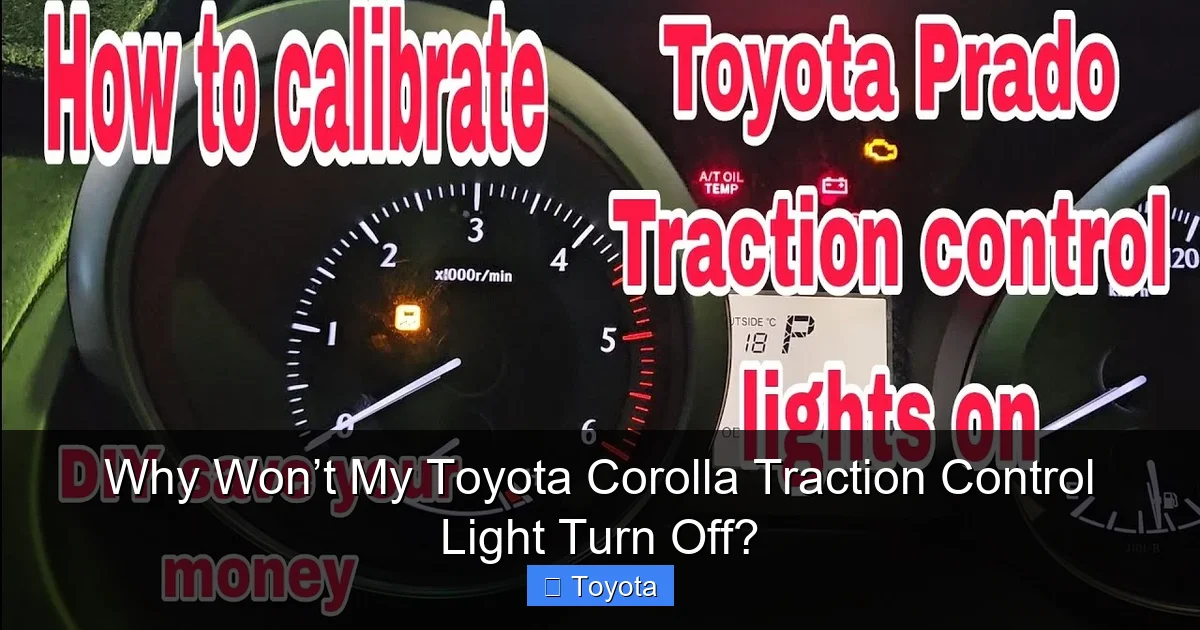
- Light that is STEADY ON (solid, not flashing): This is the problem. It means the system’s computer has detected a fault in any part of the network (sensors, wiring, module) and has deactivated TRAC and VSC as a precaution. The car will not use these functions until the fault is repaired and the light is reset.
Often, a steady traction control light is accompanied by an illuminated ABS light. This makes sense because they share the same wheel speed sensors and often the same control module. If the ABS has a problem, VSC/TRAC cannot function properly either.
The Most Common Reasons Your Light Won’t Turn Off
So, what’s causing the computer to throw in the towel and shut the system down? Based on thousands of repair orders, here are the top offenders, starting with the most likely.

Visual guide about Why Won’t My Toyota Corolla Traction Control Light Turn Off?
Image source: mechanicbase.com
1. Faulty or Contaminated Wheel Speed Sensors
This is the undisputed champion of traction control light complaints. These sensors live in a harsh environment—right at the wheel, exposed to road salt, grime, water, and constant vibration from braking.
- Physical Damage: The sensor itself can crack, or the wiring harness leading to it can get snagged, frayed, or corroded. A single broken wire can kill the signal.
- Contamination: A thick coating of brake dust, road salt, and mud can interfere with the sensor’s ability to read the tone ring (the toothed wheel it watches). A simple cleaning sometimes helps, but often the sensor is just worn out.
- Failed Internal Components: The sensor is an electronic device; its internals can simply fail over time.
Practical Example: A common failure point on many Corollas is the front passenger side sensor. The wiring harness runs close to the suspension and can get rubbed through by a metal bracket. If the car has recently had brake work done, it’s possible the sensor was accidentally damaged or not properly reconnected.
2. Damaged or Corroded Wiring Harness
The wires connecting the sensors to the ABS module are the system’s nervous system. They are flexible but not indestructible.
- Chafing: As the wheels steer and the suspension moves, the wiring can rub against other components, eventually wearing through the insulation.
- Corrosion: Connectors can get wet and develop green/white corrosion, creating a poor electrical connection.
- Pinched Wires: During other repairs (like strut or control arm replacement), a wire can be accidentally pinched or cut.
Diagnosing a wiring issue can be tricky. It often requires a visual inspection with the wheels turned and the suspension compressed to see where the harness might be stressed. Sometimes, a wiggle test with the key on can make the light flicker, indicating a bad connection.
3. Faulty ABS Module or Hydraulic Control Unit
This is the “brain and muscle” combined. While less common than sensor issues, these units can and do fail.
- Internal Valve Failure: The unit has solenoid valves that control brake fluid pressure to each wheel. A stuck or failed valve will trigger a code.
- Failed Pump Motor: The pump that provides pressure for the ABS system can burn out.
- Failed Internal Computer: The electronics within the module can short out.
Note: Replacing an ABS module is a significant expense. Sometimes, it’s possible to send the old module to a specialist for a refurbishment, which is much cheaper than a brand-new OEM part.
4. Mismatched or Under-Inflated Tires
Your car’s computer expects all four tires to be within a certain diameter and speed range. This is a surprisingly common and often overlooked cause.
- Different Tire Sizes: If you’ve recently replaced tires and the new ones are a different overall diameter (even slightly) from the old ones, or if you have a temporary spare on, the system will see a constant speed difference between wheels and set a code.
- Significant Tire Pressure Difference: A severely under-inflated tire has a smaller effective rolling diameter. This creates a constant speed mismatch that the system interprets as a sensor fault.
- Worn vs. New Tires: Having one or two new tires on the front and significantly worn tires on the rear (or vice versa) can sometimes cause enough diameter difference to trigger the light.
Check This First: Before you panic, check all four tire pressures with a reliable gauge and inflate them to the pressure listed on the driver’s door jamb sticker. Ensure all tires are identical in make, model, and tread depth.
5. Low or Failing Battery Voltage
Modern cars are extremely sensitive to voltage. The ABS and traction control modules need a stable voltage to operate correctly.
- Weak Battery: A battery on its last legs might not provide enough cranking voltage, causing voltage drops that confuse sensitive electronics during startup or while driving.
- Failing Alternator: If the alternator isn’t charging properly, system voltage can dip too low.
If your Corolla is also experiencing slow cranking, dim headlights, or other electrical gremlins, a battery/charging system test is a very good first step. It’s a cheap and easy diagnostic that can sometimes solve a mysterious traction control light.
6. A Faulty Steering Angle Sensor (Less Common)
This sensor, part of the VSC system, tells the computer which direction you’re steering. If it fails or gets out of calibration (sometimes after a steering wheel alignment or after the battery is disconnected), it can set a VSC-specific code and illuminate the light. Recalibration often requires a dealer-level scan tool.
How to Diagnose the Problem: A Step-by-Step Guide
You’re now armed with knowledge of the likely causes. But how do you know which one is affecting *your* Corolla? Follow this logical path.

Visual guide about Why Won’t My Toyota Corolla Traction Control Light Turn Off?
Image source: veasks.com
Step 1: The Simple, Free Visual Inspection
Grab a flashlight and get under your car (safely, with jack stands!). Look at each wheel speed sensor and its wiring harness.
- Visually inspect: Are any sensors hanging loose? Is the wiring cracked, frayed, or melted? Is the sensor tip covered in thick, caked-on brake dust and rust?
- Check connectors: Follow the harness to each connector. Are they fully seated? Is there any sign of corrosion (white/green powder)?
- Check for damage: Look for where the harness might be rubbing against the strut, control arm, or wheel well liner.
If you find obvious damage to a sensor or wire, that’s almost certainly your culprit. Replace the damaged part.
Step 2: Check the Obvious: Tires and Battery
This is the easiest fix if it’s the problem.
- Tire Pressure: Inflate all four tires to the exact spec on the door jamb sticker. Resetting the light can sometimes be done by driving at 50+ mph for 10-15 minutes after correcting pressure, but often a scan tool reset is needed.
- Tire Size & Tread: Ensure all four tires are the same size and have similar wear. If you have a temporary spare on, the light will likely stay on until the full-size tire is reinstalled.
- Battery Test: Take your car to any major auto parts store. They will test your battery and charging system for free. If the battery tests weak or the voltage is low, replace it. Sometimes, simply cleaning the battery terminals can help.
Step 3: Read the Trouble Codes (The Critical Step)
This is non-negotiable for a permanent fix. You need to know what the car’s computer is complaining about.
- Use an OBD2 Scanner: Any basic OBD2 scanner will read the generic P-codes (like P0500 for Vehicle Speed Sensor, or C-codes like C0200/0201/0202/0203 for Wheel Speed Sensor circuits). However, you need a scanner that can access the ABS/brake module. Many basic “code readers” cannot.
- Get a Professional Scan: The best route is to take it to a trusted mechanic or a tire shop (like Discount Tire, which often does free brake/ABS scans). They have the advanced scanners that talk to the ABS module.
- What the Codes Tell You:
- C0200, C0201, C0202, C0203: These are wheel speed sensor circuit codes. The number usually corresponds to a wheel (e.g., C0201 = Front Left). This tells you which sensor circuit has a problem.
- C1241, C1242, etc.: These can indicate a problem with the ABS pump motor, valve relay, or other hydraulic unit components.
- U codes: These are communication errors between the ABS module and the engine computer, which could point to a wiring issue.
Important: A code tells you *where* to look, not always *what* is broken. A C0201 code means “Front Left Wheel Speed Sensor Circuit Malfunction.” This could mean the sensor is bad, the wire to it is broken, the connector is corroded, or even that the tone ring on the axle shaft is damaged. The code is your starting point for targeted diagnostics.
Step 4: Testing the Sensors and Circuits
If you have a C02xx code, you need to test the sensor and its wiring. This requires some electrical knowledge and a multimeter.
- Sensor Resistance Test: Unplug the sensor connector. Set your multimeter to Ohms (Ω). Place the probes on the two sensor terminals (not the connector, the actual sensor pins). You should get a resistance reading, typically between 800 and 2000 Ohms. If it reads “OL” (open loop) or 0 Ohms (short circuit), the sensor is dead and needs replacement.
- Wiring Continuity Test: With the sensor unplugged, check for continuity from the sensor connector terminals back to the ABS module connector. This tests if the wire is intact. You also need to check for shorts to ground.
- Check for Voltage/Power: With the key on, some sensors should have a small voltage at the connector (check a service manual for specifics).
If the sensor tests bad, replace it. If the sensor tests good but the wiring test fails, you need to repair the wire harness. This often involves splicing in a new section of wire and heat-shrinking the connections, a job for someone comfortable with automotive electrical work.
Safety Implications: Why You Shouldn’t Just Live With It
It’s tempting to think, “Well, the car still drives fine, so I’ll just ignore the light.” This is a dangerous gamble. You have effectively disabled two of your car’s most important active safety systems.
Visual guide about Why Won’t My Toyota Corolla Traction Control Light Turn Off?
Image source: i.ytimg.com
Loss of Traction Control
On wet, icy, or gravelly roads, traction control is your friend. It prevents the driven wheels from spinning wildly when you accelerate, which can cause a fishtail. Without it, you must be incredibly gentle with the throttle. A sudden press of the gas pedal can easily break rear-end traction, especially in a front-wheel-drive Corolla where the front wheels both drive and steer.
Loss of Stability Control (VSC)
This is even more critical. VSC helps correct oversteer (rear-end sliding out) and understeer (front-end plowing wide) in emergency cornering maneuvers. If you need to swerve to avoid an obstacle, VSC can be the difference between regaining control and spinning out. With VSC off, you are entirely responsible for correcting any slide with counter-steering, which requires significant skill and split-second timing.
Potential for Other System Failures
The wheel speed sensor data is also used by other systems:
- Speedometer/Odometer: If the signal is gone, your speedometer may act erratically or not work at all. This is a surefire way to get a ticket.
- Automatic Transmissions: Some transmissions use wheel speed data for shift logic. You might notice harsh or delayed shifts.
- Cruise Control: Many systems will disable cruise control if there’s a wheel speed sensor fault.
You are not just driving without a “traction control” feature; you are potentially driving with impaired speed sensing and transmission behavior.
Repair Costs and Your Options
Now for the money talk. The cost to fix your traction control light varies wildly based on the diagnosis.
Cost Breakdown by Common Repair
- Single Wheel Speed Sensor Replacement: Parts cost $50-$150 for an aftermarket or OEM sensor. Labor is usually 0.5 to 1.5 hours, as they are relatively accessible on most Corollas. Total: $150 – $300.
- Wiring Harness Repair: If a wire is broken, a good shop can splice and repair it. Cost depends on labor time, but expect $100 – $300.
- Multiple Wheel Speed Sensors: If more than one sensor has failed (common on high-mileage cars), multiply the single-sensor cost. Total for all four: $600 – $1,200.
- ABS Module Replacement: This is the big one. A new OEM module from Toyota can be $1,200-$2,000+. A refurbished unit from a reputable rebuilder is often $400-$900. Labor is 2-4 hours. Total: $800 – $2,500+.
- Steering Angle Sensor Calibration: If the sensor just needs recalibrating after a repair, it might be a $100-$200 scan tool fee. If the sensor itself is bad, replacement and calibration could be $300 – $700.
DIY vs. Professional Repair
Consider DIY if: You have the diagnostic code pointing to a specific wheel speed sensor, you are comfortable with basic automotive tools, and you can find a reliable guide for your specific Corolla model year. Replacing a sensor is often a simple bolt-on job. Just be sure to torque the new sensor’s bolt correctly.
Go to a Professional if: The diagnosis points to the ABS module, you have multiple sensor codes with no obvious physical damage, you are not comfortable with electrical diagnostics, or the problem persists after you’ve replaced a sensor. A misdiagnosis can cost you hundreds in unnecessary parts. For complex electrical issues, a specialist or dealership with the correct Toyota-specific diagnostic software (Techstream) is worth the investment. They can perform active tests, like spinning each wheel while watching sensor data in real-time, to definitively find the bad component.
Frequently Asked Questions (FAQs)
Can I reset the traction control light myself?
You can sometimes reset the light by disconnecting the car’s battery for 10-15 minutes. However, if the underlying fault still exists (like a broken sensor), the light will simply come back on after a few drive cycles as the system re-detects the problem. A proper reset requires a diagnostic scan tool to clear the fault codes from the ABS module’s memory after the repair is made.
Is it safe to drive my Corolla with the VSC/TRAC light on?
It is physically safe to drive the car, but you are operating without critical safety systems. You must drive with extreme caution, especially in wet, icy, or windy conditions. Avoid hard acceleration and sudden steering inputs. Your stopping distances may be longer in an emergency if the ABS also has a fault. The safest course is to diagnose and repair the issue as soon as possible.
Why did my traction control light come on after I hit a big pothole?
A severe impact can immediately damage a wheel speed sensor or its wiring, bend a tone ring on the axle, or even jar a connector loose. The impact may have caused a direct, catastrophic failure. This is a classic scenario where a visual inspection and code scan are needed right away.
Could a bad wheel bearing cause the traction control light to come on?
Yes, indirectly. A severely worn wheel bearing can allow excessive movement of the wheel hub, which in turn can move the wheel speed sensor out of its proper alignment with the tone ring. This causes an erratic or weak signal, which the ABS computer interprets as a fault. If you have a humming or grinding noise that changes with vehicle speed, a bad bearing is a strong possibility.
My ABS and traction control lights are both on. Does that mean I have two problems?
Almost certainly not. Because the two systems share the same wheel speed sensors and often the same control module, a single fault (like one bad sensor or a wiring issue) will typically trigger both warning lights. Fixing the root cause will almost always turn both lights off.
After replacing the sensor, the light is still on. What now?
This means either the replacement sensor was defective (possible but rare with quality parts), the wiring problem is elsewhere in the circuit (a broken wire between the sensor and the module), the connector is still corroded, or the problem is actually in the ABS module itself. You need to re-scan for codes and perform the electrical tests (continuity, resistance) on the entire circuit for that wheel.
Conclusion: Take Action for Safety and Peace of Mind
That steady traction control light on your Toyota Corolla is not a design flaw or a quirk to be accepted; it is a definitive diagnostic flag. It’s your car’s way of communicating that a critical safety system is offline due to a detected malfunction. The vast majority of the time, the solution lies with a wheel speed sensor or its associated wiring—a repair that is often straightforward and moderately priced. However, you must follow the proper diagnostic procedure: start with the simple checks of tire pressure and battery health, then move to a professional scan to get the exact trouble code.
Do not delay the repair. Every time you drive with that light on, you are foregoing the electronic stability net that helps prevent accidents in unexpected loss-of-traction situations. By addressing the issue promptly—whether through a DIY sensor swap or a professional repair—you restore your Corolla’s full suite of safety technologies, ensure other systems like your speedometer function correctly, and drive with the confidence that your car is operating as Toyota’s engineers intended. The next time you see that light, you’ll know it’s not a mystery, but a clear call to action: check the sensors, read the code, and get your traction control back online where it belongs.
Frequently Asked Questions
Can I disable the traction control light if it’s just annoying me?
No. The light is an indicator, not the problem itself. You cannot “turn off” the light without repairing the underlying fault that caused the system to deactivate. Any attempt to merely disconnect the bulb will not restore the system’s function and will leave you without vital safety features.
Will an alignment fix a traction control light?
Not directly. A standard alignment adjusts wheel toe, camber, and caster. However, a severe misalignment can sometimes cause unusual tire wear that leads to diameter differences, which might trigger the light. More commonly, if the steering angle sensor is out of calibration after an alignment, it can cause a VSC light. A proper alignment shop will often calibrate the steering sensor as part of the service if needed.
My traction control light came on after my battery died. Is it related?
Very likely, yes. When a car’s battery is completely disconnected or dies, it can cause the ABS and traction control modules to lose their learned data and calibration. This can trigger a light. Often, simply driving the car for 10-20 minutes at highway speed allows the systems to recalibrate themselves and the light will turn off. If it doesn’t, a professional scan and recalibration using a dealer-level tool may be required.
How much does it cost to diagnose a traction control light at a dealership?
Diagnostic fees vary by location and dealership, but typically range from $80 to $150 for the initial scan and diagnosis. This fee is usually applied toward the repair cost if you proceed with the work. Independent shops or tire centers may offer a free scan as a customer service, especially if they sell the repair parts.
Could a clogged catalytic converter cause a traction control light?
No. The catalytic converter is part of the exhaust system and is monitored by the engine computer (P-code), not the ABS/brake computer. A traction control light is exclusively a fault within the ABS, wheel speed, or steering angle sensor circuits. Engine-related issues will turn on the check engine light, not the traction control light.
Is there a fuse for the traction control system?
Yes, there are fuses that power the ABS module and related components. A blown fuse could absolutely cause the system to shut down and illuminate the light. Check your owner’s manual for the fuse box location and the specific fuse for “ABS” or “BA” (Brake Assist). However, a blown fuse usually indicates a short circuit in the wiring it protects, so simply replacing the fuse may only provide a temporary fix until the short is found and repaired.