
Why Won’t My Tire Pressure Light Go Off on Toyota Corolla

A tire pressure light that won’t go off on your Toyota Corolla is usually due to one of a few key issues: actual low tire pressure, a faulty TPMS sensor, a dead sensor battery, or an unsuccessful reset after tire service. The solution starts with manually checking and inflating all tires to the correct PSI. If pressure is fine, you’ll need to perform the specific reset procedure for your Corolla’s model year, which often involves a button press or drive cycle. If the light persists after a correct reset, a faulty sensor or system malfunction is likely, requiring professional diagnosis.
Key Takeaways
- The TPMS light means the system has detected an issue, not necessarily low pressure. It could be a sensor fault, dead battery, or communication error.
- Always manually check tire pressure first. The system can be triggered by underinflation, but also by overinflation or a slow leak.
- Resetting the light is a specific procedure, not just turning the car off. The method varies by Corolla model year (button vs. menu vs. drive cycle).
- TPMS sensor batteries last 7-10 years. If your Corolla is older, a dead sensor battery is a prime suspect for a persistent light.
- Recent tire work is a common culprit. Mechanics sometimes forget to reset the TPMS after rotating tires or fixing a flat.
- Extreme temperature changes affect tire pressure. A 10°F drop can lower PSI by about 1 PSI, potentially triggering the light even if tires are “fine.”
- A flashing light indicates a system fault, not just low pressure. This requires immediate professional diagnosis with a scan tool.
📑 Table of Contents
Introduction: That Annoying, Persistent Light
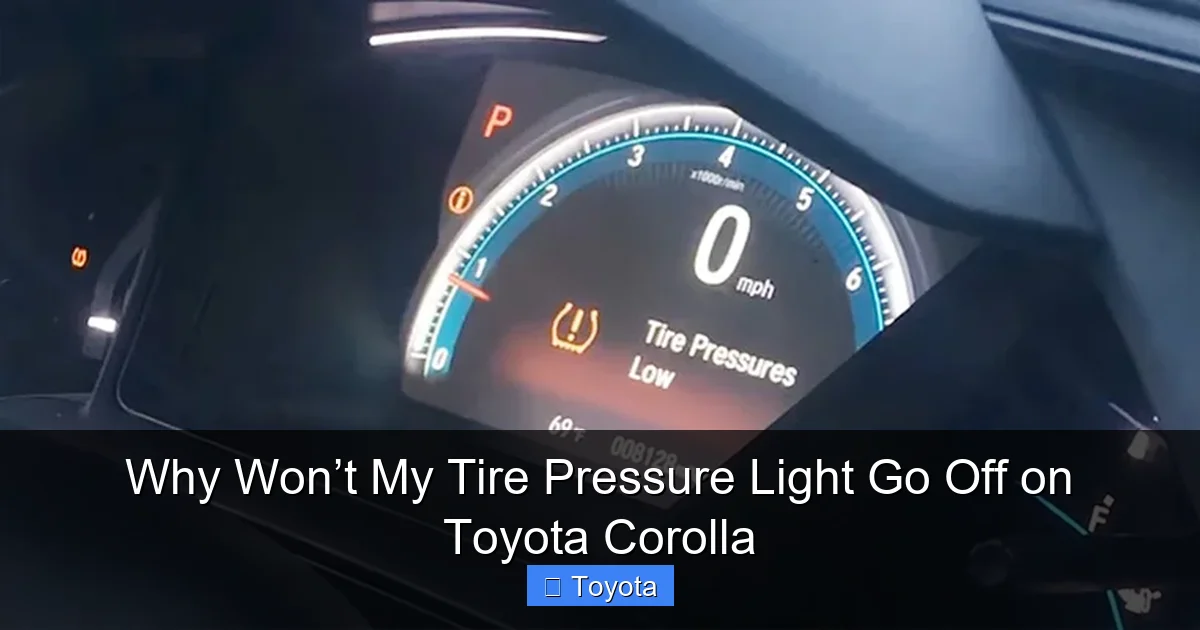
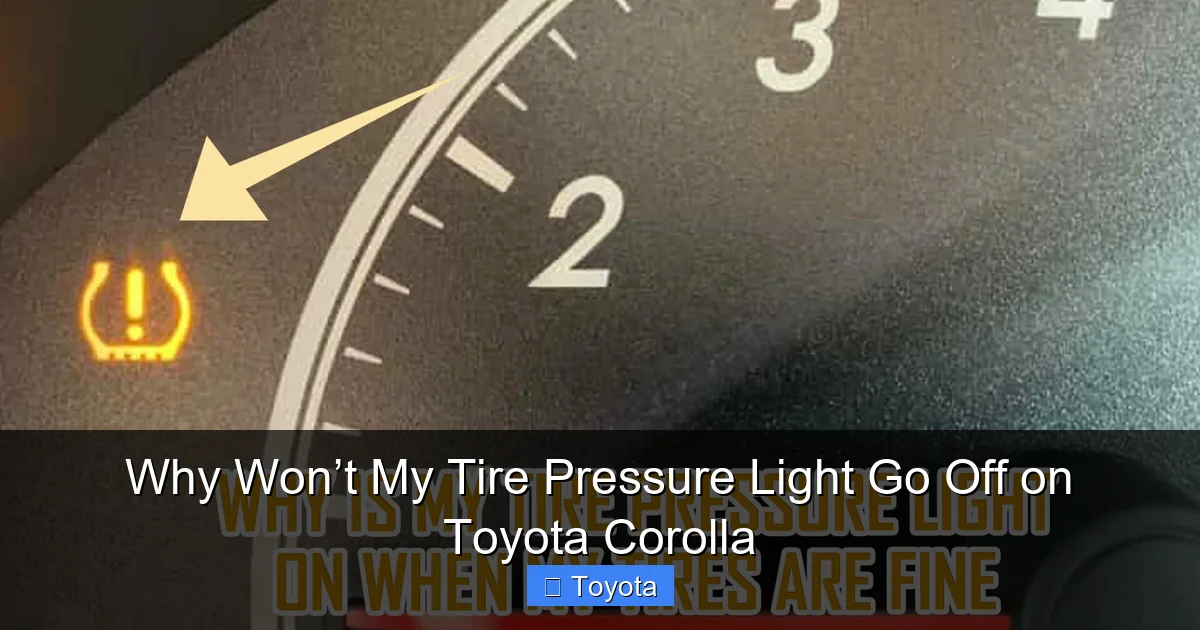
You start your Toyota Corolla, and there it is—the little yellow exclamation point inside a tire cross-section. The Tire Pressure Monitoring System (TPMS) warning light is on again. You check the tires with your gauge, they look fine, maybe even a little over-inflated from the last fill-up. You drive for a few miles, expecting it to turn off as the system “re-learns” the correct pressure. But it doesn’t. It just sits there, glaring at you from the dashboard, a constant, low-grade annoyance that makes every drive feel slightly stressful. Why won’t my tire pressure light go off on my Toyota Corolla? It’s a fantastic question, and the answer isn’t always as simple as “air in the tires.”
This light is your car’s way of saying, “Hey, something’s up with my tire pressure monitoring system.” For a reliable car like the Corolla, a persistent TPMS light is almost always a fixable issue, but the fix depends entirely on the root cause. It could be a five-minute DIY job, or it might require a trip to the shop. Let’s break down every possible reason, from the mundane to the technical, and walk through exactly how to diagnose and solve this problem for your specific model year Corolla.
Understanding Your Corolla’s TPMS: It’s Smarter Than You Think
Before we troubleshoot, we need to understand what we’re dealing with. Since 2007, all vehicles sold in the U.S., including the Toyota Corolla, have had a TPMS. There are two main types, and knowing which one your Corolla has is half the battle.
Visual guide about Why Won’t My Tire Pressure Light Go Off on Toyota Corolla
Image source: hondatheotherside.com
Direct vs. Indirect TPMS: What’s in Your Corolla?
Direct TPMS is the most common system in modern Corollas (generally 2014 and newer). It uses small, battery-powered sensors mounted inside each wheel valve stem. These sensors literally measure the air pressure and temperature inside the tire and transmit that data wirelessly to your car’s computer. If any tire’s pressure is 25% or more below the recommended level, the system triggers the warning light. The sensor itself can fail, its battery can die (they last 7-10 years), or the signal can be interrupted.
Indirect TPMS was used on some older Corollas (pre-2014 models). It doesn’t use physical sensors. Instead, it uses the existing Anti-lock Braking System (ABS) wheel speed sensors. The computer learns the “normal” rotational speed of each wheel. An under-inflated tire is slightly smaller in diameter, so it spins faster. The system detects this difference in wheel speed and triggers the light. Problems here are often related to the ABS system or mismatched tires.
How to tell which you have? If your Corolla has valve stems that look like standard metal or black plastic caps (no special sensor-looking part), it likely uses indirect TPMS. If you see a larger, often silver or black, electronic-looking cap, that’s the sensor cap for a direct system. The easiest way is to check your owner’s manual or look for a sticker on the driver’s door jamb that says “TPMS.” Most 2014+ Corollas have direct systems.
Common Reasons Your TPMS Light Won’t Turn Off
Now, let’s play detective. Here are the most frequent culprits, in order of likelihood.
Visual guide about Why Won’t My Tire Pressure Light Go Off on Toyota Corolla
Image source: tirehubz.com
1. Actual Low Tire Pressure (The Obvious One)
This is still the #1 cause. Tires naturally lose about 1 PSI per month. A nail or slow leak can drain pressure quickly. Cold weather is a huge factor—for every 10°F drop in temperature, tire pressure decreases by about 1-2 PSI. So, that light coming on in the morning after a cold snap is normal. The fix is simple: use a proper tire pressure gauge (not the one at the gas station) to check all four tires and the spare (if equipped with a sensor!). Inflate them to the pressure listed on the sticker inside your driver’s door jamb, not the number on the tire sidewall. That sidewall number is the max pressure, not the recommended pressure for your Corolla.
2. A Recent Tire Service (The “Oops, They Forgot” Reason)
Did you just get new tires, a rotation, or a flat repaired? This is a classic scenario. The technician may have inflated the tires perfectly but forgotten to reset the TPMS system. In a direct system, the sensors are still there, but the car’s computer needs to be told to recognize the new “normal” pressure for those specific sensors. This is a very common reason the light won’t go off after tire work. Always ask the shop, “Did you reset the TPMS light?” when you pick up your car.
3. Faulty or Dead TPMS Sensor (The Direct System Nemesis)
Sensors are electronic components living in a harsh environment (heat, cold, road salt, moisture). They can fail. The most common failure is a dead internal battery. Since the battery is sealed inside the sensor, the entire sensor must be replaced. A failed sensor will either stop transmitting data (causing a “sensor not detected” code) or send corrupted data. A single bad sensor can keep the light on. Sensors can also be physically damaged during tire mounting if the technician isn’t careful.
4. The Reset Wasn’t Done Correctly (User Error)
You followed a guide, pressed the button, but the light is still on. This happens because the reset procedure must be done exactly as specified, often requiring the car to be in the “ON” position but engine off, or in a specific drive mode. The steps differ between model years. For example, a 2020+ Corolla uses the multi-information display menu, while a 2015-2019 might have a dedicated physical button. Doing the wrong procedure for your year will fail.
5. Extreme Temperature Fluctuations (The Seasonal Guest)
As mentioned, cold weather reduces pressure. But here’s the twist: if you inflate your tires on a warm day to the correct PSI, and then a polar vortex hits, the pressure can drop enough to trigger the light. The system is working correctly! The fix is to add a little air when it’s cold to bring it back to spec. Conversely, very hot weather can over-inflate tires, which can also sometimes trigger a fault if a sensor reads too high, though this is less common.
6. A Problem with the Indirect System (For Older Corollas)
If your older Corolla uses indirect TPMS, the issue is likely not “low pressure” but a system calibration problem. The system needs to “learn” the new rolling diameter of your tires. This is often done by driving at a specific speed (usually 50+ mph) for several minutes after resetting or after a tire change. If the tires are mismatched in size or tread depth (like after a single tire replacement), the system may get confused and light up. An issue with the ABS wheel speed sensor itself can also trigger the TPMS light.
7. A Faulty TPMS Control Module or Wiring
This is rare but possible. The computer that receives the sensor signals (often part of the Body Control Module) can fail. Wiring to the antenna modules (which receive the sensor signals around the wheel wells) can be damaged or corroded. This is a professional-level diagnosis.
Step-by-Step: How to Diagnose & Fix the Problem on Your Corolla
Let’s get practical. Follow this flowchart to solve your problem.
Visual guide about Why Won’t My Tire Pressure Light Go Off on Toyota Corolla
Image source: offroadingpro.com
Step 1: The Manual Pressure Check (Non-Negotiable)
Get a reliable digital tire pressure gauge. Remove the valve cap, press the gauge on firmly, and note the reading. Do this for all four tires when they are cold (driven less than 1-2 miles). Compare each reading to the recommended PSI on your driver’s door jamb sticker. Inflate any tire that is low. If a tire is significantly lower than the others, you have a leak—get it inspected. After inflating, drive the car for 5-10 minutes at moderate speed. The light should go off within a few miles if pressure was the only issue. If it stays on, proceed to Step 2.
Step 2: Perform the Correct Reset Procedure for YOUR Model Year
This is crucial. Here are the general methods for recent Corollas. Consult your owner’s manual for the exact steps for your specific year and trim.
- For 2020+ Corollas (with Digital Gauge Cluster): Turn ignition to “ON” (engine off). Use the steering wheel buttons to navigate to the Vehicle Settings menu. Find Tire Pressure or TPMS. Select Initialize or Set Pressure. The system will confirm. Drive normally; the light should go off after sensors are re-read.
- For 2014-2019 Corollas (with Physical Button): Many have a dedicated TPMS reset button, often located under the steering wheel, near the hood release, or in the glove box. With the ignition ON (engine off), press and hold the button until the TPMS light blinks three times, then release. Start the engine and drive for 20-30 minutes at varying speeds. The light should turn off after the system re-learns.
- For Pre-2014 (Indirect System): The reset is often done through the gauge cluster menu. You may need to drive at 50+ mph for 10-15 minutes after resetting to allow the system to re-calibrate. Ensure all tires are exactly the same size and tread depth.
Important: If the light comes back on immediately or flashes during the reset process, it indicates a sensor fault, not a pressure issue.
Step 3: The “Wait and See” for Temperature
If you live in an area with wild temperature swings, and you’ve confirmed pressures are correct, sometimes the light just needs a day or two to stabilize as the tires acclimate to the new temperature. If it’s been more than 24-48 hours and the light is still solid (not flashing), proceed to Step 4.
Step 4: Seek Professional Diagnosis
If you’ve completed Steps 1-3 and the light remains stubbornly on, it’s time for a pro. They will use a specialized TPMS scan tool to:
- Read the specific TPMS trouble code stored in your car’s computer.
- Check the signal strength and battery life of each individual sensor.
- Test each sensor for proper function.
- Identify if the problem is a single bad sensor, a weak battery, or a system module fault.
Replacing a direct TPMS sensor typically costs $50-$150 per sensor for the part plus labor. Some shops will try to salvage the valve stem and replace just the sensor core, which is cheaper. For indirect systems, diagnosis might focus on the ABS system.
Prevention and Pro-Tips for Your Corolla
You can avoid most TPMS headaches with a little routine care.
Check Pressure Monthly and Before Long Trips
Don’t rely on the TPMS light as your primary check. It only warns you when pressure is 25% low. That’s dangerously under-inflated! By checking monthly with a good gauge, you’ll catch slow leaks early and maintain optimal fuel economy, tire wear, and safety.
Be Diligent After Tire Service
When you get new tires, a rotation, or a repair, always verify the shop reset the TPMS light before you leave. Watch them do it if possible. If they say it’s not needed, ask why—they should have a reason (e.g., “the sensors were replaced and need to be programmed”). For a simple rotation on a direct system, a reset is almost always required.
Understand Sensor Lifespan
If your Corolla is 8-10 years old and you start getting persistent TPMS lights with good tire pressure, start budgeting for sensor replacement. The internal batteries are not serviceable. When one goes, the others are likely not far behind. Some owners replace all four at once to avoid future trips to the shop.
Don’t Ignore a Flashing Light
A solid TPMS light means “low pressure or system needs reset.” A flashing TPMS light (usually for 60 seconds on startup then solid, or continuous flashing) means “TPMS system malfunction.” This is not a tire pressure issue—it’s an electronic fault. Drive cautiously and get it diagnosed immediately. Driving with a flashing TPMS light can disable other safety systems like stability control in some vehicles.
Consider Aftermarket Sensor Options
When replacing sensors, you can often choose between an expensive OEM (Toyota) sensor or a high-quality aftermarket sensor. Many reputable brands (like Schrader, which is often OEM) make direct replacements. Ensure any aftermarket sensor is compatible with your Corolla’s year and has a new battery. Some shops also offer “programmable” sensors that can be cloned from your old ones, saving the need for a costly relearn procedure at a dealer.
Conclusion: Don’t Let the Light Win
That persistent tire pressure light on your Toyota Corolla is more than just a dashboard nuisance—it’s a communication from your car’s safety system. The vast majority of the time, the solution is straightforward: check your pressures with a real gauge, inflate to the correct spec on your door jamb, and perform the precise reset procedure for your model year. If that doesn’t work, you’re likely dealing with a failed sensor, a forgotten reset from a recent tire service, or a system fault. By understanding the “why” behind the light, you move from frustrated driver to informed problem-solver. You can handle the simple checks yourself, but know when to call in a professional with the right scan tool. Keep up with monthly pressure checks, confirm resets after tire work, and you’ll keep your Corolla’s TPMS light where it belongs—off. Your tires, your fuel economy, and your peace of mind will thank you.
Frequently Asked Questions
How long does it take for the tire pressure light to turn off after inflating tires?
After correcting the pressure, drive your Corolla at speeds above 30 mph for 5-10 minutes. The sensors will transmit the new pressure, and the light should turn off within a few miles. If it doesn’t, the pressure may not be correct, there’s a slow leak, or a reset is required.
Can cold weather cause the tire pressure light to come on and stay on?
Yes, cold weather is a primary cause. For every 10°F drop in temperature, tire pressure decreases by about 1-2 PSI. This can trigger the light. Inflate your tires to the recommended PSI (found on the door jamb sticker) when they are cold to compensate. The light may go off once the tires warm up from driving, but it’s best to adjust the pressure when cold.
My tire pressure light is flashing. What does that mean?
A flashing TPMS light indicates a system malfunction, not just low pressure. It means the car’s computer isn’t receiving a clear signal from one or more sensors or there’s an internal fault. You should have it diagnosed by a professional immediately, as this is not fixable by simply adding air.
Will disconnecting the battery turn off the tire pressure light?
No. Disconnecting the battery may clear some temporary codes, but the TPMS system will reactivate and the light will return as soon as the system rechecks the sensor signals, which happens immediately upon starting the car. The proper reset procedure must be followed.
Can a bad spare tire cause the TPMS light to come on?
Yes, if your spare tire is equipped with a TPMS sensor (many full-size spares are). If the spare is significantly under-inflated or its sensor has a dead battery, it can trigger the warning light. Always check the spare’s pressure if the light comes on unexpectedly.
When should I just replace the TPMS sensors instead of trying to fix the light?
Consider replacing sensors if your Corolla is over 8-10 years old (sensor batteries die), if a diagnostic shows one or more sensors have weak or dead batteries, or if you’ve had multiple sensor failures. Replacing all four at once can be cost-effective long-term and prevents future repeat visits. A professional can test each sensor’s battery life.