
Why Won’t My Toyota Corolla Tire Pressure Light Go Off?

A stubborn tire pressure light on your Toyota Corolla usually means the Tire Pressure Monitoring System (TPMS) has detected an issue, most commonly low pressure in one or more tires. However, it can also be caused by a faulty sensor, a problem with the spare tire, recent tire service, or a system glitch. Resetting it often requires inflating tires to the correct PSI and driving the car, but sensor failure may need a professional. Don’t ignore it—proper tire pressure is crucial for safety, fuel economy, and tire wear.
That little yellow exclamation point inside a tire cross-section on your dashboard—the Tire Pressure Monitoring System (TPMS) light—is one of the most common and persistent warnings in a Toyota Corolla. You inflate your tires, you check the pressure, and yet it stubbornly remains lit. It’s more than just an annoyance; it’s your car’s way of saying something is wrong with the very thing connecting you to the road. Understanding why your Toyota Corolla’s tire pressure light won’t go off is the first step to fixing it safely and efficiently. This guide will walk you through every possible reason, from the simple to the complex, and give you the tools to solve the mystery.
Key Takeaways
- Low Pressure is the #1 Culprit: The light almost always means at least one tire is significantly underinflated compared to the manufacturer’s recommended PSI.
- It’s a TPMS Alert, Not Just a Gauge: Your Corolla uses electronic sensors in each wheel (direct TPMS) or wheel speed data (indirect TPMS) to monitor pressure, and the light signals a fault in that system.
- Resetting Requires Correct Pressure & Driving: Simply adding air isn’t always enough; the system often needs to verify proper pressure during a short drive (usually 5-10 minutes at >25 mph) to turn off.
- Temperature is a Major Factor: Cold weather can cause a legitimate drop in tire pressure, triggering the light. The light may go off on its own as tires warm up during driving.
- Faulty Sensors are Common: TPMS sensors have batteries that last 7-10 years. A dead battery or damaged sensor will keep the light on until the sensor is replaced.
- Spare Tires Can Be the Issue: Many Corollas have a full-size spare with its own TPMS sensor. If the spare is low or the sensor is faulty, it will trigger the warning.
- Professional Help is Needed for Sensor Issues: If reset procedures fail, a tire shop or dealer can diagnose sensor health with a scan tool and replace faulty units.
📑 Table of Contents
- Understanding TPMS: Your Corolla’s Tire Pressure Watchdog
- The Most Common Reasons Your Light Stays On
- Step-by-Step: How to Reset Your Corolla’s TPMS Light
- The Seasonal Rollercoaster: Temperature and Your TPMS Light
- When It’s Definitely a Sensor: Diagnosis and Replacement
- Knowing When to Call a Professional
- Conclusion: Safety First, Annoyance Second
Understanding TPMS: Your Corolla’s Tire Pressure Watchdog
Before we dive into fixes, let’s understand what we’re dealing with. Since 2007, all U.S. vehicles, including the Toyota Corolla, have been required to have a TPMS. It’s a safety system mandated to warn drivers of significantly underinflated tires, which can lead to poor handling, increased wear, reduced fuel economy, and even blowouts.
Direct vs. Indirect TPMS: Which Does Your Corolla Have?
Most modern Toyota Corollas (typically 2014 and newer) use a Direct TPMS. This means each wheel has a small electronic sensor mounted on the valve stem inside the tire. These sensors constantly measure air pressure and temperature, transmitting that data to your car’s computer. If pressure drops 25% or more below the recommended level, the light illuminates. Some older models might use an Indirect TPMS, which uses the Anti-lock Braking System (ABS) wheel speed sensors to detect differences in rotation speed that indicate underinflation. However, indirect systems are less common in recent Corollas and often require a reset via a button after tire rotation or inflation.
Knowing your system type matters. A direct system failure is almost always a sensor issue. An indirect system might need a simple recalibration. Your owner’s manual is the best source to confirm your Corolla’s specific system.
The Most Common Reasons Your Light Stays On
Now, to the heart of the problem. Why, after you’ve added air, does that light still glare at you from the dash? Here are the top suspects, in order of likelihood.
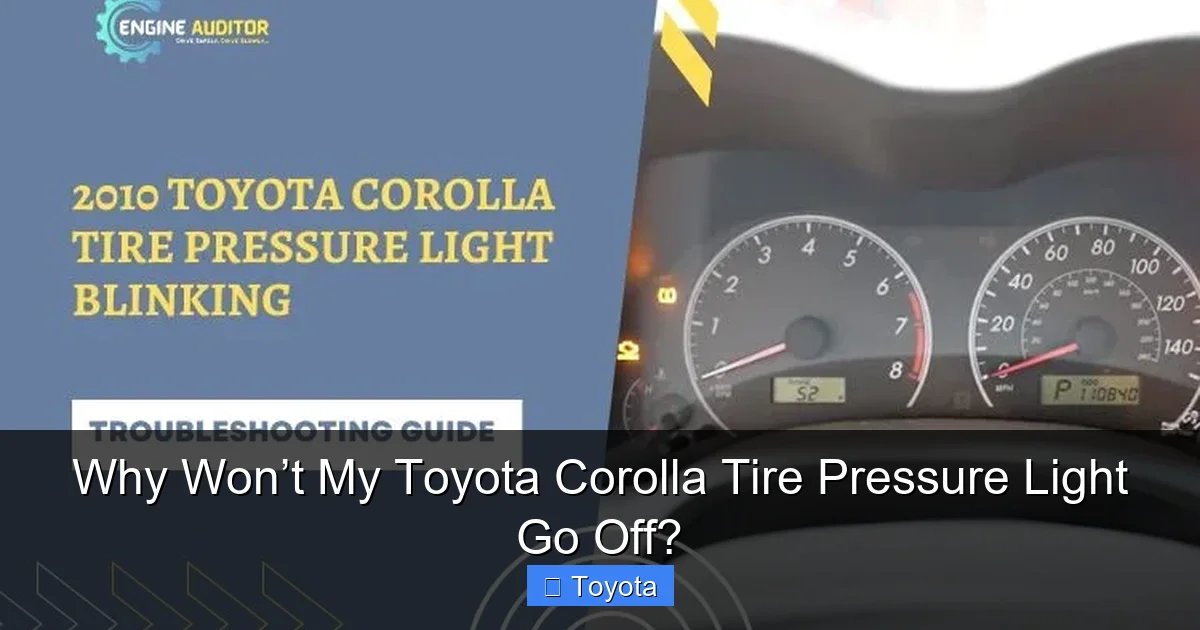
Visual guide about Why Won’t My Toyota Corolla Tire Pressure Light Go Off?
Image source: engineauditor.com
1. The Obvious One: Genuine Low Tire Pressure
This seems simple, but it’s the cause 80% of the time. You might have added air, but did you add enough? The recommended pressure is not on the tire sidewall (that’s the max). It’s on a sticker inside the driver’s door jamb or in your owner’s manual. For a typical Corolla, it’s often 32 PSI for all four tires, but always verify your specific placard.
- Practical Tip: Use a high-quality, digital tire pressure gauge. Cheap pencil gauges can be inaccurate. Check pressures when tires are cold (driven less than 2 miles). Fill each tire to exactly the PSI listed on your door jamb sticker. If the light was on for low pressure, it should go off after driving for 5-10 minutes at highway speeds. If it doesn’t, move to the next cause.
2. The Spare Tire is the Sneaky Culprit
Many people forget: your full-size spare tire (if your Corolla has one) also has a TPMS sensor! If that spare is low on air, it will trigger the same warning light as a regular tire. This is a classic “gotcha” that drives drivers crazy. Check the pressure in your spare tire immediately. Inflate it to the pressure specified on the spare tire itself or in your manual.
3. Recent Tire Service or Rotation
If you’ve recently had your tires rotated, patched, or replaced, the TPMS system may need to be manually reset. The sensors might have been disturbed, or the system needs to relearn which sensor is at which wheel location. This is especially true for indirect TPMS systems. After any tire work, the light often comes on and needs a specific reset procedure.
Internal Link Opportunity: For a general overview of why the light comes on in various situations, a resource like Why Is My Tire Pressure Light On can provide foundational knowledge that applies across many models, including your Corolla.
4. A Faulty or Dead TPMS Sensor
TPMS sensors are not immortal. They are battery-powered, sealed units with a typical lifespan of 7-10 years. When the battery dies, the sensor stops transmitting, and the TPMS light will illuminate with a code for a “sensor not responding.” Sensors can also be physically damaged by curb impacts, potholes, or during tire mounting/dismounting. A damaged sensor will either send bad data or no data, keeping the light on.
- Example: You hit a deep pothole hard. Your tire looks fine, but the sensor on that wheel may have been jarred loose or its internal components cracked. The car now gets no signal from that wheel, triggering the alert.
5. Extreme Temperature Changes
Physics is at play here. For every 10°F drop in temperature, tire pressure decreases by about 1-2 PSI. If you inflated your tires on a warm afternoon and then experienced a cold night, the pressure could have dropped enough to trigger the light. Often, as you drive and the tires warm up, the pressure increases and the light will turn off on its own after 15-20 minutes of driving. This is a normal, temporary condition, but it’s a sign your pressures are borderline and should be adjusted when cold.
Internal Link Opportunity: The phenomenon of pressure fluctuations with temperature is universal. An article like Why Does Tire Pressure Go Down When It’s Cold explains this principle in detail, which is highly relevant to your persistent Corolla light.
6. System Malfunction or Glitch
Like any computer system, the TPMS control module can have a software hiccup or electrical fault. This is less common but possible. A reset of the system’s memory (often done with a scan tool at a shop) might be required. Corrosion on the sensor’s valve stem connection or damage to the antenna ring around the wheel well can also interrupt the signal.
Step-by-Step: How to Reset Your Corolla’s TPMS Light
Once you’ve confirmed all tires (including the spare) are inflated to the correct cold pressure, follow these steps to attempt a reset. The process varies slightly by model year.
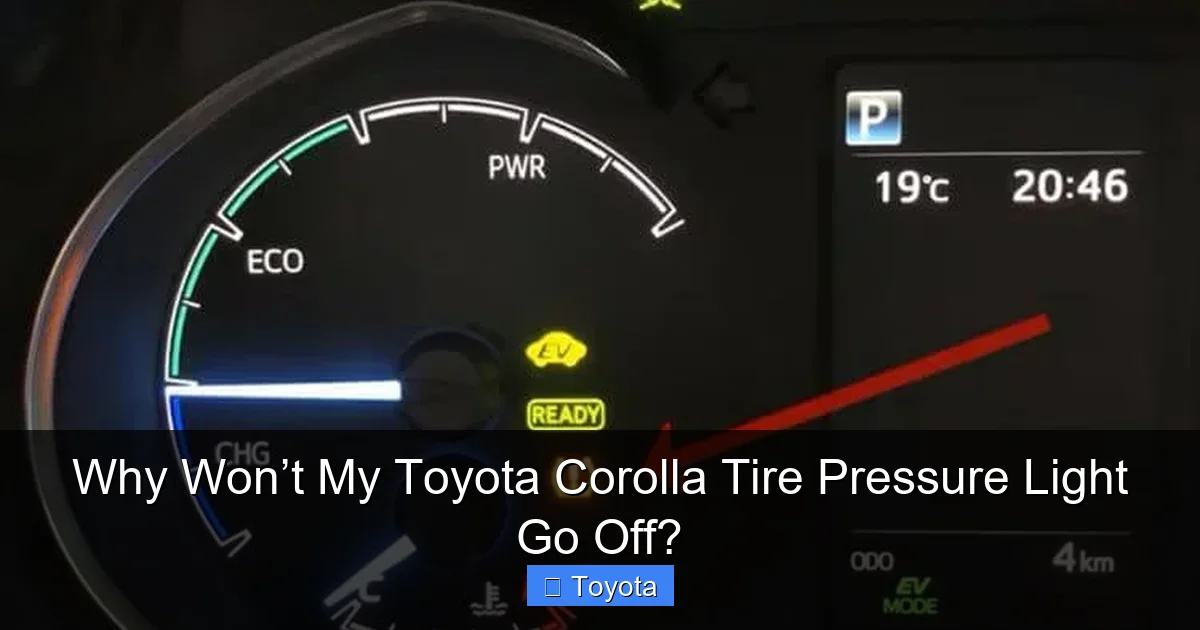
Visual guide about Why Won’t My Toyota Corolla Tire Pressure Light Go Off?
Image source: engineauditor.com
The Standard Drive Cycle Method (Most Common)
This is the first and easiest method. After correcting pressures:
- Ensure the ignition is ON (engine can be off).
- Drive the vehicle at a speed of 25 mph (40 km/h) or higher for at least 5-10 minutes.
- The TPMS light should blink a few times and then turn off once the system verifies all sensors are reporting proper pressure.
If it doesn’t turn off after this, the system may not be receiving a signal from one or more sensors, indicating a potential sensor fault.
The Manual Reset Button Method
Many Corollas have a dedicated TPMS reset button, usually located under the dash near the steering column or in the glove compartment. Consult your owner’s manual for the exact location.
- Turn the ignition to the ON position (do not start the engine).
- Press and hold the TPMS reset button until the TPMS light on the dash blinks three times slowly, then release.
- Start the engine and drive for the same 5-10 minute cycle as above.
This tells the car’s computer to start looking for sensor signals again. If a sensor is missing or faulty, the light will likely return.
Using a TPMS Scan Tool
This is what professionals use. A mechanic or tire shop will plug a diagnostic scanner into the OBD-II port. They can read the specific TPMS fault code (e.g., “Sensor ID 3 Low Battery” or “No Signal from Sensor 2”). They can then activate each sensor individually to see which one is problematic. This is the most definitive way to diagnose a sensor issue.
Note: If your Corolla is from a model year that uses an indirect system (older), the reset often involves a different button sequence or driving at a specific speed range. Again, your owner’s manual is key.
The Seasonal Rollercoaster: Temperature and Your TPMS Light
We touched on temperature, but it deserves its own section because it’s a perpetual source of confusion. Your TPMS light might come on every winter morning and then disappear by lunchtime. Here’s the cycle:
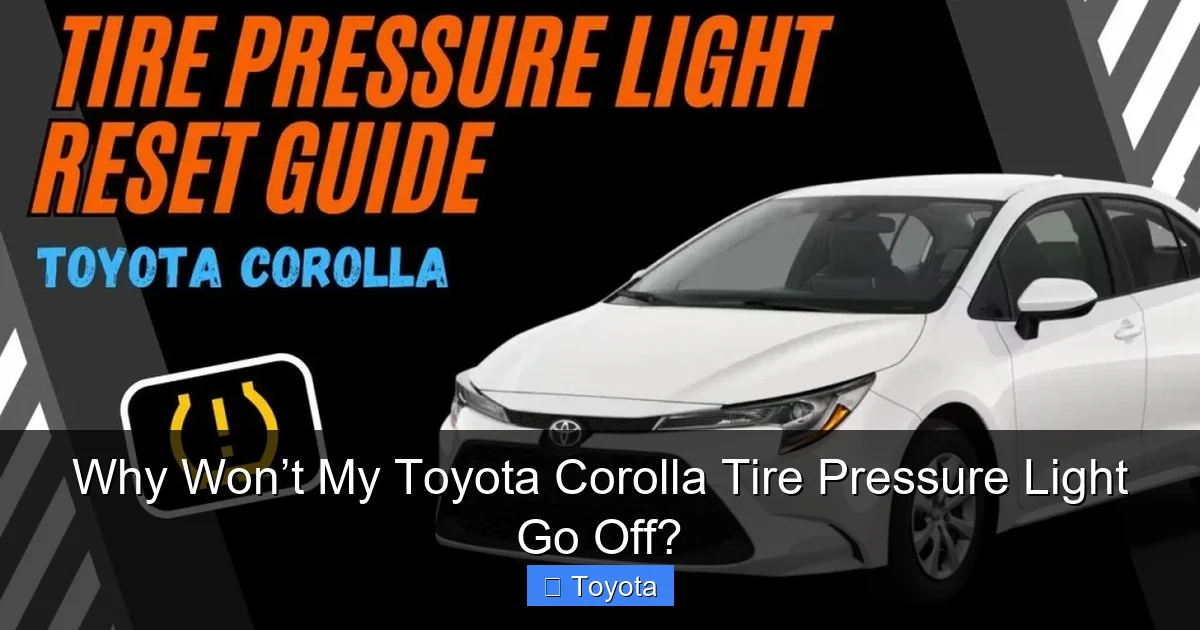
Visual guide about Why Won’t My Toyota Corolla Tire Pressure Light Go Off?
Image source: seventrumpet.com
- Cold Night: Air condenses, pressure drops. Light comes on.
- Morning Drive: Tires heat up from friction and flexing, pressure rises. The light goes off once pressure is back above the 25% threshold.
This is the system working as intended! However, it’s a warning that your pressures are too low when cold. The correct action is to add air when the tires are cold to bring them up to the placard PSI. This will give you a safety buffer so the light doesn’t activate on the next cold snap. Ignoring it and just waiting for the light to go off means you’re driving on underinflated tires for the first few miles, which wears the tire edges prematurely and hurts fuel economy.
When It’s Definitely a Sensor: Diagnosis and Replacement
If you’ve:
- Inflated all tires (and spare) to the exact correct cold pressure.
- Driven for 15+ minutes at highway speeds.
- The light is still on solid (not blinking, which can indicate a system fault).
…then you likely have a faulty TPMS sensor. Diagnosis requires a scan tool to identify which sensor is bad. Replacement is straightforward but requires special tools and knowledge.
What’s Involved in TPMS Sensor Replacement?
A technician will:
- Break the bead on the tire and remove it from the wheel.
- Replace the sensor unit (the valve stem itself is often part of the sensor).
- Remount and balance the tire.
- Program the new sensor’s unique ID code into your Corolla’s TPMS computer so it recognizes it.
Cost: A single sensor replacement typically costs $80-$150 for the part plus $50-$100 for labor per wheel, so budget $150-$300 per wheel. It’s often done when getting new tires.
Internal Link Opportunity: While this article focuses on the Corolla, the diagnostic and replacement process is similar for many vehicles. For another Toyota model, a guide like How To Reset Tire Pressure Light On Toyota Sienna provides a model-specific reset procedure that can offer parallels and additional context for Toyota TPMS systems.
Knowing When to Call a Professional
You’re a capable DIYer, but some situations call for a pro:
- The light is blinking: This often indicates a system communication error, not just low pressure.
- Multiple sensors are bad: If two or more sensors fail around the same time, it could indicate an issue with the vehicle’s antenna or control module.
- You’ve replaced sensors but the light returns: This suggests a programming issue or a deeper electrical fault.
- You get a specific sensor fault code: A shop can pinpoint the exact problem.
- You’re uncomfortable working with tires and sensors: TPMS sensors are delicate. Improper mounting can damage them.
A qualified tire shop or Toyota dealership has the specialized scan tools (like the Toyota Techstream) to diagnose TPMS codes accurately. They can also ensure new sensors are properly programmed to your vehicle.
Conclusion: Safety First, Annoyance Second
That persistent tire pressure light in your Toyota Corolla is a vital safety feature, not just a nuisance. The most common fix is also the simplest: ensure all tires, including the spare, are inflated to the exact PSI listed on your door jamb sticker when cold, then drive for 10 minutes. If that fails, you’re likely dealing with a faulty TPMS sensor that needs professional diagnosis and replacement. Don’t disable the light or ignore it. Driving on improperly inflated tires compromises your Corolla’s famous reliability, handling, and fuel efficiency. By understanding your TPMS and following these steps, you can turn that light off for good and drive with confidence.
Frequently Asked Questions
Why is my tire pressure light on when my tires are fine?
This is usually caused by a faulty TPMS sensor with a dead battery or physical damage. A spare tire with low pressure can also trigger it. A system glitch requiring a reset is another possibility. A professional scan is needed to diagnose a sensor failure.
How do I reset the tire pressure light on my Toyota Corolla?
First, inflate all tires (including the spare) to the PSI on your door jamb sticker when cold. Then, drive at 25+ mph for 5-10 minutes. If it doesn’t reset, locate and hold the TPMS reset button (see manual) until the light blinks, then drive again. If still on, a sensor is likely faulty.
Can I drive with the tire pressure light on?
You can, but it’s not advisable. If the light is on due to low pressure, you risk poor handling, excessive tire wear, and a potential blowout. If it’s a sensor fault, you’ve lost your critical pressure warning system. Get it diagnosed promptly.
How much does it cost to fix a TPMS sensor on a Corolla?
Replacing a single TPMS sensor, including parts and labor, typically costs between $150 and $300. Prices vary by location and whether you have it done at a dealership or an independent tire shop. It’s often cost-effective to replace sensors when getting new tires.
How long do TPMS sensors last in a Toyota Corolla?
TPMS sensor batteries are designed to last 7-10 years. As your Corolla ages, sensor failure becomes more common. If your car is over 7 years old and the light comes on with correct tire pressures, a dead sensor battery is a strong possibility.
Will the tire pressure light go off by itself?
Yes, if the cause was a temporary pressure drop due to cold weather. As you drive and the tires warm up, pressure increases and the light may turn off. However, if the light was triggered by a true low-pressure condition that you haven’t fixed, or by a faulty sensor, it will not go off on its own and requires action.
