Why Is My Vsc Light and Check Engine Light on in My Toyota Highlander?

Contents
- 1 Key Takeaways
- 2 📑 Table of Contents
- 3 Understanding the Dashboard Duo: What Each Light Means
- 4 The Most Common Culprits: Why Both Lights Are On
- 5 Diagnostic Journey: From Simple to Complex
- 6 Immediate Actions and Long-Term Solutions
- 7 When to Seek Professional Help
- 8 The Bottom Line: Safety and Performance Are at Stake
- 9 Frequently Asked Questions

Car Bumper Protector

Car LED Headlight Bulb

Car Back Support Cushion

Car Mud Flaps (Universal)
When your Toyota Highlander’s VSC (Vehicle Stability Control) and Check Engine lights illuminate together, it’s rarely a coincidence. The Check Engine light indicates an engine or emissions system fault, which often causes the car’s computer to automatically disable the VSC system for safety. Common triggers range from a loose gas cap to faulty oxygen sensors or catalytic converters. Ignoring both lights is risky—it can lead to poor performance, failed emissions tests, and compromised safety systems. The first critical step is retrieving the specific engine trouble codes with an OBD2 scanner to pinpoint the exact problem before proceeding with repairs.
You’re cruising down the highway in your Toyota Highlander, the ride is smooth, and everything seems fine. Then, you glance at the dashboard and your stomach drops. Two bright, unwelcome lights are staring back at you: the ominous yellow Check Engine light and the VSC (Vehicle Stability Control) light. What gives? Why are they teaming up against you? If you’re a Highlander owner, this is a common but important puzzle to solve. These lights aren’t just random warnings; they’re connected in a very specific way. Let’s break down exactly what’s happening, why it matters, and what you need to do next, in simple, plain language.
Key Takeaways
- Linked Systems: The Check Engine light (MIL) and VSC light are directly connected. An engine/emissions fault typically triggers the VSC to shut off.
- Common Triggers: Faulty oxygen sensors, a loose or damaged gas cap, and catalytic converter issues are the most frequent causes for this dual-light scenario.
- Safety First: Driving with both lights on means your stability and traction control systems are disabled, reducing safety in slippery or emergency conditions.
- Code is King: You must read the specific OBD2 trouble codes. The generic “Check Engine” description is useless without the code (e.g., P0420, P0171).
- Simple Fixes Exist: Sometimes, the solution is as simple as tightening or replacing the gas cap, which can clear the code and restore VSC function.
- Don’t Reset First: Never just reset the lights without addressing the underlying problem. The light will return, and you may erase valuable diagnostic data.
- Professional Help Needed: For complex codes related to the catalytic converter, EVAP system leaks, or multiple sensor failures, a certified mechanic is essential.
📑 Table of Contents
Understanding the Dashboard Duo: What Each Light Means
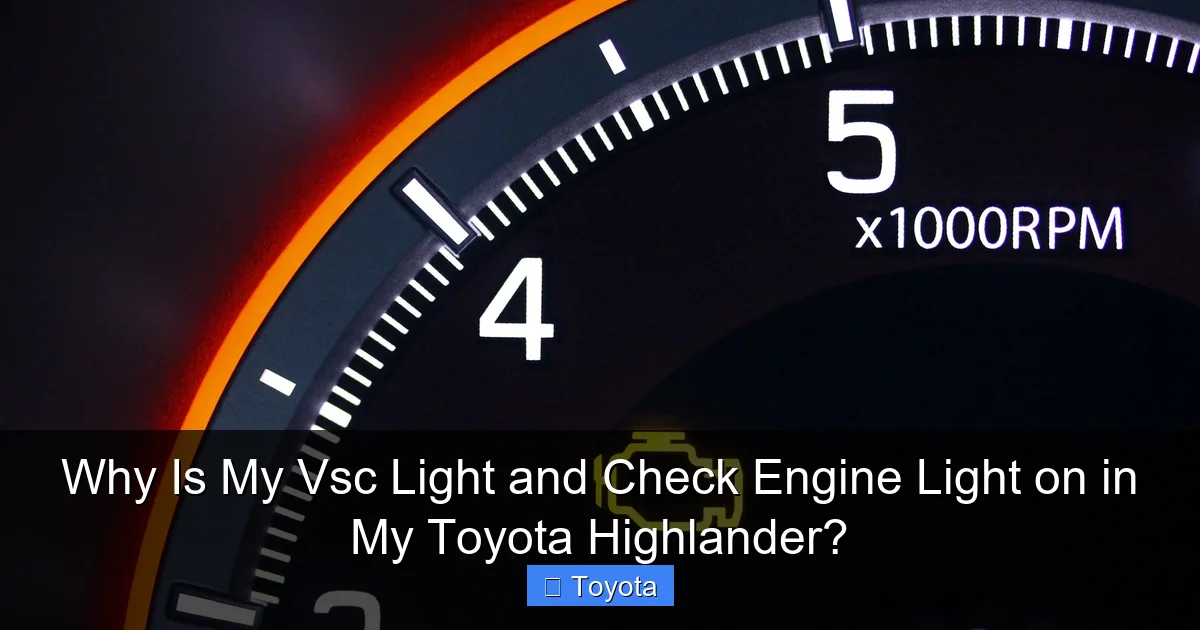
Before we connect the dots, we need to understand each light individually. Think of your car’s computer systems as a team. The Check Engine light (officially the Malfunction Indicator Lamp or MIL) is the team captain for engine and emissions health. It’s monitored by the Powertrain Control Module (PCM). When the PCM detects a problem that could increase emissions or harm the engine, it turns this light on and stores a diagnostic trouble code (DTC).
The VSC light is part of your safety team. VSC is Toyota’s name for its electronic stability control system. It uses a network of sensors (steering angle, yaw rate, wheel speed) to detect if you’re losing traction or beginning to skid. It can then automatically apply brake pressure to individual wheels and reduce engine power to help you stay on your intended path. The VSC system is incredibly sophisticated and relies on data from several other systems to work correctly.
The Critical Link: Why One Light Brings a Friend
Here’s the most important concept: Your Highlander’s computer is designed to disable the VSC system if it detects a fault that could affect its accuracy or the basic operation of the vehicle. And the most common source of such a fault is the powertrain—the engine and transmission. Many of the sensors VSC needs, like wheel speed sensors, are also shared with the anti-lock brake system (ABS) and engine management. If the PCM (engine computer) is already upset about an engine or emissions problem, it sends a signal to the VSC module: “Hey, we have bigger issues. Power me down until this is fixed.”
This is a deliberate safety and diagnostic design. It prevents the VSC from making incorrect corrections based on bad data from a malfunctioning engine sensor. So, in the vast majority of cases, the Check Engine light comes on first, and the VSC light follows as a consequence. You are almost always dealing with a primary engine/emissions issue that has a secondary effect on your stability control system.
The Most Common Culprits: Why Both Lights Are On
Now that we know they’re connected, what actually causes the initial Check Engine light to come on? Based on thousands of technician reports and diagnostic data, here are the top offenders for your Toyota Highlander that will trigger this dual-light warning.
Visual guide about Why Is My Vsc Light and Check Engine Light on in My Toyota Highlander?
Image source: fourwheeltrends.com
1. Oxygen Sensor (O2 Sensor) Failure
Your Highlander has multiple oxygen sensors, typically four on modern models. They monitor the amount of oxygen in the exhaust to help the PCM fine-tune the air-fuel mixture. A faulty upstream (before the catalytic converter) sensor is a classic cause. A failing sensor sends incorrect data, causing the engine to run “rich” (too much fuel) or “lean” (too little fuel). This hurts fuel economy, increases emissions, and can damage the catalytic converter. Codes like P0131-P0134 (Bank 1 Sensor 1) or P0151-P0154 (Bank 2 Sensor 1) are common. Replacing an O2 sensor is a frequent fix that will often turn off both lights.
2. The Loose or Faulty Gas Cap
Yes, it’s cliché, but it’s also the #1 simplest fix. Your fuel system is sealed (the EVAP system) to prevent gasoline vapors from escaping. A gas cap that isn’t tightened properly, is missing, or has a damaged seal will cause the PCM to detect a large leak. It will trigger a code like P0455 (EVAP System Large Leak) or P0442 (EVAP System Small Leak). This is a very common reason for both lights to come on together. Always start here: remove the cap, inspect the seal for cracks, re-tighten it until it clicks, and drive for a few cycles. The light may go out on its own.
3. Catalytic Converter Efficiency or Failure
The catalytic converter is your exhaust’s pollution-fighting hero. The PCM constantly monitors its efficiency by comparing readings from the upstream and downstream O2 sensors. If the converter isn’t cleaning the exhaust properly, it sets a code like P0420 (Catalyst System Efficiency Below Threshold). A failing converter is a more serious and expensive problem. It can cause poor acceleration, rotten egg smells, and will definitely disable your VSC. This is not a DIY fix and requires professional diagnosis and replacement.
4. Mass Airflow Sensor (MAF) Issues
The MAF sensor tells the PCM exactly how much air is entering the engine so it can deliver the correct amount of fuel. A dirty, contaminated, or failing MAF sensor will cause rough idling, hesitation, and poor fuel economy. It often triggers codes like P0101-P0103. Sometimes, cleaning it with a dedicated MAF cleaner can help, but replacement is often necessary. This sensor’s data is critical for engine management, so its failure will disable VSC.
5. Engine Misfire (P0300-P0304)
A misfire means fuel isn’t burning properly in one or more cylinders. Causes include worn spark plugs, bad ignition coils, clogged fuel injectors, or low compression. A persistent misfire (codes P0300 for random/multiple, or P0301-P0304 for specific cylinders) is a major problem. It can overheat and damage the catalytic converter quickly. The PCM will disable VSC during a severe misfire to prevent further damage. This requires immediate attention to find the misfiring cylinder’s root cause.
6. Faulty Wheel Speed Sensor (ABS Sensor)
While less common as a *primary* cause for the Check Engine light, a completely failed wheel speed sensor can sometimes trigger engine codes because that sensor’s data is so vital to both the ABS and VSC systems. More often, a bad wheel speed sensor will cause the VSC light and Traction Control (TRAC) light to blink or stay on, and may also illuminate the ABS light. However, if the communication between the ABS module and the PCM is disrupted, it can set a chassis or network code that illuminates the MIL. Codes in the C-series (like C0200, C1241) point to this. This is a classic case where the VSC light is the primary symptom of a non-engine issue.
Diagnostic Journey: From Simple to Complex
So you see the lights. Now what? Panic is not the answer. A methodical approach is. Your goal is to get the specific diagnostic trouble codes stored in your Highlander’s computer. This is the single most important step.

Visual guide about Why Is My Vsc Light and Check Engine Light on in My Toyota Highlander?
Image source: fourwheeltrends.com
Step 1: The Free and Easy Check
Before you go anywhere, perform the simplest check: your gas cap. Pull over safely (if possible), remove the cap, and re-tighten it firmly until you hear multiple clicks. Inspect the cap’s rubber seal for cracks or debris. If it’s old or damaged, consider replacing it (they are inexpensive). Then, drive normally for a few days. Often, if this was the issue, both lights will go out on their own after the PCM completes a successful drive cycle without detecting the leak.
Step 2: Read the Codes Yourself
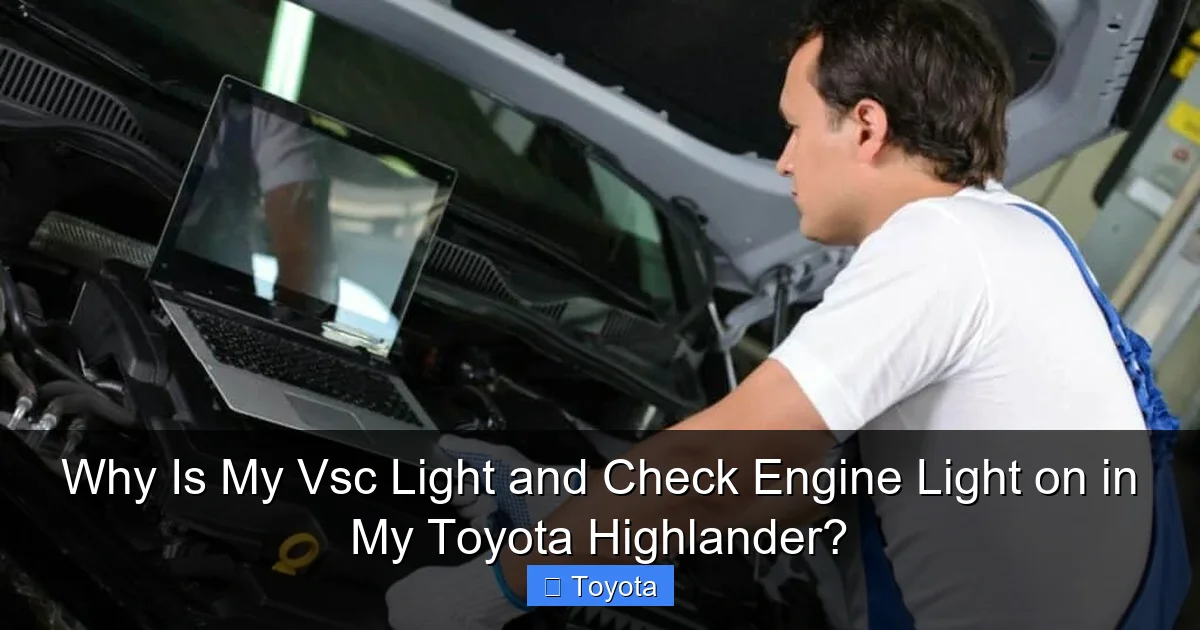
You need an OBD2 scanner. Any basic code reader (available at auto parts stores for $20-$50) will plug into the port under your dashboard (it’s required by law to be there). Turn the ignition to “ON” (don’t start), connect the scanner, and follow its prompts to read “Stored Codes” or “Permanent Codes.” Write down every code. Don’t just look for the Check Engine code; look for all codes, including any P0xxx (powertrain), C0xxx (chassis), or B0xxx (body) codes. The presence of a chassis code (like for a wheel speed sensor) can explain the VSC light directly. A code like P0420 explains both. If you’re unsure, many auto parts stores will read your codes for free.
Step 3: Interpret the Codes (The Internet is Your Friend)
Take your list of codes and search for them. For example, “Toyota Highlander P0171” or “P0420 meaning.” You’ll find detailed explanations of what each code means, common causes, and typical fixes. This research will tell you if it’s likely a simple sensor swap or a major component replacement. Be wary of forums where someone’s extreme case is presented as the norm—focus on the most common fixes listed for your specific code and vehicle year.
Immediate Actions and Long-Term Solutions
Based on your findings, here’s how to proceed.
Visual guide about Why Is My Vsc Light and Check Engine Light on in My Toyota Highlander?
Image source: urbsgarage.com
For Simple, Clear-Cut Codes (Gas Cap, MAF, Some O2 Sensors)
If your code points to a loose gas cap (P0455, P0442), tighten or replace it. Then, you can clear the code with your scanner. Drive for a week; if the light doesn’t return, you’re likely fixed. For a dirty MAF sensor (P0101), carefully clean it with MAF-specific spray (do not touch the sensing wires!). Reinstall and clear the code. For some older O2 sensor codes on high-mileage Highlanders, replacement is the cure.
For Misfire Codes (P0300-P0304)
Do not ignore these. Start with the simplest: swap the suspected bad ignition coil with a known good one from another cylinder and see if the misfire code moves. If it does, replace that coil. If not, check the spark plug in that cylinder. Also, inspect for vacuum leaks (cracked hoses), which can cause lean misfires. Addressing a misfire quickly is critical to save your catalytic converter.
For Catalytic Converter Codes (P0420/P0430)
This is a bigger deal. First, confirm it’s not a false alarm caused by a faulty downstream O2 sensor that is misreading the converter’s efficiency. Sometimes, replacing that sensor (cheaper than the converter) can solve the issue. If the converter is truly bad, it needs replacement. Get multiple quotes, as this can be a costly repair. Also, address any other underlying codes (like chronic misfires or O2 sensor codes) that may have killed the converter in the first place.
For Wheel Speed Sensor or ABS/Chassis Codes
If your scan revealed a chassis code (Cxxxx), the VSC light is the primary symptom. A failed wheel speed sensor is a common fix. These sensors can be damaged by road debris or corroded at the connector. Diagnosis might require a scan tool that can read ABS data, but visual inspection of the sensor and its wiring near each wheel hub is a good start. Replacing a wheel speed sensor is often a moderate DIY job for the mechanically inclined.
When to Seek Professional Help
Some situations absolutely require a trained technician with advanced tools.
- Multiple, Confusing Codes: If you have a mix of engine and chassis codes, or codes that seem unrelated, the issue might be a wiring problem, a bad ground, or a failing PCM itself. This requires advanced electrical diagnostics.
- Catalytic Converter Replacement: This is a major repair involving welding or exhaust system work. It’s best left to professionals who can ensure proper fit and emissions compliance.
- Persistent Codes After Repair: If you’ve replaced a part (like an O2 sensor) but the code returns, there may be an underlying issue that damaged the new part (e.g., an exhaust leak before the sensor, bad fuel quality).
- Lack of Tools/Confidence: If you don’t have an OBD2 scanner or aren’t comfortable working under the car or with electrical systems, a professional diagnosis is a wise investment. A good independent Toyota specialist or dealership technician can save you from costly misdiagnosis.
For specific Toyota models, like a 2011 Toyota Sienna, the relationship between a VSC warning and engine codes follows the same principle. The underlying engine issue must be resolved first. Similarly, if you’re dealing with a persistent Check Engine light on a different model like a Honda Civic, the diagnostic process is fundamentally the same, even if the code interpretations differ slightly.
The Bottom Line: Safety and Performance Are at Stake
Your Toyota Highlander is a remarkable blend of family hauler and capable SUV. The VSC system is a key part of its safety reputation. When that light is on, you’ve lost a critical electronic safeguard that helps prevent skids and rollovers. The Check Engine light signifies a problem that is likely wasting your fuel, polluting the air, and potentially causing expensive damage to your engine or exhaust.
Therefore, seeing both lights is your car’s way of saying, “I have a problem that affects my core function and my safety systems. Please pay attention.” The cost of ignoring it—through ruined catalytic converters, failed emissions tests, or, worst-case scenario, an accident where stability control could have helped—far outweighs the cost of a proper diagnosis and repair.
Start with the gas cap. Then, get the codes. Research them. Tackle the simple fixes. For the complex ones, find a reputable mechanic. Your Highlander, your wallet, and your family’s safety will thank you for addressing this dashboard duo head-on.
Frequently Asked Questions
Can I drive my Toyota Highlander with both the VSC and Check Engine lights on?
You can technically drive it, but you should not. You are operating without crucial stability and traction control systems, which is dangerous in wet, icy, or emergency conditions. More importantly, the underlying engine problem causing the Check Engine light could be causing serious internal damage if left unchecked. Drive only to a safe location or directly to a repair shop if absolutely necessary.
Will resetting the Check Engine light turn off the VSC light?
Sometimes, yes, but it’s usually temporary. If you clear the engine codes with a scanner without fixing the problem, the PCM will likely detect the fault again within a few drive cycles and turn both lights back on. The VSC system will re-enable itself once the engine computer reports no active faults. Resetting without repair is pointless and can erase valuable diagnostic data.
Is a bad gas cap really a common reason for both lights to come on?
Absolutely. It’s one of the most common causes. A poorly sealed gas cap creates an EVAP system leak, which is a direct emissions violation. The PCM sets a code (often P0455 or P0442) and, as a result, disables the VSC system. Tightening or replacing a $20 gas cap is the easiest and cheapest fix you can try.
How much does it typically cost to fix the problem causing both lights?
The cost varies wildly. For a gas cap: $15-$30. For an oxygen sensor: $150-$300 per sensor (parts and labor). For a wheel speed sensor: $200-$400. For a catalytic converter: $1,000-$2,500+. The only way to get a real estimate is to diagnose the specific trouble code(s) first. Never pay for a repair without a clear diagnosis linking the part to the code.
Why would a wheel speed sensor problem trigger the Check Engine light?
It’s less common, but possible. The wheel speed sensor data is critical for VSC, ABS, and sometimes the transmission control module. If the sensor circuit has a complete failure (open circuit), it can set a communication fault code in the chassis or network system that the PCM may interpret as a general powertrain issue, illuminating the MIL. More often, a bad wheel speed sensor causes the VSC/TRAC and ABS lights to come on without the Check Engine light.
My Highlander is running fine—no strange noises or performance issues. Could the lights be a false alarm?
It’s possible, especially for an EVAP (gas cap) leak or a slightly slow oxygen sensor. The car’s computer is designed to detect very subtle deviations from perfect operation. However, “running fine” is subjective. You may have a 10% drop in fuel economy you haven’t noticed, or a minor misfire that isn’t yet drivable. Do not assume it’s a false alarm. The computer detected a problem outside its acceptable parameters. Retrieve the codes to know for sure what it saw. For context, issues like a tire pressure light are often isolated, but engine and VSC lights are deeply interconnected and serious.