
Why Is My Toyota Tire Pressure Light on When My Tires Are Fine?

Your Toyota’s tire pressure light can illuminate for many reasons beyond low tire pressure. Faulty sensors, dead batteries, recent tire service, or even extreme temperature swings are common culprits. Always verify actual pressure with a gauge first. Understanding your vehicle’s TPMS system is key to diagnosing and resolving the issue correctly and safely.
Key Takeaways
- The light is a warning system, not a tire gauge: It signals a potential issue, but you must manually check pressures to confirm low inflation.
- Faulty TPMS sensors are a top cause: Sensors have internal batteries that die (typically after 7-10 years) or can be damaged during tire service.
- Temperature is a huge factor: Cold weather causes air density to drop, reducing pressure and triggering the light, even if no air was lost.
- Recent tire work often resets the system: Rotating, replacing, or repairing tires usually requires a manual TPMS relearn procedure.
- A “slow leak” might be the real problem: A puncture or faulty valve stem can lose pressure so gradually you don’t notice, but the sensor detects it.
- The system itself can malfunction: Like any computer, the TPMS control module can have glitches or require a reset.
- Never ignore the light, even if tires “look” fine: Driving on under-inflated tires harms fuel economy, handling, and tire wear, and can be dangerous.
📑 Table of Contents
- That Mysterious Yellow Dashboard Light: Your Toyota’s Silent Alarm
- Reason 1: The Obvious (But Easy to Miss) – Actual Low Pressure
- Reason 2: The Usual Suspects – Faulty or Dead TPMS Sensors
- Reason 3: Temperature’s Tricky Role – The “Cold Weather Flare-Up”
- Reason 4: Recent Tire Service – The Relearn Requirement
- Reason 5: System Glitches and Other Electrical Gremlins
- What To Do Now: A Step-by-Step Action Plan
That Mysterious Yellow Dashboard Light: Your Toyota’s Silent Alarm
You slide into the driver’s seat, start your Toyota, and there it is—that persistent, glowing yellow icon shaped like a tire with an exclamation point inside. Your heart sinks a little. You glance at your tires. They look perfectly normal. No obvious flats, no bulges, they seem as round and sturdy as ever. So why is the Tire Pressure Monitoring System (TPMS) light screaming for your attention?
This scenario is incredibly common for Toyota owners and drivers of virtually all modern vehicles. The TPMS light is one of the most misunderstood dashboard warnings. Its purpose is noble: to alert you to significant under-inflation, a major safety and efficiency hazard. But its message isn’t always as simple as “your tire is flat.” The system is complex, involving sensors, radio signals, and a computer. When the light comes on while your tires appear visually fine, it’s your car’s way of saying, “Hey, something in my pressure-sensing network needs your attention.” Let’s unravel the mystery, chapter by chapter, so you can diagnose the issue with confidence.
Reason 1: The Obvious (But Easy to Miss) – Actual Low Pressure
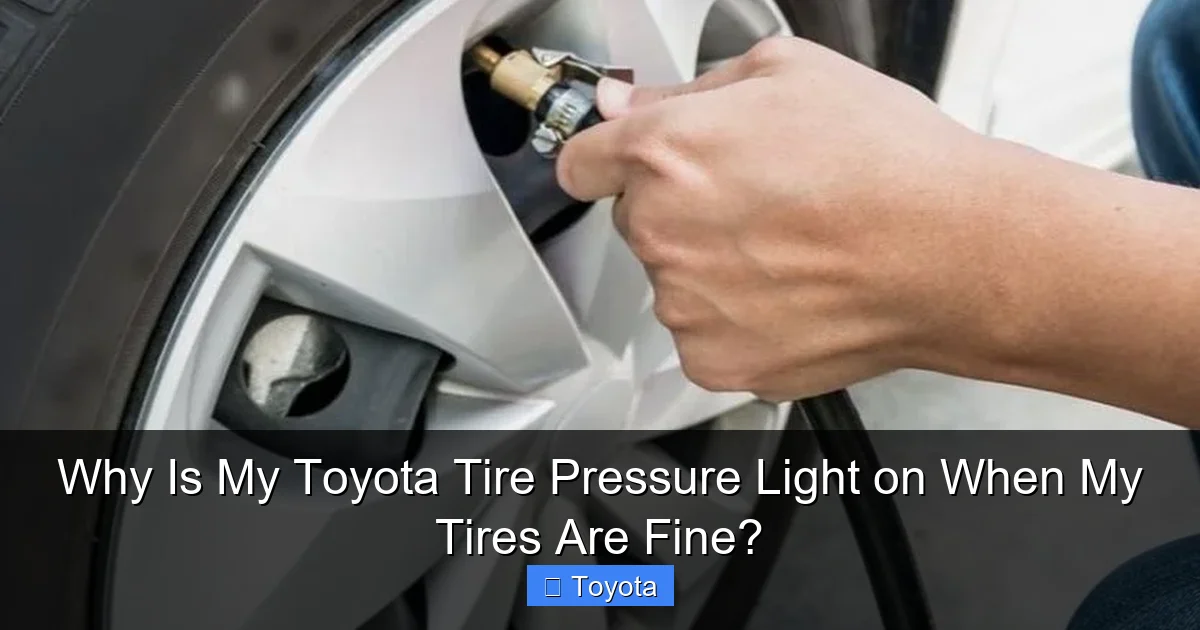
Before we dive into electronics, let’s rule out the most fundamental reason. “But the tires look fine!” is a natural reaction. However, visual inspection is notoriously unreliable for tire pressure. A tire can be 20-25% under-inflated—the typical threshold for triggering the TPMS light—and still appear perfectly normal to the eye. You cannot accurately judge air pressure by looking at a radial tire.
Visual guide about Why Is My Toyota Tire Pressure Light on When My Tires Are Fine?
Image source: roadsumo.com
How to Be 100% Sure: The Gauge Test
The only way to know for certain is to use a reliable tire pressure gauge. Here’s the critical step: check the pressure when the tires are cold. “Cold” means the car has been parked for at least three hours or driven less than a mile. Driving heats the tires and air inside them, giving a falsely high reading. Remove the valve cap, press the gauge on firmly, and note the reading. Compare it to the recommended pressure, which is found on a sticker inside the driver’s door jamb (not the number on the tire sidewall, which is maximum pressure). If any tire is 4-5 PSI or more below the recommended spec, that’s your problem. Inflate them to the correct pressure. The light should turn off after a few minutes of driving as the system re-registers the correct pressures. If it doesn’t, the issue lies elsewhere.
This is also the perfect time to check for a slow leak. After inflating, note the pressure. Check it again in 24 hours. A significant drop indicates a leak from a nail, a faulty valve stem, or a poor bead seal at the wheel rim.
Reason 2: The Usual Suspects – Faulty or Dead TPMS Sensors
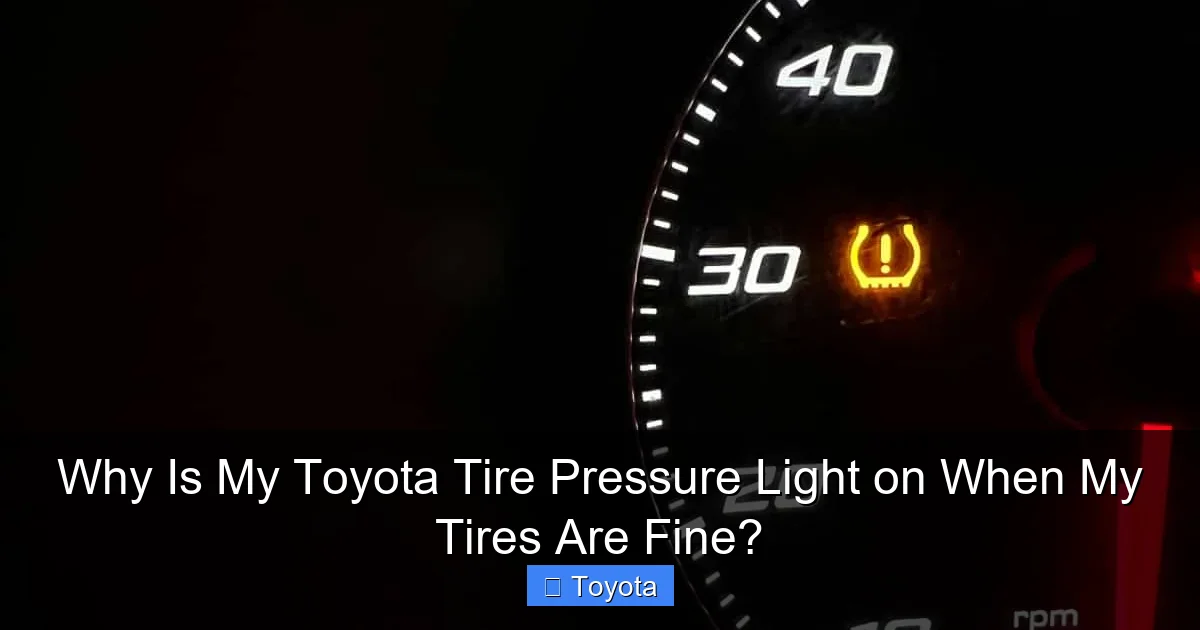
This is, by far, the most common reason for a persistent TPMS light when tire pressures are verified as correct. Each wheel on your Toyota has a small electronic sensor mounted inside the valve stem. These sensors have a non-replaceable internal battery that lasts, on average, 7-10 years. When the battery dies, the sensor goes silent. The TPMS control module in your car doesn’t receive a signal from that wheel and interprets the silence as a fault, illuminating the warning light.
Visual guide about Why Is My Toyota Tire Pressure Light on When My Tires Are Fine?
Image source: mechanicbase.com
The Anatomy of a TPMS Sensor Failure
Sensors are delicate. They are exposed to relentless road hazards—curbs, potholes, debris—and extreme conditions of heat, cold, and moisture. Common failure points include:
- Dead Battery: The inevitable end of life for the sensor. The light will typically come on and stay on continuously.
- Physical Damage: A bent or broken valve stem from a curb hit can destroy the sensor.
- Corrosion: Especially on older vehicles or in regions that use road salt, corrosion at the sensor’s base or on the valve stem threads can cause failure.
- O-Ring Seal Failure: The rubber seal that keeps air in and moisture out can degrade, allowing air to leak slowly from the sensor itself.
Diagnosing a bad sensor requires a TPMS scan tool that can read each sensor’s individual ID, pressure, and battery status (if the sensor supports it). A tire shop or dealership can do this. If a sensor is dead, it must be replaced. On most Toyotas, the entire sensor unit (inside the tire) is replaced. This involves removing the tire, swapping the sensor, remounting the tire, and then performing a TPMS relearn procedure so the car’s computer recognizes the new sensor’s unique ID code.
Reason 3: Temperature’s Tricky Role – The “Cold Weather Flare-Up”
Here’s a phenomenon that baffles countless drivers, especially in fall and winter. You check your tires in the garage on a mild evening, they’re perfect. You wake up to a frigid morning, start the car, and the TPMS light is glaring. The tires haven’t leaked; what happened?
Visual guide about Why Is My Toyota Tire Pressure Light on When My Tires Are Fine?
Image source: tirehubz.com
The Science of Air and Temperature
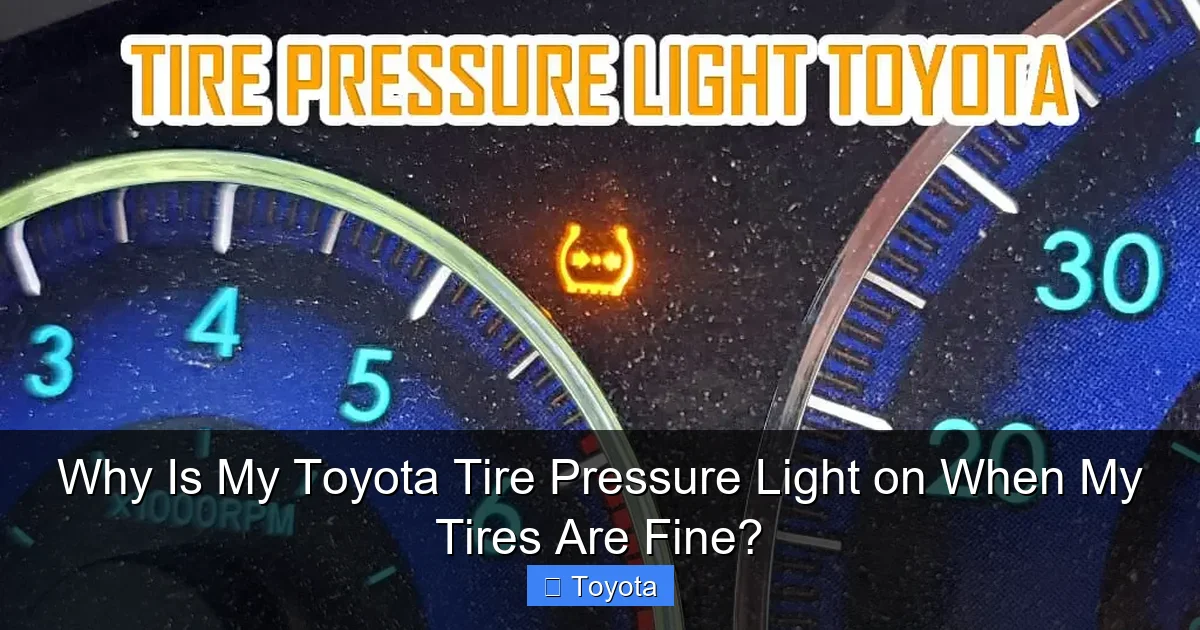
Air is a gas, and gases expand when heated and contract when cooled. For every 10°F (about 5.6°C) drop in temperature, tire pressure decreases by approximately 1 PSI. A 30-degree overnight temperature drop can easily cause a 3 PSI loss in all four tires. That’s often enough to dip below the TPMS trigger threshold. The system isn’t broken; it’s correctly reporting a genuine pressure drop caused by physics. This is why it’s crucial to check and adjust tire pressure seasonally, especially with major temperature swings. The light will often go away on its own after you drive for a while and the tires warm up, but it’s better to manually add air to the correct cold-inflation pressure to ensure optimal safety and fuel economy year-round. For more on this, see our detailed guide on why tire pressure drops in cold weather.
Reason 4: Recent Tire Service – The Relearn Requirement
Did you just get new tires installed? Have your tires rotated? Have a puncture repaired? If the TPMS light came on immediately after any of these services, this is almost certainly the cause. The TPMS system is programmed to recognize the unique radio signal from each specific sensor on each specific wheel position (e.g., Front Left, Rear Right).
Why Rotation and Replacement Confuse the System
When you rotate tires, the sensors physically move to new wheel positions. The car’s computer still thinks the “Front Left” sensor is at the front left, but the actual sensor that was originally on the Rear Left is now there. The system sees a “new” sensor in a known position and flags it as an error. Similarly, when a sensor is replaced, the new one has a different ID code that the car doesn’t know.
The solution is a TPMS relearn procedure. This process teaches the car’s computer the ID codes of the sensors now on the vehicle and their correct wheel locations. The method varies by Toyota model and year. Some vehicles have an automatic relearn that occurs after driving at a steady speed for several minutes. Others require a manual sequence using the steering wheel controls and a scan tool. Some newer Toyotas use a “direct” system that may need a specialized tool to activate each sensor during the relearn. If you had recent work done and the light is on, contact the shop that performed the service—they should ensure the relearn is completed. You can find model-specific reset instructions for vehicles like the Toyota Sienna in our library.
Reason 5: System Glitches and Other Electrical Gremlins
Sometimes, the fault isn’t with the tires or sensors, but with the brain of the operation. The TPMS is controlled by a dedicated module or is integrated into the vehicle’s main computer network.
When the Computer Gets Confused
Like any electronic system, it can experience:
- Software Glitches: A temporary bug in the module’s software can cause a false positive. A full system reset (disconnecting the car battery for a few minutes) can sometimes clear this, but it’s a temporary fix at best.
- Faulty TPMS Control Module: The module itself can fail. This is less common but possible, especially on higher-mileage vehicles.
- Interference: While rare, strong radio frequency interference from aftermarket devices (poorly installed remote starters, certain charging systems) could potentially disrupt the sensor signals.
- Weak Vehicle Battery: A chronically low or failing 12-volt battery can cause all sorts of erratic electronic behavior, including false TPMS warnings, as the system doesn’t get clean, consistent power.
Diagnosing these issues requires professional-grade diagnostic tools to scan for TPMS-related trouble codes. If all sensors check out and pressures are perfect, a technician will investigate the control module and vehicle electrical system.
What To Do Now: A Step-by-Step Action Plan
So, you’ve seen the light. Your tires look okay. Don’t panic. Follow this logical sequence:
- Verify with a Gauge: This is non-negotiable. Get a digital or good-quality pencil gauge. Check all four tires and the spare (if equipped with a sensor) when cold. Inflate any low tire to the exact pressure on the door jamb sticker.
- Drive and Observe: After inflating, drive normally for 10-15 minutes. The light should extinguish as the system confirms all pressures are within range. If it stays on, proceed.
- Recall Recent Events: Have you had tires rotated, new tires put on, or a flat repaired in the last few days/weeks? If yes, the system likely needs a relearn. Contact your tire shop.
- Consider the Weather: Was there a significant temperature drop? If pressures are now correct after your adjustment, the light may turn off on its own as tires warm. If it blinks or stays on, the issue is separate.
- Scan for Codes: If the above steps fail, you need a professional diagnosis. A shop will use a TPMS scan tool to read each sensor’s data and check for any stored fault codes in the TPMS module. This will pinpoint if it’s a dead sensor, a bad module, or something else.
Remember, driving with the TPMS light on means you are operating without a critical safety net. You must manually check your tire pressures regularly until the issue is resolved. Under-inflated tires are dangerous: they overheat (risk of blowout), wear unevenly and prematurely, reduce handling precision, and lower your fuel economy. For a broader look at dashboard warnings, our article on why your car’s oil light comes on explains how different warning systems function.
Frequently Asked Questions
Can a dead key fob battery cause the tire pressure light to come on?
No. The TPMS operates on its own dedicated radio frequency system separate from your key fob. A dead key fob battery will not trigger the tire pressure light, though it may cause other issues like an inability to remotely lock/unlock the car.
My TPMS light blinks for a few seconds when I start the car, then stays solid. Is that normal?
Yes, that is the standard “bulb check.” The light should illuminate for a few seconds when you turn the ignition on as the system performs a self-test, then turn off. If it stays on solid after that, it indicates a fault. If it blinks repeatedly for 30+ seconds before staying on, that often points to a sensor communication failure.
How much does it cost to fix a Toyota TPMS light caused by a bad sensor?
Replacing a single TPMS sensor typically costs between $100 and $250 per wheel for parts and labor, depending on your Toyota model, year, and local labor rates. The sensor itself is usually $50-$120. Some vehicles require a special relearn procedure after replacement, which may add to the cost.
Will disconnecting the battery reset the TPMS light?
It might temporarily, but it is not a proper fix. Disconnecting the battery will reset the car’s computer memory, and the light may go out. However, the underlying fault (low pressure, bad sensor, etc.) has not been addressed. The light will simply come back on once the system re-scans and detects the same problem again.
Can I replace the TPMS sensor battery myself?
No. The batteries are sealed inside the sensor unit and are not user-replaceable. When the battery dies, the entire sensor assembly must be replaced by a professional who can mount it to the wheel and perform the necessary system relearn.
Is it safe to drive with the TPMS light on?
It is not safe or advisable. The light means the system has detected a pressure issue. Even if you manually check and find pressures are currently okay, a new problem (like a slow leak) could develop at any time. Driving on under-inflated tires is a serious safety risk that increases stopping distances, reduces control, and can cause a catastrophic tire failure. You should diagnose and fix the cause as soon as possible.