Why Is My Check Engine Light on in My Toyota Highlander?

Contents
- 1 Key Takeaways
- 2 📑 Table of Contents
- 3 Understanding Your Toyota Highlander’s Check Engine Light
- 4 The Most Common Culprits in a Toyota Highlander
- 5 How the OBD-II System Works in Your Highlander
- 6 What To Do When the Light Comes On: An Action Plan
- 7 Decoding Common Highlander Trouble Codes
- 8 When to Immediately Seek Professional Help
- 9 The Bottom Line: Proactive Care for Your Highlander
- 10 Frequently Asked Questions

LED Indicator Light

Car Bumper Protector

Steering Wheel Cover

Liquid Car Polish
That glowing check engine light in your Toyota Highlander is your vehicle’s way of signaling an issue, often related to emissions or engine performance. While sometimes as simple as a loose gas cap, it can also indicate serious problems like a faulty oxygen sensor or catalytic converter. Never ignore a steady light, and treat a flashing light as an emergency. The only way to know for sure is to have the onboard diagnostic system scanned for trouble codes, which will point you and your mechanic to the specific problem.
Key Takeaways
- The light is a general warning: It means the engine management system has detected a problem affecting emissions or performance, not a single specific issue.
- Common causes are often simple: A loose or faulty gas cap is the #1 culprit. Other frequent offenders include oxygen sensors, spark plugs, and the catalytic converter.
- A flashing light is critical: A steady light means plan a repair soon. A flashing light means severe engine misfire—stop driving immediately to prevent catastrophic damage.
- Diagnosis requires a code scan: You must use an OBD-II scanner to read the stored Diagnostic Trouble Codes (DTCs). These codes are the starting point, not the final diagnosis.
- Don’t just reset the light: Clearing the code without fixing the underlying problem will cause the light to return, often within days or even minutes of driving.
- Your Highlander may still drive: For a steady light, short-distance driving to a repair shop is usually okay. For a flashing light, have it towed.
- Regular maintenance prevents many issues: Staying on top of scheduled service, like replacing spark plugs and air filters, is the best way to avoid unexpected check engine lights.
📑 Table of Contents
- Understanding Your Toyota Highlander’s Check Engine Light
- The Most Common Culprits in a Toyota Highlander
- How the OBD-II System Works in Your Highlander
- What To Do When the Light Comes On: An Action Plan
- Decoding Common Highlander Trouble Codes
- When to Immediately Seek Professional Help
- The Bottom Line: Proactive Care for Your Highlander
Understanding Your Toyota Highlander’s Check Engine Light
You’re cruising down the highway in your reliable Toyota Highlander, the family is settled in, and suddenly—a small, amber engine-shaped icon illuminates on your dashboard. That familiar “check engine” light. Your heart sinks a little. It’s an unwelcome guest, a silent alarm that something isn’t right under the hood. But what does it actually mean? Is it a minor hiccup or a major disaster waiting to happen? For Highlander owners, this light is a crucial communication tool from your vehicle’s sophisticated computer brain. Ignoring it is never the right strategy, but panicking isn’t necessary either. This guide will demystify that glowing icon, walk you through the most likely reasons it’s on in your specific SUV, and give you a clear action plan to get your Highlander back to its dependable self.
The check engine light, officially called the Malfunction Indicator Lamp (MIL), is part of your Highlander’s On-Board Diagnostics II (OBD-II) system. This system is constantly monitoring dozens of sensors and components related to engine performance, fuel efficiency, and emissions. When a sensor reports a value outside the expected range, or a component fails a self-test, the computer stores a Diagnostic Trouble Code (DTC) and turns on the light to get your attention. It’s a broad warning system, like a fever for your car—it tells you something is wrong, but not exactly what. The key is to interpret the signal correctly and take measured steps.
The Most Common Culprits in a Toyota Highlander
While the check engine light can signify hundreds of potential issues, a handful of problems are statistically the most frequent offenders across Toyota Highlanders of various model years. Knowing these common causes can help you understand the potential severity and cost. Often, the solution is surprisingly simple and inexpensive. Other times, it points to a component that needs prompt replacement to avoid damaging more expensive parts, like the catalytic converter.

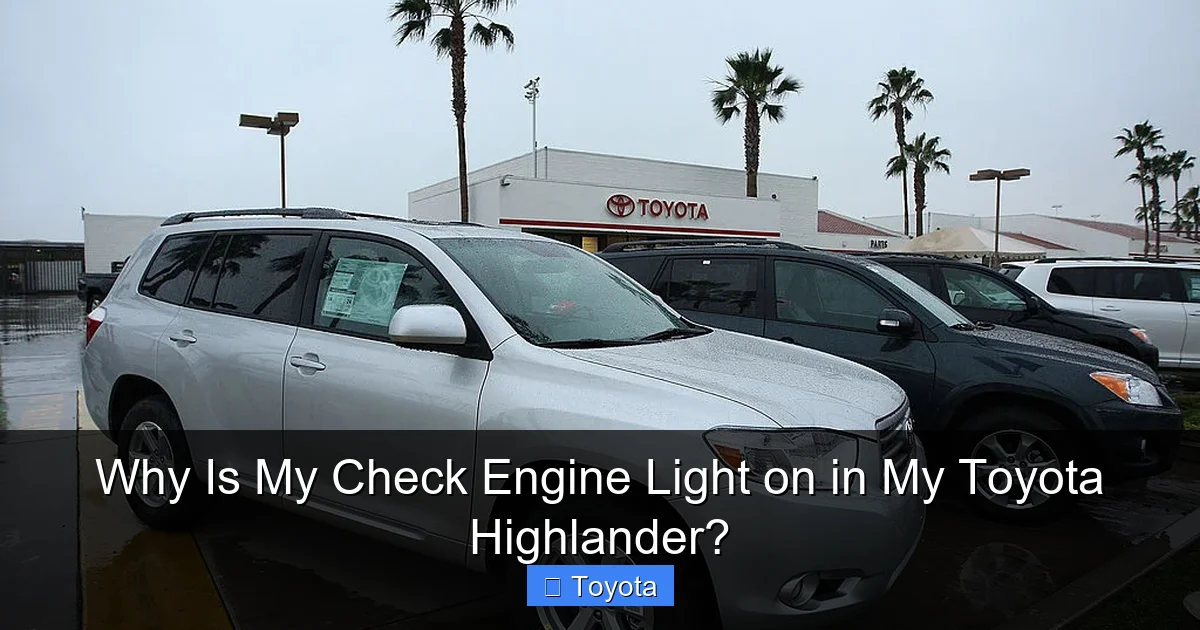
Visual guide about Why Is My Check Engine Light on in My Toyota Highlander?
Image source: motortrend.com
1. A Loose or Faulty Gas Cap
Yes, really. It sounds almost too simple, but a gas cap that isn’t tightened properly or has a damaged seal is by far the most common reason for a check engine light to illuminate. Your Highlander’s fuel system is a sealed evaporative (EVAP) system designed to prevent fuel vapors from escaping into the atmosphere. If the cap is loose, cracked, or missing, the system detects a leak and sets a code (commonly P0455, P0456, or P0442). The fix is usually free: remove the cap, inspect the seal for cracks, and re-tighten it until you hear several clicks. If the seal is damaged, a new OEM gas cap costs under $20. After tightening or replacing it, the light may turn off on its own after a few drive cycles, or you may need to clear the code.
2. Faulty Oxygen (O2) Sensors
Oxygen sensors are critical for monitoring the amount of oxygen in your Highlander’s exhaust. This data helps the engine computer (ECU) calculate the perfect air-to-fuel mixture for efficient combustion. Over time, these sensors, especially the upstream sensors before the catalytic converter, can become contaminated by fuel additives or simply wear out. A failing O2 sensor triggers codes like P0130-P0134 (Bank 1) or P0150-P0154 (Bank 2). Symptoms often include a noticeable drop in fuel economy (you’re filling up more often), a rough idle, and possibly a sulfur or rotten egg smell from the exhaust. Replacing an O2 sensor is a common and relatively affordable repair that can restore lost performance and mileage.
3. Mass Airflow Sensor (MAF) Problems
The Mass Airflow Sensor measures the volume of air entering your Highlander’s engine. This is another vital piece of data for the ECU to determine fuel delivery. The MAF sensor can get dirty from oil vapor (especially in older models with certain engine designs) or simply fail. Codes like P0100-P0103 indicate a MAF circuit issue. You might notice poor acceleration, a hesitant throttle, and decreased fuel efficiency. Sometimes, a careful cleaning with a dedicated MAF sensor cleaner can resolve the issue if it’s just contamination. If cleaning doesn’t work, replacement is necessary.
4. Spark Plugs and Ignition Coils
Worn-out spark plugs or failing ignition coils are classic causes of engine misfires, which the OBD-II system detects very sensitively. Misfire codes (P0300-P0304) are serious because unburned fuel can wash oil from cylinder walls and overheat the catalytic converter. If your check engine light is flashing, this is the most likely culprit—a severe, active misfire. Symptoms include a rough, shaking engine, loss of power, and possibly a strong fuel smell from the exhaust. On many Highlander models, spark plugs are a routine maintenance item replaced every 30,000-60,000 miles. Ignition coils can also fail independently. Addressing misfires immediately is crucial to prevent expensive catalytic converter damage.
5. Catalytic Converter Failure
The catalytic converter is your Highlander’s exhaust “scrubber,” converting harmful pollutants into less harmful gases. It can fail due to age, contamination from oil or antifreeze, or from prolonged driving with unaddressed misfires (which dump raw fuel into it). A failing converter often sets codes like P0420 (Catalyst System Efficiency Below Threshold). Signs include poor acceleration, a sulfur smell, and sometimes a rattling noise from underneath. Unfortunately, catalytic converter replacement is one of the more expensive repairs. This is why it’s so important to diagnose and fix the *root cause* (like bad spark plugs or O2 sensors) that might be destroying your converter.
6. Exhaust Leaks or Loose Components
An exhaust leak before the oxygen sensors can allow extra oxygen into the exhaust stream, fooling the O2 sensors into thinking the engine is running lean (too much air). This can trigger multiple codes related to fuel trim and oxygen sensor readings. Similarly, a loose or damaged exhaust gas recirculation (EGR) valve or its passages can cause issues. These problems might present as a ticking or hissing sound from the engine bay or under the car, along with the check engine light.
How the OBD-II System Works in Your Highlander
To truly understand the check engine light, you need to grasp the basics of your Highlander’s OBD-II system. This isn’t just a magic light; it’s the endpoint of a complex network of sensors, actuators, and the Engine Control Unit (ECU). The ECU runs constant, rapid-fire tests on these systems. When a test fails repeatedly, it stores a specific five-character Diagnostic Trouble Code (DTC) in its memory and illuminates the MIL.

Visual guide about Why Is My Check Engine Light on in My Toyota Highlander?
Image source: autoily.com
Reading the Codes: The First Step
The only way to know what your Highlander’s computer is complaining about is to scan for codes. You have three main options:
- Auto Parts Store Scan (Free): Stores like AutoZone, Advance Auto Parts, and O’Reilly offer free code scanning services. A technician will plug a basic scanner into your Highlander’s OBD-II port (located under the dashboard, near the driver’s knees) and read the stored codes. This is a great first step. They can often print the code definition for you.
- Buy a Personal Scanner: For $30-$100, you can purchase a basic OBD-II Bluetooth or wired scanner (like an Autel, Launch, or Innova). Pair it with a free app on your phone (like Torque or the manufacturer’s app) to read and clear codes yourself. This is highly recommended for any DIY-minded owner.
- Dealership or Mechanic: They use more advanced, expensive scanners that can access manufacturer-specific codes and perform active tests on components.
Crucially, a code is a starting point, not a diagnosis. For example, a P0302 code means “Cylinder 2 Misfire Detected.” The problem could be a spark plug, ignition coil, fuel injector, or even a vacuum leak affecting that specific cylinder. The code tells you *where* to look, not *what* to replace.
Understanding Code Types
Codes fall into categories:
- Generic vs. Manufacturer-Specific: The first letter indicates this. “P” is powertrain (engine/transmission). “P0XXX” are generic codes. “P1XXX” are Toyota-specific codes that provide more precise information. A good scanner will show both.
- Pending vs. Confirmed: A pending code means the system has detected an issue once but hasn’t confirmed it yet (usually needs 2-3 occurrences). A confirmed code means the issue is verified and the light is on.
- Stored vs. Active: A stored code is in memory even if the problem fixed itself. An active code means the fault is currently present.
What To Do When the Light Comes On: An Action Plan
Seeing that light can be stressful, but a calm, logical approach is best. Here’s your step-by-step guide for your Toyota Highlander.

Visual guide about Why Is My Check Engine Light on in My Toyota Highlander?
Image source: coursepivot.com
Immediate Assessment: Is It Flashing?
This is the most important question. A flashing check engine light indicates a severe, active engine misfire. Unburned fuel is being dumped into the exhaust, which can overheat and permanently destroy the catalytic converter in a matter of minutes. If the light is flashing, pull over safely as soon as possible, turn off the engine, and have your Highlander towed to a repair shop. Do not continue driving. For a steady, non-flashing light, you typically have time to diagnose the issue, but you should plan to get it checked within a few days.
Step 1: Perform a Basic Visual Inspection
Before you go anywhere, take 5 minutes under the hood and around the vehicle. Look for obvious issues:
- Is the gas cap tight? Remove it and re-tighten until it clicks.
- Check for obvious disconnected or damaged electrical connectors, especially around the air filter box and engine bay.
- Look for loose wires or hoses.
- Inspect the engine oil and coolant levels. Low levels can trigger the light.
- Listen for unusual noises (hissing, knocking) and note any performance changes (rough idle, hesitation, loss of power).
Step 2: Scan for Codes
As outlined above, get the codes read. If you use a free service at a parts store, write down the exact code(s) (e.g., P0171, P0420) and their definitions. This is your most valuable piece of information. If you own a scanner, do this yourself.
Step 3: Research the Code for Your Specific Highlander
Take the code and search online for “[Code] Toyota Highlander [Your Model Year].” You’ll find forums, repair guides, and technical service bulletins (TSBs) specific to your vehicle. For instance, certain Highlander years have known issues with specific O2 sensors or EVAP system components. This research will tell you if it’s a common, easy fix or a complex problem. You can also look up the code in our resource on how to reset the check engine light on a Toyota Highlander, but remember: resetting is only step two after the repair.
Step 4: Decide on a Course of Action
Based on your research:
- Simple Fix: If the code points to a loose gas cap, air filter, or a known easy replacement (like a specific sensor), you might tackle it yourself if you’re mechanically inclined.
- Professional Help Needed: For codes related to the catalytic converter, internal engine issues, complex electrical problems, or if you’re unsure, take it to a trusted mechanic or the dealership. Give them the code(s) you found—this saves them diagnostic time and can save you money.
- Monitor: For a very old, pending code with no symptoms, some owners choose to clear the code and see if it returns. If it does, it needs attention.
Important: If your Highlander is due for an emissions inspection (smog check), the light must be off and the codes cleared for it to pass. Driving with the light on will cause an automatic fail.
Decoding Common Highlander Trouble Codes
While every code is unique, here are some you’re statistically likely to encounter and what they typically mean for your Highlander. Remember, context is everything.
P0171 / P0174: System Too Lean (Bank 1 / Bank 2)
This means there’s too much air or not enough fuel in the combustion mixture. Common causes include a vacuum leak (cracked hose, leaky intake manifold gasket), a dirty or faulty MAF sensor, or clogged fuel injectors. A lean condition can cause overheating and poor performance.
P0420: Catalyst System Efficiency Below Threshold
This is the dreaded catalytic converter code. It means the rear O2 sensor is seeing similar activity to the front sensor, indicating the converter isn’t doing its job. Do not immediately replace the converter. First, rule out other causes: exhaust leaks before the converter, faulty O2 sensors giving bad data, or ongoing misfires that have poisoned the converter. A proper diagnosis is essential here.
P0455 / P0456: EVAP System Leak (Large / Very Small)
These are the gas cap codes. P0455 is a large leak (like a missing cap or a major hose split), while P0456 is a tiny leak (often a deteriorating seal or purge valve). Start with the cap, then inspect the charcoal canister and associated hoses for cracks.
P0300 – P0304: Random/Multiple Cylinder Misfire / Cylinder X Misfire
This is serious, especially if flashing. P0300 means multiple cylinders are misfiring randomly. P0301-P0304 pinpoint the specific cylinder (1-4 for a 4-cylinder, 1-6 for a V6 Highlander). Causes range from spark plugs, ignition coils, fuel injectors, to low compression. Diagnosis requires swapping components (like coils) between cylinders to see if the code moves, pinpointing the faulty part.
When to Immediately Seek Professional Help
Some situations are beyond DIY and require a trained technician with advanced tools. Seek professional help for your Highlander if:
- The check engine light is FLASHING. This is an emergency.
- You have codes related to the catalytic converter (P0420, P0430) and haven’t ruled out other causes.
- Codes indicate internal engine problems (like low compression codes P0300 with no ignition component fault).
- Multiple related codes appear (e.g., multiple O2 sensor codes, misfire codes with fuel trim codes). This suggests a larger systemic issue.
- The vehicle has noticeable, severe symptoms like extreme shaking, loss of power, strange noises, or smoke from the exhaust.
- You are not comfortable performing the diagnostics and repairs yourself.
A good independent mechanic or Toyota dealership will use their high-end scan tool to view live data from all sensors, perform active tests (like cycling the EVAP system or testing ignition coils), and check for Manufacturer Technical Service Bulletins (TSBs) that apply to your specific VIN. These bulletins are goldmines—they document known, common problems and the factory-approved fixes for your Highlander, which can save you from costly misdiagnosis.
The Bottom Line: Proactive Care for Your Highlander
Your Toyota Highlander’s check engine light is a friend, not a foe. It’s an early warning system that, when heeded, can save you from thousands of dollars in repairs and keep your family safe on the road. The most important rule is this: never, ever ignore a steady light, and treat a flashing light as a dire emergency. Start with the simplest possibility—the gas cap—but be prepared to get the codes scanned and interpreted. Invest in a good OBD-II scanner for your own use; it’s one of the best tools a car owner can have. And remember, staying on top of your Highlander’s regular maintenance schedule—replacing spark plugs, air filters, and sensors at the recommended intervals—is the absolute best way to prevent those unexpected, anxiety-inducing check engine lights from ever appearing. A well-maintained Highlander is a happy, reliable Highlander, ready for every road trip and school run for years to come.
Frequently Asked Questions
Can I drive my Toyota Highlander with the check engine light on?
If the light is steady and your Highlander is running normally (no rough idle, no loss of power), you can drive it a short distance to get it diagnosed. However, you should schedule a repair promptly. If the light is flashing, you must stop driving immediately and have the vehicle towed to prevent engine damage.
Will the check engine light turn off by itself?
Sometimes, if the issue was temporary and the system completes several successful drive cycles without detecting the problem, the light may turn off on its own. However, this is rare for persistent issues. A loose gas cap might cause the light to go out after a few drives once tightened, but most faults will require a code to be cleared manually after the repair is made.
How much does it cost to diagnose a check engine light?
Diagnosis typically costs between $80 and $150 at a repair shop. Many auto parts stores offer free code scanning, which gives you the trouble code but not a full diagnosis. The diagnostic fee is often waived if you proceed with the recommended repair at the same shop.
Will my Toyota Highlander fail emissions with the check engine light on?
Yes, absolutely. A check engine light is an automatic failure for a smog or emissions inspection in all states. The vehicle’s computer will not allow the test to be completed if the MIL is illuminated. The light must be off, and all related codes cleared, to pass.
What is the most common reason for a check engine light in a Toyota?
The most common reason across all Toyota models, including the Highlander, is a loose, damaged, or missing gas cap. This triggers the EVAP system leak codes. The second most common cause is a faulty oxygen sensor, which affects fuel economy and emissions.
My check engine light is on, but the car runs fine. What could it be?
If there are no noticeable performance issues, the problem is likely related to the emissions system—such as a minor EVAP leak (gas cap), a slow-responding oxygen sensor, or a less critical sensor with an out-of-spec reading. These still need attention to pass inspections and prevent future problems, but they aren’t immediately dangerous.