Why Do Jeep Windshields Crack So Easily

Contents
- 1 Key Takeaways
- 2 📑 Table of Contents
- 3 The Flat Windshield Dilemma: A Big Target
- 4 Frame Flex and Structural Stress: The Twisting Frame
- 5 Off-Road Assault: More Than Just Rocks
- 6 Temperature Turbulence: Thermal Shock
- 7 Age and Manufacturing Quirks: It’s Not All the Same
- 8 Prevention and Protection: Your Action Plan
- 9 The Repair and Replacement Reality: Cost and Complexity
- 10 Frequently Asked Questions

Portable Air Pump

Car USB Charger

Carburetor Cleaner

Car LED Headlight Bulb
Jeep windshields are notoriously prone to cracking, and it’s not just bad luck. Their unique design—featuring a nearly vertical windshield angle, a flexible body-on-frame construction, and a culture of off-road adventure—creates a perfect storm for glass damage. Small impacts that might only chip other vehicles can lead to full cracks in a Jeep. Understanding these factors is key to prevention and managing costly repairs.
You love your Jeep. You love the feeling of the wind in your hair, the capability to go anywhere, and that iconic, boxy silhouette. But there’s one love-hate relationship every Jeep owner knows all too well: the windshield. It seems like a tiny pebble, a stray piece of gravel, or even a sudden temperature shift can turn a perfectly clear view into a spiderweb of cracks with alarming ease. It’s not just your imagination. Jeep windshields, particularly on the Wrangler and Gladiator models, are statistically more susceptible to damage than those on many other vehicles. But why? The answer isn’t a single flaw, but a perfect storm of engineering choices, usage patterns, and plain old physics working against that big pane of glass.
Key Takeaways
- The Flat Windshield Design: Jeeps, especially Wranglers, have a nearly vertical windshield that presents a larger, more direct surface area to oncoming debris compared to the sloped windshields of most cars and SUVs.
- Frame Flex is a Major Culprit: The solid axle, body-on-frame design that gives Jeeps their legendary off-road capability also allows the frame to twist. This flexing puts constant stress on the glass and its seal, making it more vulnerable to cracking from minor impacts.
- Off-Road Use Invites Damage: Driving on trails means a constant barrage of flying gravel, kicked-up rocks, and low-hanging branches. Even following another vehicle on a highway can launch stones directly at the Jeep’s upright glass.
- Temperature Extremes Weaken Glass: Jeeps are often used in all conditions. Rapid temperature changes—like pouring cold water on a hot windshield after a desert run—can create thermal stress that exacerbates small chips into long cracks.
- Age and Manufacturing Changes: Older Jeep models may have windshields with different tempering or mounting techniques. Some owners report that windshields from certain production years seem more fragile than others.
- Repairs are Complex and Costly: Because of the windshield’s integration with the roll cage and the need for precise calibration of sensors (ADAS), replacement is often expensive and must be done by experts familiar with Jeep specifics.
- Prevention is Your Best Defense: Investing in a high-quality rock chip protection film, avoiding tailgating, and addressing chips immediately with a professional repair can dramatically extend the life of your Jeep’s windshield.
📑 Table of Contents
- The Flat Windshield Dilemma: A Big Target
- Frame Flex and Structural Stress: The Twisting Frame
- Off-Road Assault: More Than Just Rocks
- Temperature Turbulence: Thermal Shock
- Age and Manufacturing Quirks: It’s Not All the Same
- Prevention and Protection: Your Action Plan
- The Repair and Replacement Reality: Cost and Complexity
The Flat Windshield Dilemma: A Big Target
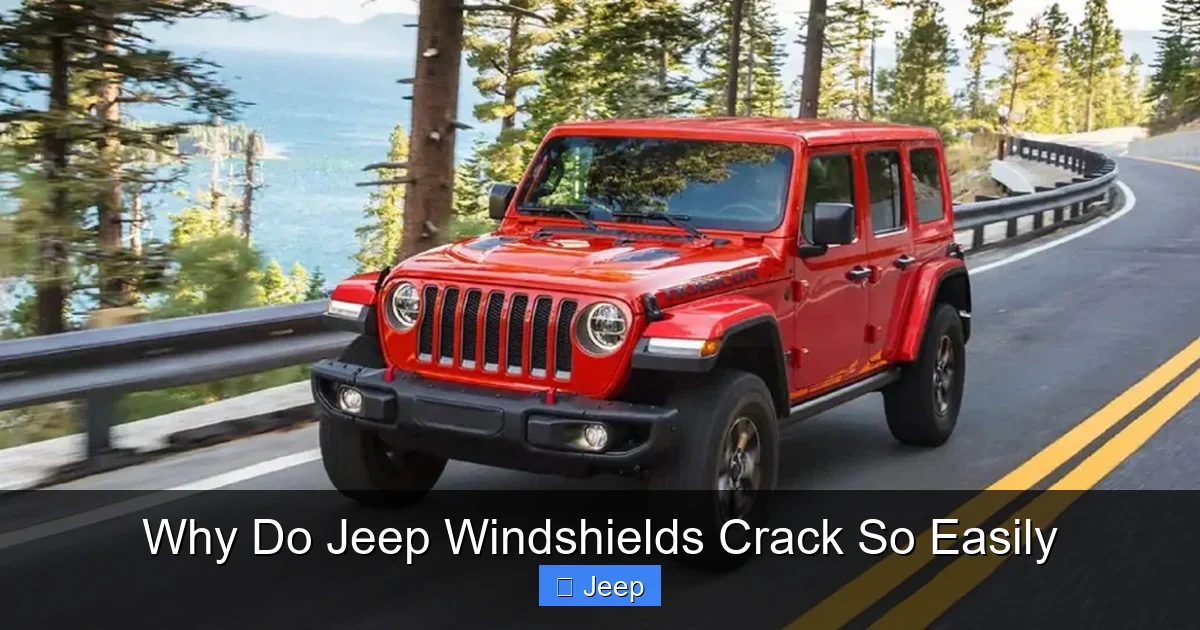
Let’s start with the most obvious reason: geometry. Look at a Jeep Wrangler or Gladiator from the side. That windshield is almost vertical. Now, look at a family sedan or a crossover SUV. Its windshield is significantly raked back. This simple angle difference has a huge impact on vulnerability.
The Physics of an Upright Glass
A sloped windshield acts like a ramp. When a rock or piece of debris is kicked up from the road or another vehicle’s tires, it has a higher chance of glancing off the angled surface or losing energy before impact. It’s the difference between throwing a ball at a flat wall versus a sloping roof. The vertical Jeep glass presents a direct, perpendicular target. The force of impact is transferred more directly into the glass itself rather than being deflected. This means even a small stone that would merely ping harmlessly off a minivan’s windshield can deliver a concentrated blow to a Jeep’s, creating a chip that often rapidly spreads into a crack.
Furthermore, the large surface area of the upright glass means there’s simply more glass exposed to potential hazards. Every mile on the highway, every trail ride, increases the statistical probability of an impact. For Jeep owners who frequently remove doors and roofs, that vulnerability extends to the entire side structure, but the windshield remains the primary, unprotected frontal barrier.
Frame Flex and Structural Stress: The Twisting Frame
This is the engineering heart of the matter. Jeeps are built with a body-on-frame construction and solid axles. This is non-negotiable for their legendary off-road articulation and capability. The wheels can move up and down independently through huge ranges, allowing the tires to stay in contact with uneven terrain. However, this system allows the entire frame to twist and flex. This flex is a good thing when you’re crawling over rocks, but it’s a constant, low-grade stress test on the windshield and its bonding seal.
Visual guide about Why Do Jeep Windshields Crack So Easily
Image source: carnewsbox.com
The Bond Is Under Constant Strain
The windshield isn’t just glued in place; it’s a critical structural component. It bonds to the frame and, in modern Jeeps, works in conjunction with the roll cage to maintain cabin rigidity. As the frame twists during off-road use—or even during hard cornering on pavement—the windshield is subjected to shear forces. It’s being gently pulled and pushed at its edges constantly. This pre-stressed state means the glass is already under tension. When a minor impact occurs, that stress concentration at the chip site is enough to make a crack propagate much more easily than it would in a rigid, unstressed mounting system.
This is also why improper windshield replacement can be so problematic. If the new glass isn’t seated perfectly or the adhesive isn’t allowed to cure under the correct conditions (often requiring specific temperatures and times), the new windshield will be under uneven stress from day one, making it a candidate for a spontaneous crack. This is a key reason why you should always seek a specialist for Jeep glass work.
Off-Road Assault: More Than Just Rocks
Let’s be honest, a huge percentage of Jeeps see trail duty. And the trail is a windshield’s nightmare. While the “rock” is the classic villain, it’s just one player in a hostile environment.
Visual guide about Why Do Jeep Windshields Crack So Easily
Image source: glennsaid.com
Gravel, Sand, and Branches, Oh My!
On a loose gravel road, your own tires can launch small stones backward at high speed. This is called “gravel spray” and is a leading cause of front-end rock chips for all vehicles, but the Jeep’s vertical glass takes the full force. On rocky trails, it’s not just the big boulders you’re avoiding. It’s the smaller stones and gravel that get displaced by your tires or the vehicle in front of you. These can be launched with surprising velocity.
Then there’s “trail rash”—the low-hanging branches, overgrown bushes, and even the occasional encounter with a tree limb. These often hit the windshield with a glancing or direct blow that can cause a star break or a long crack. Even something as soft as a thick branch can deliver enough force to damage glass that’s already stressed from frame flex. For many Jeep owners, a windshield crack is a badge of honor, a direct result of their adventures. But it’s also a costly and inconvenient one.
Temperature Turbulence: Thermal Shock
Glass expands and contracts with temperature. Rapid, uneven changes create stress within the pane itself, known as thermal stress. Jeeps are uniquely subjected to extreme thermal cycling.

Visual guide about Why Do Jeep Windshields Crack So Easily
Image source: glennsaid.com
From Desert Sun to Mountain Stream
Picture this: you’ve been crawling through a desert trail all afternoon. The windshield is scorching hot, expanded and slightly more pliable. You find a cool stream and, in a moment of bliss, splash cold water on the glass to clean off the dust. That sudden, localized cooling causes that area of the glass to contract rapidly while the surrounding glass remains expanded. This creates immense internal stress. If there’s even a tiny, invisible flaw or a minuscule chip you haven’t noticed, that thermal shock can turn it into a visible crack in seconds.
The same principle applies in winter. You run the defroster at full blast on a bitterly cold morning, creating a huge temperature differential between the cold outside air and the heated inner layer of glass. While less common than the hot-to-cold scenario, it’s another form of thermal stress. The combination of a pre-stressed windshield from frame flex and these extreme temperature swings makes the glass far less forgiving.
Age and Manufacturing Quirks: It’s Not All the Same
Not all Jeep windshields are created equal, and age plays a role. There are anecdotal reports and some owner forum consensus that windshields from certain model years or production plants seem more fragile.
Changes in Glass and Bonding
Over decades of production, Jeep (and its parent companies) have sourced windshields from different suppliers and may have made subtle changes to glass tempering processes or the chemical composition of the urethane adhesive. Some older TJ and early JK owners swear by the durability of their “old school” glass, while some newer JL/JT owners report a higher incidence of spontaneous cracks from minor impacts. It’s difficult to prove definitively without manufacturer data, but the collective experience suggests that factors like the thickness of the glass, the precise tempering pattern, and even the curing process of the adhesive can vary, leading to differences in resilience. This makes finding a reputable glass shop that understands these nuances even more important.
Prevention and Protection: Your Action Plan
Knowing why they crack is only half the battle. What can you, the Jeep owner, actually do about it? While you can’t eliminate risk, you can drastically reduce it.
Invest in a High-Quality Protection Film
This is the single most effective step. Paint Protection Film (PPF), often called a “clear bra,” isn’t just for your hood. A full-front windshield protection film, applied by a professional, is a thick, clear urethane layer that absorbs the impact of small stones and sand. It won’t stop a baseball or a large rock, but it will handle 90% of the highway gravel and trail debris that causes chips. It’s sacrificial; you replace the film, not the windshield. When you consider the cost of a single windshield replacement, a good film is a wise investment. For those who frequently tackle tough trails, exploring options like a heavy-duty front bumper with a integrated winch can also slightly alter approach angles, but this is more about overall protection than just the glass.
Smart Driving and Maintenance Habits
- Increase Following Distance: This is the #1 rule on highways. Give the vehicle in front of you extra room to minimize being hit by its thrown gravel.
- Avoid Tailgating on Gravel: On dirt roads, slow down. The dust cloud hides rocks, and following too close guarantees you’ll eat everyone else’s spray.
- Address Chips IMMEDIATELY: A rock chip is a ticking time bomb. The longer you wait, the more likely dirt and moisture will work their way into the fracture, making a simple repair impossible. Get it injected with a professional resin within days.
- Mind the Temperature: Avoid the “cold water on hot glass” trick. Let the windshield cool naturally or use the wipers with washer fluid. In winter, use a proper ice scraper, not hot water.
The Repair and Replacement Reality: Cost and Complexity
When the inevitable happens, you face a decision: repair or replace. For a Jeep, this decision is often weighted heavily toward replacement, and here’s why.
Safety, Sensors, and Calibration
Modern Jeeps are loaded with safety technology. The windshield is no longer just glass; it’s a host for the forward-facing camera (for adaptive cruise control, forward collision warning, lane-keeping assist), a rain sensor, and sometimes even a heating element or an antenna. A simple chip in the driver’s line of sight often necessitates full replacement because the repair resin can distort the camera’s view.
Replacing the windshield is not a simple plug-and-play job. The new glass must be bonded with a specific, certified urethane adhesive that cures to exact specifications to maintain structural integrity in a rollover. The adhesive must be allowed to cure for a precise “safe drive-away time” before the vehicle can be driven. Most importantly, any camera or sensor mounted to the glass must be recalibrated after replacement. This requires specialized, often expensive, calibration equipment and software. This integration is why you should never assume a generic auto glass shop can properly handle a Jeep. Shops that specialize in ADAS calibration are essential, and this complexity is a key reason why a Jeep windshield replacement can cost significantly more than on a standard car.
Insurance and Aftermarket vs. OEM
Comprehensive auto insurance typically covers windshield damage, often with a deductible. However, some states have specific “glass” deductibles or laws. Check your policy. When a claim is filed, the insurance company may push for an aftermarket windshield to save costs. For Jeeps, this is a critical decision. Aftermarket glass may have different thickness, curvature, or optical quality. It may not bond identically to the frame. For a vehicle where the windshield is a structural component, many Jeep enthusiasts and safety experts insist on OEM (Original Equipment Manufacturer) glass to guarantee fit, finish, and safety. Be prepared to advocate for yourself with your insurer. You might also find it helpful to read about general car insurance costs to understand how claims and vehicle type affect your premiums.
Frequently Asked Questions
Why does a tiny chip on my Jeep spread into a long crack so fast?
Because the Jeep’s windshield is under constant stress from frame flex and is often mounted in a way that puts the edges under tension. A small impact creates a stress concentration at the chip, and that built-in tension causes the crack to propagate rapidly along the path of least resistance, usually toward the edge of the glass.
Is a windshield repair on a Jeep as effective as on a regular car?
It can be, but with caveats. If the chip is small (smaller than a quarter), not in the driver’s direct line of sight, and is repaired promptly with a high-quality resin by a skilled technician, it can restore most of the glass’s strength and prevent crack spread. However, if the chip is large, complex (a star break), or in a critical sensor area, replacement is often the only safe and recommended option.
Should I use an aftermarket windshield for my Jeep to save money?
Proceed with extreme caution. Aftermarket windshields may have subtle differences in thickness, curvature, or optical quality that can affect fit, seal integrity, and sensor accuracy. For a Jeep where the windshield is a structural component and houses critical ADAS cameras, OEM glass is strongly recommended for safety and long-term reliability. The savings on an aftermarket part may be negated by poor fit or the need for an early replacement.
What’s the single best thing I can do to protect my Jeep’s windshield?
Invest in a professional-grade, full-front windshield protection film (PPF). It’s a clear, tough urethane coating that absorbs impacts from stones and sand, preventing chips in the first place. It’s the automotive equivalent of a screen protector for your phone and is the most effective proactive measure you can take.
Does lifting my Jeep make windshield cracks more likely?
Yes, it can. A lift kit, especially one that is poorly installed or exceeds the manufacturer’s recommended height, changes the geometry of the vehicle and can increase frame flex. It may also alter the angle at which debris strikes the windshield and put additional stress on the glass mounting points. If you’re considering a lift, it’s crucial to choose a quality kit and have it installed by experts who understand these implications, such as those familiar with the best options for a Jeep Gladiator.
My windshield cracked spontaneously with no impact. What happened?
This is rare but possible. The most common cause is a pre-existing, microscopic flaw or a very small, unnoticed chip that was exacerbated by thermal stress (sudden temperature change) or the constant stress of frame flex. In very rare cases, a manufacturing defect or improper installation (where the glass was under stress from the start) can lead to spontaneous breakage. Always have a professional inspect the crack to rule out an impact point.