
Why Are My Toyota Daytime Running Lights Not Working?

Daytime Running Lights (DRLs) are a critical safety feature in your Toyota, enhancing visibility for you and others during daylight hours. When they fail, it’s usually due to a burnt-out bulb, a blown fuse, faulty wiring, or a malfunctioning DRL control module. This guide provides a step-by-step approach to diagnosing and fixing the issue, from simple checks to more complex electrical troubleshooting, ensuring you can address the problem safely and effectively.
You rely on your Toyota’s Daytime Running Lights (DRLs) every time you drive. Those bright, distinctive lights automatically turn on when you start your car, making your vehicle more visible to pedestrians, cyclists, and other drivers during the day. They’re not just a convenience; they’re a proven safety feature. So, when you notice your Toyota daytime running lights not working, it’s more than a minor annoyance—it’s a problem that needs attention. The good news is that the cause is often something you can diagnose and fix yourself. The bad news? The issue can range from incredibly simple to frustratingly complex. This comprehensive guide will walk you through every possible reason, from a $5 bulb to a faulty computer, and give you the confidence to tackle the repair or know exactly when to call a professional.
Key Takeaways
- Burnt-out bulbs are the most frequent culprit: Like any light bulb, DRL bulbs have a finite lifespan and will eventually burn out, requiring replacement.
- Electrical issues are a close second: Blown fuses, damaged wiring harnesses, or corroded connectors can interrupt power to the DRL system.
- The DRL module is the system’s brain: This electronic control unit can fail due to age, moisture, or voltage spikes, disabling the entire DRL circuit.
- Model-specific quirks exist: Certain Toyota models and years have known, common failure points for their DRL systems that are good to know.
- Diagnosis is a systematic process: Start with the simplest checks (bulbs, fuses) before moving to more complex components like modules and wiring.
- Safety and legality are at stake: Non-functional DRLs can reduce your vehicle’s visibility and may cause a failed vehicle inspection in your region.
- Not all DRL issues are DIY: While bulb and fuse replacement is often simple, diagnosing module or wiring faults may require a professional with diagnostic tools.
📑 Table of Contents
- Understanding Your Toyota’s Daytime Running Light System
- Most Common Causes for Toyota DRL Failure
- How to Diagnose Your Toyota’s DRL Problem: A Step-by-Step Guide
- Repair Options: From DIY to Professional
- Safety and Legal Implications of Non-Functional DRLs
- Conclusion: Getting Back on the Road Safely
Understanding Your Toyota’s Daytime Running Light System
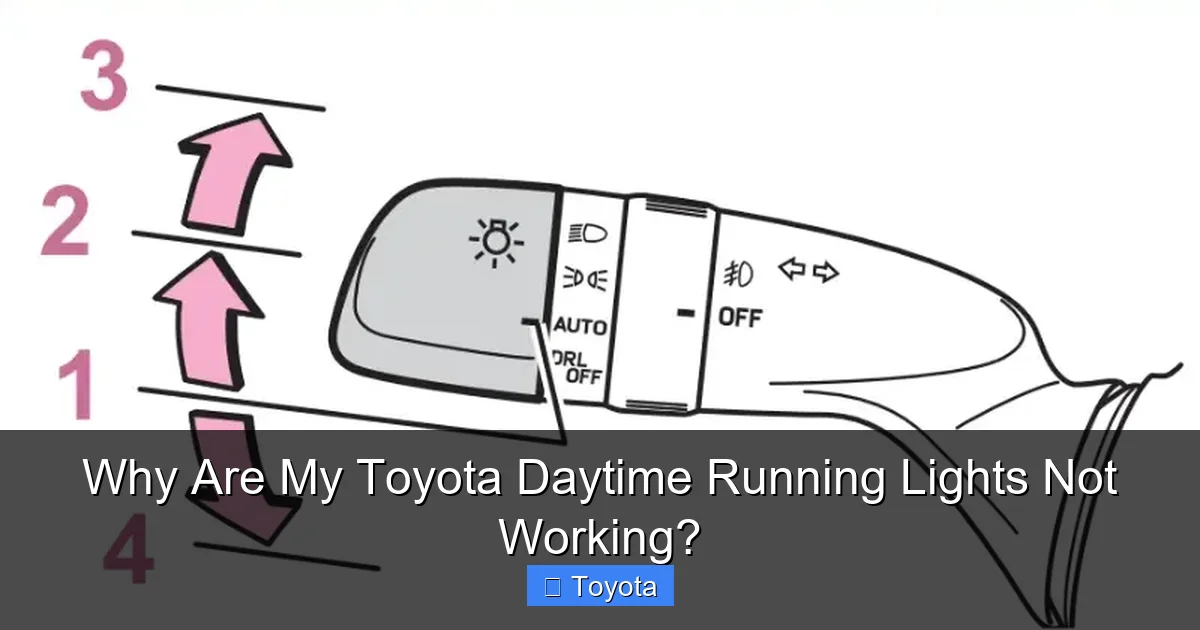
Before we dive into what’s broken, let’s quickly understand how it’s supposed to work. In most modern Toyotas, the DRL system is fully automatic and controlled by the vehicle’s computer network. When you turn the ignition on (or sometimes when you release the parking brake), a signal is sent from the Body Control Module (BCM) or a dedicated DRL module to activate the lights. In many models, the DRLs are simply the low-beam headlights at reduced brightness. However, some models use dedicated, smaller DRL bulbs, often located in the headlight assembly or in a separate housing. The system also involves fuses, relays, wiring, and switches. Knowing which type your Toyota has is the first step. Check your owner’s manual—it will specify if your DRLs are “integrated” (using the low beams) or “dedicated.” This distinction dramatically changes your troubleshooting path.
The Two Main Types of Toyota DRLs
Integrated DRLs: These are the most common. Your regular low-beam headlight bulbs serve double duty, acting as both nighttime headlights and daytime running lights. A module or the BCM reduces the voltage to these bulbs when in DRL mode, making them slightly dimmer than full low-beam operation. If these aren’t working, it’s often a bulb issue, but it could also be the control module or a fuse for the headlight circuit.
Dedicated DRLs: These are separate, smaller bulbs (often halogen or LED) specifically for daytime use. They are typically located in the corner of the headlight assembly or in a separate light cluster. A failure here is almost always a burnt-out dedicated bulb or a fuse/relay specific to that DRL circuit. These are generally easier and cheaper to fix.
Most Common Causes for Toyota DRL Failure
Now, let’s get to the heart of the matter. When your Toyota daytime running lights are not working, the cause falls into a handful of common categories. We’ll start with the easiest and most likely.

Visual guide about Why Are My Toyota Daytime Running Lights Not Working?
Image source: provscons.com
1. Burnt-Out Bulbs (The #1 Suspect)
This is the simplest and most frequent cause. Light bulbs fail. It’s a fact of automotive life. For integrated DRLs using the low-beam headlight bulbs, a single burnt-out bulb will take out the DRL function on that side. For dedicated DRL bulbs, a single burnt-out bulb will obviously take out that light. The telltale sign is that one DRL is out while the other works (unless both bulbs coincidentally failed). Replacing a headlight bulb can be straightforward or a major headache depending on your Toyota model. Some require removing the entire headlight assembly. Consult a model-specific repair guide or YouTube video for your specific year and model (e.g., “2018 Toyota RAV4 headlight bulb replacement”). Always handle new halogen bulbs with a cloth or gloves, as oils from your skin can cause them to overheat and fail prematurely.
2. Blown Fuses or Faulty Relays
Every electrical circuit in your car is protected by a fuse. The DRL circuit is no exception. A blown fuse is a very common and easy fix. Fuses can blow due to a short circuit in the wiring, a power surge, or simply old age. Your owner’s manual will have a fuse box diagram showing which fuse controls the DRLs or headlights. Locate the fuse box (usually under the dash and/or in the engine compartment), find the correct fuse, and pull it with a fuse puller or needle-nose pliers. Check the metal strip inside; if it’s broken, replace it with a new fuse of the exact same amperage (e.g., 10A, 15A). Never use a higher amperage fuse, as this can cause a fire. In some systems, a relay (an electronic switch) controls power to the DRLs. These can also fail. Swapping a suspected bad relay with an identical one from another circuit (like the horn) is a quick test.
3. Wiring Problems and Corroded Connectors
Cars are full of wires, and over time, they can get damaged. The wiring for your headlights and DRLs runs through the engine bay and behind the headlight assemblies, areas exposed to heat, cold, road salt, and vibration. A wire can become frayed, pinched, or its insulation can crack. More commonly, the plastic connectors that plug into the back of the headlight assembly or the DRL module can become corroded, loose, or brittle. This prevents a good electrical connection. Inspect the connectors on the back of the headlight assembly. Look for white/green crusty corrosion, bent pins, or melted plastic. Clean the contacts with electrical contact cleaner and a small brush. If a wire is visibly damaged, it will need to be repaired by splicing in a new section and using heat-shrink tubing or, for a permanent fix, by a professional.
4. Failed DRL Control Module or Body Control Module (BCM)
This is the “brain” of the operation. In many Toyotas, a dedicated DRL module receives signals from the BCM and controls the power to the DRL bulbs or headlights. In others, the BCM itself performs this function. These are solid-state electronic computers, and they can fail. Symptoms of a bad module include: both DRLs are out (if they are dedicated), the DRLs stay on all the time (even with headlights off), or they flicker erratically. Sometimes, a failing module will also cause other odd electrical gremlins. Diagnosing a bad module usually requires a professional scan tool to check for fault codes in the BCM or DRL module. If you have a dedicated DRL module, it’s often located under the hood, near the fuse box, or behind the headlight assembly. These can sometimes be replaced by a savvy DIYer, but you must ensure the replacement is properly programmed or matched to your vehicle’s VIN, which often requires a dealer or locksmith/technician with the right software.
5. Model-Specific Known Issues
Certain Toyota models have a reputation for specific DRL failures. For example, some older models (early 2000s Camry, Corolla) with dedicated DRLs had issues with the DRL resistor pack overheating and failing. Some models with integrated DRLs have had problems with the headlight switch itself failing. A quick search for “**[Your Toyota Year, Make, Model] DRL common problem**” can save you hours of diagnosis. You might find a TSB (Technical Service Bulletin) from Toyota acknowledging the issue and outlining a specific fix. This is valuable information. For instance, if you drive a Toyota with a known faulty DRL module, you can often source a remanufactured unit with an improved design.
How to Diagnose Your Toyota’s DRL Problem: A Step-by-Step Guide
Don’t just start replacing parts randomly. Follow this logical sequence to pinpoint the exact cause. You’ll need basic tools: screwdrivers, socket set, multimeter (optional but helpful), and your owner’s manual.
Visual guide about Why Are My Toyota Daytime Running Lights Not Working?
Image source: provscons.com
Step 1: Visual Inspection & Bulb Test
Start with the simplest check. Are both DRLs out, or just one? If it’s just one, the problem is almost certainly on that side—bulb, socket, or wiring. If both are out, the problem is likely a shared component (fuse, relay, module, or main power/ground). For dedicated DRLs, simply look at the bulb through the lens. If it’s dark and the filament is visible (for halogen), you might see it’s broken. For integrated systems, turn on your low-beam headlights. Do both low beams work? If one low beam is out, that bulb is your culprit for the DRL on that side. If both low beams work perfectly, the DRL-specific control circuit is at fault.
Step 2: Check the Fuses
Always check fuses first when dealing with any electrical issue. Find the fuse box diagram in your manual. Look for fuses labeled “HEAD LIGHT,” “DRL,” “PARKING LIGHT,” or “DAYTIME RUNNING.” Pull each suspect fuse and inspect it. Replace any that are blown with a new fuse of the same amperage. If a new fuse blows immediately after installation, you have a short circuit that needs professional diagnosis. Do not keep putting in larger fuses.
Step 3: Inspect Connectors and Wiring
With the car off and keys removed, pop the hood. Locate the back of the headlight assembly(ies). Unplug the electrical connector for the headlight/DRL. Look inside for corrosion, bent pins, or melted plastic. Give it a gentle wiggle. Do the lights flicker or come on? If so, it’s a bad connection. Clean it thoroughly with electrical contact cleaner and a small wire brush. While you’re there, trace the wiring harness from the connector back toward the fuse box. Look for any signs of chafing, crushing, or rodent damage (especially if you park in a garage or shed).
Step 4: Test for Power and Ground
This step requires a multimeter or a simple test light. Set your multimeter to DC volts (20V range). With the ignition in the “ON” position (DRLs should be active), back-probe the connector at the headlight. You should see battery voltage (12V+) at the pin that supplies power to the bulb. If there’s no power, the fault is upstream (fuse, relay, module, wiring). If there is power but the bulb is new and good, then you have a bad ground. Check for a good ground connection at the headlight assembly or at a nearby bolt on the chassis/frame. A bad ground will prevent the circuit from completing. A test light is easier: connect its clip to a good ground (like the negative battery terminal) and probe the power pin in the connector. If the light illuminates brightly, you have power.
Step 5: Investigate the Control Module
If you have power and ground at the headlight connector but a good bulb still doesn’t light, the control module (DRL module or BCM) is the likely suspect. Diagnosing this definitively often requires a scan tool to read for stored fault codes. However, you can sometimes perform a “tap test.” With the DRLs on, gently tap the suspected module (located per your manual). If the lights flicker or come on temporarily, the module has a bad solder joint or internal component and needs replacement. Important: If your Toyota’s DRL system is integrated with the key fob or security system (some models have “keyless” DRLs that come on when you unlock the car), a faulty key fob battery or module could also be a factor. In such cases, checking the key fob battery is a good idea. If you suspect a complex electronic issue, it’s time to consider professional help. Issues with the vehicle’s main computer network can be tricky, and a misstep could affect other systems. For example, problems with the BCM might also impact your Toyota key fob’s functionality or even cause the check engine light to illuminate if communication is disrupted.
Repair Options: From DIY to Professional
Once you’ve diagnosed the issue, it’s time to fix it. Your approach depends on your skill level and the problem’s complexity.
Visual guide about Why Are My Toyota Daytime Running Lights Not Working?
Image source: provscons.com
DIY-Friendly Repairs
- Bulb Replacement: The most common and usually easiest fix. Purchase the correct bulb type (e.g., H11, 9005, 7443) from an auto parts store. Watch a YouTube tutorial for your specific model to avoid damaging the headlight assembly or new bulb.
- Fuse Replacement: Trivial. Just ensure you use the correct amperage.
- Connector Cleaning/Repair: If corrosion is the issue, cleaning the connectors with contact cleaner and a brush can restore function. You can also use a small amount of dielectric grease on the connectors after cleaning to prevent future corrosion.
- Relay Replacement: If your model uses a DRL relay and you’ve confirmed it’s bad (by swapping with a known-good one), simply plug in a new one.
Intermediate/Professional Repairs
- Wiring Repair: Splicing and repairing damaged wires requires soldering and heat-shrink tubing skills. A poor repair can lead to shorts or fires. If you’re not confident, have a professional do it.
- DRL Module/BCM Replacement & Programming: This is not typically a DIY job for most people. The new module often must be “programmed” or “paired” to your vehicle’s VIN using a specialized diagnostic computer. This is a dealer or high-level independent auto technician procedure. Attempting to install it without programming will likely result in a non-functional system or other electrical errors. The cost includes the part and labor for programming.
- Headlight Assembly Removal/Installation: If the DRL bulb is inside a sealed headlight assembly that requires full removal for access, this can be a moderately difficult job involving bumper cover removal. Again, a model-specific guide is essential.
Cost Estimate: A bulb costs $15-$50. A fuse is $1. A DRL module can range from $100 to $400+ for the part, plus $100-$200+ for programming labor. A wiring repair is labor-intensive. Always get a quote before authorizing work on modules.
Safety and Legal Implications of Non-Functional DRLs
It’s tempting to ignore a faulty DRL, especially if your regular headlights work fine. Don’t. Daytime Running Lights significantly reduce the risk of daytime collisions by increasing your vehicle’s conspicuity. Studies show they can reduce accidents by up to 10-15%. From a legal standpoint, many regions (including all of Canada and many US states) require DRLs to be functional for vehicle safety inspections. A failed DRL can mean your car won’t pass its annual inspection, leading to a failed sticker and potential fines. Furthermore, if you are in an accident during the day and your DRLs were out (and they are mandated in your area), it could potentially affect insurance liability or be seen as a contributing factor of negligence. Simply put, fixing your DRLs is about safety, legality, and responsible vehicle ownership.
Conclusion: Getting Back on the Road Safely
Your Toyota daytime running lights not working is a solvable problem. The vast majority of cases boil down to a burnt-out bulb or a blown fuse—issues you can often handle in under an hour with basic tools. By following the systematic diagnostic approach outlined here—starting with the bulb and fuse, then moving to connectors, wiring, and finally the control module—you can efficiently find the root cause. Remember to consult your owner’s manual and seek out model-specific information online. For the simple fixes, embrace the DIY spirit; it’s satisfying and cost-effective. For complex electronic module replacements that require programming, recognize when it’s time to call in a professional. Don’t delay the repair. Functional DRLs are a critical safety feature that protects you, your passengers, and everyone else on the road. Get them fixed, drive with confidence, and enjoy the peace of mind that comes with a fully operational and visible Toyota.
Frequently Asked Questions
Can I replace a dedicated DRL bulb myself?
Yes, in most cases. Dedicated DRL bulbs are typically accessible by removing a plastic cover or the entire headlight assembly. The difficulty varies by model. Always disconnect the car’s battery first and avoid touching the glass of a new halogen bulb with your bare skin.
My Toyota’s low beams work, but the DRLs don’t. What gives?
If your Toyota uses integrated DRLs (low beams at reduced voltage), this indicates a fault in the DRL control circuit. The bulbs themselves are likely fine. The problem is probably the DRL module, a faulty headlight switch, a specific DRL fuse/relay, or a wiring issue that only affects the DRL power feed.
Are LED DRLs harder to fix than halogen ones?
Yes, typically. If an LED DRL strip or module fails, you usually cannot replace just the individual LED diodes. You must replace the entire LED assembly or module, which is often more expensive. Diagnosing LED failures can also be trickier as they don’t “burn out” with a visible broken filament; they may dim, flicker, or not light at all due to a failed driver circuit.
Why did both my DRLs go out at the same time?
Simultaneous failure of both DRLs almost always points to a shared component, not two separate bulbs burning out at once. Check the fuse for the DRL/headlight circuit, the main relay for that circuit, the DRL control module itself, or a major wiring issue that feeds both sides (like a damaged main harness).
Will a dead car battery affect my DRLs?
A severely discharged or dead battery will prevent *any* electrical system from working, including DRLs. However, if your battery is weak but the car starts, the DRLs should still function. Persistent DRL problems are not usually a sign of a weak battery unless the battery is so bad it can’t maintain voltage under the load of the lights.
My DRLs come on but are very dim. Is that a problem?
Yes. DRLs should be noticeably bright. Dimness can indicate a failing bulb (especially for halogen bulbs nearing the end of life), a poor ground connection causing voltage drop, or a failing DRL module that isn’t providing full voltage. It reduces the safety benefit and should be investigated.
