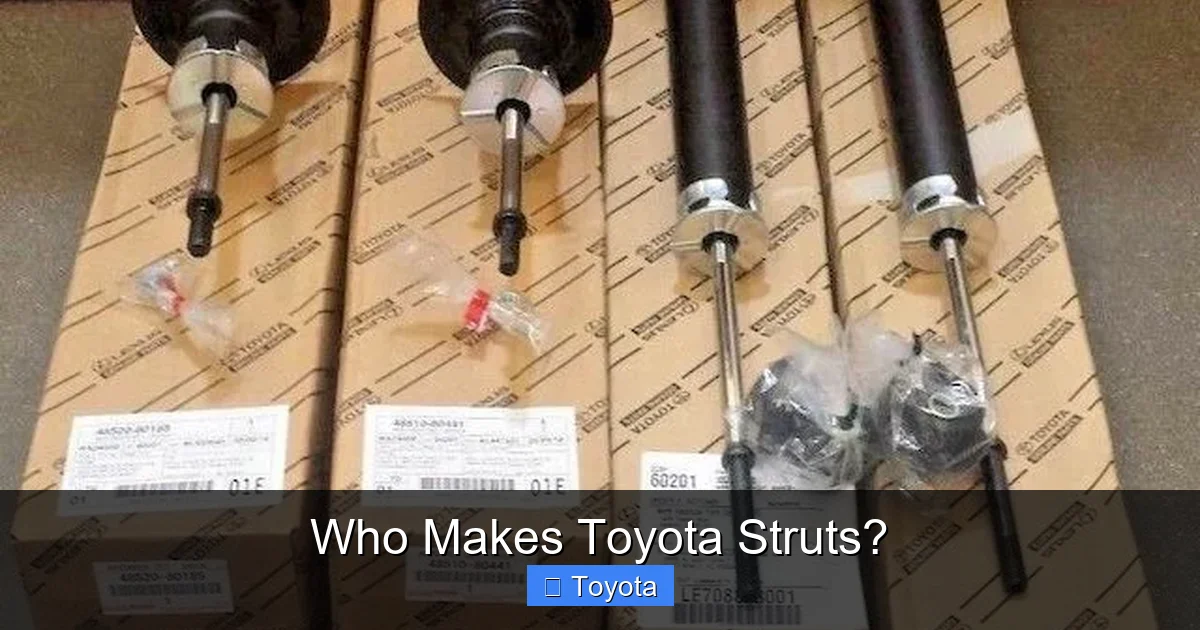
Who Makes Toyota Struts?

Contents
- 1 Key Takeaways
- 2 📑 Table of Contents
- 3 Who Makes Toyota Struts? A Deep Dive into the Brands Behind Your Ride
- 4 The Role of Original Equipment Manufacturers (OEMs) in Toyota Struts
- 5 Top OEM Suppliers of Toyota Struts
- 6 Aftermarket Struts: Quality Options Beyond OEM
- 7 Signs It’s Time to Replace Your Toyota Struts
- 8 Conclusion: Making the Right Choice for Your Toyota
- 9 Frequently Asked Questions

Car Ambient Light Kit

Car Hydraulic Jack

Car Door Edge Guard

Liquid Car Polish
Who makes Toyota struts? The answer isn’t just Toyota itself—several top-tier automotive suppliers produce struts for Toyota vehicles under strict OEM standards. These include brands like KYB, Monroe, and ACDelco, which manufacture high-quality struts designed specifically for Toyota models. Understanding who builds these parts helps you make smarter, longer-lasting choices for your vehicle’s suspension system.
Key Takeaways
- Toyota struts are made by both Toyota and trusted third-party manufacturers: While Toyota designs the specifications, companies like KYB, Monroe, and ACDelco produce many of the struts used in Toyota vehicles.
- Original Equipment Manufacturer (OEM) suppliers play a major role: These suppliers meet Toyota’s rigorous quality and performance standards to ensure safety and durability.
- KYB is one of the largest suppliers of Toyota struts: Known for their advanced damping technology, KYB supplies struts for many popular Toyota models including the Camry, Corolla, and RAV4.
- Aftermarket options offer quality and value: Brands like Monroe, ACDelco, and Gabriel provide reliable aftermarket struts that meet or exceed OEM standards at a lower cost.
- Proper strut selection improves ride comfort and safety: Choosing the right strut—whether OEM or aftermarket—ensures better handling, reduced wear on tires, and a smoother driving experience.
- Regular inspection and timely replacement are essential: Worn struts can compromise braking, steering, and overall vehicle control, so routine checks are critical.
- Installation by a certified mechanic ensures optimal performance: Even the best struts won’t perform well if not installed correctly, so professional service is recommended.
📑 Table of Contents
- Who Makes Toyota Struts? A Deep Dive into the Brands Behind Your Ride
- The Role of Original Equipment Manufacturers (OEMs) in Toyota Struts
- Top OEM Suppliers of Toyota Struts
- Aftermarket Struts: Quality Options Beyond OEM
- Signs It’s Time to Replace Your Toyota Struts
- Conclusion: Making the Right Choice for Your Toyota
Who Makes Toyota Struts? A Deep Dive into the Brands Behind Your Ride
If you’ve ever wondered, “Who makes Toyota struts?” you’re not alone. It’s a common question among Toyota owners who want to understand what’s under their hood—or more accurately, under their chassis. Struts are a critical part of your vehicle’s suspension system, responsible for absorbing shocks, maintaining tire contact with the road, and ensuring a smooth, controlled ride. But while Toyota designs and engineers its vehicles with precision, the actual manufacturing of struts often involves a network of trusted partners.
So, who’s really building these vital components? The short answer: it’s a mix of Toyota’s own production and several world-class automotive suppliers. These companies—known as Original Equipment Manufacturers (OEMs)—produce struts that meet Toyota’s exacting standards. They’re not just generic parts; they’re engineered to fit specific Toyota models, ensuring compatibility, performance, and longevity. Whether you’re driving a compact Corolla or a rugged Tacoma, the struts under your vehicle were likely made by one of these specialized manufacturers.
In this article, we’ll explore the key players behind Toyota struts, how OEM and aftermarket options compare, and what you should know when it’s time to replace them. Whether you’re a DIY mechanic or just a curious car owner, understanding who makes your struts can help you make better decisions about maintenance, repairs, and upgrades.
The Role of Original Equipment Manufacturers (OEMs) in Toyota Struts

Visual guide about Who Makes Toyota Struts?
Image source: rparts-sites.s3.amazonaws.com
When you buy a new Toyota, the struts installed at the factory aren’t necessarily made by Toyota itself. Instead, they’re often produced by third-party companies that specialize in suspension components. These companies are called Original Equipment Manufacturers (OEMs), and they play a crucial role in the automotive supply chain.
OEMs like KYB, Monroe, and ACDelco work closely with Toyota to design and manufacture struts that meet strict performance, safety, and durability requirements. Toyota provides detailed engineering specifications—everything from load capacity and damping force to mounting points and material composition. The OEM then builds the struts to those exact standards, ensuring a perfect fit and reliable performance.
This partnership benefits both parties. Toyota can focus on vehicle design and assembly while relying on experts to produce high-quality components. Meanwhile, OEMs gain credibility and volume by supplying parts for a globally respected brand. For consumers, it means that even though the strut might not say “Toyota” on it, it’s built to the same standards as if it did.
One of the biggest advantages of OEM struts is consistency. Because they’re made to Toyota’s specs, they offer predictable performance and longevity. They’re also often covered under Toyota’s warranty when installed at the factory or by a certified dealer. This makes OEM parts a popular choice for owners who want peace of mind and minimal hassle.
How OEM Struts Are Selected and Tested
Toyota doesn’t just pick any supplier for its struts. The selection process is rigorous and involves extensive testing. Potential OEMs must demonstrate their ability to meet Toyota’s quality benchmarks, which include everything from material strength to corrosion resistance.
Once a supplier is approved, the struts undergo a series of tests. These include:
– Durability testing: Struts are subjected to thousands of compression and extension cycles to simulate years of real-world use.
– Temperature resistance: They’re tested in extreme heat and cold to ensure they perform in all climates.
– Vibration and shock absorption: Specialized equipment measures how well the struts dampen road vibrations and impacts.
– Fit and finish: Each strut is checked for precise dimensions and smooth operation.
Only after passing these tests do the struts make it into Toyota vehicles. This level of scrutiny ensures that every strut delivers the ride quality and safety Toyota is known for.
Top OEM Suppliers of Toyota Struts
Visual guide about Who Makes Toyota Struts?
Image source: jinboshock.com
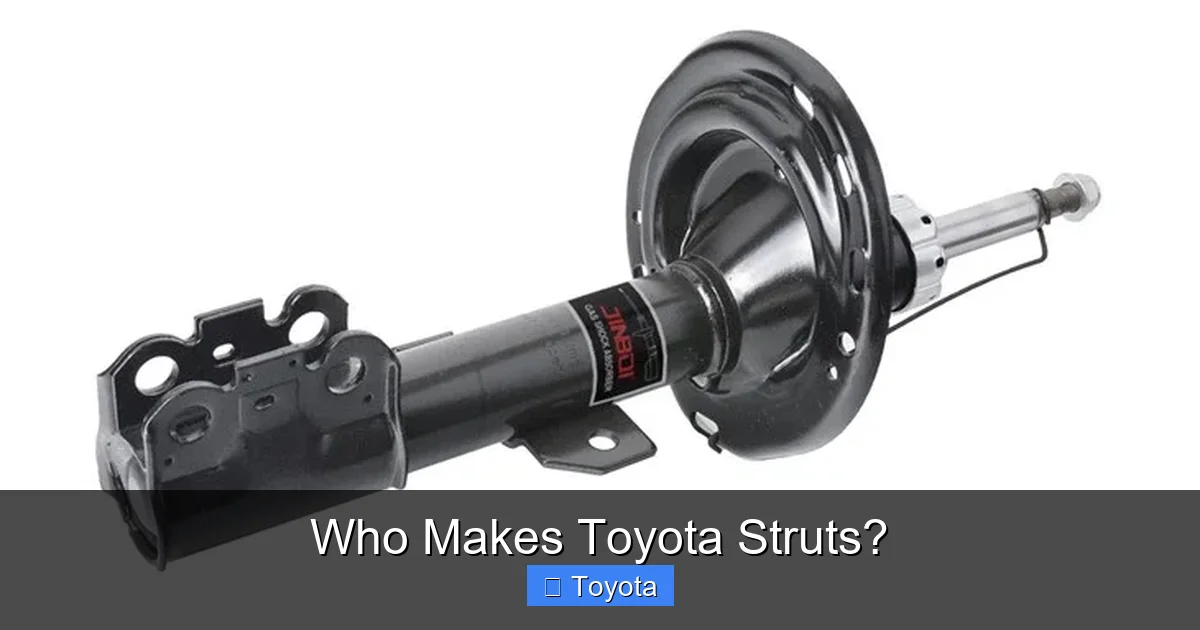
Now that we understand the role of OEMs, let’s look at the key manufacturers behind Toyota struts. These companies are leaders in the suspension industry and have earned Toyota’s trust through years of reliable performance.
KYB: The Global Leader in Suspension Technology
KYB Corporation, based in Japan, is one of the largest and most respected suspension manufacturers in the world. In fact, KYB is often considered the go-to supplier for Toyota struts. They produce struts for a wide range of Toyota models, including the Camry, Corolla, RAV4, Highlander, and Tacoma.
KYB is known for its advanced damping technology, which helps control vehicle motion and improve ride comfort. Their struts are designed to reduce body roll during cornering, minimize nose-dive during braking, and keep tires firmly planted on the road. Many Toyota owners report a noticeable improvement in handling and stability after installing KYB struts—even if they’re replacing worn OEM units.
One of KYB’s standout features is their use of high-quality materials and precision engineering. Their struts often include features like hardened steel rods, multi-stage valves, and nitrogen gas charging, which help maintain consistent performance over time. KYB also offers a range of performance-oriented struts for drivers who want a sportier feel.
Monroe: A Trusted Name in Aftermarket and OEM Struts
Monroe, a brand under Tenneco, is another major player in the strut market. While Monroe is widely known for its aftermarket products, it also supplies OEM struts to Toyota and other automakers. Their struts are designed to deliver a smooth, comfortable ride while maintaining excellent control and stability.
Monroe’s Quick-Strut line, for example, is a popular choice for both dealerships and independent repair shops. These pre-assembled units include the strut, spring, and mount, making installation faster and easier. They’re built to meet or exceed OEM specifications and are often used as direct replacements for worn factory struts.
What sets Monroe apart is their focus on innovation. They’ve developed technologies like their patented Impact strut, which uses advanced valving to respond instantly to road conditions. This results in better handling on rough roads and improved safety during sudden maneuvers.
ACDelco: GM’s Brand with Toyota Ties
You might be surprised to learn that ACDelco, a General Motors brand, also supplies struts for some Toyota vehicles. While not as common as KYB or Monroe, ACDelco has partnered with Toyota on certain models, particularly in regions where GM and Toyota have manufacturing collaborations.
ACDelco struts are known for their durability and consistent performance. They’re built to withstand harsh conditions and provide long service life. Like other OEM suppliers, ACDelco follows Toyota’s strict quality guidelines, ensuring that their struts meet the same standards as those made by Japanese manufacturers.
Other Notable Suppliers
While KYB, Monroe, and ACDelco are the most prominent, other companies also contribute to Toyota’s strut supply chain. These include:
– Showa: Another Japanese manufacturer with a long history in suspension systems. Showa has supplied struts for various Toyota models, especially in earlier production years.
– ZF Sachs: A German company known for high-performance suspension components. ZF Sachs has provided struts for select Toyota trucks and SUVs.
– Bilstein: While primarily an aftermarket brand, Bilstein has collaborated with Toyota on performance-oriented models, such as the TRD (Toyota Racing Development) variants.
These suppliers may not be as visible to the average consumer, but they play a vital role in ensuring that Toyota vehicles meet global quality standards.
Aftermarket Struts: Quality Options Beyond OEM

Visual guide about Who Makes Toyota Struts?
Image source: jinboshock.com
While OEM struts are a reliable choice, many Toyota owners turn to aftermarket options for better value, performance, or availability. Aftermarket struts are made by third-party companies and sold independently of the dealership network. They’re often more affordable than OEM parts and can offer enhanced features.
But are aftermarket struts as good as OEM? The answer is: it depends on the brand and quality. Reputable aftermarket manufacturers like Monroe, KYB, Gabriel, and ACDelco produce struts that meet or exceed OEM standards. In some cases, they even offer improved performance—such as better damping or longer lifespan.
Benefits of Aftermarket Struts
– Cost savings: Aftermarket struts are typically 20–40% cheaper than OEM parts, making them a budget-friendly option.
– Wider selection: You can choose from standard, performance, or heavy-duty struts depending on your driving needs.
– Improved performance: Some aftermarket struts offer better handling, reduced body roll, or a smoother ride than stock units.
– Availability: Aftermarket parts are often easier to find, especially for older or less common Toyota models.
Choosing the Right Aftermarket Strut
When shopping for aftermarket struts, it’s important to do your research. Look for brands with a strong reputation and positive customer reviews. Check compatibility with your specific Toyota model and year. And always opt for struts that are labeled as “OE+” or “meets or exceeds OEM standards.”
For example, if you drive a Toyota RAV4 and want a sportier ride, you might consider KYB’s Gas-a-Just struts, which offer firmer damping for better cornering. Or, if you frequently drive on rough roads, Monroe’s Reflex struts provide extra impact absorption.
Signs It’s Time to Replace Your Toyota Struts
Knowing when to replace your struts is just as important as knowing who makes them. Worn struts can seriously affect your vehicle’s performance and safety. Here are some common signs that it’s time for a replacement:
– Bouncy ride: If your car continues to bounce after hitting a bump, your struts may be losing their damping ability.
– Uneven tire wear: Worn struts can cause tires to lose contact with the road, leading to cupping or scalloping on the tread.
– Longer stopping distances: Poor suspension can increase braking distance, especially on wet or uneven surfaces.
– Nose-diving during braking: If the front of your car dips sharply when you brake, your struts may be failing.
– Leaking fluid: Visible oil or fluid on the strut body is a clear sign of internal damage.
– Excessive body roll: If your car leans heavily in corners, the struts aren’t providing enough support.
If you notice any of these symptoms, it’s time to have your struts inspected by a professional. Most experts recommend replacing struts every 50,000 to 100,000 miles, depending on driving conditions.
DIY vs. Professional Installation
Replacing struts is a job that requires special tools and knowledge. While some experienced DIYers can handle it, most Toyota owners are better off leaving it to a certified mechanic. Improper installation can lead to poor performance, noise, or even safety issues.
Professional installation also ensures that the struts are properly aligned and torqued to specification. Many shops offer warranties on both parts and labor, giving you added peace of mind.
Conclusion: Making the Right Choice for Your Toyota
So, who makes Toyota struts? The answer is a network of trusted OEM suppliers like KYB, Monroe, and ACDelco, along with Toyota’s own production facilities. These companies work together to deliver high-quality suspension components that keep your Toyota riding smoothly and safely.
Whether you choose OEM or aftermarket struts, the key is to select a reputable brand that meets Toyota’s standards. Pay attention to signs of wear, and don’t delay replacement when needed. And when in doubt, consult a certified mechanic for advice and installation.
Understanding who makes your struts empowers you to make informed decisions about your vehicle’s maintenance. With the right parts and proper care, your Toyota will continue to deliver the reliability and performance you’ve come to expect.
Frequently Asked Questions
Are Toyota struts made by Toyota?
Not always. While Toyota designs the specifications, many struts are manufactured by third-party OEM suppliers like KYB and Monroe. These companies build the struts to Toyota’s exact standards.
Can I use aftermarket struts on my Toyota?
Yes, as long as they’re compatible and meet OEM standards. Reputable brands like KYB, Monroe, and ACDelco offer high-quality aftermarket struts that are safe and reliable.
How often should I replace my Toyota struts?
Most experts recommend replacing struts every 50,000 to 100,000 miles, or sooner if you notice signs of wear like bouncing, leaking, or poor handling.
Do I need to replace all four struts at once?
It’s not required, but it’s often recommended. Replacing struts in pairs (front or rear) ensures balanced performance and prevents uneven wear.
Are KYB struts good for Toyota vehicles?
Yes, KYB is one of the leading suppliers of Toyota struts and is known for high-quality damping technology and durability. Many Toyota owners prefer KYB for both OEM and aftermarket use.
Can worn struts affect my car’s safety?
Absolutely. Worn struts can increase stopping distance, reduce tire contact with the road, and compromise handling—especially in emergency situations. Regular inspection is essential for safety.